
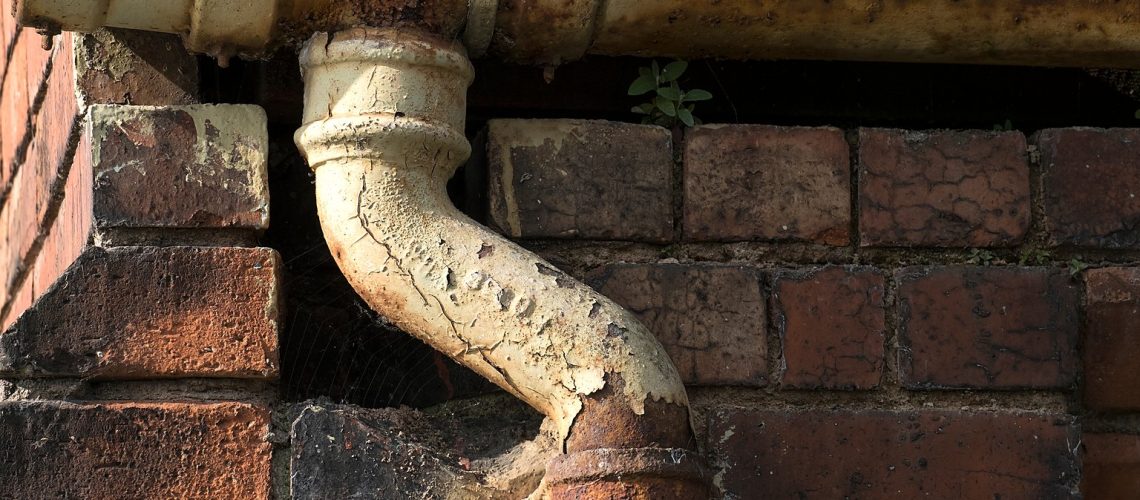
A ground-level inspection guide for owners of listed and period houses, and for the surveyors and contractors they call. Ten visible signs that a cast iron gutter or downpipe is failing, what each one usually means, what happens if it is left through the winter, and when repair, replacement or a site survey is the right next step.
Technical summary. Cast iron guttering rarely fails without warning. Most faults show themselves from the ground months or years before they become serious: green staining on the wall below a joint, a gutter that has lost its fall, a bracket that has dropped, a downpipe socket split by frost. This guide sets out ten signs to look for in an autumn inspection, what each one usually means, the damage that follows if it is ignored, and whether repair or replacement is the right response. Most cast iron rainwater systems can be repaired rather than replaced; replacement is justified only where sections are holed, fractured or missing. On a listed building, like-for-like repair is normally treated as maintenance, while replacement or alteration usually needs Listed Building Consent. Where the cause is not obvious from the ground, a chargeable site survey establishes it before money is spent.
Cast iron rainwater goods on a period house are expected to last a century or more, and most of them do. The signs that a cast iron gutter or downpipe is failing are almost always visible from the ground — staining, standing water, sagging runs, weeping joints, rust, vegetation, cracked sockets, loose brackets, overflow in rain and splash damage at the base of the wall — and an autumn walk around the building with a pair of binoculars will find most of them before winter does real harm.
This guide is written first for the owners of listed and period houses, and second for the surveyors and contractors they call. It explains what each sign looks like from the pavement or the garden, what it usually means, what happens if it is left through a wet winter, and what to do about it. We have kept the language plain and explained the trade terms as they arise, without softening the technical content.
Why autumn? Because three things coincide. Leaf fall blocks outlets. The first frosts freeze whatever water is trapped. And the wettest months follow. A gutter that has been quietly leaking through a dry summer will start to damage the building in earnest between November and February. The time to find a fault is before that happens.
We have deliberately not repeated what our other guides already cover. How blockages damage historic fabric, how to cut, drill and seal cast iron, how to prepare and repaint it, and what Listed Building Consent requires are each dealt with in their own articles, linked where relevant. This one is about seeing the problem, understanding it, and knowing what to ask for. It sits beneath our broader guide to rainwater disposal on historic buildings, which covers failure, repair and replacement across every historic material.
Cast iron fails slowly, and it fails at predictable points: at joints, at the back of the gutter where debris sits, at fixings, and wherever water is allowed to stand and freeze. Understanding why makes the ten signs much easier to read.
Cast iron is strong, rigid and dimensionally stable. It expands and contracts far less with temperature than most other rainwater materials, which is one reason its joints stay tight for so long — we explain this in our article on thermal movement in cast iron rainwater systems. Its weakness is that it is brittle. It cracks rather than bends when something forces it, and the thing that most often forces it is ice. Water trapped in a blocked gutter or a jammed downpipe expands by roughly nine per cent as it freezes. In a socketed joint that has nowhere to give, the socket splits.
The second weakness is corrosion, and here cast iron is more forgiving than its reputation suggests. A well-painted casting corrodes very slowly. Rust takes hold where the paint has been allowed to fail — typically along the top edge and inside of the gutter, at the back against the fascia, and around fixings — and wherever water stands. Rust occupies several times the volume of the iron it replaces, so corrosion at a bolted joint or a bracket fixing physically forces the components apart. Surveyors call this rust jacking. Our guide to cast iron corrosion protection covers the chemistry and the paint systems that prevent it.
Third, a rainwater system is a chain. The gutter, its brackets, the outlet, the hopper head, the downpipe, the shoe at the bottom and the gully below it all depend on one another. A failure in one part shows up as a symptom somewhere else, often several metres away. Green staining on a wall at first-floor level is rarely caused by the gutter directly above it. This is why each sign below explains where to look for the cause, not just where the symptom is.
A useful ground-level inspection needs binoculars, a camera, twenty minutes in the rain and twenty minutes in the dry. It does not need a ladder, and it should not involve one. The purpose of inspecting from the ground is to find and record the signs so that whoever goes up — a contractor with a tower, or a surveyor with a platform — goes up knowing what to look at.
Walk every elevation twice. On the first pass, look up: sight along the gutter line from each corner, follow every run to its outlet, and follow every downpipe from hopper to shoe. On the second pass, look at the wall and the ground: staining, wet patches, spalled brick, scoured soil, buried gullies. Note the position of anything you find against a fixed point, such as a window, so that you can describe it later.
Do it in rain if you possibly can. A dry gutter tells you very little. Ten minutes during a heavy shower will show you exactly where water is escaping, overflowing or failing to arrive at the bottom of a downpipe, and that information is worth more than any amount of dry-weather looking. Then go round again a day or two later when it is dry, to see what the wet weather left behind.
The best times are late October or November after most of the leaves are down, during or immediately after heavy rain, after the first hard frost, and again in early spring. The seasonal calendar later in this guide sets this out in full.
The ten signs below are ordered roughly from the wall up to the gutter and back down to the ground, which is the order in which most people notice them. Each one describes what you will see, what it usually means, what follows if it is ignored, and what to do. Several signs share a cause: a gutter that has lost its fall (Sign 3) produces standing water, which produces corrosion (Sign 6), overflow (Sign 9) and staining (Sign 1). Finding one usually means looking for the others.
What you see. A vertical streak of green algae, a dark damp band, or a pale chalky tide mark on the brickwork or render below the gutter line, often narrowing as it goes down. It usually starts just below a gutter joint, an outlet, or the back of a downpipe socket. On limewashed or painted walls it shows as a grey-green shadow; on stone it can look like a wet patch that never quite dries.
What it usually means. Water is escaping at that point and running down the face of the wall regularly enough for algae to establish. The commonest causes are a weeping gutter joint directly above, a downpipe socket leaking at the back where you cannot see it, or a gutter that has lost its fall and is spilling over its back edge. A tide mark with a white crust is often lime or salts being carried out of the mortar by the water — a sign that the wall behind is saturated rather than merely wet on the surface.
If ignored. Persistent wetting of a solid-walled period house drives moisture through to the inside, decays the ends of any timber lintels or joists bearing in the wall, and sets up frost damage in the face of the brick or stone. The staining is the least of it.
What to do. Note exactly where the streak starts. Look for the joint or socket immediately above it, then check in rain whether that is where the water is coming from. A weeping joint is a repair, not a replacement (see Sign 4). A leaking downpipe socket may need re-jointing or, if the socket itself is cracked, that length replacing. Clean the algae off only after the leak has been fixed; otherwise it returns within a season.
What you see. A damp stain, bubbling paint or lifting wallpaper in the top corner of a first-floor room, along the junction of wall and ceiling, or around the eaves in a loft. It is worse after rain and may fade in dry spells. Sometimes the first clue is a musty smell in a bedroom that nobody can account for.
What it usually means. Water is getting in at eaves level. The gutter is the first suspect: either overflowing over its back edge onto the wall plate and the top of the wall, or leaking at a joint against the fascia. A gutter set too high, so that the roof covering sheds water behind it rather than into it, produces the same symptom, as does a rotten fascia board behind the gutter. But defective roof coverings, flashings and parapet gutters produce it too, so it is important not to assume.
If ignored. Wet wall plates and rafter feet rot. Ceiling plaster fails. In older houses with timber embedded in the wall, the decay stays hidden until it is serious. Damp at the eaves is the classic route for water into a solid wall, and the stain inside is usually the last stage of the process rather than the first.
What to do. Go outside and find the point on the gutter line directly above the internal damp, then look for the other signs on this list at that point, in rain. If nothing shows at the gutter, the problem is more likely to be the roof and needs a roofer. If the gutter is overflowing or leaking against the wall, this is usually a fall, blockage or joint problem, all of which are repairable. If you are in any doubt about the source, our companion guide on diagnosing damp in historic buildings explains how to rule causes in and out before any treatment is bought.
What you see. Stand at the corner of the house and sight along the gutter. A sound run is straight, with a fall so slight you cannot see it. What you are looking for is anything that is not straight: a dip between two brackets, a section that has dropped away from the fascia, a run that visibly falls away from its outlet rather than towards it, or a joint where one length sits lower than its neighbour. After rain, a sagging gutter holds a line of standing water for days; in frost, a strip of ice.
What it usually means. One or more brackets have failed or dropped, the fixings have pulled out of a rotten fascia or a soft mortar joint, or the gutter was refixed at some point without proper fall. Cast iron is heavy. It needs a bracket at roughly one-metre centres and support close to each joint. Where brackets were spaced too widely during an earlier repair, the run sags between them. Back-fall — water running away from the outlet — usually means the outlet end has lifted or the far end has dropped.
If ignored. Standing water is the single most damaging condition for a cast iron gutter. It keeps the inside wet, so the paint fails and corrosion starts at the waterline. It freezes, and the expansion stresses the joints. It overflows over the back edge in rain, wetting the wall. Left for a few winters, a sagging gutter becomes a holed gutter.
What to do. This is nearly always a bracket and fixing repair, not a gutter replacement. The run is lifted, re-bracketed at correct centres into sound material and re-set to fall. Adjustable rise and fall brackets exist for exactly this purpose on rafter-fixed half-round gutters. If the fascia is rotten, that has to be dealt with first, and the gutter comes off to allow it.
What you see. In rain, a steady drip from the underside of a joint — the point where one length of gutter overlaps the next — or a dark wet streak on the outside of the gutter below the joint. On a downpipe, a wet line down the back of the pipe from a socket, or a small green beard growing from the socket itself. In dry weather, look for a rust-brown stain or a white crust at the joint, and for old sealant smeared over the outside of it.
What it usually means. The jointing compound has failed. Cast iron gutters are joined with a socket at one end overlapping the plain end of the next length, bedded in a soft compound — historically putty or mastic — and pulled together with a nut and bolt. Over decades the compound dries, shrinks and cracks, the bolt corrodes, and the joint opens. This is the normal, expected ageing of a cast iron system and it is the commonest fault of all. A joint that has been “repaired” with sealant over the outside will usually leak again within a season, because the water is getting in from the inside.
If ignored. A weeping joint drips onto the wall or the ground below, producing Sign 1 or Sign 10. In frost, the water held in the open joint freezes and the socket may crack (Sign 7). A corroded bolt eventually fails altogether and the joint opens fully.
What to do. Re-make the joint: separate it, clean back to bare metal, re-bed it in a suitable jointing compound and fit a new bolt. This is a straightforward job for a competent contractor and is covered step by step in our guide to repairing cast iron guttering; confident owners will find the same ground covered in our DIY gutter repairs guide. It is not a reason to replace a run. Count the weeping joints on each elevation and note them on the checklist, so that a contractor can price the work properly from the outset.
What you see. A green fringe along the top edge of the gutter, tufts of grass or moss showing above the front edge, or a small tree — ash, buddleia, sycamore and willowherb are the usual suspects — growing out of a hopper head or a gutter corner. From below, a downpipe with plants growing from the top of its socket. Birds working along the gutter line in spring are a further clue that there is something in there worth their attention.
What it usually means. The gutter has not been cleared for some time and holds enough silt, debris and moisture to support plant life. Moss usually arrives from the roof: on north-facing slopes of slate or stone slate it grows on the covering, is washed off in rain and collects in the gutter. Where plants are actually growing, the outlet below them is almost certainly blocked or restricted.
If ignored. Vegetation holds water against the iron, keeps the paint film permanently wet and blocks outlets. A blocked outlet means the gutter fills and overflows at its lowest point — usually over the back edge, onto the wall — and holds a standing pool that freezes in winter. Roots can lift joints. Our guide on how blocked rainwater systems damage historic buildings sets out the consequences in detail, so we will not repeat them here.
What to do. Clear the gutters, outlets and hopper heads by hand, from a safe working platform — not by anyone standing on the roof or leaning out from a ladder. Then check that each downpipe runs freely, and check the gully at the bottom. If the roof sheds moss constantly, expect to clear twice a year and consider whether the roof itself needs attention. Plants growing from a downpipe socket usually mean the joint has opened and is holding silt; once cleared, the joint needs re-making.
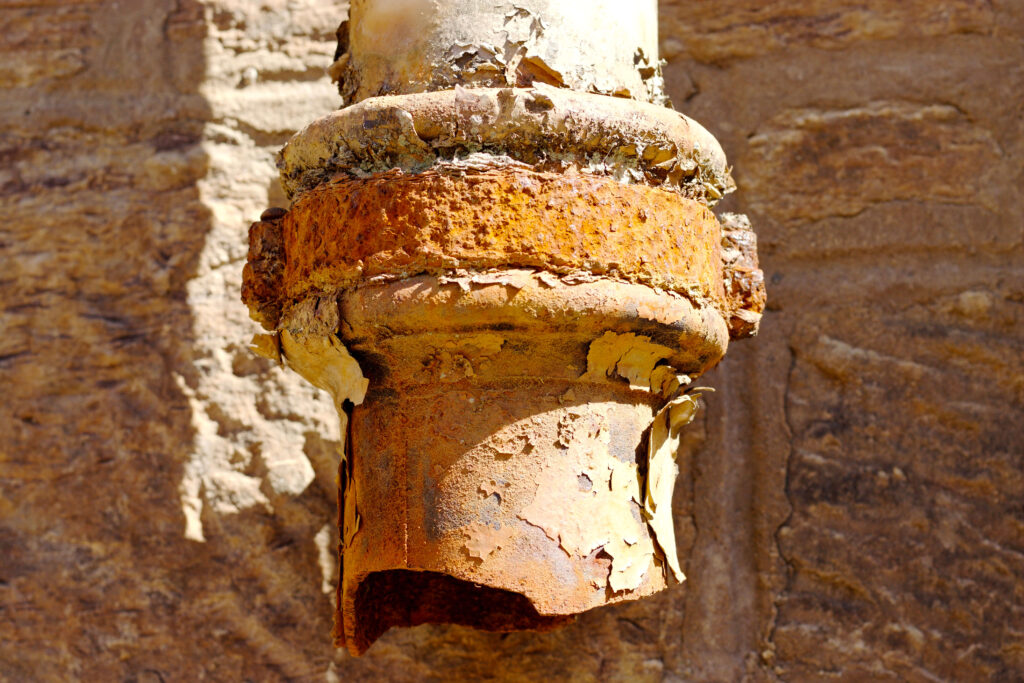
What you see. Paint lifting in blisters or flakes, especially along the top front edge and at the back of the gutter against the fascia; orange-brown rust bleeding through the paint; rough, pitted or scaly patches; and, in advanced cases, daylight through the bottom of the gutter or a drip from the middle of a length rather than from a joint. On downpipes, rust most often shows at the back of the pipe, hidden from view, and at the sockets. A rust stain running down the wall from a bracket or fixing is a related sign and is covered under Sign 8.
What it usually means. The paint film has failed and the iron is corroding. Surface rust under lifting paint is early-stage and entirely recoverable. Deep pitting, scale that comes away in flakes, or holes mean that the section has lost metal and is at or near the end of its useful life. Corrosion is commonest where water stands (Sign 3) or debris sits (Sign 5), and on elevations that are shaded, north-facing or facing the prevailing weather. Not all discolouration is rust: a chalky grey-white bloom on the surface is usually the paint itself weathering, not the iron beneath it.
If ignored. Surface rust becomes pitting; pitting becomes perforation. A holed gutter leaks onto the wall. Rust at the sockets weakens the joints. A downpipe corroded through at the back can discharge directly onto the wall for years without anyone noticing, because the front still looks sound.
What to do. Early rust is a preparation and repainting job, and the gutter stays where it is; our guide to cleaning, stripping and preparing cast iron rainwater goods explains how to do this without damaging the casting skin that protects the iron. Where a section is deeply pitted or holed, that length alone is replaced with a matching profile and the rest of the run retained. Standard half-round and ogee sections are stock items despatched in five to seven working days; less common standard profiles take seven to ten working days; anything that must be copy cast to match an original pattern takes twelve to fourteen weeks from pattern approval. Where most of a run is beyond repair, this is the point at which a site survey pays for itself, because someone needs to establish which lengths can be kept before anything is ordered. Our guide to cast iron gutter profiles will help you identify what you have.
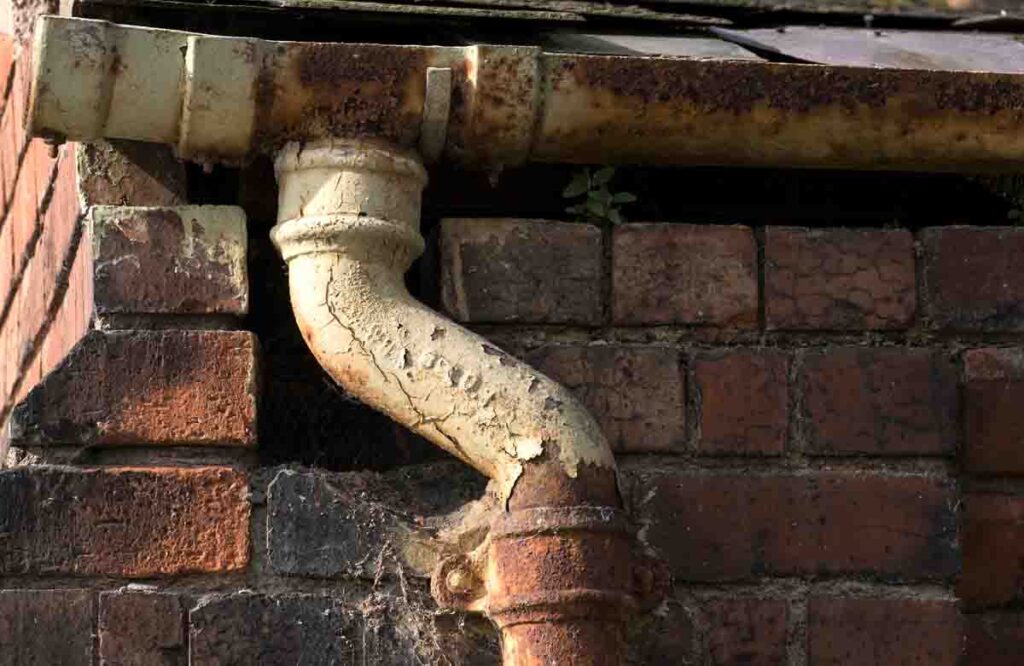
What you see. A clean, straight crack running along a downpipe from a socket; a socket that has split open along one side; a gutter socket with a hairline crack around the bolt hole; or a length of pipe with a piece missing altogether. The crack is often visible only as a fine dark line until it weeps in rain, and it is frequently at the back of the pipe. The lowest length of a downpipe, and any pipe with a blocked shoe or a bend at the bottom, are the most likely places to find one.
What it usually means. Water was trapped inside the pipe or the joint and froze. Downpipes should never hold water; if one splits in frost, it was blocked — by leaves, silt, a bird’s nest, a ball, or by a blocked or collapsed gully at the bottom backing water up the pipe. Cast iron does not stretch, so the ice has to go somewhere and the casting gives. A crack around a gutter bolt hole is more often the result of an over-tightened joint, or one that has rust-jacked, than of frost.
If ignored. A split pipe discharges through the split every time it rains. Because the split is usually at the back, it wets the wall directly and is hidden from view. Over one winter this can soak a solid wall through. A cracked socket is also the point at which the joint above it will fail next.
What to do. Cracked cast iron cannot be reliably welded, and patch repairs are short-lived; the affected length is replaced. But first find and clear the blockage that caused it. A new pipe on a blocked gully will split again next winter. Standard cast iron downpipe lengths, sockets and shoes are stock items, and replacing a single length is a modest job; our note on fixing rainwater pipes bottom-up or top-down explains the sequence. Check every other downpipe on the building for the same problem while you are looking.
What you see. A gap between a bracket and the gutter it should be carrying; a bracket that has rotated or dropped; a downpipe that moves in the wind or stands off the wall at an angle; rust stains running down the wall from a fixing point; a pipe ear with its fixing gone; cracked or spalled brick or stone around a fixing; and any run with brackets visibly further apart than about a metre. Where a bracket is missing altogether there is often a shadow, a plugged hole or a pair of rust marks on the wall to show where it was.
What it usually means. The fixings have corroded, the timber or mortar they were driven into has decayed or softened, or the bracket itself has rusted through. Rust jacking — the expansion of corroding iron — splits the masonry around a fixing and pushes the bracket away from the wall. Mixed metals make it worse: steel fixings in contact with iron, or iron fixings in contact with copper or lead, corrode faster through galvanic action. On a downpipe, a missing or loose ear lets the pipe work at every joint, and the joints then open.
If ignored. The gutter run sags (Sign 3), the joints open (Sign 4), and in the worst case a length of cast iron gutter comes down. A loose downpipe pulls its joints apart and leaks at the back. Fixings that are rust-jacking go on splitting the wall.
What to do. Refix into sound material with compatible fixings, replace brackets and ears that have corroded, and restore the correct spacing. This is a repair, not a replacement, and it is done before the gutter is re-set to fall. Where a decorative bracket or an unusual ear pattern is missing, it can be matched from the survivors. Our page on gutter and pipe brackets shows the standard patterns.
What you see. This one needs rain. Water pouring over the front or back edge of the gutter at a corner or a stop end; a curtain of water over the lip of a hopper head; water spurting from the top of a downpipe socket; or a downpipe that stays dry while the gutter above it is full. After the rain, look for a wet fan on the wall below a hopper, a clean patch on a dirty wall where water regularly runs, or a scoured hollow in the ground.
What it usually means. Either the outlet or the pipe below it is blocked, which is by far the commonest cause, or the system does not have the capacity for the roof it serves. Hopper heads collect from several pipes and are natural leaf traps; a hopper that overflows in every heavy shower is very often simply full. Overflow at a corner or stop end with a clear outlet points to loss of fall (Sign 3) or an outlet that is too far from where the water arrives. Genuine under-capacity does occur — where a roof has been re-covered in a smoother material, where an outlet has been blanked off in an earlier repair, or where an extension now drains into the original gutter — but it is the exception.
If ignored. Overflow wets the wall at the same point every time it rains, producing Sign 1, saturating the wall and, in winter, icing the path below. A hopper that overflows chronically will eventually rust through at the back.
What to do. Clear the outlet, the hopper and the downpipe first, then watch it again in rain. If it still overflows with a clear pipe, the problem is fall or capacity and needs a proper assessment. Outlet position and detail affect capacity more than gutter size does, and reinstating a blanked outlet or adding a discreet downpipe on a rear elevation is usually preferable to enlarging a historic gutter, which changes the appearance of the building and needs consent. Our article on flow rates and hydraulic sizing explains how capacity is calculated under BS EN 12056-3.
What you see. A downpipe that ends in a plain cut length rather than a shoe; a shoe that is cracked or has been knocked off; a downpipe discharging onto a path or a flower bed rather than into a gully; a gully grating buried under soil or leaves; a wet, green or crumbling band of brick or stone at the foot of the wall behind the pipe; a scoured hollow in the ground; or render at low level that sounds hollow when tapped.
What it usually means. Water is arriving at the base of the wall rather than being carried away. Missing shoes are common: they are the component most often broken by lawnmowers, bins and vehicles, and the one least often replaced. A blocked or collapsed gully backs water up the pipe (see Sign 7) and floods the base of the wall. On a period house without a damp-proof course, wetting the plinth is a direct cause of damp at ground-floor level inside.
If ignored. Persistent wetting of the wall base leads to frost damage of the face, decay of any timber at low level, salt damage to render and plaster inside, and the kind of “rising damp” diagnosis that leads to expensive and unnecessary chemical treatment when the actual problem is a missing shoe.
What to do. Fit a shoe — a stock item — and make sure it discharges into a clear gully. Clear the gully and check that it drains; if it does not, that is a below-ground job and should be dealt with before anything else. If the wall base is already damaged, let it dry before any repair, and repair in lime rather than cement so that it can go on drying.
What you see. A vertical line of filled or open holes down a wall with no pipe beside them; a clean patch on a weathered wall in the shape of a hopper head; a stub of pipe emerging from a parapet with nothing below it; a change in the brickwork or render where a pipe once ran; a blanked outlet in the gutter with a plate or a cement plug over it; or a gutter that stops short of a corner.
What it usually means. The rainwater system has been altered — a downpipe removed, an outlet blanked, a hopper taken down — usually during earlier repair or redecoration, and the water it used to carry now goes somewhere else. Very often that somewhere else is a gutter that now overflows (Sign 9) or a wall that is now damp (Sign 1). On a listed building, ghost marks are also evidence of the original arrangement, which matters when consent is sought to reinstate it.
What to do. Photograph them. They tell a surveyor what the building was designed to do, and reinstating a lost downpipe or outlet is often the simplest cure for a chronic overflow. Reinstatement of an original arrangement is usually welcomed by conservation officers, and where the original hopper or bracket pattern survives elsewhere on the building it can be reproduced by copy casting.
Twice-yearly clearance — after leaf fall and again in spring — with a walk round in heavy rain and a check after hard frost will catch almost every fault on this list while it is still a minor repair. The calendar below sets out what to do and when, and why that timing matters.
| When | What to do | Why now |
|---|---|---|
| Late October to November, after leaf fall | Clear gutters, outlets, hopper heads and gullies. Walk the building in rain and run through the ten signs. Photograph anything you find. | The leaves are down, the wettest months are ahead, and a blockage found now will not freeze. |
| December to February | After each hard frost, check downpipes and sockets for new cracks. Watch for ice held in gutters, which means standing water and therefore loss of fall or a blockage. Note icicles from joints. | Freeze-thaw is when trapped water splits castings. A crack found in January is one length replaced; the same crack found in May has soaked a wall all winter. |
| March to April | Second clearance. Check for winter damage: dropped brackets, cracked sockets, new staining. Clear moss shed from the roof over the winter. | Storm and frost damage has shown itself, and spring is the time to book repairs for the summer. |
| May to August | Joint repairs, bracket refixing, preparation and repainting, and replacement of failed sections, all in dry, warm weather. Order anything bespoke or linseed-finished early in this window. | Paint and jointing compounds need dry conditions. Bespoke castings take twelve to fourteen weeks and a linseed oil finish adds six to seven, so a June order arrives in the autumn. |
| Any heavy rain, any season | A ten-minute walk round looking for overflow, weeping joints and downpipes that stay dry. | This is the only time the system shows you exactly where it is failing. |
| Every five years, or at each quinquennial inspection on a church | Close inspection at height by tower, platform or drone, with photographs of the inside of every gutter. | Binoculars miss rear-of-gutter corrosion, fine cracks and partially blocked outlets. |
Most of what this guide describes is repairable, and repair is almost always the right answer on a period house: it keeps the original castings, it is the conservation-appropriate approach, and on a listed building it is usually treated as maintenance rather than alteration. Replacement is reserved for lengths that are holed, fractured or missing, and even then it is normally a single length rather than a run.
| What you found | Usual response | Notes |
|---|---|---|
| Weeping or dripping joint | Repair: separate, clean, re-bed and re-bolt the joint | Not a reason to replace the run. Sealant over the outside is not a repair. |
| Sagging or back-falling run | Repair: refix brackets at correct centres and re-set the fall | Deal with rotten fascia or soft masonry first. |
| Loose, missing or corroded bracket, ear or fixing | Repair: refix into sound material or replace the bracket | Use compatible fixings. Match the pattern where brackets are decorative. |
| Surface rust, blistered or flaking paint, no deep pitting | Repair: prepare and repaint | A linseed oil finish is the heritage-appropriate choice; see below. |
| Deep pitting, scaling or a holed section | Replace that length only | Retain sound lengths. Match the profile and size exactly. |
| Cracked socket or split downpipe | Replace that length, and clear the blockage that caused it | Cast iron cannot be reliably welded; patch repairs are short-lived. |
| Missing shoe, hopper head or stop end | Replace the component | Stock item unless the original is decorative or unusual, in which case copy cast from a survivor. |
| Blocked or overflowing outlet or hopper | Clear, then watch again in rain | If it still overflows when clear, the problem is fall or capacity. |
| Ghost marks of a removed downpipe or blanked outlet | Reinstate the original arrangement | Alters appearance, so consent is likely on a listed building. Usually supported. |
| Most of a run holed, fractured or missing | Replace the run like-for-like | Survey first to establish what can be kept. Listed Building Consent required. |
| An earlier replacement in a material other than cast iron | Reinstate cast iron | Normally supported by conservation officers. Consent required. |
Two things follow from this table. First, a contractor who proposes replacing a whole run because some joints leak or a bracket has dropped is proposing more than the building needs. Second, where lengths do have to be replaced, they must match the existing profile and size, not merely the nominal description. “Four-inch half-round” covers several sections that will not join to one another. Photographs and a measurement of the gutter width and depth are the minimum needed to match it; where the profile is unusual, a sample length or a survey settles it.
A dozen photographs taken from the ground will let a contractor, surveyor or supplier give you a sensible first answer without a visit, and will let them plan the visit properly when one is needed. Take them on your phone in reasonable light, and use the zoom rather than a ladder.
Add a note of the approximate length of each gutter run and the height of each downpipe (count the courses of brickwork, or the storeys), whether the building is listed and at what grade, and whether it sits in a conservation area. With that, a supplier can tell you what is likely to be stock and what will need casting, and a surveyor can tell you whether a ground survey is enough or a platform is needed.
On a listed building, genuine like-for-like repair of cast iron rainwater goods is normally treated as maintenance and does not need Listed Building Consent; replacing sections in a different material, changing the profile, or adding, moving or removing a downpipe or outlet alters the building and normally does. That is the general position across the UK, but the decision rests with your local planning authority, and it is always worth a short conversation with the conservation officer before work starts.
In practice this means that everything in the first half of the decision table — re-making joints, refixing brackets, repainting, replacing a cracked length with an identical one — can usually proceed as maintenance. Reinstating an original arrangement that an earlier repair removed is an alteration on paper, but it is one that conservation officers generally welcome, because it puts the building back as it was designed. In a conservation area, changes to rainwater goods on the principal elevation may be controlled under an Article 4 direction even where the house is not listed.
The advisory bodies differ by nation — Historic England, Cadw in Wales, Historic Environment Scotland and the Historic Environment Division in Northern Ireland — but the principle is the same. Our guide to planning requirements for gutter repair and replacement on listed buildings covers the process in detail, and our listed building questions page answers the points that come up most often. Keep the photographs you took: they are the evidence base for any application, and they show the officer that the work has been thought through.
A site survey is worth commissioning when the cause of a fault cannot be established from the ground, when more than a few lengths appear to need replacing, when the profile or the hopper pattern is unusual, or when the building is listed and the work will need consent. It is a chargeable service, with a proportion of the fee credited against a subsequent order, and it is the point at which guessing stops.
What a survey delivers is a schedule: which lengths are sound, which need re-jointing, which must be replaced, what profile and size they are, what brackets and fixings are needed, where fall has been lost, whether outlets are adequate, and what the original arrangement was where it has been altered. That schedule is what allows a contractor to price the work accurately, a supplier to match the castings exactly, and a conservation officer to see what is proposed. Our article on the importance of on-site surveys explains what is measured and why.
Some of this can be done from the ground with the right equipment; the rest needs access. Where the gutter line is high, the roof is complex, or the inside of the gutter has to be seen, we carry out aerial platform surveys using our own mobile elevating platform, which avoids scaffolding for the survey stage. Details of the service, and how to book a visit, are on our site survey page.
If your inspection finds surface rust and failing paint rather than holed iron, the answer is preparation and repainting, and on a period house the finish we recommend is linseed oil paint. It is the finish these castings were designed to carry, it is breathable rather than film-forming, and it ages by gradually chalking rather than by cracking and peeling, which means maintenance is a wipe down and a fresh coat rather than another strip back to bare metal.
The system is straightforward: surface preparation to bare, sound metal; two coats of pure linseed red oxide primer; three top coats for exterior work, each allowed to dry for forty-eight to seventy-two hours depending on temperature and light, and applied by brush so that the slight brush texture and low sheen sit correctly against old brick and stone. We apply this finish in our own workshop to castings supplied through us, which is worth knowing when a run is coming down for re-bracketing in any case: the lengths can be finished under cover and refixed ready-painted. A linseed oil finish adds six to seven weeks to the supply time, so it needs to be planned into the summer window rather than left until the autumn.
Colour matters on a listed building, and the range is wider than black. Thirty-eight historically accurate colours are available across seven families — whites and creams, greys and stones (including a lead-grey formulated to match aged lead rainwater goods), greens, blues, ochres, reds and browns, and two blacks — with matches to an existing sample produced to order. Our linseed oil paint guide covers the application and longevity in full, and the colour families are illustrated on our paints and finishes page.
The most expensive mistakes with failing cast iron guttering are diagnostic rather than technical: fixing the symptom instead of the cause, inspecting only in dry weather, and replacing what could have been repaired. The table below lists the ones we see most often and what they lead to.
| Mistake | Consequence |
|---|---|
| Diagnosing from the stain rather than the source | Repairs are made in the wrong place and the damp continues. The failure is usually higher up or round the back. |
| Inspecting only in dry weather | Weeping joints, overflow and dry downpipes are missed entirely. |
| Sealant smeared over the outside of a leaking joint | The water is getting in from inside. The joint leaks again within a season and is harder to re-make properly. |
| Fitting a new downpipe on a blocked gully | It splits again the following winter. |
| Replacing a whole run because some joints leak or a bracket has dropped | Original castings lost, consent risk on a listed building, and money spent on a problem that needed a bracket and a bolt. |
| Ordering replacement lengths by nominal size only | “Four-inch half-round” covers several sections that will not join. Measure width and depth and photograph the profile, or send a sample. |
| Brackets refixed too far apart | The run sags, water stands, and corrosion follows within a few years. |
| Cement fillets and cement-bedded fixings | Traps water against the iron, accelerates rust jacking and splits the masonry. |
| Steel or mixed-metal fixings against cast iron | Galvanic corrosion at the fixing, and the bracket lets go early. |
| Shot blasting castings before repainting | Removes the casting skin that protects the iron. Prepare by hand or with methods that preserve it. |
| Clearing gutters once a year, or not at all | Where there are trees, once a year is not enough. Autumn and spring is the minimum. |
| Treating casting and finishing lead times as a detail | Bespoke sections take twelve to fourteen weeks; a linseed finish adds six to seven. An autumn order is a winter without gutters. |
The five examples below are representative of what a ground-level inspection finds on period and listed houses, and of how little of it needs replacement when it is caught in time. They are illustrative of the building types and faults encountered across the UK rather than accounts of specific projects.
Georgian rectory, Herefordshire — Grade II listed
A damp patch in the corner of a first-floor bedroom appeared each winter. From the garden, the ogee gutter on that elevation visibly fell away from its outlet, and a line of ice sat in it after the first frost. Two brackets had pulled out of a softened mortar joint. The run was lifted, re-bracketed at one-metre centres into sound masonry and re-set to fall. No castings were replaced, and the bedroom dried out over the following summer.
Victorian terrace, Bristol — conservation area
A green streak on the front elevation was assumed to come from the gutter above it. In rain, the gutter ran clear; the water was coming from a frost split at the back of the lowest downpipe length, which had frozen because the gully below was full of silt. One length and a shoe were replaced with stock half-round downpipe, the gully was cleared and rodded, and the algae was removed once the wall had dried.
Farmhouse, Perthshire — Category B listed
The rones overflowed at a rear corner in every heavy shower. The hopper was full of leaves, but clearing it made little difference: an earlier repair had blanked off a second outlet, leaving one downpipe to serve two roof slopes. Reinstating the blanked outlet and its downpipe, which altered the appearance of a listed building and went through consent first, resolved the overflow without enlarging the historic gutter.
Nonconformist chapel, Ceredigion — Grade II listed
Rust-jacked bracket fixings had split the sandstone quoins on the gable, and ghost marks showed where a downpipe and hopper had been removed decades earlier. The surviving brackets were refixed with compatible fixings into sound stone, and the missing downpipe was reinstated with a hopper copy cast from the surviving example on the opposite gable. The whole system was finished in linseed oil paint, in a dark green matched to paint fragments found on the original hopper.
Manor house, Norfolk — Grade II* listed
The half-round gutters on the north elevation had held standing water for decades, and from the ground about a quarter of the lengths showed pitting and daylight through the base. A site survey from a platform established that around a third of the lengths needed replacing like-for-like, the remainder could be re-jointed and repainted, and the falls had to be re-established throughout. The survey schedule formed the basis of the consent application and the contractor’s price.
| Question | Answer |
|---|---|
| How can I tell whether my cast iron gutters need replacing or just repairing? | Look for holes, deep pitting, cracked sockets or missing lengths: those need replacing, one length at a time. Weeping joints, sagging runs, loose brackets, surface rust and flaking paint are all repairs, and they account for most of the faults found on period houses. Whole-run replacement is only justified when most of the lengths are holed or fractured, and a survey should establish that before anything is ordered. |
| What causes the green staining on the wall below my gutter? | Water escaping at that point often enough for algae to grow. The usual sources are a weeping gutter joint directly above the streak, a downpipe socket leaking at the back, or a gutter that has lost its fall and is spilling over its back edge. Find the source in rain and repair it before cleaning the wall, or the staining returns. |
| Why has my cast iron downpipe cracked over the winter? | Water was trapped in the pipe and froze. Water expands by roughly nine per cent as it turns to ice, and cast iron cracks rather than stretches. A downpipe should never hold water, so a frost split means it was blocked, usually by leaves, silt, a nest or a blocked gully at the bottom. Replace the split length and clear the blockage, or the new pipe will split next winter. |
| Is it normal for cast iron gutter joints to drip, and can they be resealed? | Dripping joints are the commonest fault on an old cast iron system and are entirely normal ageing: the jointing compound dries and shrinks and the bolt corrodes. The repair is to separate the joint, clean it to bare metal, re-bed it in a suitable compound and fit a new bolt. Smearing sealant over the outside does not work, because the water is getting in from inside. |
| How often should cast iron gutters be cleared on a period house? | Twice a year as a minimum: in late autumn after leaf fall and again in spring. Once a year is not enough where there are trees nearby. Add a ten-minute walk round in heavy rain, which is the only time the system shows you exactly where it is failing, and a check of downpipes after the first hard frost. |
| Do I need Listed Building Consent to repair or replace cast iron gutters on a listed building? | Like-for-like repair, including replacing a cracked length with an identical one, is normally treated as maintenance and does not need consent. Replacing in a different material, changing the profile, or adding, moving or removing a downpipe or outlet alters the building and normally does. The decision rests with your local planning authority, so speak to the conservation officer before work starts. |
| Can rusty cast iron guttering be saved, or does rust mean it has to come down? | Surface rust under blistered or flaking paint is early-stage and fully recoverable with proper preparation and repainting; the gutter stays where it is. Rust only means replacement where the iron has lost metal: deep pitting, scale that flakes away, or holes. Even then, only the affected length is replaced and the sound lengths are kept. |
| Why does my gutter overflow at the corner even though it looks clear? | If the outlet and downpipe are genuinely clear, overflow at a corner or stop end means the gutter has lost its fall and water is not reaching the outlet, or the outlet is too far from where most of the water arrives. Less often the system is undersized for the roof, usually because an outlet was blanked off in an earlier repair or an extension now drains into it. Re-setting the fall or reinstating a lost outlet is normally the answer, not a bigger gutter. |
| Can I inspect my gutters myself, or do I need a surveyor? | You can and should do the ground-level inspection yourself, with binoculars and a camera, in rain and in the dry. It will find most faults and it tells a contractor or surveyor what to look at. What you cannot do from the ground is see inside the gutter, and you should not go up a ladder to try. Where the cause is not obvious, several lengths look beyond repair, or the building is listed, a survey is the next step. |
| What is a site survey for cast iron guttering, and is it worth paying for? | A site survey records every run and downpipe: what is sound, what needs re-jointing, what must be replaced, the exact profile and size, the brackets and fixings required, and where fall or outlets have been lost. It is a chargeable service, with a proportion of the fee credited against a subsequent order. It is worth it whenever the answer is not obvious from the ground, because it prevents ordering the wrong castings or replacing lengths that could have been kept. |
| How long does it take to get replacement cast iron gutter sections? | Standard half-round and ogee sections, downpipes, shoes and brackets are stock items despatched in five to seven working days. Less common standard profiles take seven to ten working days. Anything that must be copy cast to match an original pattern takes twelve to fourteen weeks from pattern approval, and a linseed oil finish adds six to seven weeks. Order bespoke items in spring or early summer, not in October. |
| What is the best paint for repainting cast iron gutters on a listed house? | Linseed oil paint is the heritage-appropriate finish: it is breathable, it ages by chalking rather than cracking and peeling, and it is maintained by cleaning and recoating rather than stripping back. The system is two coats of linseed red oxide primer and three top coats, brush-applied, with forty-eight to seventy-two hours between coats. Thirty-eight historically accurate colours are available, and we apply the finish in our own workshop to castings supplied through us. |
| How long should cast iron guttering last? | A century or more is common with upkeep, and many Victorian systems are still in service. The three things that shorten its life are standing water from lost fall or blockage, paint left to fail until rust gets into the metal, and fixings that corrode and let the run drop. Twice-yearly clearance and repainting before the rust reaches the iron address all three. |
| Should I clear my gutters before or after the leaves have finished falling? | After. Clearing in late October or November, once most of the leaves are down, means the outlets are clear for the wettest months and for the first frosts. If there are trees overhanging the roof, an earlier clearance in early autumn as well does no harm, but the one that matters is the one after leaf fall. |
| What should I photograph before contacting a contractor or supplier about my gutters? | Each elevation in full; each fault close up and in context; a straight-on shot of a gutter end showing the profile; a bracket and a downpipe ear; each hopper head face-on; the bottom of each downpipe with its shoe and gully; any ghost marks or blanked outlets; and any internal damp. Add the approximate run lengths, the number of storeys, and whether the building is listed or in a conservation area. |
Cast iron guttering gives ample warning before it fails, and almost all of that warning can be read from the ground. Walk the building in rain and in the dry, after leaf fall and after frost. Look for staining and damp below the gutter line, for runs that are not straight, for joints that weep, for plants, rust, cracks, loose brackets, overflow and splash damage at the base of the wall, and for the ghost marks of fittings that have gone. Photograph what you find, and note where it is.
Then respond in proportion. Weeping joints, lost fall, loose brackets and surface rust are repairs, and on a listed building they are maintenance. Holed, cracked and missing lengths are replaced individually with matching castings. Whole-run replacement is the exception, and it is preceded by a survey and, on a listed building, by consent. Clear the system twice a year and repaint it in a breathable finish before the rust gets into the metal, and there is no reason why a Victorian gutter should not see out another century.
We have supplied cast iron rainwater goods for period and listed buildings since 1893, and much of what we do is helping owners and their contractors work out what actually needs replacing — which is usually less than they fear. If your autumn inspection turns up something on this list, send us the photographs and we will tell you what is stock, what will need casting, and whether a survey is warranted. Our cast iron guttering range, rainwater heads and products for heritage buildings are on the website, and you can contact us or call 0333 987 4452.