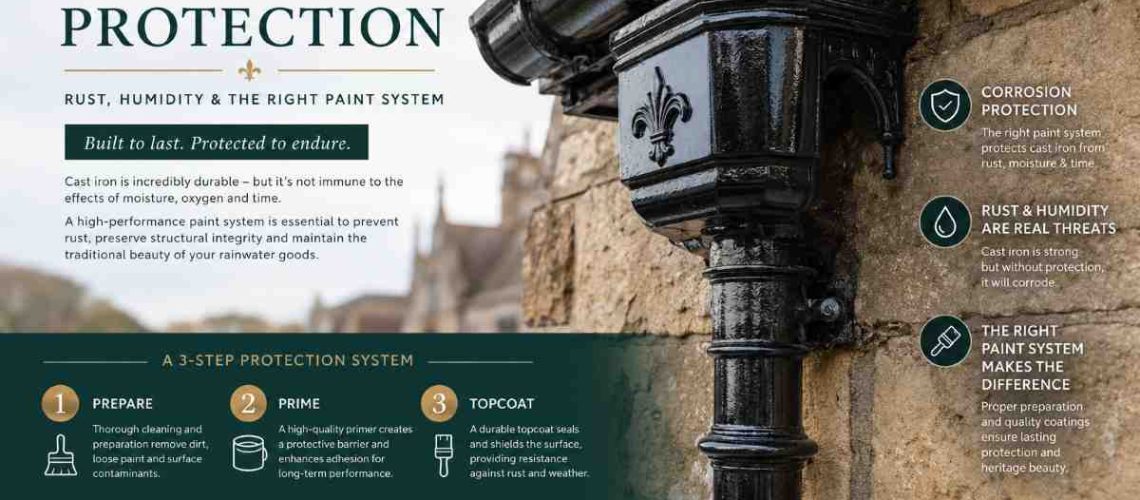
A technical guide to how cast iron corrodes, why relative humidity above 65% accelerates attack, and how linseed oil and epoxy paint systems compare for heritage and industrial ironwork. Written for architects, conservation officers and specifiers making paint system decisions on listed and non-listed cast iron rainwater goods.
Cast iron corrodes through an electrochemical process in which the iron matrix oxidises anodically while its graphite flakes act as noble, permanently cathodic sites — a mechanism called graphitic corrosion that can hollow out a casting from within while leaving its outward shape intact. Atmospheric corrosion accelerates sharply once relative humidity exceeds a critical threshold of approximately 65%, the point at which a continuous electrolyte film forms on the metal surface; hygroscopic salt deposits can lower this threshold significantly. Two paint strategies address this differently: heritage-appropriate linseed oil paint systems, which cure by autoxidation into a flexible, vapour-permeable film suited to historic ironwork, and two-pack epoxy-polyurethane systems, which form a dense, low-permeability barrier suited to industrial and marine exposure under ISO 12944. This article sets out how to choose correctly between them.
On listed buildings, the choice of paint system is a conservation decision, not just a maintenance one. Historic England and the Society for the Protection of Ancient Buildings (SPAB) consistently specify traditional, breathable finishes for historic cast iron rainwater goods, casement windows and architectural ironwork, and conservation officers will generally expect a like-for-like approach on Grade I, Grade II* and Grade II ironwork. Changing from an original linseed oil system to a modern synthetic coating — or the reverse — can itself be a material change requiring consideration under Listed Building Consent.
The regulatory preference for breathable systems is not sentimental; it reflects material behaviour. Modern rigid film-forming paints, including heavy alkyds and standard epoxies, often fail on historic ironwork precisely because they are too inflexible for cast iron’s thermal movement. Moisture trapped behind micro-cracks in a hard, impermeable coating accelerates graphitic corrosion at the metal surface and causes the paint shell to flake catastrophically once the substrate beneath has degraded. This is one of the clearest practical links between correct paint specification and long-term structural performance on heritage ironwork.
Cast iron rusts because a thin film of moisture on its surface acts as an electrolyte, allowing iron atoms to lose electrons and dissolve at anodic sites while oxygen is reduced at cathodic sites elsewhere on the same casting. This is a bimetallic galvanic cell operating at microscopic scale, driven by the potential difference between different microstructural phases within the metal itself.
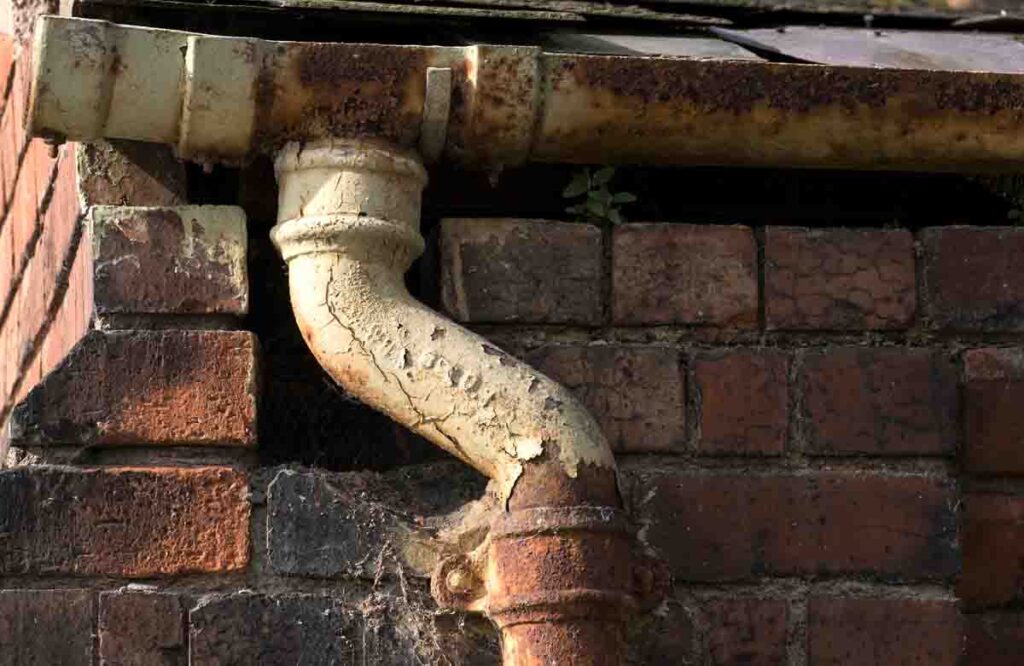
Cast iron is an iron-carbon alloy containing more than 2.0% carbon by weight — typically 2.5% to 4.0% — together with silicon above 1.0%. When exposed to moisture and oxygen, metallic iron undergoes anodic oxidation, releasing electrons into the bulk metal. Those electrons migrate to cathodic sites, where reduction reactions sustain the cell. In neutral or alkaline atmospheric moisture, oxygen reduction is the dominant cathodic process; in acidic conditions, or in micro-environments depleted of dissolved oxygen, hydrogen evolution takes over instead.
The ferrous ions released at the anode react with hydroxyl ions to form ferrous hydroxide, which further oxidises in the presence of oxygen into hydrated ferric oxides and magnetite — collectively, the reddish-brown rust visible on unprotected ironwork. This basic electrochemistry applies to any ferrous metal. What makes cast iron distinct, and considerably more consequential to get wrong, is what happens next.
Graphitic corrosion is a dealloying process in which the graphite flakes within grey cast iron act as permanent, noble cathodic sites that accelerate the selective dissolution of the surrounding iron matrix, leaving a porous graphite-oxide skeleton that retains the casting’s original shape but almost none of its strength. Unlike uniform surface rusting, it does not remove metal evenly across a surface — it leaches the iron out from within.
Grey cast iron’s microstructure consists of graphite flakes embedded within a pearlitic or ferritic iron matrix. Graphite occupies a far more noble position than metallic iron in the galvanic series, so where grey cast iron is exposed to stagnant, low-pH or salt-bearing water, the graphite flakes act as fixed cathodes, continuously drawing electrons from the adjacent, less noble iron. The iron dissolves; the insoluble graphite network stays put, trapping corrosion products such as iron hydroxides within its pores while retaining the casting’s original dimensions and surface detail.
This is what makes graphitic corrosion a genuine engineering risk rather than a cosmetic one: it cannot reliably be detected by visual inspection. A gutter, pipe or hopper affected by graphitic corrosion can look entirely sound while its physical density, tensile strength and ductility have collapsed. The remaining porous structure has effectively zero fracture toughness, so a component that appears intact can fail suddenly and brittlely under a modest mechanical load, a thermal expansion stress, or a surge in hydraulic pressure. Conditions that accelerate graphitic corrosion include stagnant water sitting in valley gutters or blocked outlets, soft water carrying traces of hydrogen sulphide, acidic soils around buried pipework, high sulphate levels, and elevated chloride concentration, which penetrates corrosion deposits, lowers solution resistivity and prevents passive film formation.
Because the risk is structural rather than visible, we treat any suspected graphitic corrosion — softness under a probe, a hollow sound when tapped, or unexplained paint failure at a single point — as grounds for closer inspection before any repainting proceeds. Guidance on identifying and addressing this is covered in our note on the repair and restoration of cast iron guttering, and fixing choices that avoid introducing a further galvanic pairing are set out in our article on galvanic corrosion and fixings.
Atmospheric corrosion of cast iron does not proceed in dry air; it requires a thin film of condensed water on the surface to act as an electrolyte, and the rate of attack rises sharply once relative humidity passes a critical threshold of approximately 65%. Below that threshold, corrosion proceeds slowly; above it, a continuous surface electrolyte forms and electrochemical oxidation accelerates markedly.
This boundary is known in corrosion science as the Critical Relative Humidity, or CRH. For clean, uncorroded ferrous surfaces, the CRH generally falls between 60% and 70%, with 65% widely used as the operational threshold. The physical mechanism is capillary condensation: microscopic pores, surface roughness pits and the spaces between graphite flakes act as capillary channels, allowing liquid water to condense within them at relative humidities well below the point at which the wider atmosphere would show visible condensation. This is why cast iron in a damp, poorly ventilated valley gutter or an enclosed downpipe void can be corroding actively even when the surrounding air feels merely humid rather than wet.
Hygroscopic salt contamination lowers this threshold substantially, which is why coastal and de-iced sites corrode faster than the ambient humidity alone would suggest. Ionic salts such as sodium and magnesium chloride are deliquescent: above a specific Deliquescence Relative Humidity, a crystalline salt deposit absorbs atmospheric moisture directly and forms a saturated solution on the surface, independent of the surrounding air reaching its own dew point. Magnesium chloride deposits, for instance, can begin deliquescing at relative humidities as low as 33% to 35%, while sodium chloride typically requires closer to 75% RH — but once either salt is present on a cast iron surface, from coastal salt spray, road de-icing spray, or contaminated blast media, liquid micro-droplets can form well below the clean-metal CRH. These concentrated salt solutions conduct current readily, disrupt passive film formation and can sustain localised graphitic pitting even in conditions that would otherwise be considered conditionally dry.
Linseed oil and epoxy-polyurethane systems protect cast iron through opposite strategies: linseed oil cures into a flexible, vapour-permeable film that moves with the metal and allows trapped moisture to escape, while epoxy systems form a dense, largely impermeable barrier that excludes water and oxygen outright. Each is the right answer in a different context, and the two should not be treated as interchangeable alternatives to the same specification.
Linseed oil is a natural drying oil derived from flax seed. It forms a film through autoxidation rather than solvent evaporation: the applied film absorbs atmospheric oxygen under UV light and trace metallic driers, converting unsaturated fatty acid double bonds into organic hydroperoxides. These cleave to generate free radicals that drive extensive cross-linking, converting the liquid triglyceride into linoxyn — a flexible, micro-porous polymeric matrix. Modern heritage-compliant formulations use red iron oxide, zinc oxide and titanium dioxide for opacity, strength and mould resistance, in place of the lead pigments used historically.
Application is deliberately gradual: two full coats of linseed red oxide primer, worked into casting recesses with natural bristle brushes and each cured for 24 to 48 hours in dry, UV-exposed conditions, followed by three thin topcoats applied in succession once each layer has fully cured. Thin coats matter — they allow oxygen to penetrate the full film thickness and avoid surface skinning that would trap uncured oil beneath. The result is a low-sheen, flexible, micro-porous film that expands and contracts with the cast iron’s thermal movement without cracking, and that allows any moisture reaching the substrate to migrate back out through the film rather than becoming trapped beneath it. Maintenance is correspondingly simple: rather than full stripping, the surface is washed down and refreshed with a light top-up coat roughly every five to seven years.
Modern industrial protection relies on two-pack thermosetting epoxies, typically a Bisphenol A or F diglycidyl ether resin cured with an amine, polyamide or cycloaliphatic hardener. Curing proceeds through step-growth polymerisation into a dense, rigid, highly cross-linked polymer network with low water vapour and oxygen permeability, high chemical resistance and strong mechanical adhesion to correctly prepared metal.
These systems are specified under ISO 12944, the international standard classifying atmospheric exposure by corrosivity — from C1 (very low, heated indoor environments) through C3 (medium, urban and light industrial) and C4 to C5 (high to very high, coastal and heavy industrial or marine exposure) up to CX (extreme offshore and tidal conditions) — with coating durability rated Low (up to 7 years), Medium (7 to 15 years), High (15 to 25 years) or Very High (over 25 years) before first major maintenance. A standard high-performance system uses three functional layers: a zinc-rich or high-build epoxy primer for passivation or cathodic protection, a high-build epoxy intermediate coat that extends the diffusion path for water and ions, and a finish topcoat. Because aromatic epoxy resins chalk and lose gloss under solar UV, that topcoat is specified as an aliphatic polyurethane or polysiloxane rather than epoxy itself.
Performance depends heavily on surface preparation. Cast iron often carries a non-conductive foundry skin, scale and oil residue that must be removed by abrasive blast cleaning to ISO 8501-1 Sa 2½ or SSPC-SP10 (near-white metal), generating a sharp anchor profile — typically 50 to 85 microns — for mechanical interlock. Soluble chloride and sulphate contamination must be reduced below critical thresholds before blasting; residual salts left beneath an impermeable epoxy film draw atmospheric water vapour through the coating by osmosis, generating pressures that rupture the adhesion bond from beneath — a failure mode with no equivalent in a vapour-permeable linseed system. Adhesion is verified on site by pull-off testing to ASTM D4541 or BS EN ISO 4624; a well-specified epoxy system on cast iron should achieve 5 to 8 MPa, failing cohesively within the coating rather than at the metal interface.
The two approaches are best understood side by side against the criteria that actually determine performance on cast iron:
| Criterion | Linseed Oil Paint | Epoxy-Polyurethane |
|---|---|---|
| Cure mechanism | Autoxidation (oxygen uptake, radical cross-linking) | Chemical reaction between resin and hardener |
| Film character | Flexible, micro-porous, vapour-permeable | Dense, rigid, low permeability |
| Moisture handling | Allows trapped moisture to migrate out | Excludes moisture, but traps any present beneath |
| Substrate prep | Hand-tool cleaning, retains historic layers | Abrasive blast to Sa 2½ / SSPC-SP10 |
| Typical use | Listed and historic cast iron, decorative ironwork | ISO 12944 C3–C5/CX industrial, marine, buried assets |
| Maintenance | Wash and top-up coat every 5–7 years | Full recoat cycle per ISO 12944 durability rating |
| Conservation compliance | Preferred by Historic England, SPAB, IHBC | Not generally appropriate on listed ironwork |
The correct system follows directly from the building’s status and the casting’s exposure: heritage and listed cast iron calls for a linseed oil system with hand-tool preparation, while heavy industrial, marine or buried infrastructure calls for a blast-cleaned epoxy-polyurethane build under ISO 12944. Treating the two as interchangeable, or specifying on cost alone, is the single most common source of premature paint failure we see on cast iron rainwater systems.
For period and listed buildings, including churches and ecclesiastical buildings, abrasive blasting is rarely appropriate — it destroys fine casting detail and typically falls outside what a conservation officer will accept. Hand-tool preparation (ISO 8501-1 St 2/St 3) followed by the traditional two-primer, three-topcoat linseed oil build is the correct specification, and it is the one we recommend across our own cast iron guttering and pipes.
For heavy industrial, municipal or marine assets — trunk mains, bridge components, treatment works, offshore or immersion-exposed castings — barrier performance and mechanical strength are what matters, and the ISO 12944 C3 to C5/CX epoxy-polyurethane build described above is appropriate, with strict soluble salt limits before blasting to avoid osmotic blistering.
Where a component’s condition is uncertain — suspected graphitic corrosion, historic damage, or a run with an unclear repaint history — we recommend an on-site survey before specification is finalised. This is a chargeable service, but on complex or sensitive projects it is what allows an accurate specification to be written in the first place, rather than discovering the true condition once scaffolding is up. Where a casting has degraded beyond repair, copy casting from the original pattern, drawings or a surviving fragment typically takes 8 to 10 weeks from pattern confirmation to delivery; standard stock profiles remain available for prompt despatch, subject to confirming current availability at the time of enquiry.
The most costly specification errors on cast iron rainwater systems involve applying the wrong film type for the substrate’s condition and history, rather than any failure of the paint itself. In our experience, the following recur most often:
Overcoating with a rigid modern paint over an older linseed system. The mismatch in flexibility causes cracking at movement joints, and any moisture that gets behind the new film has no way to escape, accelerating graphitic corrosion beneath an intact-looking surface.
Painting over undiagnosed graphitic corrosion. A fresh coat of paint over a graphitised component conceals the structural loss rather than addressing it, and the casting can still fail suddenly under load.
Insufficient salt removal before an epoxy system. Skipping high-pressure water washing ahead of blast cleaning leaves residual chlorides beneath the film, setting up osmotic blistering within a few seasons.
Full abrasive blasting on decorative heritage castings. This is faster and cheaper than hand preparation, but it erodes fine surface detail and is generally inconsistent with conservation requirements on listed ironwork.
Ignoring site-specific microclimate. A north-facing valley gutter, an enclosed downpipe void, or a coastal elevation can sit above the 65% humidity threshold, or below a lower deliquescence threshold where salt is present, far more of the year than the local weather station average would suggest.
Specifying by cost rather than context. A cheaper system that is wrong for the exposure category or listed status will cost more over its lifecycle once early repainting, scaffolding and potential component replacement are accounted for.
The following examples illustrate how paint system selection plays out in practice across different building types and exposures.
A Victorian valley gutter system had been overpainted with a modern gloss finish that trapped condensation against the casting. Inspection found active graphitic corrosion beneath sound-looking paint at several low points. The affected sections were mechanically cleaned, one hopper was copy cast to replace a section too degraded to save, and the full run was returned to a two-primer, three-topcoat linseed oil system, agreed with the conservation officer as the correct like-for-like finish.
Cast iron downpipes on a terrace within a World Heritage Site conservation area showed surface bloom and early flaking. The original linseed oil system had simply reached the end of its maintenance interval. Rather than stripping back to bare metal, the surface was washed down and refreshed with a topping coat, consistent with SPAB guidance on minimal intervention and avoiding unnecessary loss of historic fabric.
Coastal salt exposure had accelerated corrosion on hopper heads facing the Firth of Forth, well beyond what the building’s general humidity exposure would predict. A closer inspection identified deliquescent chloride contamination lowering the effective corrosion threshold at the affected elevation. The hoppers were cleaned, repainted with a linseed oil system, and a shorter maintenance interval was agreed to account for the coastal microclimate.
A stable block’s rainwater goods had been left unpainted for over a decade following partial demolition works nearby. Soft, acidic run-off from adjacent planting had encouraged early-stage graphitic attack on a short run of pipework. Following an on-site survey, the affected pipework was replaced with new castings, and the full system was brought back under a linseed oil maintenance regime to prevent recurrence.
A converted mill retaining its original cast iron downpipes as a design feature sits in an ISO 12944 C3 urban-industrial environment without listed status constraints. Here, a blast-cleaned epoxy-polyurethane system was the appropriate specification, providing a 15-to-25-year maintenance interval consistent with the building’s commercial use, illustrating that the correct system follows exposure and status rather than material alone.
Preventing premature failure in cast iron rainwater systems comes down to two things: understanding that graphitic corrosion is a hidden, structural risk rather than a cosmetic one, and matching the paint system to the building’s status and exposure rather than treating linseed oil and epoxy as interchangeable options. Relative humidity above roughly 65%, or the presence of deliquescent salts at any humidity, is what turns a dormant risk into an active one — which is why correct specification, adequate surface preparation and a realistic maintenance interval matter more than the brand of paint used.
Tuscan Foundry Products has supplied and specified cast iron rainwater systems for period and listed buildings for over 130 years, and we apply that same reasoning to every enquiry — recommending linseed oil paint systems for heritage and listed ironwork, and appropriate industrial coating specifications where the context calls for it. Where a casting has degraded beyond repair, our copy casting service reproduces it from the original pattern, drawings or a surviving fragment. For guidance on a specific building or a suspected case of graphitic corrosion, get in touch or browse our full product catalogue.