
Established 1893 | BS 460:2002 Certified | UK & International Supply | Expert Technical Support | 0333 987 4452
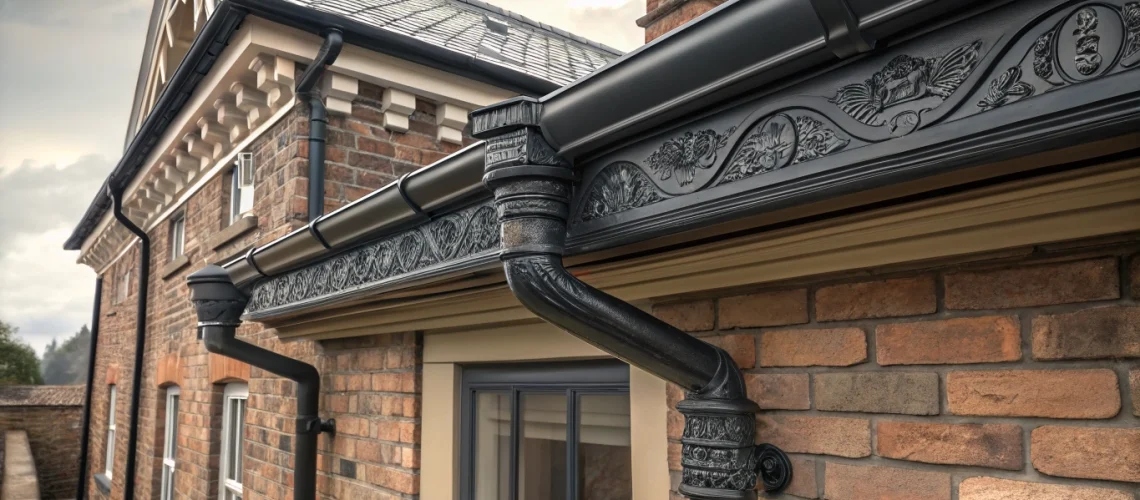
Cast iron downspouts remain the standard specification for listed and historic buildings because they reproduce the exact profiles, jointing methods, and visual weight of the originals while offering a service life measured in decades rather than years. Whether your project calls them downspouts, downpipes, drainpipes, or rhone pipes, the component performs the same function: carrying water vertically from the gutter outlet to ground level without compromising the historic fabric it protects.
For conservation architects, surveyors and contractors working to Listed Building Consent or Faculty Jurisdiction requirements, getting the specification, jointing and fixing detail right is not optional — it is the difference between a system that protects the building for another century and one that accelerates its decay. This guide sets out the terminology, the engineering, the corrosion risks, and the regulatory framework that govern cast iron downspouts on heritage properties.
A downspout is the vertical pipe that carries rainwater from a gutter or hopper head down to ground level, a soakaway, or a storm drain. In historic buildings, this same component is also commonly called a downpipe, a drainpipe, or — north of the border — a rhone pipe. The terms are regionally and professionally interchangeable: American and increasingly international specifications favour “downspout,” British trade and conservation literature defaults to “downpipe,” and Scottish heritage practice still uses “rhone” for the whole rainwater run, gutter included.
None of these terms describes a different product. They describe the same vertical conduit, typically supplied in cast iron with spigot-and-socket jointing, that connects two other named components: the gutter above (the horizontal channel, in profiles such as Ogee or Half Round) and the hopper head or rainwater head that frequently sits between the two.
A cast iron downspout does not work in isolation; it is one stage in an integrated drainage chain, and each junction has its own engineering logic. The system runs from gutter, through hopper head, down the downspout, and into the gully or soakaway.
Our cast iron gutters carry rainwater horizontally to an outlet, laid to a shallow fall, and are typically supplied in standard six-foot lengths with curved or radius sections cast specially to follow turrets and bay windows. The hopper head that frequently sits at the head of the downspout does more than decorate the junction: as it fills during heavy rainfall, it submerges the downspout’s inlet entirely, switching the system from a gravity-fed annular flow to a full-bore siphonic flow that draws water away at significantly higher capacity.
Below the downspout, the system discharges either into a gully connected to storm drains — typical in urban terraces and townhouses — or directly into a soakaway, more common on rural churches and estate buildings without a connected sewer.
Cast iron downspouts are deliberately not sealed at their vertical joints. The spigot of the upper length sits loosely inside the socket of the length below, traditionally centred with small lead wedges or timber off-cuts to prevent wind rattle while still permitting seasonal thermal movement. Horizontal gutter joints, by contrast, are bedded and sealed — traditionally with red lead putty, and on modern installations with low-modulus silicone or EPDM gasket systems.
“Eared” downspouts carry integrated cast lugs fixed directly to the masonry; “uneared” pipes are held with drive-in spikes, holderbats, or screw-to-wall brackets. The pipe must stand clear of the wall face by a measured gap so that any incidental leakage runs down the rear of the pipe rather than saturating the masonry behind it, and to allow access for repainting.
Bimetallic corrosion is one of the most common and most preventable causes of premature downspout failure. Where stainless steel fixings sit in direct, wet contact with cast iron, the electrochemical potential between the two metals accelerates pitting corrosion in the iron around every fixing point. We recommend hot-dip galvanised or zinc-plated mild steel fixings as standard.
Standard primed cast iron is supplied with a thin transit primer offering short-term protection only, and must be spot-primed, undercoated, and finished with exterior gloss before and after installation. Our pre-finished cast iron carries a factory-applied, oven-cured polyurethane coating offering a substantially longer maintenance interval. For Grade I and Grade II* listed structures, vapour-permeable linseed oil paint is the finish recommended by the SPAB and the IHBC.
A blocked or failed downspout is rarely a minor maintenance issue on a historic building — it is frequently the root cause of major structural damage. Debris blockages cause overflow onto the facade below, saturating masonry, washing out mortar joints, and triggering face-spalling in freezing conditions. Sustained high-level saturation can penetrate timber wall plates and roof bearings, activating dormant dry rot spores. Cast iron’s resistance to metal theft — unlike copper or lead — also makes it a more secure long-term specification for vulnerable rural and ecclesiastical sites.
Downspouts, hoppers and their fixings on a listed building are protected components under the Planning (Listed Buildings and Conservation Areas) Act 1990 in England and the Historic Environment (Wales) Act 2023. Like-for-like repair using traditional techniques will not usually require consent, but any change of profile, dimension or material requires formal Listed Building Consent.
Active churches sit outside this system, instead governed by Faculty Jurisdiction. Routine cleaning and minor like-for-like repair (List A) requires only a logbook entry; substantial like-for-like replacement (List B) requires written notice to the Archdeacon; and any material change requires a Full Faculty with Diocesan Advisory Committee review.
Where original cast iron downspouts have suffered damage, conservation practice prioritises repair over wholesale replacement. Cold metal stitching — the Metalock process — drills and keys across a crack with ductile nickel-iron dumbbell keys, restoring tensile strength without heat and producing a near-invisible, watertight repair.
Where a downspout or hopper head is too damaged to repair, our copy casting service produces an exact pattern-matched replica. We always recommend an on-site survey ahead of bespoke or copy-cast work; bespoke and copy-cast downspouts typically carry an 8–10 week lead time, which we flag at enquiry stage so projects can plan around it.
Chatsworth House, Derbyshire — A Grade I listed seat with an extensive cast iron rainwater system spanning multiple wings and centuries of alteration. Sections of the original downspouts required exact pattern replication to maintain visual consistency across the building’s principal elevations.
Georgian terraces, Bath — The honey-coloured limestone terraces of Bath, largely Grade I and II* listed, rely on slender cast iron downspouts that follow the strict regularity of their Georgian facades. Conservation officers routinely require like-for-like cast iron specification.
Windsor Castle, Berkshire — Downspout repairs favour cold metal stitching over replacement wherever structurally significant decorative castings survive, reflecting the elevated scrutiny applied to consent and specification on royal and state heritage buildings.
Southwell Minster, Nottinghamshire — This Grade I listed minster church operates under ecclesiastical exemption and Faculty Jurisdiction. Keeping the downspout system clear directly protects the minster’s thick stone walls from saturation.
Saracen Foundry-supplied terrace, Glasgow — Many Glasgow tenements still carry downspouts cast by Walter Macfarlane’s Saracen Foundry, known locally as rhone pipes, combining functional drainage with ornamental detailing.
There is no functional difference — downspout and downpipe describe the same vertical rainwater pipe. Downspout is the more common term in American and international usage, while downpipe is the standard British term; in Scotland the same component is often called a rhone pipe.
Like-for-like repair using traditional materials and techniques generally does not require consent, but any change of material, profile or dimension does require formal Listed Building Consent in England or equivalent consent under the Historic Environment (Wales) Act 2023.
Downspouts sit beneath a hopper head, which collects water from the gutter outlet above and, when full, submerges the downspout inlet to create a full-bore siphonic flow that significantly increases drainage capacity during heavy rainfall.
Vertical downspout joints use a loose spigot-and-socket connection, traditionally centred with lead wedges, to allow for seasonal thermal movement, whereas horizontal gutter joints must be fully sealed to remain watertight along their run.
Galvanic corrosion occurs when stainless steel fixings sit in direct contact with cast iron in wet conditions, accelerating pitting around the fixing points; hot-dip galvanised or zinc-plated mild steel fixings are the standard recommended alternative.
Yes — cold metal stitching, also known as the Metalock process, mechanically repairs cracked or damaged cast iron without heat, avoiding the thermal distortion risk associated with welding.
Bespoke and copy-cast downspouts typically carry an 8–10 week lead time from confirmed pattern and order, while standard stock profiles are available for prompt despatch.
As a specialist supplier of heritage cast iron rainwater goods, we work daily with the terminology, jointing, and consent challenges set out in this guide — whether a project calls for downspouts, downpipes, or rhone pipes. From our cast iron gutters through to fully bespoke copy-cast replicas of damaged historic components, we supply listed building specifications across England, Wales and Scotland, and support churches and ecclesiastical clients through the Faculty Jurisdiction process.