
Rainwater Disposal on Historic Buildings: Failure, Repair and Replacement
A conservation guide to gutters, downpipes, hoppers and outlets in lead, cast iron, copper, timber and stone — how they fail, when to repair, and when replacement is genuinely justified.
In summary
Rainwater disposal is the single largest cause of decay in historic buildings. Almost all serious fabric damage to historic structures begins with water that should have been carried away and was not — through blocked or undersized gutters, split downpipes, failed hopper heads, or discharge at the wrong point. Historic rainwater systems were made in lead, cast iron, copper, timber and stone, each with distinct failure modes and repair options. The default should be repair and reinstatement of the original system rather than replacement, since the existing arrangement usually reflects how the building was designed to shed water. Where a system has been replaced in unsuitable modern materials, reinstatement in the original material is normally the correct specification on a listed building.
On this page
- Why rainwater goods matter more than their cost suggests
- Historic materials and how to identify them
- How rainwater systems fail
- Diagnosing the real problem
- Capacity: when the system was never adequate
- Repair options by material
- When replacement is justified
- Consent position
- Specification and procurement
- Maintenance that actually prevents recurrence
- Common mistakes
- Find a specialist
- Frequently asked questions
Why rainwater goods matter more than their cost suggests
Rainwater goods are among the cheapest components on a historic building and among the most consequential. A blocked gutter costs nothing to clear and, left alone, will in time produce saturated masonry, decayed wall plates, failed plaster, beetle and fungal attack in embedded timbers, and frost damage to stone and brick. The repair bill is routinely a hundred times the cost of the maintenance that would have prevented it.
They are also the component most often replaced badly. Because they are seen as plumbing rather than architecture, decisions about them are frequently delegated to whoever is nearest — and historic profiles, correct outlet positions and original discharge arrangements are lost in the process.
The purpose of this guide is to put those decisions in the right order: understand the system, diagnose the failure, repair what can be repaired, and replace only what must be.
Historic materials and how to identify them
Identify the material before specifying anything, because repair method, compatible fixings and appropriate coatings all follow from it.
Lead
The oldest surviving material for gutters and rainwater heads on significant buildings, in continuous use from the medieval period. Lead appears as parapet gutter linings, valley gutters, box gutters, decorative rainwater heads and, less commonly, downpipes.
Lead is soft, malleable and extremely durable when correctly detailed. It fails through fatigue cracking caused by restrained thermal movement, through under-sized bays, through inadequate falls, and through corrosion from condensation on the underside where the substrate cannot breathe.
Decorative lead rainwater heads are frequently dated and initialled, and are often the most significant single component of the whole system. They should never be scrapped without recording.
Cast iron
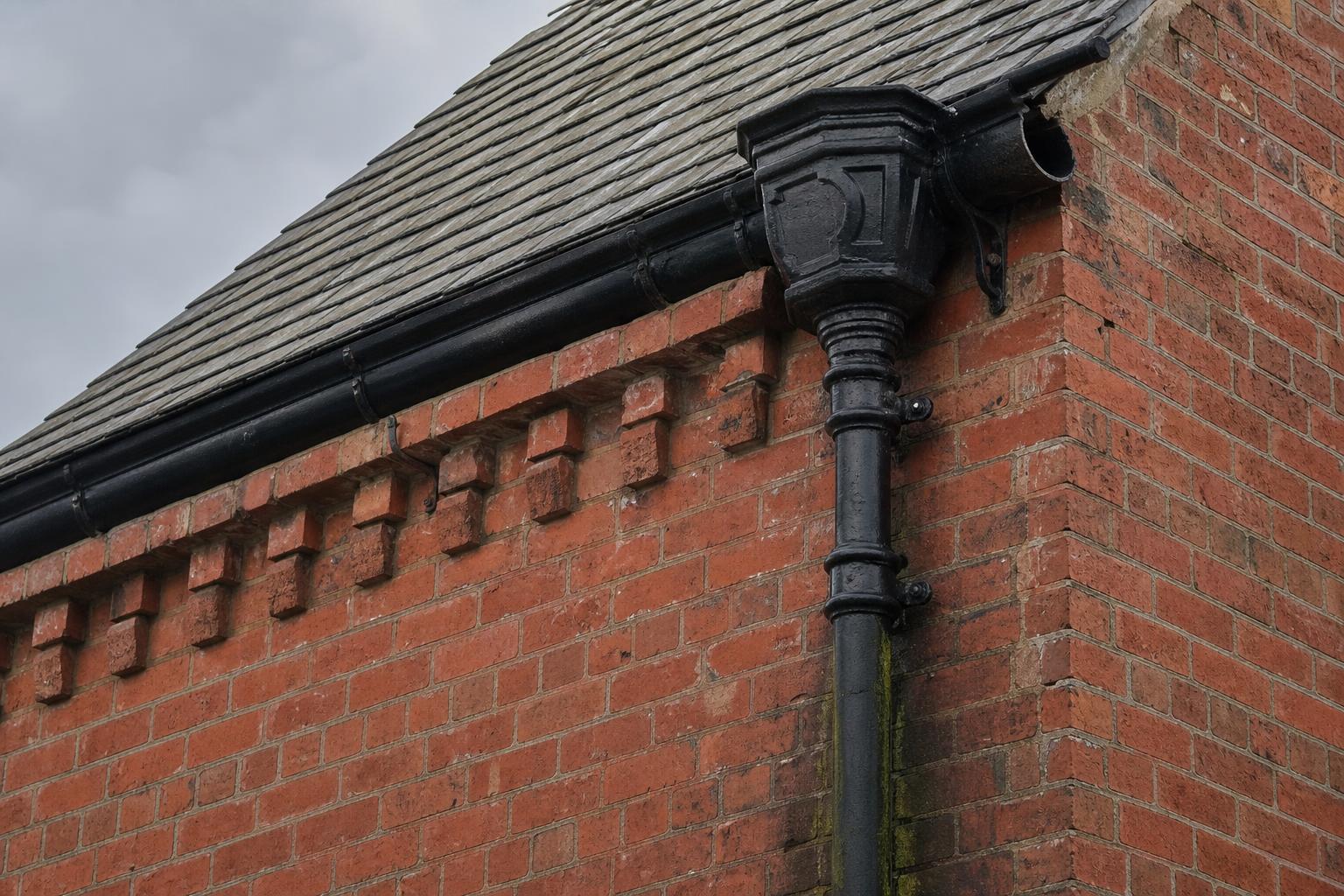
Dominant from the late eighteenth century to the mid twentieth. Look for the mould parting line, socketed joints, and identical repeating sections. Profiles are regionally and chronologically diagnostic — half round, ogee, moulded, beaded — and are frequently the strongest surviving evidence of a building’s period detailing.
Cast iron fails by corrosion at joints and at the rear of gutters where debris sits, by fracture from impact or from ice, and by rust jacking at fixings. It is brittle and cannot be forged or conventionally welded, but it is highly repairable by mechanical means and extremely long-lived when maintained.
Where a cast iron system survives, the presumption should be strongly towards retention. A hundred-and-fifty-year-old gutter that has been repainted is doing its job; the same is rarely true of its replacement at the same age.
Copper
Used for gutters, downpipes and rainwater heads, more often on higher-status and later buildings, and widely on ecclesiastical work. Durable and self-protecting through its patina. Fails through fatigue at restrained joints and through erosion where water discharges onto it at velocity.
Note the galvanic risk: copper in contact with, or discharging onto, iron or zinc will accelerate corrosion of the less noble metal considerably.
Timber
Timber gutters — often lead-lined, sometimes pitch-lined — survive on vernacular buildings, agricultural structures and some parish churches. They are frequently mistaken for decayed fascia boards and removed without recognition. Failure is almost always of the lining rather than the timber, and relining is usually the correct repair.
Stone
Stone gutters, spouts and gargoyles occur on churches, castles and high-status masonry buildings. Failure is by cracking, by blocked or eroded channels, and by the loss of the mortar or lead bedding that made the joints watertight.
How rainwater systems fail
The list is short and repetitive, which is what makes prevention practical.
Blockage. Leaves, moss, nesting material, and debris from adjacent roof works. The commonest fault by a wide margin, and the cheapest to prevent.
Joint failure. In cast iron systems, joints were bedded in putty or mastic with a bolted fixing; these degrade and open. In lead and copper, joints fail through thermal fatigue where movement was restrained.
Loss of fall. Gutters sag between brackets, brackets corrode and drop, or later repairs set the gutter level. Standing water follows, then corrosion at the standing point, then perforation.
Bracket and fixing failure. Fixings corrode, rust jacking splits the fascia or the masonry, and brackets are set too far apart during replacement work.
Discharge in the wrong place. Downpipes discharging onto a lower roof, onto masonry, or into a blocked or disconnected gully. Water that leaves the gutter correctly and then arrives at the wall is no better than water that never left.
Under-capacity. See Part 5.
Impact and ice. Ladders, scaffolding, falling slates, and freezing standing water. Cast iron in particular fractures rather than deforming.
Incompatible later repair. Cement fillets, mastic smeared over joints, mismatched sections bolted in, and plastic components inserted into a metal run. Each of these usually creates a new failure point rather than fixing the old one.
Diagnosing the real problem
The visible damage is rarely at the point of failure. Staining, damp and decay appear where water lands and soaks, which may be several metres from the split or blockage causing it. Specifying repairs from the ground, based on where the damp is, produces work that does not solve anything.
A proper diagnosis involves:
Inspection in wet conditions, or under simulated flow. A dry gutter tells you very little. Systems should be observed running. Where that cannot be arranged, controlled water testing will find leaks that inspection will not.
Close inspection at height. Binoculars from the ground miss joint failures, fine cracks, rear-of-gutter corrosion and blocked outlets almost entirely. Access by tower, mobile elevating platform or drone survey is proportionate on any building where the works are likely to be significant.
Tracing the whole run. Follow water from roof to outlet to gully to drain. Blocked or collapsed below-ground drainage is a common cause of apparent gutter failure — the system backs up because the water has nowhere to go.
Reading the building. Where has the system been altered? Are there redundant fixings, blanked outlets, or brackets that do not match? These usually indicate that the original arrangement differed, and that the current one may be the problem.
Recording before disturbance. Photograph the system in place, including profiles, joint details, bracket types, outlet positions and any dates or founders’ marks. Once dismantled, this evidence is gone, and it is what makes accurate reinstatement possible.
Capacity: when the system was never adequate
Some historic systems fail because they are worn out. Others fail because they were under-sized from the start, or because the catchment changed.
Common causes of genuine under-capacity:
- Roof coverings replaced with a less absorbent material, increasing run-off
- Valleys or roof planes rearranged in earlier alterations
- Outlets blanked off during previous works, leaving fewer than originally intended
- Extensions discharging into an existing system not sized for them
- Higher-intensity rainfall than the original design assumed
Where capacity is genuinely inadequate, calculation is required rather than guesswork. Roof drainage design for gravity systems is covered by BS EN 12056-3:2000, which sets out how catchment area, rainfall intensity, gutter profile and outlet arrangement determine required capacity.
On a historic building the challenge is meeting that requirement without altering appearance. Options in rough order of conservation preference:
- Reinstating outlets that were blanked in earlier works
- Improving outlet efficiency — outlet position and detail affect capacity substantially, often more than gutter size does
- Increasing gutter depth within the same visible profile where a deeper section exists in the same pattern
- Adding a discreet additional downpipe in a concealed elevation
- Increasing the visible gutter size — normally a last resort, and a change that will require consent
Repair options by material
Repair is almost always possible, and almost always cheaper over the building’s life than replacement.
Lead
- Lead burning (welding) of cracks and splits by a competent leadworker, which is the correct repair and is like-for-like
- Re-dressing and re-fixing where movement has been restrained, addressing the cause rather than the symptom
- Renewal of individual bays where fatigue is extensive, retaining sound bays
- Recasting decorative rainwater heads from the original where loss is total — note that surviving heads should be recorded and, where possible, retained even if no longer functional
Avoid soldered patch repairs, mastics and liquid coatings applied over failing lead; they conceal the problem and shorten the life of the sheet.
Cast iron
- Clearing, re-bedding and re-bolting joints, which resolves a high proportion of leaks without replacing anything
- Mechanical repair of fractures — pinning, strapping, cold metal stitching
- Replacement of individual failed sections from matching stock, retaining the run
- Recasting from a pattern taken off a surviving section where a match is not available
- Re-bracketing to restore correct fall and spacing
- Correct surface preparation and recoating (see the companion guide on paint systems for exterior historic metalwork)
Cast iron is not conventionally weldable, and welded repairs risk cracking the parent metal.
Copper
- Localised patching and re-seaming by a competent coppersmith
- Addressing restraint at joints where fatigue cracking has occurred
- Reviewing galvanic relationships where copper discharges onto other metals
Timber
- Renewal of the lining, which is the usual repair
- Splicing in new timber to decayed sections, retaining sound material
- Re-establishing fall and support
Stone
- Indenting or piecing-in to damaged sections
- Relining channels where erosion has compromised the fall
- Re-bedding joints in appropriate mortar or lead
When replacement is justified
Replacement is justified in three situations, and should be argued in these terms:
- The material is spent. Perforation is extensive, sections are fractured beyond mechanical repair, and the cost of piecemeal repair exceeds like-for-like renewal.
- The existing system is an unsympathetic later replacement. Where original cast iron or lead was replaced with unsuitable modern material, reinstatement in the original material is normally the correct specification on a listed building, and is usually welcomed rather than resisted by conservation officers.
- Capacity cannot be resolved by repair. See Part 5.
Where replacement proceeds, it should reinstate the original profile, the original material, the original outlet positions and the original bracket type. Where the original is not known, evidence should be sought before the specification is written — surviving fragments, shadow lines, redundant fixings, historic photographs, and comparable buildings by the same hand.
Where components must be cast to match, allow programme for it. Pattern-making and casting for bespoke profiles typically runs to eight to ten weeks from pattern approval, and radius gutters longer. This is regularly the item that delays completion, because it was treated as a detail.
Consent position
On a listed building, replacement of rainwater goods normally requires Listed Building Consent, and changing the material almost always does. Genuine like-for-like repair is often treated as maintenance, but this should be confirmed with the local planning authority rather than assumed.
Points that recur:
- Replacing cast iron with a different material is a material alteration, not maintenance, and is commonly refused on listed buildings.
- Reinstating cast iron where unsuitable modern material was previously installed is normally supported, and is often the easiest consent application in a project.
- Adding a downpipe, moving an outlet, or altering a gutter profile changes appearance and requires consent.
- In conservation areas, alterations to rainwater goods on principal elevations may be controlled, particularly where an Article 4 direction is in force.
- Requirements differ across the UK. Determinations rest with the local planning authority, advised where relevant by Historic England, Cadw, Historic Environment Scotland, or the Historic Environment Division in Northern Ireland.
Most authorities offer a pre-application service. For rainwater goods it is usually worth using, because the central question — is this repair or alteration — is one an officer can settle in a short exchange.
Specification and procurement
A specification for rainwater works should state:
- A schedule by elevation and by run, identifying what is retained, repaired and renewed
- Material and profile for every component, with the evidence base for any reinstated profile
- Joint detail and bedding material
- Bracket type, fixing method and spacing, and what fixings are to be bedded in
- Falls and outlet positions, stated rather than left to the fixer
- Surface preparation and coating system, by product and film build
- Access provisions, since these often dominate the cost
- A requirement that removed components are retained and not disposed of without written instruction — dated lead heads and marked castings are lost this way routinely
- A contingency for concealed defects, stated openly so tenderers price the same risk
- Programme allowance for any casting or pattern-making
- Drainage below ground, tested and included in scope where relevant
Do not write “repair as necessary.” It produces non-comparable tenders and disputes on site, and the lowest price will be the one that assumed least.
Maintenance that actually prevents recurrence
Most rainwater failure is deferred maintenance. A regime that works:
- Clear gutters, hoppers, outlets and gullies twice a year, in late autumn after leaf fall and again in spring. Once a year is not enough where there are trees.
- Inspect during or immediately after heavy rain, at least annually. This is the only time the system tells you the truth.
- Check discharge points, not just gutters. Gullies block silently.
- Deal with vegetation in and around the system before it establishes.
- Repair coating failures locally and early rather than waiting for a full redecoration cycle.
- Keep a record. A dated inspection log turns maintenance from an occasional reaction into a programme, and it is invaluable evidence in any later consent application or insurance discussion.
For buildings in institutional or ecclesiastical ownership, this should be written into the quinquennial or planned maintenance regime rather than left to whoever notices.
Common mistakes
| Mistake | Consequence |
|---|---|
| Diagnosing from the ground | Repairs specified in the wrong place; damp continues |
| Inspecting only in dry weather | Joint and capacity failures missed entirely |
| Replacing rather than repairing sound cast iron | Loss of historic profile; consent risk; shorter service life |
| Mastic smeared over failing joints | Conceals the fault, traps water, shortens life |
| Cement fillets and cement-bedded fixings | Traps moisture; accelerates rust jacking; splits masonry |
| Brackets spaced too far apart on replacement | Sagging, standing water, corrosion within a few years |
| Scrapping dated lead heads and marked castings | Irreplaceable evidence lost |
| Ignoring below-ground drainage | System backs up; apparent gutter fault never resolves |
| Treating casting lead times as a detail | Programme delay of two months or more |
| No maintenance regime after completion | The same failure recurs within a decade |
Find a specialist
The Building Restoration Index lists vetted specialists across the trades involved in rainwater disposal:
- Guttering and Pipework — cast iron rainwater systems, repair and supply
- Leadwork — lead gutters, linings, rainwater heads and downpipes
- Roofing Contractors — roof coverings, valleys and associated drainage
- Metalwork — repair and replication of architectural castings
- Paints and Finishes and Paint Removal — coating systems for exterior metalwork
- Drainage — below-ground drainage and gully work
- Aerial Drone Surveys and Surveyors — inspection at height and condition reporting
- Architects and Heritage Consultants — significance assessment and consent applications
Related guides in the library: Historic ironwork, Historic roofs, Damp in historic buildings. The full set is on the Technical Library page of the Building Restoration Index.
Frequently asked questions
Do I need consent to replace guttering on a listed building?
Normally yes, and almost always where the material or appearance changes. Genuine like-for-like repair is often treated as maintenance — confirm with your local planning authority.
Can I replace cast iron guttering with a modern material?
On a listed building this is a material alteration and is commonly refused. Cast iron like-for-like is the correct specification.
My gutters were replaced in the 1970s. Can I put cast iron back?
Usually yes, and reinstatement of the historic material is normally supported by conservation officers. It is often among the more straightforward consent applications.
How do I know whether the gutter can be repaired?
Inspect at close quarters, in wet conditions where possible. Joint failure, lost fall and localised fracture are all repairable. Extensive perforation is not.
Why is there damp on the wall when the gutter looks fine?
The failure is often elsewhere — a joint above, a blocked outlet, a split downpipe at the rear, or a blocked gully. Trace the whole run.
Can cast iron gutters be welded?
Not conventionally. Cast iron is brittle and welding risks cracking the parent metal. Mechanical repair or cold stitching is preferred.
How often should gutters be cleared?
Twice a year as a minimum where there are trees nearby — late autumn and spring. Add an inspection during heavy rain.
What is rust jacking?
Corroding iron expands to several times its volume, forcing apart the masonry or timber it is fixed into. It is the usual cause of cracked fascias and split stonework at fixings.
Are my gutters big enough?
If they overflow in heavy rain, possibly not. Capacity is calculated under BS EN 12056-3:2000 from catchment area, rainfall intensity, profile and outlet arrangement.
Can I add a downpipe to solve overflow?
Sometimes, and it is often preferable to enlarging the gutter. It changes appearance, so consent is likely to be required on a listed building.
What should gutter joints be bedded in?
Follow the original detail. Modern mastics smeared externally over a failing joint are not a repair.
Should fixings be bedded in lead or cement?
Lead or an appropriate lime-based mortar in almost all cases. Cement traps water and accelerates corrosion at the fixing.
How long does it take to get matching cast sections made?
Typically eight to ten weeks from pattern approval for bespoke profiles, and longer for radius work. Programme it early.
Is it cheaper to cast several matching sections at once?
Substantially. Pattern-making is the main cost and is a one-off; further castings from the same pattern are much cheaper.
What about timber gutters?
They are frequently mistaken for fascias and removed. The failure is normally the lining, not the timber, and relining is usually the correct repair.
Does copper cause problems next to iron?
It can. Copper discharging onto or in contact with iron or zinc accelerates corrosion of the less noble metal. Review the relationship before specifying.
Who should inspect a system at height?
Someone competent and appropriately equipped. Tower, mobile elevating platform or drone survey are all proportionate depending on the building.