
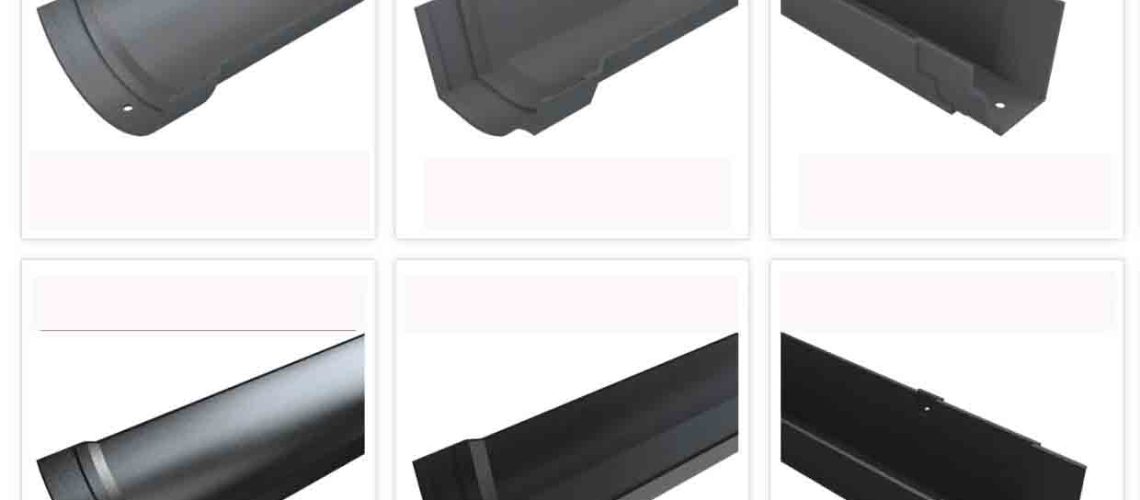
From the elegant S-curve of the Victorian Ogee to the understated practicality of the deep half-round, cast-iron gutter profiles carry centuries of architectural meaning. This guide explains how each profile evolved, which building types it suits, and how to specify correctly for listed buildings and conservation projects.
Cast iron rainwater goods are among the most architecturally legible elements of any historic building. The shadow line cast by a gutter profile at the eaves defines the transition between roof and wall — a detail that conservation architects and building surveyors scrutinise closely. Specify the wrong profile on a listed building, and you alter the character of the façade in a way that may not be reversible without further work and further cost.
The principle that underpins all heritage rainwater specifications is like-for-like replacement. Under the terms of Listed Building Consent, any material change to the external character of a building — including alterations to its rainwater goods — requires prior approval from the local planning authority or conservation officer. Selecting a profile that is visually faithful to the original is not merely good practice; it is a conservation and legal obligation.
We have been casting rainwater goods since 1893, and we offer eight standard cast iron gutter profiles, alongside twenty-six large sand-cast profiles for industrial and ecclesiastical applications, and a further twenty-eight special profiles. Understanding why each profile exists and where it belongs is the foundation of any well-specified heritage rainwater project.
Before cast iron, gutters were fashioned from timber lined with lead, or occasionally carved from stone. Lead remained the material of choice for high-status ecclesiastical and aristocratic buildings well into the eighteenth century — the ornate lead hopper heads found on many Georgian country houses are a surviving reminder of that tradition.
The pivot towards cast iron was driven largely by legislation. The London Building Act of 1774 mandated parapeted frontages on new buildings, moving drainage away from open eaves and into integrated parapet and valley systems that required robust vertical disposal. As lead was prohibitively expensive for the expanding middle-class housing market of the Industrial Revolution, the foundries provided a timely and economical answer.
Cast iron became the default material for rainwater goods from the late eighteenth century onward, and by the Victorian era foundries such as Walter Macfarlane’s Saracen Foundry in Glasgow were producing vast trade catalogues offering hundreds of decorative variations. The profiles we specify today are direct descendants of those Victorian patterns — manufactured to BS 460 standards, but rooted in designs that have served British buildings for two centuries. The sustainability and longevity of those original systems is a powerful argument for their continued use.
The half-round profile is the most versatile cast iron gutter in the historic palette. Its semicircular cross-section promotes smooth, rapid water flow and is largely self-cleaning — the absence of corners or flat sections means silt and debris have nowhere to lodge. For these reasons, it has been the default choice for modest residential buildings, rural cottages, and agricultural outbuildings throughout British building history.
Our plain half-round and beaded half-round gutters are cast centrifugally — a pipe is cast and then cut lengthwise to produce two gutters of consistent metal thickness and an even internal surface. This method produces a straighter, more dimensionally reliable product than sand-cast alternatives, which is particularly important on long elevation runs where any bow in the gutter will affect both appearance and fall.
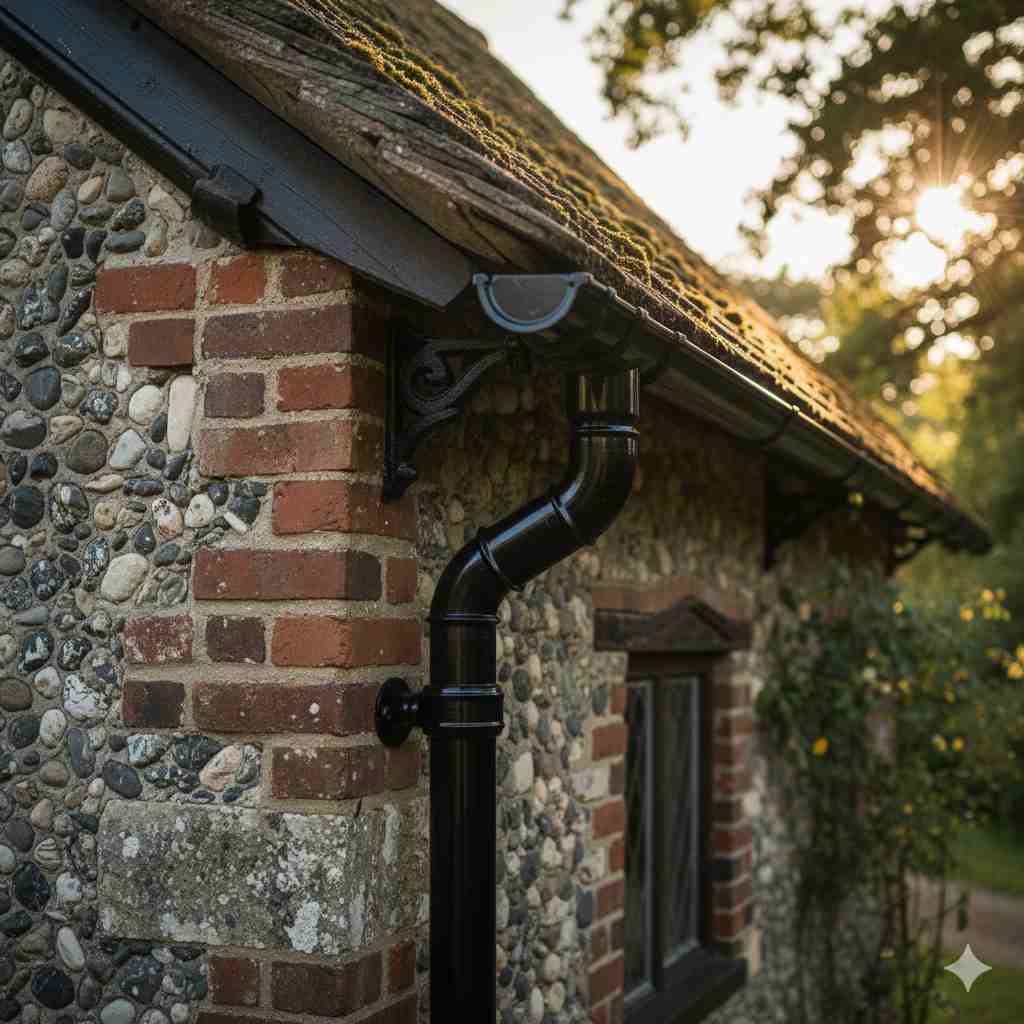
The beaded half-round adds a decorative rolled bead along the outer leading edge, providing additional rigidity and a regional character associated with traditional Scottish and Northern English architecture. Where a building retains its original beaded half-round system — or where survey evidence indicates that was the original specification — like-for-like replacement in beaded profile is the correct approach.
The deep half-round is a larger-capacity variant designed for buildings with steep roof pitches or extensive roof areas where a standard 112mm or 115mm gutter would be at risk of overflowing during heavy rainfall. It delivers meaningfully greater flow capacity than the standard profile while maintaining the same clean, understated aesthetic — an important consideration where the guttering should serve without drawing attention to itself.
The Ogee profile takes its name from the ogive — the double S-curve or cyma recta moulding found in classical stone cornices. Cast iron Ogee gutters were designed to echo those stone mouldings at the eaves, giving Victorian terraced housing a decorative transition between the brickwork and the roof that was simultaneously functional and architecturally expressive.
The Victorian Ogee is probably the most widely encountered cast iron gutter profile in the UK. It is the standard system found on millions of terraced houses built between roughly 1840 and 1914, and its elegant, shallow S-curve is instantly recognisable on the streetscapes of cities and towns across Britain. We offer this profile in three widths, and it remains one of our most frequently specified products for conservation and restoration projects.
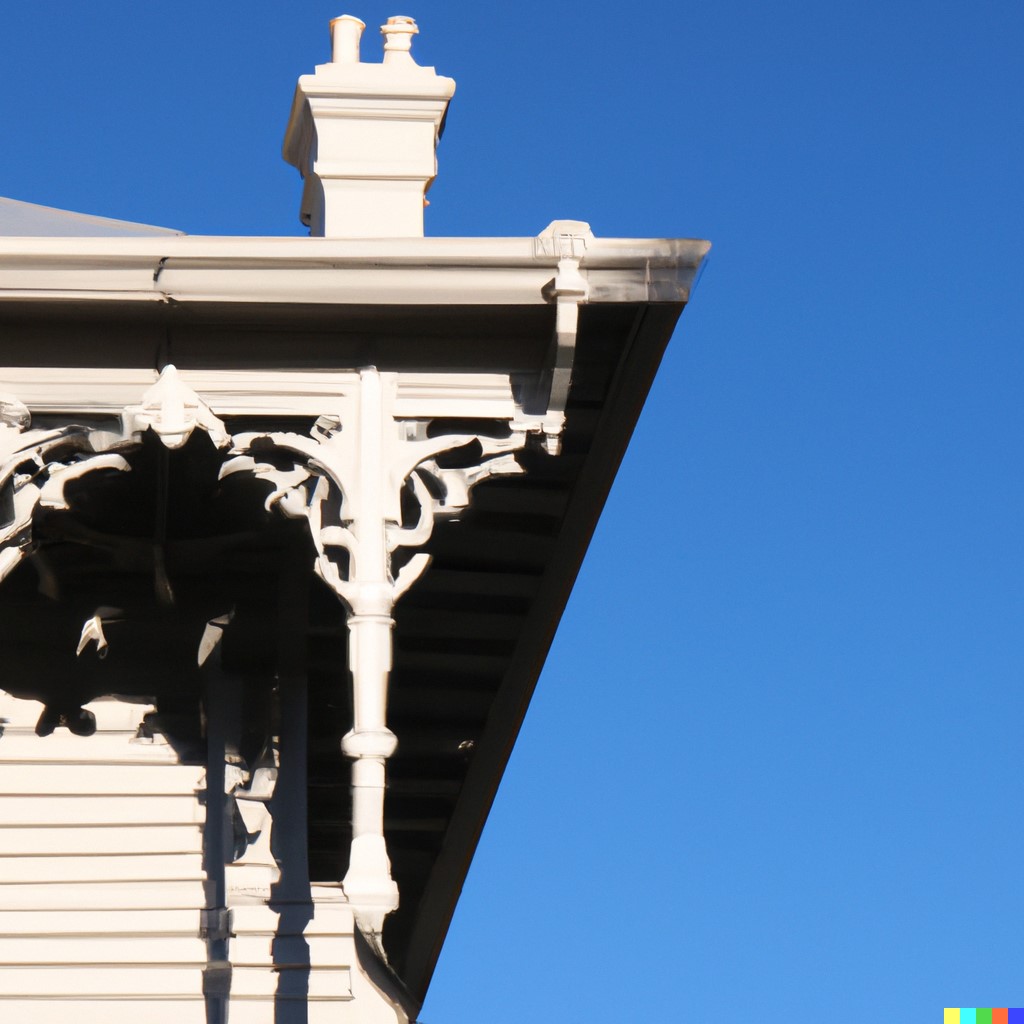
The Moulded G46, sometimes referred to as the railway pattern on account of its widespread use by the Great Western Railway and other Victorian industrial enterprises, is a deeper and more robust moulded profile. It offers higher hydraulic capacity than the Victorian Ogee and a greater visual presence, making it appropriate for substantial estate buildings, large Victorian villas, and industrial heritage structures where the gutter needs to make an architectural statement while managing considerable volumes of water.
The Notts Ogee is a distinctive regional variation produced historically by foundries in Nottinghamshire. Its profile differs subtly from the standard Victorian Ogee, and it is a reminder that the industrial geography of the nineteenth century directly influenced the specific gutter patterns found on regional streetscapes. Where this profile is present on an existing building in the East Midlands, its replacement should be in Notts Ogee to preserve that regional character.
Box gutters and large moulded profiles are the working gutters of grand civic buildings, industrial warehouses, churches, and country houses with extensive parapet drainage systems. Their flat-bottomed, high-capacity form is designed to handle water volumes that would overwhelm any half-round or Ogee profile.
The Regent No. 16 is the most impressively proportioned decorative cast-iron gutter in our standard range — an ornate, moulded profile used on grand Victorian villas and institutional buildings where architectural weight is as important as drainage performance. Its flow capacity exceeds 2.0 litres per second, placing it in a different performance category from any of the domestic profiles.
Our large sand-cast range extends to 26 profiles for industrial conservation projects, church restoration, and parks and estate work — including large half-round, moulded Ogee, and box gutter profiles in sizes not available from general builders’ merchants. For any major heritage structure, the correct gutter profile is rarely a catalogue standard item from a national supplier; it requires the judgement and manufacturing capability of a specialist foundry.
The table below provides a quick reference to all eight standard Tuscan cast-iron gutter profiles, their visual character, recommended applications, and approximate flow capacity.
| Profile | Visual Character | Period / Building Type | Flow Capacity (approx.) |
| Half Round | Semicircular, clean, minimal | Rural cottages, farmhouses, modest residential — all periods | 0.53–1.40 l/s |
| Beaded Half Round | Semicircular with decorative rolled bead at outer edge | Scottish & Northern English regional vernacular | 0.9–1.1 l/s |
| Deep Half Round | Larger semicircle — increased capacity, same plain aesthetic | Steep-pitched roofs, large catchment areas, estate buildings | Up to 2.0+ l/s |
| Victorian Ogee | Elegant shallow S-curve (cyma recta) | Victorian terraces, Georgian townhouses, period residential | 1.2–1.4 l/s |
| Moulded G46 | Deeper S-profile, more robust — railway pattern | Estate buildings, industrial heritage, high-status Victorian | 1.3–1.8 l/s |
| Notts Ogee | Regional Ogee variant — East Midlands foundry pattern | Traditional buildings in Nottinghamshire & surrounding counties | Similar to Ogee |
| Box Section | Rectangular, angular, flat-bottomed | Industrial buildings, parapet gutters, civic structures | ~1.2 l/s |
| Regent No. 16 | Large ornate moulded profile — grand architectural weight | Stately homes, Victorian civic buildings, grand estates | >2.0 l/s |
The correct gutter profile for any historic building is determined by three factors: the building’s architectural period and style; the elevation’s status and character; and the hydraulic requirements of the roof catchment area. These factors will, in most cases, point clearly towards a single appropriate profile.
Georgian and Regency buildings called for profiles that echoed classical stone cornices — Ogee gutters and square or rectangular downpipes on townhouses and grander rural buildings, and simple half-rounds on modest cottages. Victorian terraces almost universally carry Victorian Ogee; Victorian villas and estate buildings step up to Regent No. 16 or G46 moulded profiles, typically accompanied by decorative hopper heads. Edwardian buildings are similar in character but often larger in scale, with deeper-flow profiles to manage their wider roof areas. Arts and Crafts buildings were deliberately restrained — plain half-round gutters and round downpipes finished in muted heritage colours were the architects’ preferred specification, who valued material honesty over Victorian decorative excess.
Where original rainwater goods survive on a building, they provide the most reliable evidence of the correct specification. A site survey will establish profiles, dimensions, jointing methods, and fixings — information that is essential for accurate like-for-like procurement. Where original goods have been lost, our copy-casting service can replicate profiles from a surviving fragment or from the architect’s drawings.
| Building Type | Period | Recommended Profile |
| Rural cottage / farmhouse | All periods | Plain Half Round |
| Georgian townhouse | Georgian / Regency | Victorian Ogee or Box |
| Urban terrace | Victorian | Victorian Ogee |
| High-status Victorian villa | Late Victorian | Moulded Regent No. 16 or G46 |
| Agricultural estate range | Victorian / Edwardian | Moulded G46 or Deep Half Round |
| Arts & Crafts villa | Edwardian | Plain Half Round |
| Civic / institutional building | Victorian / Edwardian | Regent No. 16 or Box Section |
| Traditional Scottish tenement | Victorian | Beaded Half Round |
All our cast iron gutters and pipes are manufactured in accordance with BS 460, the British Standard that governs materials, dimensions, and coatings for cast iron rainwater goods. Our products are primed with a grey metal primer containing rust inhibitors as standard. Pre-painted stock carries a factory-applied two-pack polyurethane finish with a life expectancy of at least ten years, subject to annual inspection.
The green sand casting process used to produce our gutters is largely unchanged from the method used by Victorian foundries. This process is what gives genuine cast iron as a building material its characteristic surface texture and wall thickness, distinguishing it from modern polymer imitations. Our bespoke and copy-cast service uses the same method to replicate profiles that are no longer commercially available, or to create entirely new patterns from site surveys or client drawings.
For ongoing maintenance and decoration, we recommend linseed oil-based topcoats for heritage conservation work, as these penetrate the iron surface rather than forming a brittle film that can trap moisture. For coastal installations or those within five kilometres of salt water, please contact our team to discuss the appropriate specification.
At Tuscan Foundry, we have been manufacturing cast iron rainwater goods since 1893. Our standard range of eight gutter profiles, supported by twenty-six large sand-cast profiles and twenty-eight special patterns, means that almost any historic profile can be matched from stock or produced to order through our copy-casting service. Whether your project calls for a Victorian Ogee on a terrace of listed cottages, a Regent No. 16 on a civic hall, or a deep half round on an agricultural estate range, we can supply to BS 460 standards with the technical knowledge to support your specification from initial survey through to installation. Call our specialist team on 0333 987 4452 or visit tuscanfoundry.com to discuss your project.