
Established 1893 | BS 460:2002 Certified | UK & International Supply | Expert Technical Support | 0333 987 4452
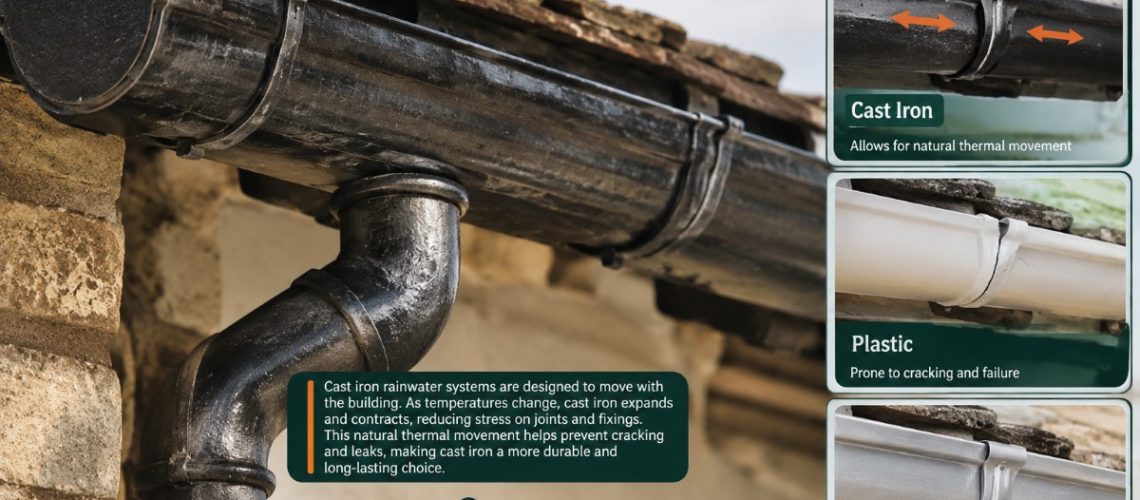
Why cast iron’s low coefficient of thermal expansion protects joints, fixings and historic fabric, while lightweight aluminium, zinc and copper systems move, creak and fail. A technical comparison for architects, surveyors and heritage professionals specifying rainwater goods for listed and traditional buildings.
Cast iron’s coefficient of linear thermal expansion is approximately 10.0 to 10.8 x10⁻⁶ per °C — less than half that of extruded or cast aluminium (23.0 x10⁻⁶/°C) and titanium zinc (22.0 to 23.0 x10⁻⁶/°C), and around 40 to 45 per cent lower than architectural copper (16.0 to 18.0 x10⁻⁶/°C). Over a 10-metre gutter run under a 60°C temperature differential, cast iron moves only 6.0 to 6.5mm, against up to 13.8mm in aluminium and titanium zinc. Combined with substantial wall thickness and high flexural rigidity, this low movement rate all but eliminates joint shearing, sealant fatigue, oil-canning and fastener loosening — the principal causes of premature failure in lightweight metal rainwater systems on historic buildings.
Why do some rainwater systems fail at the joints within a decade, while cast iron gutters installed a century ago remain watertight? The answer lies principally in thermal movement: cast iron expands and contracts at roughly half the rate of aluminium or zinc, and around 40 per cent less than copper, under identical temperature swings, which keeps joints, seals and fixings under far lower cyclical stress across the life of the building. For architects, conservation officers and surveyors specifying replacement cast iron rainwater systems on listed and period buildings, thermal movement is not a marginal consideration. It determines whether a system stays watertight for a decade or a century, and whether the rainwater goods behave sympathetically with the masonry, brick and timber around them.
This article sets out the physics of thermal movement in metal rainwater systems, compares the thermal expansion characteristics of cast iron against aluminium, steel, copper and zinc, and explains the structural consequences that follow when a material moves too much. It is written for professionals specifying or approving rainwater systems on historic and listed buildings, where the wrong material choice can introduce recurring leaks, differential movement against masonry, and maintenance costs that a correctly specified system would never generate.
Thermal movement is the dimensional change a material undergoes as its temperature rises and falls, and it is a primary cause of joint leakage, structural distortion and premature failure in metal rainwater goods. The amount of movement is governed by three factors: the material’s coefficient of linear thermal expansion, the length of the run, and the temperature differential it experiences, expressed by the standard formula ΔL = α × L × ΔT.
In UK and Northern European climate conditions, the temperature differential experienced by rainwater goods is significantly greater than ambient air temperature alone would suggest. Shadow air temperatures typically range from around freezing in winter to the low twenties Celsius in summer, but direct solar radiation on dark or factory-painted metal surfaces can elevate the metal’s own surface temperature to 60°C or higher. Rainwater systems must therefore be engineered for an operational temperature differential of up to 50 to 70°C — not the narrower range that ambient weather data implies. This is the differential that governs joint design, sealant selection and fixing spacing, and it is why coefficient of thermal expansion matters so much more on a south or west-facing elevation than the forecast temperature suggests.
Cast iron has one of the lowest coefficients of thermal expansion of any metal used in rainwater goods — roughly half that of aluminium and titanium zinc, and substantially below architectural copper. The table below sets out the coefficient of thermal expansion, resulting movement over a 10-metre run under a 60°C differential, and typical service life for the principal rainwater metals.
| Material | CTE (×10⁻⁶/°C) | Movement per 10m run (ΔT 60°C, mm) | Typical service life (years) | Movement vs cast iron |
|---|---|---|---|---|
| Cast Iron | 10.0 – 10.8 | 6.0 – 6.5 | 60 – 100+ | 1.0x (baseline) |
| Carbon / Mild Steel | 10.0 – 12.0 | 6.0 – 7.2 | 15 – 25 | 1.0x – 1.1x |
| Stainless Steel (304) | 16.0 – 17.3 | 9.6 – 10.4 | 50+ | 1.5x – 1.6x |
| Architectural Copper | 16.0 – 18.0 | 9.6 – 10.8 | 50 – 100+ | 1.6x – 1.7x |
| Titanium Zinc | 22.0 – 23.0 | 13.2 – 13.8 | 50 – 100 | 2.1x – 2.2x |
| Aluminium (Extruded/Cast) | 23.0 | 13.8 | 30 – 50+ | 2.2x |
Two figures here are worth pausing on. First, cast iron’s coefficient of expansion sits close to that of brick, stone and concrete — the structural materials that form the fabric of the historic buildings our rainwater systems are fitted to. This is one of the principal reasons cast iron has remained the standard specification for period and listed buildings for two centuries. Second, carbon and mild steel share a similarly low coefficient of expansion to cast iron, yet modern steel gutters are manufactured from thin pre-painted or galvanised sheet rather than a thick cast section, so despite moving by a similar amount, the material lacks the section modulus to resist the resulting stress without buckling. Coefficient of expansion alone does not determine performance; wall thickness and stiffness determine whether that movement translates into distortion.
When a metal rainwater system undergoes repeated cycles of expansion and contraction, mechanical stress develops across joints, fixings and structural supports, compounding over thousands of diurnal heating and cooling cycles rather than appearing after a single hot summer. Four failure modes account for the great majority of problems on lightweight metal systems.
In a continuous gutter run, thermal expansion forces individual sections to lengthen towards union joints or outlets. High-expansion metals push past flexible seals during expansion and pull away during cooling, and over thousands of cycles the seals undergo compression set and adhesion loss until they crack and leak. Cast iron’s low displacement rate keeps joint movement minimal, so traditional low-modulus sealants or luted joints remain under low shear strain and maintain long-term watertightness without wide expansion-gap allowances.
Where expansion movement is restricted by fixed brackets or overtightened fixings, thermal strain converts into compressive force. In thin-gauge sheet metals, this exceeds the flexural buckling threshold, producing ripples, twisting or bowing along the run — altering the fall gradient and creating low spots where water ponds and freezes in winter. Cast iron’s thick profile walls and high elastic modulus prevent this kind of buckling even under extreme solar heating.
Gutter brackets fixed to timber fascias act as anchor points, and when a lightweight metal gutter expands rapidly against a fixed bracket, cyclic lateral forces shear bracket screws or enlarge the screw holes. Over time, brackets loosen, fascia timber rots from localised water ingress, and the run begins to sag. Cast iron’s low expansion rate generates far lower lateral cyclic forces on fixing brackets, preserving fascia and rafter integrity across a multi-decade service life.
High-expansion lightweight gutters expand dynamically across bracket contact pads during ambient temperature shifts, and stick-slip friction between metal and dry bracket surfaces produces audible clicking or creaking that can transmit into rooms below. Cast iron’s mass, damping capacity and low expansion rate eliminate this stick-slip movement, keeping the system silent through ambient temperature change.
Extruded and cast aluminium systems are widely specified for their light weight, but aluminium’s coefficient of expansion is 2.2 times greater than cast iron’s. Over a 12-metre run under a 60°C differential, cast iron moves around 7.5mm while aluminium moves closer to 16.5mm — more than double. To accommodate this, aluminium gutters require specialised union connectors with wide internal expansion gaps. If installers push aluminium lengths tight against fitting stops during a summer installation, winter contraction can pull the gutter clear of its internal seals, causing an immediate leak. Aluminium’s thinner profile is also more readily distorted by snow slides, heavy ice accumulation or ladder contact — problems heavy-section cast iron gutters simply do not experience.
Galvanised and mild steel share a broadly similar coefficient of thermal expansion to cast iron, but modern steel systems are manufactured from thin pre-painted or zinc-coated sheet rather than a thick cast section, so oil-canning along unreinforced edges remains common. Stainless steel grades such as 304 and 316 exhibit a notably higher coefficient of expansion than cast iron, and unaccommodated movement in stainless box gutters can cause structural distortion and seam splitting. Our article on cast iron vs steel guttering sets out this comparison in more technical detail.
Architectural copper absorbs solar radiation rapidly, producing elevated peak surface temperatures that place significant thermal stress on soldered flat-lock seams, a recognised cause of fatigue cracking along long runs. Titanium zinc expands at more than double the rate of cast iron and becomes brittle in cold conditions, so freeze-thaw contraction cycling is a known cause of micro-fracturing at soldered joints. Both materials have a legitimate place in architectural metalwork, but neither offers the dimensional stability that heavy-section cast iron provides for continuous rainwater runs on historic building envelopes.
A rainwater system does not perform in isolation from the building it is fixed to, and thermal compatibility with the surrounding fabric matters as much as the performance of the gutter itself. Historic buildings are assemblies of materials — brick, stone, lime render, timber and, in many cases, cast iron — that were designed and have weathered together for a century or more. When a replacement rainwater system moves at two or three times the rate of the masonry and timber it is fixed to, the mismatch introduces a low-level but continuous source of differential movement stress at every fixing point, precisely where conservation practice asks us to minimise intervention and disturbance to original fabric.
Cast iron’s coefficient of expansion sits close to that of brick and stone, so the rainwater goods and the building envelope expand and contract in sympathy rather than working against one another. Fixings into historic masonry or timber fascias should not be repeatedly stressed by a rainwater system moving independently of the wall behind it, and a fixing that loosens through thermal cycling can, over decades, damage the very fabric a conservation specification is meant to protect. This is consistent with long-established conservation guidance on using materials and methods sympathetic to a building’s original construction and rate of movement — thermal compatibility between rainwater goods and masonry is a direct, measurable expression of that approach.
Correct specification protects the thermal performance advantage cast iron already provides. For jointing, low-modulus neutral cure silicone sealants or traditional luting compounds are appropriate for cast iron rainwater systems, because the low displacement rate at the joint means the sealant is never asked to accommodate the wide movement tolerances aluminium or zinc systems require. Fixings should be stainless steel wherever practicable, chosen to outlast the fascia and building fabric behind it.
Surface finish also plays a role, since dark, heat-absorbing coatings raise the peak surface temperature a system experiences and therefore increase the operational temperature differential, even where the substrate has a low coefficient of expansion. We recommend traditional linseed oil paint systems for cast iron rainwater goods on listed and period buildings, both as the historically correct, breathable finish for cast iron and as part of a considered, sustainable specification. Linseed oil paint allows the ironwork to be maintained and refreshed over decades rather than stripped and recoated with modern synthetic systems, consistent with the whole-life, low-intervention approach that thermal stability is intended to support.
A number of recurring errors undermine thermal performance even where the correct material has been chosen. Fixing aluminium or zinc sections tight to their stops during summer installation, without allowing for the specified expansion gap, is one of the most common causes of first-winter leaks. Overtightening brackets converts free thermal movement into restrained compressive stress — precisely the mechanism behind oil-canning. Specifying standard sealants on high-movement joints, rather than systems designed for the anticipated cyclic strain, shortens joint life considerably. And treating coefficient of thermal expansion as the only relevant figure, without considering wall thickness and section modulus, can lead to thin-gauge systems being specified on “low expansion” figures alone, when it is the combination of low movement and structural rigidity that gives cast iron its long-term stability.
We work with architects, conservation officers and surveyors from the earliest stages of a specification, and on projects involving long, exposed, or south and west-facing gutter runs — where thermal movement is at its greatest — we recommend an on-site survey before final specification is confirmed, so jointing and bracket spacing can be set correctly for the full seasonal temperature range the installation will experience. Site surveys and site visits are a chargeable service, but on complex bespoke work or sites with genuine access or exposure challenges, the cost is modest against the risk of a specification that fails at its joints within the first few winters.
Where an existing cast iron system has been damaged or partially replaced with an incompatible material, we also undertake copy casting from photographs, drawings or physical samples, allowing a historically accurate, thermally compatible profile to be reinstated. Standard cast iron downpipes and gutter profiles are available for prompt dispatch, while bespoke and copy-cast components typically carry an eight-to-ten-week lead time, which we always confirm clearly at enquiry stage.
The following examples are illustrative and drawn from typical heritage rainwater scenarios, representative of the kind of thermal movement problems and solutions we advise on.
Cotswold Wool Church, Gloucestershire
A Grade I listed wool church in the Cotswolds retained its original cast iron box gutters and downpipes along a long, south-facing nave elevation for over a century. When a partial repair scheme in the 1990s introduced aluminium sections at one end of the run, those sections developed recurring joint leaks within fifteen years, while the adjoining original cast iron remained sound. The parochial church council subsequently specified matching cast iron replacement sections, restoring uniform thermal behaviour along the full run.
Georgian Terrace, Bath
A Grade II* listed Georgian terrace in Bath, within a conservation area governed by strict material controls, required replacement rainwater goods after storm damage. The unified Bath stone terrace demanded a system whose movement would not visibly distort against the coursed ashlar façade. Cast iron half-round gutters and eared downpipes were specified, matching the coefficient of expansion of the stonework and avoiding the differential movement a lightweight alternative would have introduced at every fixing bracket.
Victorian Mill Conversion, West Yorkshire
A former worsted spinning mill in West Yorkshire, converted to residential use, retained long, continuous eaves runs exposed to full afternoon sun on its south elevation. Early estimates favoured aluminium for cost and weight, until the design team calculated the movement over a 20-metre run and identified an unacceptable risk of joint failure. Cast iron ogee gutters were specified instead, with stainless steel fixings and low-modulus sealant, avoiding the wide expansion unions the aluminium scheme would otherwise have required.
Baronial House, Perthshire
A Category B listed baronial house in Perthshire, with steeply pitched slate roofs and exposed, elevated gutter runs, experienced repeated bracket failure and fascia damage under a mid-century steel guttering scheme installed in the 1960s. Investigation identified cyclic thermal fatigue at the bracket fixings as the principal cause. Reinstatement in cast iron, finished in traditional linseed oil paint, addressed both the movement problem and the building’s original historic character.
Nonconformist Chapel, Ceredigion
A Grade II listed nonconformist chapel in Ceredigion, with an exposed, west-facing principal elevation, had its original cast iron rainwater goods replaced with zinc during a 1980s refurbishment. Within two decades, freeze-thaw cycling at the chapel’s exposed elevation had caused micro-fracturing at several soldered zinc joints. A subsequent restoration reinstated cast iron gutters and downpipes to the original profile, resolving the recurring leaks and restoring the chapel’s historic appearance.
Cast iron has a coefficient of linear thermal expansion of around 10.0 to 10.8 x10⁻⁶ per °C, roughly half that of aluminium and titanium zinc, both around 22 to 23 x10⁻⁶ per °C. Over the same temperature swing, an aluminium or zinc gutter run will lengthen and shorten by more than double the amount a cast iron run does, which is why those systems require wider expansion joints and are more prone to seal and bracket problems over time.
Cast iron’s low rate of thermal movement means it does not require the wide expansion-gap unions that aluminium and zinc systems rely on. Traditional luted or low-modulus sealant joints are generally sufficient, because the cyclic movement at each joint stays within the working tolerance of these traditional methods across the full seasonal temperature range.
While UK shadow air temperatures typically range from around freezing in winter to the low twenties Celsius in summer, direct solar radiation on dark metal surfaces can raise the metal’s own surface temperature to 60°C or higher. Rainwater goods should therefore be specified to accommodate an operational temperature differential of up to 50 to 70°C, not simply the ambient air temperature range.
Yes. Long, south or west-facing runs experience the greatest solar heat gain and therefore the greatest thermal movement, which is exactly where cast iron’s low expansion rate offers the clearest advantage over lightweight alternatives. For particularly long or exposed runs, we recommend a site survey to confirm bracket spacing and jointing before specification is finalised.
Low-modulus neutral cure silicone sealants or traditional luting compounds are appropriate for cast iron joints, paired with stainless steel fixings selected to outlast the fascia and building fabric. Because cast iron’s joint movement is minimal, these traditional methods remain under low shear strain across the system’s service life.
A rainwater system that expands and contracts significantly more than the surrounding masonry or timber places repeated stress on fixing points, which over time can loosen brackets, enlarge fixing holes and contribute to fascia and masonry damage. Cast iron’s coefficient of expansion sits close to that of brick, stone and concrete, so it moves in sympathy with historic fabric rather than working against it.
Correctly specified and maintained cast iron rainwater systems regularly achieve a service life of 60 to 100 years or more, compared with a typical 30 to 50 years for aluminium and 15 to 25 years for thin-gauge galvanised steel. The lower maintenance and joint-replacement burden over that period is a significant factor in cast iron’s whole-life cost advantage.
Thermal movement is one of the most consistent, measurable reasons rainwater systems fail, and it is entirely predictable at the specification stage. Cast iron’s low coefficient of thermal expansion, combined with substantial wall thickness and high flexural rigidity, keeps joints, fixings and fascia timber under far lower cyclical stress than aluminium, zinc, copper or thin-gauge steel across the full range of UK seasonal and solar temperature variation. For historic and listed buildings in particular, this thermal compatibility with brick, stone and timber is not a secondary benefit; it is a direct expression of the conservation principle that a building’s fabric performs best when its materials move together rather than against one another.
At Tuscan Foundry Products, we have supplied cast iron gutters, downpipes and hopper heads for period and listed buildings since 1893, and we work with architects, conservation officers and surveyors from the earliest stages of specification through to on-site survey, copy casting and finishing in traditional linseed oil paint. Where a project involves long or exposed runs, damaged historic profiles, or a rainwater system that has never performed as it should, we are always glad to advise, and to survey the building in person before a single component is specified. You can view our full cast iron rainwater product range or contact us to discuss a project.