
Damp in Historic Buildings: Diagnosis Before Treatment
A conservation guide to identifying the real cause of damp — and to recognising the treatments that are routinely sold and rarely needed.
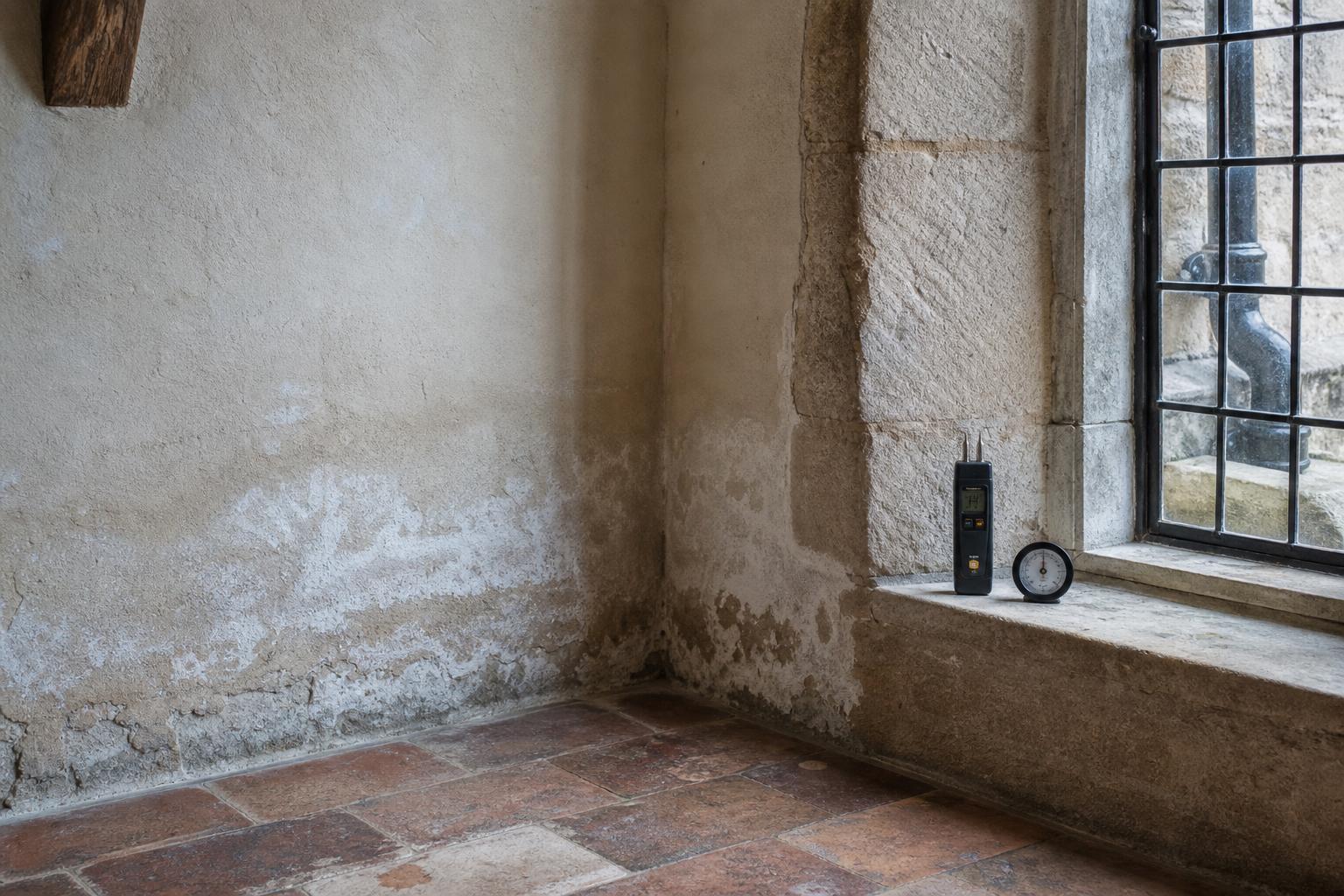
In summary
Damp in a historic building almost always has an identifiable physical cause, and in the great majority of cases that cause is a defect that can be fixed: failed rainwater goods, raised external ground levels, cement render or pointing, blocked sub-floor ventilation, or condensation. Genuine rising damp is far less common than the volume of treatment sold for it would suggest, and chemical injection combined with impermeable render is frequently applied to buildings where the moisture was arriving from somewhere else entirely. That combination causes lasting harm: it removes historic plaster, traps moisture in the wall, and pushes damp upwards and sideways to appear above the treated zone. The correct sequence is always diagnosis first, remediation of the cause second, drying third, and redecoration last.
On this page
- Why damp diagnosis goes wrong
- How a solid wall handles moisture
- The five causes, in order of likelihood
- Penetrating damp
- Condensation
- Ground-related damp and the rising damp question
- Plumbing and services
- Salts and hygroscopic moisture
- How to diagnose properly
- Measurement: what meters actually tell you
- Remediation, in the right order
- Treatments to be sceptical about
- Timber decay
- Beetle
- Drying and reinstatement
- Consent position
- Commissioning a damp survey
- Common mistakes
- Find a specialist
- Frequently asked questions
Why damp diagnosis goes wrong
Damp is the area of historic building work where owners are most often sold treatment they do not need, and the reasons are structural rather than dishonest.
The most readily available “damp survey” is frequently free, carried out by a company that sells damp-proofing, and conducted by someone using an electrical resistance meter to identify a condition — rising damp — that the same company treats. The survey and the sale are the same visit.
Meanwhile the actual cause is often outside the room being surveyed: a gutter overflowing on the elevation above, a path laid over the plinth, cement render applied thirty years ago. None of these will be found by a meter held against internal plaster.
A diagnosis that does not identify a physical source of water is not a diagnosis. Water arrives from somewhere. Finding where is the entire task.
How a solid wall handles moisture
A solid masonry wall — brick, stone, cob — is permeable by design. It absorbs moisture during wet weather and releases it by evaporation afterwards. It is a buffering system, not a barrier.
Three things allow it to work:
- Permeable mortar and plaster, letting moisture move to the surface and evaporate
- Free evaporation surfaces, internally and externally
- A rate of drying that matches the rate of wetting
Damp becomes a problem when that balance is disturbed — either because more water is arriving, or because evaporation has been prevented.
This is why so many “damp” problems are caused by previous remedial work. Cement render, cement pointing, impermeable masonry paint, gypsum plaster, vinyl wallpaper, tanking and impermeable floor finishes all reduce evaporation. The wall gets wetter, and the damp appears somewhere the treatment does not cover.
The five causes, in order of likelihood
- Penetrating damp from a building defect — rainwater goods, roof, flashings, pointing, render, cills, copings. By some distance the most common.
- Condensation — very common, frequently misdiagnosed as ingress, and increasingly so as buildings are made more airtight.
- Ground-related moisture, bridged or trapped — raised external levels, blocked sub-floor ventilation, impermeable floor finishes, cement render below ground level.
- Plumbing and services leaks — including underground drainage, which is frequently overlooked.
- Genuine capillary rise in the absence of any of the above — real, but considerably less common than the treatment market implies.
Work down this list in order. Most cases resolve at item one or two.
Penetrating damp
Water arriving through the fabric from outside. The pattern usually gives it away: damp that worsens during and after rain, that is concentrated rather than general, and that corresponds to something on the elevation outside.
Common sources:
- Overflowing or leaking gutters, which is the single commonest cause of damp in historic buildings
- Split, blocked or disconnected downpipes, particularly at the rear where nobody looks
- Blocked gullies, causing discharge to pond against the wall
- Failed flashings, cement fillets and abutments
- Defective cills, copings and string courses without adequate throating or weathering
- Open or eroded pointing on exposed elevations
- Cracked or debonded render, particularly cement render, which admits water through cracks and then prevents it drying
- Exposed elevations in severe driving rain, which may be a matter of exposure rather than defect
The diagnostic discipline is to go outside. Nearly every case of penetrating damp is solved by looking at the elevation above and around the affected area, during or immediately after rain.
Condensation
Condensation is extremely common and is regularly misdiagnosed as penetrating or rising damp. It occurs where moist air meets a surface below its dew point.
Signs that suggest condensation:
- Damp appears in cold weather rather than in wet weather
- Mould growth, particularly black spot mould, in corners, behind furniture, on cold external walls and around window reveals
- Damp on cold bridges — lintels, reveals, floor and ceiling junctions
- Worse in bedrooms, bathrooms and kitchens
- Improves with ventilation and heating
Causes:
- High internal moisture production — drying laundry, unvented cooking and bathing, unflued heaters
- Reduced ventilation — blocked chimneys, sealed windows, draughtproofing without compensating ventilation, removed air bricks
- Cold surfaces — uninsulated walls, cold bridges, and rooms that are heated intermittently
- Retrofit that increased airtightness without addressing ventilation
Interstitial condensation — occurring within the fabric rather than on its surface — is the more damaging form, and is a real risk where insulation has been added to a solid wall or at rafter level. It shows as decay in embedded timbers rather than as visible surface damp, and it is often not discovered until it is serious.
Note the interaction with damp treatment. Making a wall’s surface impermeable does not stop condensation; it commonly moves mould growth elsewhere.
Ground-related damp and the rising damp question
Moisture can rise through porous masonry by capillary action. That is physics and it is not in dispute. The practical questions are how often it is the actual cause of a given damp problem, and what should be done about it.
Before concluding rising damp, eliminate the bridges. Almost all damp at low level in historic buildings has one of these explanations:
- Raised external ground levels. Paths, patios, drives and flower beds built up against the wall, bridging the plinth or any damp-proof course. This is extraordinarily common and is usually straightforward to remedy.
- Cement render or pointing carried down below ground level, trapping moisture and preventing the wall from drying.
- Blocked or missing sub-floor ventilation. Air bricks blocked by soil, paving, insulation or render. Suspended timber floors depend entirely on this ventilation.
- Impermeable floor finishes — concrete slabs, damp-proof membranes, vinyl — which push moisture that previously evaporated through the floor out to the wall edges instead.
- Impermeable internal finishes — gypsum plaster, tanking, vinyl paper — preventing evaporation.
- External hard landscaping directing surface water towards the building.
- Leaking drains below ground, which is a genuinely common and frequently missed cause.
Where all of these are eliminated and moisture is still rising, the appropriate response for a historic building is generally environmental rather than chemical: lower the ground, improve ventilation, remove impermeable finishes, replaster in lime, and allow the wall to evaporate. Many buildings have functioned satisfactorily in this state for centuries.
Chemical injection into a rubble-filled, variable, wide historic wall is unlikely to produce a continuous barrier, and the accompanying works — stripping historic plaster and applying dense cement-based render — do the greater part of the damage. The render prevents evaporation, so moisture travels higher and appears above the treated zone, which is then frequently treated again.
Plumbing and services
Frequently overlooked, and worth a specific check:
- Leaking supply pipes, particularly in walls and under floors
- Leaking waste pipes and soil stacks
- Below-ground drainage, which is a common cause of persistent unexplained damp and which can be tested inexpensively
- Overflow discharges
- Boiler and heating system leaks
- Condensate discharges from modern appliances
Where damp has no apparent external cause and does not fit a condensation pattern, test the drains before doing anything else.
Salts and hygroscopic moisture
Where water has been moving through masonry over long periods, it carries dissolved salts — chlorides and nitrates, often from historic uses of the building, from soil, or from de-icing salt. These accumulate in the plaster and at the wall face.
Salts are hygroscopic: they absorb moisture from the air. A salt-contaminated wall will read as damp on a meter, and will feel damp, even after the original moisture source has been eliminated. Damp patches that vary with the weather but never fully dry are characteristic.
This matters because it is frequently interpreted as proof that the damp problem persists, and it leads to repeated treatment.
The response is:
- Eliminate the moisture source first
- Allow drying
- Remove salt-contaminated plaster where necessary
- Poultice the masonry where contamination is heavy
- Replaster in lime, allowing salts to migrate into the sacrificial plaster rather than being sealed in
How to diagnose properly
Start outside, in the rain.
- Inspect the exterior during or immediately after heavy rain. Watch the rainwater goods running. This one step identifies a large share of cases.
- Check ground levels all round, relative to internal floor level and to any plinth or damp-proof course.
- Check sub-floor ventilation — locate air bricks, confirm they are clear and that the void is ventilated through.
- Look at previous treatments — cement render, cement pointing, masonry paint, tanking, injected DPC evidence.
- Inspect the roof, valleys, flashings and chimney junctions.
- Test the drains.
- Map the damp internally — extent, height, sharpness of the tide line, variation between elevations.
- Correlate the internal pattern with external features. Damp corresponding to a downpipe, a valley, an abutment or a raised path is diagnosed.
- Consider the occupancy pattern — heating, ventilation, moisture production.
- Monitor over time and weather. A single visit in dry weather is not a diagnosis.
Take advice from someone with nothing to sell. An independent surveyor with historic building experience, who does not carry out remedial treatment, is worth considerably more than a free survey.
Measurement: what meters actually tell you
Electrical resistance meters — the common “damp meters” — measure electrical conductivity, not moisture content. In masonry and plaster, conductivity is strongly affected by salts, by metal, and by the material itself. A high reading on a salt-contaminated wall does not indicate free water.
These meters are calibrated for timber, where they are reasonably reliable. On masonry and plaster they are indicative at best.
More reliable methods:
- Gravimetric analysis — drilled samples taken at depth and weighed before and after oven drying. This gives actual moisture content, and can distinguish moisture at the surface from moisture within the wall.
- Hygroscopic salt analysis alongside gravimetric testing, distinguishing free water from salt-held moisture.
- Data logging of temperature and humidity, which is how condensation is confirmed or excluded.
- Thermal imaging, useful for locating cold bridges and evaporative cooling, though it images temperature, not moisture, and needs interpretation.
- Drain testing.
A report based only on resistance meter readings, concluding rising damp and recommending injection, should be treated with real scepticism — particularly if the same organisation would carry out the work.
Remediation, in the right order
- Fix the water. Gutters, downpipes, gullies, roof, flashings, pointing, render, plumbing, drains.
- Lower ground levels where they bridge the plinth, and form a drained margin where appropriate.
- Restore ventilation — clear air bricks, unblock and ventilate flues, address sub-floor ventilation.
- Remove impermeable finishes — cement render, masonry paint, tanking, vinyl — so the wall can dry.
- Allow drying. This takes months, not weeks. A thick solid wall may take a year or more.
- Address salts where they remain a problem.
- Replaster in lime, permeable and sacrificial.
- Decorate with permeable finishes — limewash, distemper, or a breathable paint.
- Address heating and ventilation where condensation was a factor.
The commonest failure is skipping step five. Redecorating a wall that has not dried guarantees the decoration will fail and the owner will conclude the problem was never fixed.
Treatments to be sceptical about
Chemical injected damp-proof courses. Unlikely to form a continuous barrier in a wide, rubble-filled or variable historic wall. The accompanying render is generally what does the harm. Frequently applied where the cause was elsewhere.
Dense cement-based “tanking” render internally. Prevents evaporation, moves moisture higher and laterally, and destroys historic plaster. On a listed building this normally requires consent and is frequently refused.
Impermeable masonry paint externally. Traps moisture and causes spalling.
Cavity drain membranes on solid walls. Appropriate in some basement contexts, but they conceal rather than resolve, and they leave the masonry permanently wet.
Chemical timber treatment applied blanket-fashion. Rarely necessary. Drying the timber is what stops decay.
Electro-osmotic systems. Evidence of efficacy is weak.
Any recommendation made without an identified source of water.
None of these is invariably wrong in every context. But on a solid-walled historic building, each carries real risk, and each is routinely applied where the actual cause was a gutter.
Timber decay
Timber decays where it is persistently wet. Dry, ventilated timber does not decay, however old.
Wet rot — the common form. Confined to the wet area, and it stops when the timber dries. Found at joist ends built into damp walls, at skirtings behind impermeable finishes, at wall plates below failed gutters, at window and door cills.
Dry rot — more serious because it can spread through masonry to reach timber elsewhere, and because it can continue in timber that is only moderately damp. Still requires a moisture source to establish.
Contemporary conservation practice for dry rot favours environmental control:
- Locate and eliminate the moisture source
- Improve ventilation and promote drying
- Remove clearly decayed timber, retaining sound material
- Isolate timber from damp masonry
- Monitor
rather than the older approach of extensive timber removal, masonry irrigation and wholesale chemical treatment, which is destructive of historic fabric and frequently unnecessary.
Assess residual capacity before condemning timber. Large historic sections frequently retain ample structural capacity despite significant surface loss. Repair by splicing in new timber to sound material is standard practice.
Beetle
Flight holes indicate that beetle have emerged. They do not indicate current activity, and the emergence may have been decades ago.
Active infestation shows:
- Fresh, clean, sharp-edged holes
- Frass — fine bore dust — that is fresh and continues to appear
- Adult beetles in season
Common furniture beetle requires elevated moisture content. Dry timber is unattractive to it, and drying is the primary control.
Death watch beetle attacks hardwood already affected by fungal decay, and is associated with damp embedded timbers, particularly in churches and large-section oak.
Blanket chemical treatment for historic flight holes is unnecessary, and is sold routinely. Where treatment is genuinely justified, it should be targeted and should sit alongside moisture control, not replace it.
Drying and reinstatement
- Drying is slow. A solid wall may take many months to a year or more after the source is fixed. Thickness, exposure, ventilation and temperature all affect it.
- Do not force it. Excessive heat causes salt movement to the surface and can damage adjacent fabric.
- Ventilate. Air movement matters more than heat.
- Monitor rather than guess. Gravimetric testing over time confirms progress.
- Do not replaster or decorate until dry, or the work will fail and the diagnosis will be blamed.
- Reinstate in permeable materials — lime plaster, permeable decoration.
- Keep the ventilation and heating regime that prevented condensation, if that was a factor.
Consent position
On a listed building, removing historic plaster, installing injected damp-proofing, tanking, and applying render or masonry paint all normally require Listed Building Consent.
Points that recur:
- Removing historic plaster for damp treatment is a common application and a commonly refused one, particularly where diagnosis is weak
- Many conservation officers will want evidence that the cause was investigated before consenting to remedial treatment
- Removing cement render and replacing with lime is normally supported
- Lowering external ground levels is usually straightforward but may affect archaeology on some sites
- Internal tanking and cavity membranes are generally resisted
The broader framework is covered in Listed Building Consent: What Needs It, What Does Not.
Commissioning a damp survey
Ask for:
- Independence. A surveyor who does not sell or carry out remedial treatment.
- Historic building experience, specifically with solid wall construction.
- External inspection, in wet conditions where possible.
- Measurement beyond a resistance meter — gravimetric and salt analysis where the diagnosis matters.
- An identified source of water. If the report does not say where the water is coming from, it is not a diagnosis.
- A remediation sequence, not a product recommendation.
- Drain testing where the cause is not otherwise apparent.
Expect to pay for it. A free survey from a company that sells damp-proofing is priced accordingly.
Common mistakes
| Mistake | Consequence |
|---|---|
| Diagnosing from inside only | The actual cause, usually external, is never found |
| Relying on resistance meter readings | Salt contamination read as free water; wrong diagnosis |
| Free survey from a treatment company | Diagnosis aligned with the product being sold |
| Injecting a DPC without eliminating bridges | Damp continues; historic plaster lost; money wasted |
| Cement tanking render internally | Evaporation prevented; damp appears higher up |
| Impermeable paint or render externally | Wall gets wetter; brick and stone spall |
| Blocking air bricks with insulation or paving | Sub-floor decay; damp at floor level |
| Redecorating before the wall has dried | Decoration fails; owner concludes nothing was fixed |
| Blanket chemical timber treatment | Cost and chemical load for no benefit |
| Treating old flight holes as active infestation | Unnecessary treatment |
| Extensive timber removal for dry rot | Historic fabric lost where environmental control would suffice |
| Draughtproofing without ventilation | Condensation increases |
Find a specialist
The Building Restoration Index lists vetted specialists in damp diagnosis and related trades:
- Damp and Timber Decay — independent diagnosis and remediation
- Surveyors — building surveyors with historic building experience
- Non-Destructive Investigations — moisture profiling and investigation
- Drainage — drain testing and below-ground repair
- Guttering and Pipework — rainwater goods, the commonest single cause
- Roofing Contractors and Leadwork — roof and flashing defects
- Mortars and Renders and Lime Mortars and Plaster — removal of cement, reinstatement in lime
- Plasterwork — lime replastering
- Structural Timber Testing — assessment of affected timber
- Timber Frame Builders — repair of decayed structural timber
- Insulation — where retrofit is a contributing factor
- Architects and Heritage Consultants — significance and consent
Related guides in the library: Rainwater disposal on historic buildings, Historic brickwork, Historic roofs. The full set is on the Technical Library page of the Building Restoration Index.
Frequently asked questions
Does rising damp exist?
Capillary rise is real physics. But it is far less often the actual cause of a given damp problem than the treatment market implies, and bridges should be eliminated first.
Do I need an injected damp-proof course?
Rarely, in a historic building. Injection is unlikely to form a continuous barrier in a wide variable wall, and the accompanying cement render usually does the harm.
Why does the damp come back after treatment?
Almost always because the actual source was never addressed, or because impermeable render moved the moisture higher rather than removing it.
How do I tell condensation from penetrating damp?
Condensation worsens in cold weather rather than wet, appears in corners and on cold bridges, is associated with mould, and improves with ventilation and heating.
Are damp meters reliable?
On masonry and plaster, no. They measure conductivity, which is strongly affected by salts. They are reasonably reliable on timber.
What is a better way to measure?
Gravimetric analysis of drilled samples, with hygroscopic salt analysis alongside, plus data logging for condensation.
Why is my wall still damp after the leak was fixed?
Drying is slow — many months, sometimes over a year for a thick wall — and salt contamination can hold moisture from the air indefinitely.
Should I remove cement render from my old house?
Usually yes on a solid wall, replacing with lime. Expect the wall to be wetter than anticipated and allow drying time.
My path is right up against the wall. Does that matter?
Very much. Raised external ground levels bridging the plinth are one of the commonest causes of damp at low level, and are usually straightforward to remedy.
Do I need to worry about blocked air bricks?
Yes. Suspended timber floors depend on sub-floor ventilation, and blocked air bricks lead directly to decay.
Is dry rot as serious as people say?
It is more serious than wet rot because it can spread through masonry, but it still requires a moisture source. Environmental control is now generally preferred to wholesale removal and chemical treatment.
I have woodworm holes. Do I need treatment?
Probably not. Old flight holes show emergence, often long ago. Active infestation shows fresh clean holes and fresh frass. Drying the timber is the primary control.
Can decayed joist ends be repaired?
Usually, by splicing in new timber and isolating the timber from damp masonry. Assess residual capacity before condemning.
Should I use a dehumidifier?
It can help with surface condensation, but it does not address a building defect. Ventilation and fixing the cause matter more.
What plaster should I use after remediation?
Lime — permeable and sacrificial, allowing salts to migrate into the plaster rather than being sealed into the wall.
Do I need consent for damp treatment?
On a listed building, removing historic plaster, tanking and injection normally require consent, and are frequently refused where diagnosis is weak.
Who should I get to look at it?
An independent surveyor with historic building experience who does not sell remedial treatment. Expect to pay for the survey.