Paint Systems for Exterior Historic Metalwork
A conservation guide to preparation, coating selection, colour and maintenance on historic ironwork, railings, rainwater goods, gates and architectural castings.
In summary
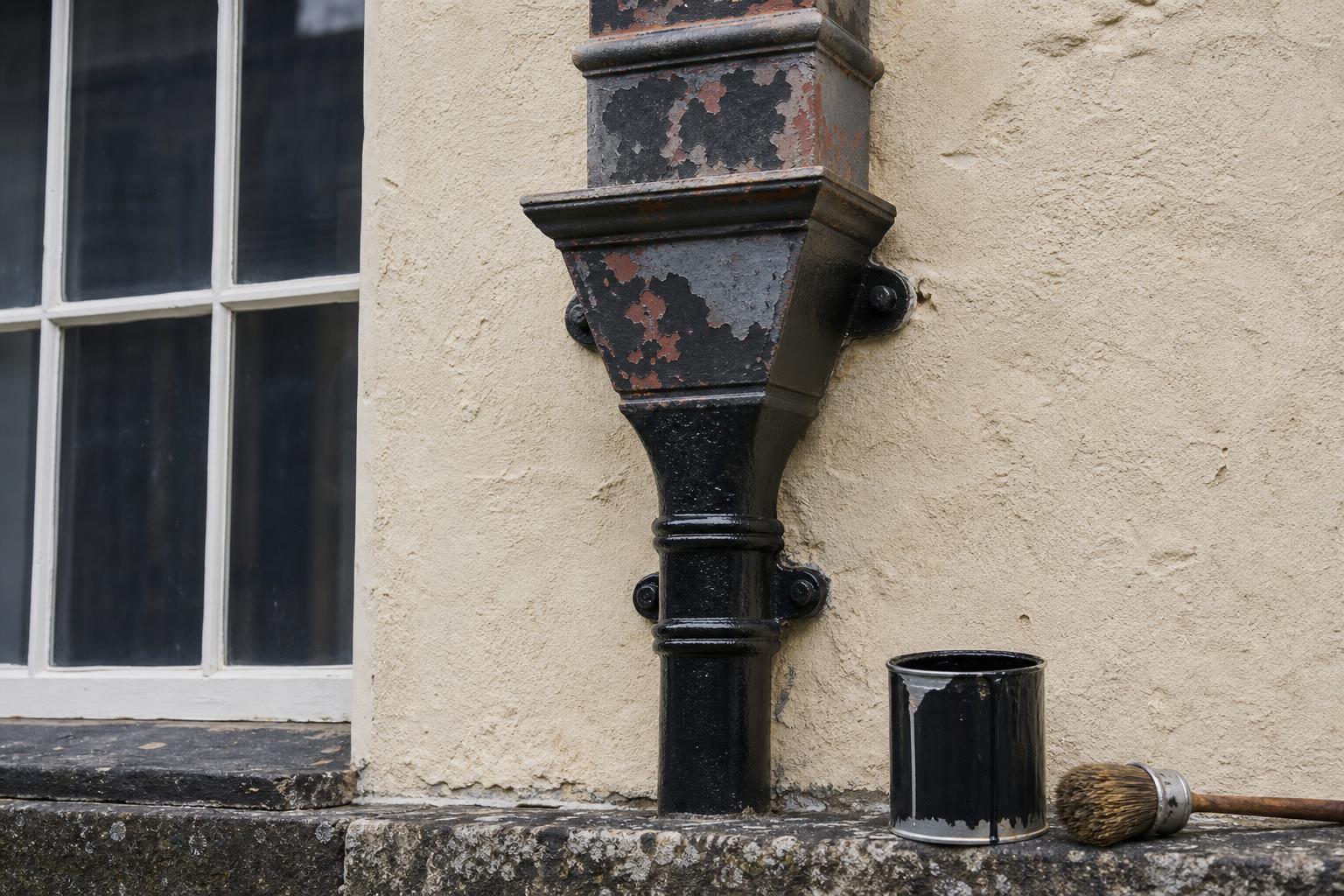
Coatings on historic metalwork fail predictably: at edges and arrises where film thickness is lowest, and on horizontal surfaces where water stands longest. Almost all premature failure is caused by inadequate surface preparation rather than by the paint itself. The objective is a system that excludes water, tolerates movement, and can be maintained by local repair and overcoating rather than by full stripping at every cycle. Preparation method must be matched to the substrate: aggressive dry abrasive blasting removes crisp cast detail permanently and is rarely appropriate on significant historic castings. Historic architectural metalwork was seldom black before the twentieth century, and the original scheme can usually be established by paint analysis before redecoration begins.
On this page
- Why coatings fail
- Know the substrate first
- Assessing the existing coating
- Paint analysis and the colour question
- Preparation methods
- Lead paint and site controls
- Priming and the critical first hours
- Coating systems compared
- Application in practice
- Specification
- Maintenance
- Common mistakes
- Find a specialist
- Frequently asked questions
Why coatings fail
Paint on exterior metalwork is a barrier. It fails when the barrier is breached and water reaches steel or iron beneath.
The breach almost always begins in one of four places:
Edges and arrises. Wet paint flows away from a sharp edge under surface tension, so film thickness at an arris can be a fraction of that on a flat face. Every railing spearhead, every moulding edge, every casting arris is a thin point.
Horizontal and upward-facing surfaces. Water sits, and the coating is under constant load. Gutter interiors, the tops of rails, the upper faces of decorative enrichment.
Joints, junctions and fixings. Where two components meet, water is drawn in by capillary action and cannot dry. Bolt heads, bracket junctions, sockets.
Undercutting from existing corrosion. Where preparation left corrosion products in place, rust continues beneath the new coating and lifts it from below. This is the reason a two-year-old paint job can look worse than the fifty-year-old one it replaced.
The fifth cause is not a breach at all: incompatibility. A hard, impermeable modern coating applied over a soft historic one, or over inadequately prepared substrate, will fail by delaminating in sheets rather than weathering back gradually. Sheet failure is the worse outcome, because it forces a full strip at every cycle.
Know the substrate first
Preparation and coating decisions follow from material identification, and the three metals commonly encountered behave differently.
Cast iron is brittle, dimensionally stable and carries crisp moulded detail that aggressive preparation will destroy. Its surface, where original, has a casting skin that is worth retaining. Cast iron rainwater goods, railing standards and decorative panels are the components most often damaged by over-aggressive stripping.
Wrought iron is fibrous and corrodes along its grain, delaminating into layers. Preparation must remove loose material without gouging the surface.
Mild steel corrodes faster and more generally than either once the coating fails, and demands a robust system with good film build.
Non-ferrous components — lead, copper, bronze — appear in the same assemblies and generally should not be painted at all. Check before specifying a blanket system across a whole run.
Where different metals meet, review the galvanic relationship. Coating is one of the mitigations, but the detail matters more than the paint.
The identification sequence is set out in the companion guide, Historic Ironwork: Railings, Gates and Architectural Castings.
Assessing the existing coating
Before deciding anything, establish:
- How many layers there are, and whether the build-up has obscured detail. Heavy accumulated paint on cast enrichment is itself a loss of significance.
- Whether the existing coating is sound and adherent. A well-adhered system with localised failure is a candidate for local repair and overcoating, not a full strip.
- Where failure is occurring, and whether it is at edges, at joints, or general. General failure across sound flat surfaces usually indicates incompatibility or a preparation failure at the last cycle.
- What is underneath. Deterioration concealed by thick paint is the commonest cause of cost overrun on metalwork projects. Open up a trial area before pricing, not after.
- Whether the paint has evidential value. See Part 4.
Do not default to full removal. Stripping to bare metal is a significant intervention: it removes evidence, exposes the substrate, and commits the owner to a full system build. It should be a considered decision supported by the condition assessment.
Paint analysis and the colour question
Architectural metalwork was not usually black before the twentieth century. Greens, blues, greys, stone colours, lead colours and red-browns were all common, frequently chosen to relate to the building’s joinery or masonry rather than to contrast with it. Default black is a modern convention applied retrospectively to buildings that never had it.
Where the original scheme matters — and on a listed building it generally does — it can be established rather than guessed.
Sampling. Take samples from sheltered locations that have escaped later stripping: the underside of a handrail, a rebate, the back of a bracket, the inside of a socket. Several samples from different components give a more reliable picture than one.
Cross-section analysis. A sample is set in resin, polished, and examined under magnification so the layer sequence is visible. This establishes the order of schemes and often the original.
Timing matters. Sample before stripping begins. Once preparation has started the evidence is gone, and the question becomes unanswerable.
This is inexpensive relative to the cost of redecoration, and it converts a decoration decision from a matter of taste into a matter of evidence — which is also what a conservation officer will want to see.
Preparation methods
Preparation determines coating life far more than paint selection does, and the method should be specified rather than left to the contractor’s discretion.
Hand preparation
Scrapers, wire brushes, and needle guns for localised work. Slow, controlled, and appropriate for delicate detail and for localised repair. Cannot achieve the cleanliness standard that a full system build ideally wants, but is frequently the right compromise on significant historic castings.
Low-pressure abrasive methods
Controlled abrasive at reduced pressure, sometimes with a wet or damp medium to suppress dust. Effective and much safer for historic detail than conventional dry blasting — but “low pressure” is meaningless as a specification unless the pressure, nozzle, standoff and abrasive medium are all stated.
Always require an agreed trial area before general work begins. It sets the standard, gives everyone a reference point, and is the single most useful clause in a metalwork specification.
Conventional dry abrasive blasting
Fast and thorough, and appropriate for structural steel and non-significant fabricated work. It is rarely appropriate for historic cast iron, because it softens arrises, erodes moulded detail, removes the casting skin, and can damage thin sections irrecoverably. Where a client or contractor proposes blasting a historic casting, that is the point to stop and reassess.
Chemical stripping
Appropriate for delicate cast detail and for heavy paint build-up on ornament. Must be fully neutralised and the surface fully dried before priming, or the residue will attack the new coating from beneath. Consider run-off and containment, particularly where lead paint is present.
Controlled heat
Effective on heavy build-up, but requires fire precautions, careful control on thin sections, and awareness that heating lead-based paint generates fume. Not appropriate close to combustible fabric.
Standards
Where a defined cleanliness standard is required for a coating system’s warranty, it should be stated explicitly in the specification along with the permitted method of achieving it. A standard specified without a permitted method invites the contractor to reach for the fastest option.
Lead paint and site controls
Assume paint on historic metalwork contains lead until testing shows otherwise. Architectural metalwork was routinely finished in lead-based systems well into the twentieth century.
The practical implications:
- Test before disturbance; simple test kits give an indication, laboratory analysis gives certainty
- Dry sanding, dry blasting and heat above the relevant threshold all generate hazardous dust or fume
- Containment, sheeting and controlled disposal of waste and residues are required
- Operatives need appropriate protection and welfare provision
- Neighbouring occupants, gardens and watercourses need protecting from run-off and fallout, particularly on boundary railings in residential streets
This is a duty on the specifier as much as the contractor. A specification that is silent on lead is an incomplete specification.
Priming and the critical first hours
Bare ferrous metal begins to oxidise immediately, and flash rust under a primer will destroy the system from beneath.
The rules are simple and frequently broken:
- Prime the same day as preparation, and preferably within hours. Bare metal left overnight in damp conditions is compromised.
- Do not prepare more area than can be primed the same day. Sequencing the work in manageable bays is more important than site efficiency.
- Do not apply over damp or contaminated surfaces. Check moisture, check for chemical residue, check for salts on components that have been in the ground.
- Work within the temperature and humidity limits of the system in use. Cold and damp conditions extend cure times unpredictably and can prevent proper film formation altogether.
- Build film thickness at edges and arrises by striping them in with an additional brush-applied coat before the general coat. This single practice addresses the commonest failure point.
Where components are removed to a workshop, priming can be controlled properly and the result is usually better. Where work is in situ, the weather window is part of the programme and should be acknowledged in it.
Coating systems compared
There is no universally correct system. The choice depends on significance, exposure, the condition of the substrate, whether full removal is being undertaken, and how the building will be maintained.
Linseed oil paint
A traditional system, widely used on historic exterior metalwork and appropriate where breathability, reversibility and heritage character matter.
Characteristics: penetrates rather than sitting as a discrete film; low sheen; slight brush texture, which is a property of the material and not a defect; weathers back gradually rather than failing in sheets; can be maintained by cleaning and overcoating without full removal.
Trade-offs: longer drying and cure times, particularly in cold or damp conditions; requires hand application and a competent decorator; initial protection builds more slowly than a modern system.
It is generally the most appropriate system where a building is on a maintenance regime, because progressive weathering and easy overcoating suit periodic inspection much better than a system that either looks perfect or has failed.
Modern protective systems
Multi-coat systems, typically primer and finish coats formulated as a package, with specified film thickness and preparation standard.
Characteristics: rapid protection; predictable performance where preparation matches the specified standard; wide colour range; suited to exposed and marine environments.
Trade-offs: performance is contingent on achieving the preparation standard, which on historic castings may require methods that are themselves damaging; failure mode is more often sheet delamination than progressive weathering; local repair and overcoating can be more difficult; heavy film build can obscure fine cast detail over successive cycles.
Traditional oil-based systems
Conventional oil paint systems occupy the middle ground, and are appropriate on much historic work where a full traditional linseed system is not being used.
Choosing
Ask four questions:
- Is the substrate being taken back to bare metal, or overcoated? Overcoating restricts you to systems compatible with what is already there.
- What is the exposure? Marine, industrial and highly exposed situations justify a more robust system.
- How will the building be maintained? If there is a real inspection regime, a system that weathers progressively is preferable. If maintenance will be sporadic, initial robustness matters more.
- What does significance require? On highly significant historic castings, the preparation the system demands may itself be the deciding factor.
Do not mix systems without checking compatibility. Applying a modern coating over a traditional oil or linseed system, or the reverse, is a common cause of early failure.
Application in practice
- Stripe in edges, arrises and fixings first, then apply the general coat.
- Do not skip coats to save a site visit. Film build is what carries the system.
- Allow proper overcoating intervals. Recoating too early traps solvent and moisture; too late, and adhesion between coats suffers.
- Paint the backs and hidden faces. The rear of a gutter, the back of a bracket and the underside of a rail are where failure starts, and they are what gets missed on in-situ work.
- Do not paint over debris, moss or bird fouling. Obvious, and routinely done.
- Protect adjoining fabric. Paint run-off stains masonry, and coating removal residues damage planting.
- Record what was applied. Product, colour reference, number of coats, dates. This is what makes the next maintenance cycle straightforward rather than speculative.
Specification
State:
- Substrate material, component by component
- Existing coating condition and whether full removal or overcoating is intended
- Lead testing requirement, and controls where lead is present
- Preparation method, with pressure, medium and standoff where abrasive methods are used
- Trial area requirement, with an approval process before general work
- Cleanliness standard to be achieved, and the permitted means of achieving it
- Maximum interval between preparation and priming
- Coating system by product, number of coats and dry film thickness
- Colour, with the basis on which it was determined
- Environmental limits for application
- Areas to be left unpainted — non-ferrous components, moving parts, bearing surfaces
- Containment, waste and protection requirements
- Record requirements — photographs and a written schedule of what was applied where
- A contingency for concealed deterioration, stated openly so tenders are comparable
Maintenance
The single greatest determinant of coating life is whether anyone looks at it between redecorations.
- Inspect annually, concentrating on edges, arrises, horizontal surfaces, joints and fixings.
- Wash down to remove salts, pollutants and organic growth. On coastal and roadside sites this alone extends coating life materially.
- Repair breaches locally and immediately. A touched-in chip costs nothing; the same chip left for three years means corrosion undercutting the surrounding coating.
- Overcoat on a planned cycle rather than waiting for visible failure. The correct interval depends on system and exposure and should be stated at handover.
- Keep vegetation off the metalwork and keep water away from fixings.
- Keep the record. Knowing what was applied, when, and in what colour turns the next cycle into maintenance rather than investigation.
Common mistakes
| Mistake | Consequence |
|---|---|
| Dry abrasive blasting historic cast iron | Permanent loss of crisp detail and casting skin |
| Specifying a cleanliness standard without a permitted method | Contractor reaches for the most aggressive option |
| Preparing more area than can be primed the same day | Flash rust beneath the primer; system fails early |
| Painting over residual corrosion | Undercutting; coating lifts from beneath within a year or two |
| No trial area | No agreed standard; disputes on site |
| Stripping before paint sampling | Historic colour evidence destroyed |
| Defaulting to black | Loss of the building’s historic colour relationship |
| Mixing incompatible systems | Sheet delamination |
| Not striping edges and arrises | Failure begins exactly where it always begins |
| Ignoring lead content | Health, environmental and legal exposure |
| Painting non-ferrous components | Unnecessary, and difficult to reverse |
| No maintenance regime after completion | Full strip required at every cycle instead of overcoating |
Find a specialist
The Building Restoration Index lists vetted specialists for coating work on historic metalwork:
- Paints and Finishes — traditional and conservation coating systems
- Paint Removal — specialist stripping and surface preparation
- Paint Research — paint sampling and cross-section analysis
- Metalwork — conservation blacksmiths and ironwork specialists
- Guttering and Pipework — cast iron rainwater systems
- Painters and Decorators — decorators experienced in historic buildings
- Materials Analysts — laboratory analysis including lead testing
- Architects and Heritage Consultants — for significance and consent
Related guides in the library: Historic ironwork, Rainwater disposal on historic buildings, Historic windows and doors. The full set is on the Technical Library page of the Building Restoration Index.
Frequently asked questions
Why does new paint on my railings fail so quickly?
Almost always preparation. Corrosion left in place undercuts the new coating, or bare metal was left too long before priming.
Should I strip back to bare metal?
Not automatically. Sound, well-adhered coating with localised failure is better repaired and overcoated. Full stripping is a significant intervention.
Can I sandblast cast iron?
Conventional dry blasting is rarely appropriate on historic castings — it erodes moulded detail and removes the casting skin. Use gentler controlled methods with an agreed trial area.
Does old paint on ironwork contain lead?
Assume so until tested. Architectural metalwork was routinely finished in lead-based paint well into the twentieth century.
Were railings originally black?
Usually not. Greens, blues, greys, stone colours and red-browns were common before the twentieth century.
Can the original colour be found out?
Yes. Cross-section analysis of samples taken from sheltered locations establishes the layer sequence. Sample before stripping.
Is linseed oil paint suitable for exterior metalwork?
Yes, and it is widely used on historic work. It weathers back progressively, can be overcoated without full removal, and its low sheen suits historic buildings.
Are brush marks in linseed paint a defect?
No. Slight brush texture and low sheen are characteristics of the material.
How long does linseed oil paint take to dry?
Longer than modern systems, and considerably longer in cold or damp conditions. Programme accordingly.
Can I put modern paint over linseed oil paint?
Not without checking compatibility. Mixing systems is a common cause of early sheet failure.
How soon must I prime after preparation?
The same day, and preferably within hours. Bare ferrous metal left overnight in damp conditions is compromised.
Why does paint always fail at the edges first?
Wet paint flows away from sharp edges, so film thickness is lowest there. Stripe edges in with an extra brush coat before the general coat.
Should I paint the back of the gutter?
Yes. Hidden and upward-facing surfaces are where failure starts, and they are what gets missed.
How often should metalwork be redecorated?
It depends on system and exposure, but inspect annually, wash down, and repair breaches immediately. Planned overcoating beats waiting for visible failure.
Do I need consent to repaint ironwork on a listed building?
Repainting in a similar finish is often maintenance, but a change of colour or system may require consent, particularly on principal elevations. Confirm with your local planning authority.
Should non-ferrous components be painted?
Generally not. Lead, copper and bronze within the same assembly should normally be left unpainted.