
Historic Ironwork: Railings, Gates and Architectural Castings
A conservation guide to identifying, assessing, repairing and replicating historic ironwork — and to commissioning the work without losing the original.
In summary
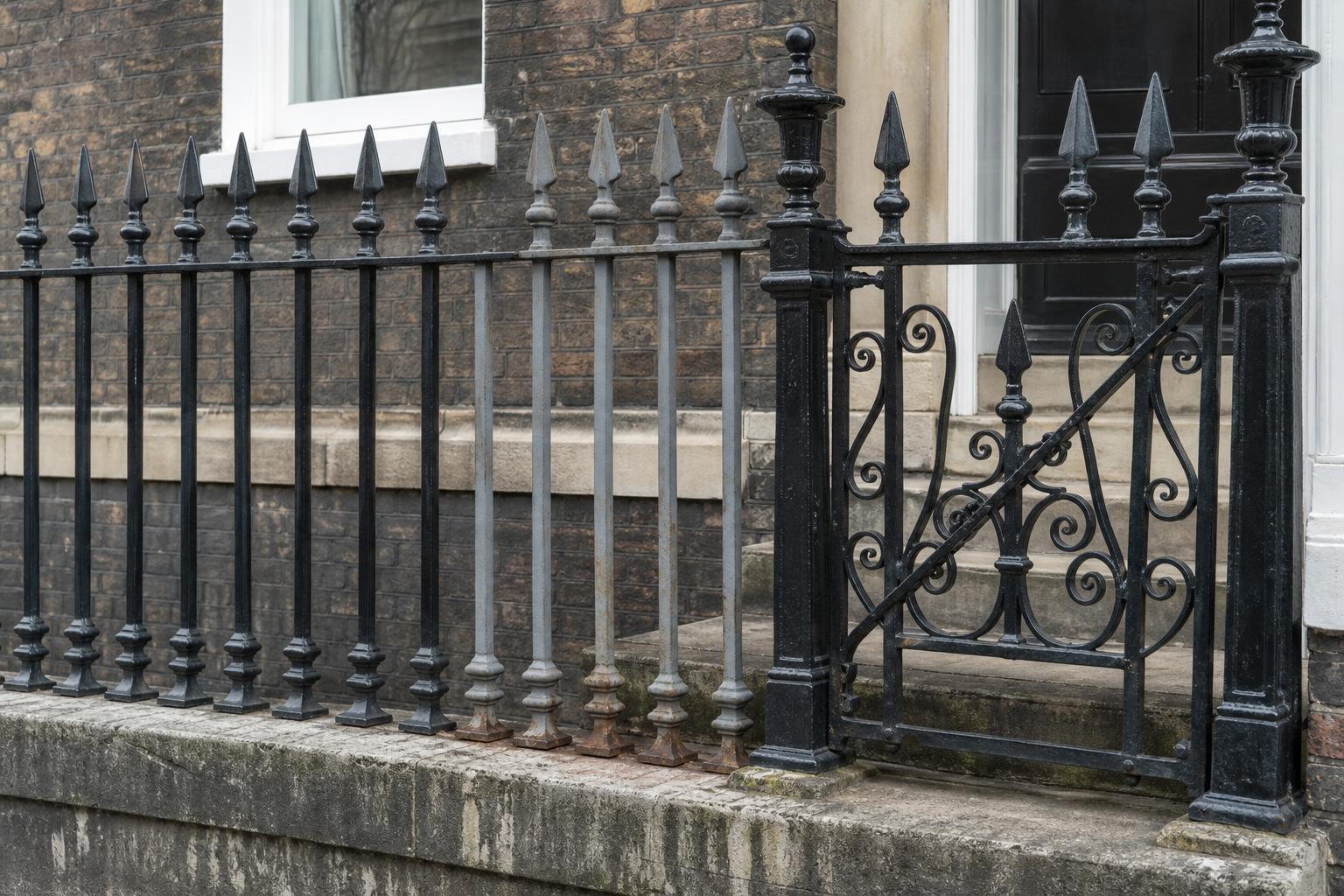
Historic ironwork should be repaired in situ wherever material survives, and replicated only where loss has compromised structure or legibility. The single most important step is correct identification: wrought iron, cast iron and mild steel look similar under paint but behave differently, corrode differently and demand entirely different repair techniques. Most avoidable damage on historic railings and gates comes from three sources — rust jacking splitting adjacent masonry, aggressive paint removal, and welded repairs applied to metal that cannot be welded. Listed Building Consent is normally required for alteration or replacement, and frequently for repair where the method changes the appearance.
On this page
- Why ironwork is misdiagnosed
- Identifying what you have
- How historic ironwork fails
- Assessment before any decision
- Repair, and where the line to replication sits
- Paint: removal, systems, and the colour question
- Consent and statutory position
- What a competent specification contains
- Choosing and briefing a contractor
- Common mistakes
- Find a specialist
- Frequently asked questions
Why ironwork is misdiagnosed
Ironwork is the element most often lost through well-intentioned work. It is small, it is usually peripheral to the main fabric, and it rarely attracts the scrutiny that windows or roofs receive. A set of railings can be stripped, welded, primed and repainted by a competent general contractor over a fortnight, and the historic material can be entirely gone by the end of it — replaced by fabricated mild steel that looks broadly similar from ten metres away.
The problem is not usually carelessness. It is that the decisions which matter are made early, by people who have not been asked to consider them. By the time a conservation officer sees the work, the original sections are in a skip.
This guide is written for owners, architects, surveyors and contractors who are about to make those early decisions.
Identifying what you have
Correct material identification comes before every other decision, because wrought iron, cast iron and mild steel cannot be repaired by the same methods. Under a century of paint, all three read as “old metal.” They are not interchangeable.
Wrought iron
Made by hand until the late nineteenth century, wrought iron is fibrous. It was worked hot at the forge and shows it: slight irregularity along a bar, hammer marks at junctions, tapers that are not quite symmetrical. Components are joined by forge welding, collaring, riveting and tenoning — never by electric arc welding, which did not exist.
Wrought iron is tough and ductile. It bends before it breaks. It corrodes slowly and along its grain, delaminating into layers rather than pitting through.
Typical use: gates, scrollwork, balustrades, brackets, and most decorative smithing before around 1850.
Cast iron
Poured into a mould, so every unit in a run is identical. Look for the parting line where the two halves of the mould met, slight draft on vertical faces, and repeated ornament that is exactly repeated — not merely similar.
Cast iron is hard, dimensionally stable and excellent in compression. It is also brittle. It has very little tolerance of impact or uneven loading, and it cannot be forged, bent or conventionally welded. A vehicle reversing into a cast iron standard does not dent it; it breaks it.
Typical use: railing standards and panels, balusters, gate posts, ornamental panels, and architectural components including rainwater goods, from the late eighteenth century onwards.
Mild steel
Available from the 1850s and dominant from the 1880s. Uniform, clean-surfaced, weldable, and considerably more prone to rapid general corrosion than wrought iron once its protective coating fails. Much “historic” ironwork on Victorian and Edwardian buildings is in fact mild steel, and much twentieth-century repair to genuinely historic ironwork was carried out in it.
Practical test sequence
- Look at the joints. Rivets, collars and forge welds indicate wrought. Bolted or slotted assembly with repeated identical parts indicates cast.
- Look for a mould parting line and draft angles. Present means cast.
- Look at corrosion behaviour. Laminating along a grain suggests wrought; sharp pitting and shell-like flaking suggests cast; even general rusting suggests mild steel.
- Sound it. Cast iron rings dully and briefly; wrought and steel ring on.
- Where the decision carries cost, commission analysis. Metallographic examination of a small sample is inexpensive relative to getting it wrong.
Assume mixed construction. Most surviving assemblies of any age contain more than one material, often with cast standards, wrought decorative work and steel repairs in the same run.
How historic ironwork fails
Ironwork fails for a small number of predictable reasons, and almost all of them begin with water reaching bare metal.
Rust jacking
The dominant failure mode, and the one that damages more than the ironwork itself. Iron oxide occupies substantially greater volume than the metal it forms from — in the order of seven times. Where iron is set into stone, brick or a masonry plinth, corrosion at the joint generates expansion forces that split the surrounding masonry apart.
The visible symptom is a cracked or delaminating plinth, coping or step, often with rust staining running down from the fixing. The damage to the stone is frequently more expensive to remedy than the ironwork.
Historic fixings were commonly run in molten lead, which is soft, slightly tolerant and reversible. Later repairs frequently used cement mortar, which traps water at the joint and accelerates the problem considerably.
Impact and overload on cast components
Cast iron does not deform under load; it fractures. Common causes are vehicle contact, ground movement, ivy and tree growth, and adjacent scaffolding. Fractures often run through the thinnest section — a scroll termination, the neck of a finial, or the junction of a panel to its standard.
Coating failure
Paint on exterior metalwork fails at edges, arrises and horizontal surfaces first, because film thickness is lowest where the surface curves away and water sits longest where it is flat. Once the film is breached, corrosion runs beneath it and lifts adjacent sound paint.
Loss of small components
Finials, scroll terminations, dog bars, spearheads and cast enrichment are lost progressively over decades, usually to impact or theft. Because they are small, they are frequently not recorded before they go — which makes later replication speculative rather than evidenced.
Vegetation and ground movement
Roots move plinths and lift fixings; climbing plants hold water against the metal and force apart assemblies as stems thicken. Both are slow, both are cumulative, and both are cheap to prevent and expensive to remedy.
Assessment before any decision
No specification should be written for historic ironwork before a condition survey has established what the material is, what survives, and what has already been lost. Writing a schedule of works from a site walk-round is how original fabric is lost.
A proportionate assessment covers:
Record as found. Photograph everything before disturbance, including details that appear insignificant. Photograph both faces. Record dimensions of repeating components. If anything is loose, label and store it before the work starts — detached pieces are lost on site constantly, and a surviving fragment is the difference between evidenced replication and invention.
Establish significance. Not all ironwork on a historic building is historic. Twentieth-century replacement gates on an eighteenth-century wall may have no significance at all, while an apparently plain run of railings may be a rare survival of a local foundry’s pattern. The distinction determines how much intervention is acceptable.
Identify materials, section by section, using the sequence in Part 2.
Establish the extent of loss. How many components are missing? Is there surviving evidence for their form — a single example, a photograph, a mortice where something once sat, a matching run elsewhere on the site?
Examine the fixings and the substrate. Assess the masonry at every fixing point. Determine what the joints were originally run with.
Note the paint. Old paint layers carry evidence of the original scheme, and are worth sampling before removal. See Part 6.
Record where paint obscures condition. Deterioration under thick coatings is often not apparent until stripping begins. This is the single most common source of cost overrun on ironwork projects, and the reason a contingency sum should be carried and stated at tender.
Repair, and where the line to replication sits
The conservation default is repair: retain the maximum original material, make interventions reversible where possible, and replicate only where loss is such that repair is not achievable. In practice, most projects are a mixture of both.
Repair techniques by material
Wrought iron can be repaired by traditional forge techniques — forge welding, collaring, riveting, and splicing in new wrought sections. A competent conservation blacksmith working in wrought iron is repairing like with like. Sourcing genuine wrought iron for repair is possible, generally from reclaimed stock, and should be specified where the significance justifies it.
Cast iron cannot be forged or conventionally welded. Repair options are:
- Mechanical repair — pinning, strapping, bolting and bushing a fracture. Fully reversible, visible on close inspection, and the conservation-preferred approach for structurally significant breaks.
- Cold metal stitching — a specialist mechanical technique using interlocking keys set across the fracture. Effective, reversible in principle, and appropriate where a repair must carry load without heat.
- Bronze welding or brazing — joins at lower temperature than fusion welding. Sometimes appropriate; requires skill and careful assessment.
- Fusion welding of cast iron — possible with correct pre-heat, filler and slow controlled cooling, but risks cracking the parent metal and is generally not the first choice on significant historic castings.
Mild steel is conventionally weldable and the least constrained to repair.
When replication is the right answer
Replication is justified where a component is missing entirely, or so badly corroded that insufficient sound material remains for repair. For cast components this means taking a pattern.
Where a matching original survives anywhere on the site, it can be used to produce a pattern, from which replacements are cast. The pattern is the principal cost, and it is a one-off: once made, further castings from the same pattern are substantially cheaper. That economic shape matters when planning phased works. If twenty standards will eventually need replacing, casting them from one pattern in two phases is far better value than making two patterns.
Where nothing survives, evidence must come from elsewhere — historic photographs, measured drawings, the mortice or seating left behind, a matching run on a neighbouring property, or a foundry catalogue. Where no evidence exists, the honest options are a deliberately simplified replacement that does not claim to be a reconstruction, or leaving the gap. Inventing detail is not conservation.
Bespoke and copy casting typically takes eight to ten weeks from pattern approval. Programme it accordingly; this is regularly the item that delays completion because it was treated as a late-stage decision.
Paint: removal, systems, and the colour question
Removal
Paint removal is where historic surface detail is most often destroyed, and the method should be specified rather than left to the contractor. Aggressive dry abrasive blasting removes crisp arrises, softens cast detail and can damage thin sections irrecoverably.
Appropriate options, matched to the substrate and to significance:
- Hand preparation — scrapers, wire brushes, needle guns for localised work
- Low-pressure abrasive methods with a controlled medium, with pressure and abrasive specified and a trial area agreed in writing before general work
- Chemical strippers, applied and neutralised properly, for delicate cast detail
- Controlled heat, used with care and appropriate fire precautions
Whatever is used, an agreed trial area is essential. It sets the standard, and it gives everyone a reference point if the work drifts.
Note also that old paint on architectural metalwork may contain lead. Assume it does until tested, and manage it accordingly.
Coating systems
The objective is a system that excludes water, tolerates movement, and can be maintained without stripping back to bare metal every cycle.
Practical principles:
- Prepare to a defined standard and prime the same day. Bare iron left overnight in damp conditions will flash rust beneath the primer.
- Build film thickness at edges, arrises and fixings, where coatings are thinnest and fail first.
- Prefer systems that can be locally repaired and overcoated. A coating that fails by lifting in sheets is worse than one that weathers back gradually, because it forces a full strip at every maintenance cycle.
- Linseed oil paint systems are widely used on historic exterior metalwork. They are breathable, they weather back progressively rather than failing catastrophically, they are readily maintained by overcoating without full removal, and their low sheen and slight brush texture are appropriate to historic work. Brush marks in a linseed finish are a characteristic of the material, not a defect.
- Whatever system is chosen, specify a maintenance interval and tell the owner what it is. Most ironwork failure is deferred maintenance, not coating failure.
Were railings always black?
No. Black became the default only in the twentieth century. Before that, architectural ironwork was commonly finished in greens, blues, greys, stone colours and red-browns, often selected to relate to the building’s joinery or stonework rather than to contrast with it.
Where the original scheme matters, it can be investigated. Paint sampling and cross-section analysis of layers from a sheltered location — the underside of a handrail, a rebate, a junction that has escaped later stripping — can establish the sequence of historic schemes. This is inexpensive relative to the cost of redecoration, and it converts a decoration decision from taste into evidence. It is worth doing before stripping begins, not after.
Consent and statutory position
Where ironwork forms part of a listed building or is within its curtilage, Listed Building Consent is normally required for alteration, replacement or removal — and may be required for repair where the proposed method would change appearance. Railings, gates, gate piers and boundary ironwork are frequently curtilage structures in their own right.
The practical position:
- Like-for-like repair, using matching materials and traditional methods, is often accepted as maintenance and may not require consent. Confirm this with the local planning authority rather than assuming it.
- Replacement of historic ironwork with new fabricated work almost always requires consent, and is frequently refused where repair was achievable.
- Changing the material — replacing cast with fabricated steel, for example — is a material alteration, not maintenance.
- In conservation areas, the demolition or removal of boundary railings and gates may require consent even where the building is not listed.
- Ironwork is also commonly protected under Article 4 directions where permitted development rights have been withdrawn.
- Requirements differ across the UK. Determinations rest with the local planning authority, advised where relevant by Historic England, Cadw, Historic Environment Scotland or the Historic Environment Division in Northern Ireland.
Most authorities offer a pre-application service. For ironwork it is generally worth using, because the questions at issue — is this repair or alteration, is the existing significant — are exactly the questions a conservation officer can answer quickly and an applicant can spend months guessing at.
What a competent specification contains
Without a proper specification, tenders are not comparable. Contractors will each assume a different scope and a different standard, and the lowest price will usually be the one that assumed least. This is the most common cause of dispute on ironwork projects.
A specification should state:
- Schedule of works, component by component, identifying what is retained, repaired, replicated and renewed
- Material identification for each element, with repair methods appropriate to each
- Named repair techniques, not “repair as necessary”
- Paint removal method, with the trial area requirement and approval process
- Coating system, by product and film thickness, with the number of coats and the preparation standard
- Fixing details, including what joints are to be run with and how existing fixings are to be treated
- Colour, with the basis on which it was determined
- Recording requirements — photographic record before, during and after
- Handling and storage of removed components, with a requirement that nothing is disposed of without written instruction
- A contingency sum for concealed deterioration, stated openly, so tenderers price the same risk
- Programme, allowing for pattern-making and casting lead times where replication is involved
Specify levels of intervention as options where budget is uncertain. It is far better to price three defined scopes than to receive three prices for three different unstated assumptions.
Choosing and briefing a contractor
Ironwork conservation is a specialism. General metal fabrication skill is not the same thing, and the difference does not show until the work is complete.
Ask to see:
- Previous conservation work on comparable material, with references
- Evidence of traditional technique — forge welding, collaring, riveting, tenoning for wrought work; pattern-making and casting capability for cast work
- Understanding of conservation principles, expressed in their own terms rather than repeated back from the specification
- Willingness to question the specification. A contractor who asks good questions at tender is a considerably better prospect than one who prices without comment.
Allow adequate tender periods and answer questions properly. Ambiguity resolved at tender costs nothing; ambiguity resolved on site costs a great deal.
Recognised bodies including the National Heritage Ironwork Group, the Worshipful Company of Blacksmiths and regional blacksmith organisations can assist in identifying practitioners with relevant conservation experience.
Common mistakes
| Mistake | Consequence |
|---|---|
| Welding a cast iron fracture without assessment | Cracking of the parent metal, often worse than the original break |
| Aggressive blasting to remove paint | Permanent loss of cast detail and crisp arrises |
| Bedding fixings in cement mortar | Water trapped at the joint; accelerated rust jacking; split masonry |
| Disposing of detached components before recording | Replication becomes speculative; evidence lost permanently |
| “Repair as necessary” in the specification | Non-comparable tenders and disputes on site |
| Treating replication as a late decision | Programme delay; pattern-making and casting need 8–10 weeks |
| Painting black by default | Loss of the building’s historic colour relationship |
| Assuming repair needs no consent | Enforcement risk; work required to be undone |
| No maintenance regime after completion | The same failure repeats within a decade |
Find a specialist
The Building Restoration Index lists vetted specialists across the trades involved in ironwork conservation:
- Metalwork — conservation blacksmiths, ironwork specialists and foundries
- Guttering and Pipework — cast iron rainwater systems and architectural castings
- Paints and Finishes — traditional coating systems including linseed oil paints
- Paint Removal — specialist stripping and surface preparation
- Architectural Salvage — reclaimed components and matching originals
- Stone and Stonework — for masonry damaged by rust jacking
- Heritage Consultants and Architects — for significance assessment and consent applications
Related guides in the library: Paint systems for exterior metalwork, Rainwater disposal on historic buildings, Historic stonework. The full set is on the Technical Library page of the Building Restoration Index.
Frequently asked questions
How do I tell cast iron from wrought iron?
Cast iron is moulded — look for a parting line, draft angles and exactly repeating ornament. Wrought iron is forged — look for slight irregularity, hammer marks, and joints made by riveting, collaring or forge welding.
Can cast iron be welded?
Not conventionally. It can be fusion welded with controlled pre-heat and slow cooling, but this risks cracking. Mechanical repair, cold stitching or bronze welding are usually preferred on significant historic castings.
Do I need Listed Building Consent to repair railings?
Often not for genuine like-for-like repair, which may be treated as maintenance — but yes where the method or appearance changes, and almost always for replacement. Confirm with your local planning authority.
Are railings within the curtilage of a listed building protected?
Frequently, yes. Boundary railings, gates and gate piers are commonly treated as curtilage structures and carry the same protection as the principal building.
What causes the stone around my railings to crack?
Rust jacking. Corroding iron expands to several times its original volume and forces the surrounding masonry apart. It usually indicates a failed fixing joint.
Should the fixings be re-run in lead or cement?
Lead, in almost all cases. It is the traditional material, it is soft enough to accommodate movement, and it is reversible. Cement traps moisture and accelerates rust jacking.
How long does copy casting take?
Typically eight to ten weeks from pattern approval. Programme it early; it is frequently the item that delays completion.
Is it cheaper to replicate several components at once?
Yes, substantially. Pattern-making is the principal cost and is a one-off. Further castings from the same pattern are far cheaper, so phased renewal from a single pattern is good value.
Were historic railings originally black?
Usually not. Before the twentieth century, greens, blues, greys, stone colours and red-browns were common. Paint analysis can establish the original scheme.
Can original paint colours be identified?
Yes. Cross-section analysis of paint samples taken from sheltered locations can establish the sequence of historic schemes. Sample before stripping, not after.
Is linseed oil paint suitable for exterior ironwork?
It is widely used on historic metalwork. It is breathable, weathers back progressively rather than failing in sheets, and can be maintained by overcoating without full removal.
Should I strip back to bare metal at every redecoration?
No. Sound, well-adhered coating is best retained and overcoated. Full stripping should be a considered decision, not a default.
Does old paint on ironwork contain lead?
Assume it does until tested. Manage removal accordingly, with appropriate control measures.
What if a component is missing entirely?
Look for evidence — a surviving match elsewhere, historic photographs, the seating left behind, a foundry catalogue. Where no evidence exists, a deliberately simplified replacement is more honest than invented detail.
Who determines applications for listed building works?
The local planning authority, advised where relevant by Historic England, Cadw, Historic Environment Scotland, or the Historic Environment Division in Northern Ireland.
How do I stop this happening again?
Set a maintenance interval and keep to it. Clear vegetation, keep water off the fixings, and repair coating failures locally and early rather than waiting for a full redecoration.