
Historic Brickwork: Repointing, Repair and Cleaning
A conservation guide to brick and mortar on historic buildings — why cement pointing causes the damage it was meant to prevent, how to specify a lime mortar that matches, and when repair beats replacement.
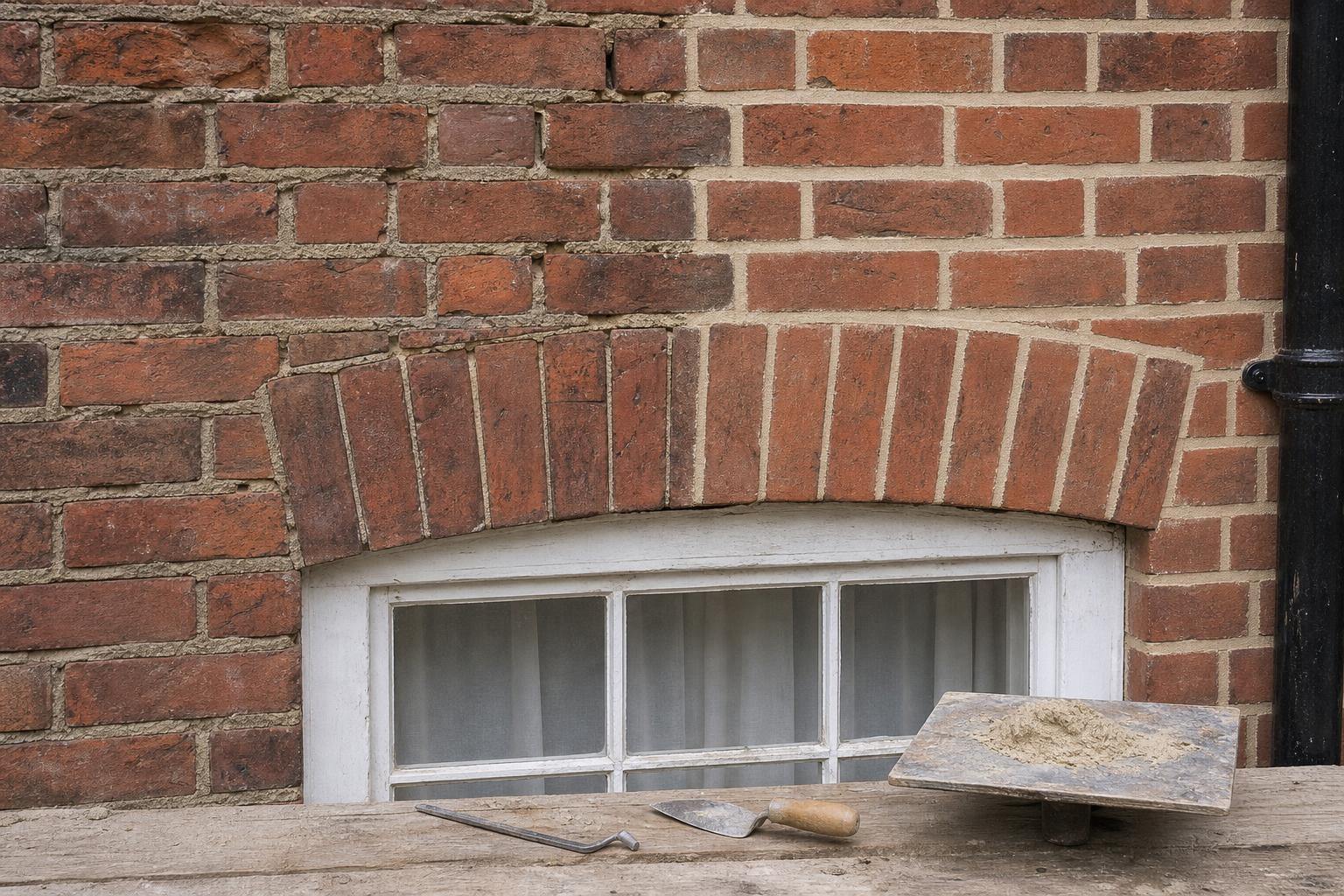
In summary
Mortar in a historic wall is designed to be softer and more permeable than the brick, so that moisture evaporates through the joint and decay occurs in the mortar rather than in the brick. Cement pointing reverses this: it is harder and less permeable than most historic brick, so moisture is driven out through the brick face instead, causing spalling, salt damage and frost damage that would not otherwise occur. Repointing is also the most over-specified operation in historic building maintenance — sound pointing should be left alone, and only failed joints need attention. Where repointing is genuinely required, the mortar should be matched to the original in binder, aggregate, colour and strength, and the joint finish should match the original profile. Aggressive cleaning and sandblasting remove the fired brick face permanently and are almost never appropriate.
On this page
- How a historic brick wall works
- Historic bricks and how to read them
- Bonds, and why they matter
- Historic mortars
- Cement: what it does to a historic wall
- When repointing is actually needed
- Specifying a matching mortar
- Raking out and repointing properly
- Joint profiles
- Brick repair and replacement
- Gauged and rubbed brickwork
- Cleaning
- Salts, damp and efflorescence
- Consent position
- Specification and procurement
- Common mistakes
- Find a specialist
- Frequently asked questions
How a historic brick wall works
A solid brick wall is not waterproof and was never intended to be. It manages water: it absorbs some during rain and releases it by evaporation afterwards. The mortar joint is the principal route for that evaporation, and it is deliberately the weakest element in the wall.
Three consequences follow, and almost every question in this guide reduces to one of them.
The mortar must be softer than the brick. When the wall moves — thermally, seasonally, or through settlement — the mortar accommodates the movement by fine cracking distributed across many joints. Where the mortar is harder than the brick, the brick fails instead.
The mortar must be more permeable than the brick. Water leaves through the joint. Where it cannot, it leaves through the brick face, carrying dissolved salts with it, and the face spalls.
The mortar is sacrificial. It is meant to decay and be renewed periodically. That is a maintenance cycle, not a defect.
Historic bricks and how to read them
Handmade bricks — formed in a mould by hand, irregular in size, texture and colour, with a folded surface texture and often a shallow frog or none at all. In use until the mid nineteenth century and later in some regions.
Machine-made bricks — from the mid nineteenth century, regular in size, sharp arrises, uniform colour, usually with a deep frog.
Firing and colour. Colour derives from clay chemistry and firing conditions. Local clays produced strongly regional colours — the reds of the midlands, the yellows and greys of London stocks, the whites of Suffolk, the multi-coloured variation of hand-fired stocks. Colour variation within a wall is normal and is part of its character.
Hardness varies enormously. Underfired bricks from the outside of a clamp are soft and porous; overfired bricks are hard and sometimes vitrified. Both appear in the same wall, often deliberately, with harder bricks used for exposed positions and softer ones internally. This matters when specifying mortar, because the mortar must be softer than the softest brick it bears on.
Brick sizes changed over time, partly through taxation and regulation. Matching size is one of the harder parts of sourcing replacements, and a modern brick of the wrong dimension in a historic wall is conspicuous even where the colour matches.
Bonds, and why they matter
Bond is the pattern in which bricks are laid, and it is structural as well as decorative.
- English bond — alternating courses of headers and stretchers. Strong, early.
- Flemish bond — headers and stretchers alternating within each course. Common from the later seventeenth century.
- English garden wall, Flemish garden wall and regional variants.
- Stretcher bond — indicates cavity construction, and therefore generally twentieth century. Finding stretcher bond in an apparently older wall usually means rebuilding.
Bond matters practically because headers tie the wall through its thickness. Where repairs, inserted openings or previous rebuilding have interrupted the bond, the wall’s structural behaviour changes. It also matters diagnostically: changes of bond within an elevation record phases of alteration.
Reinstate the original bond in any repair. A patch in stretcher bond within a Flemish wall is a permanent visual and structural discontinuity.
Historic mortars
Historic mortars were lime-based. Broadly:
Lime putty mortars — non-hydraulic lime, slaked and matured, set by carbonation with atmospheric carbon dioxide. Soft, highly permeable, slow to set, and the most forgiving. Traditional and appropriate for most soft historic brickwork.
Hydraulic lime mortars — limes containing clay impurities that allow a chemical set in the presence of water. Available in a range of strengths. Faster-setting and harder than lime putty, and appropriate where exposure or strength requires it. The temptation is always to specify a stronger hydraulic lime than the situation needs.
Hot-mixed mortars — mortars mixed with quicklime and damp sand, generating heat in the mix. Historically very widespread, and increasingly used again in conservation because the resulting mortar is workable, sticky, and closely resembles historic material.
Aggregate is at least as important as binder. The sand’s grading, shape and colour determine the mortar’s strength, porosity and appearance more than most specifiers appreciate. Well-graded sharp sand, matched to the original, is what makes a repair invisible.
Additions. Animal hair, brick dust, and other additions appear in historic mortars and can be relevant to matching.
Cement: what it does to a historic wall
Cement pointing on soft historic brickwork causes the decay it was intended to prevent, and it is the single most common damaging intervention on historic brick buildings.
The mechanism:
- Cement is harder and considerably less permeable than most historic brick.
- Water entering the wall — from rain, from a defect above, from rising damp — cannot evaporate through the joint.
- It evaporates through the brick face instead.
- Dissolved salts crystallise at or just behind that face.
- Crystallisation pressure, and frost action on the saturated face, spall the brick.
The visible result is a wall where the joints stand proud and the brick faces have eroded back — a diagnostic pattern, and one visible on countless buildings repointed in the second half of the twentieth century.
Cement also fails to accommodate movement, so cracking concentrates through bricks rather than distributing through joints.
Removing cement pointing is difficult and risky. It is harder than the brick, so removal by disc cutter or aggressive chisel work damages arrises. Where removal is undertaken it should be by careful hand raking, with a trial area agreed first, and with the acceptance that some joints may be better left than removed destructively. This is a genuine judgement call and is worth taking advice on.
When repointing is actually needed
Sound pointing should be left alone. Repointing an entire elevation because part of it has failed is a very common over-specification, and it destroys sound historic mortar which is itself evidence.
Repointing is required where:
- Mortar has eroded back significantly from the face, typically more than the joint width, allowing water to lodge
- Joints are open, cracked or hollow, admitting water
- Previous cement pointing is causing brick decay
- Mortar has lost cohesion and can be raked out by hand
Repointing is not required because:
- The mortar looks old or weathered
- The wall is being repaired elsewhere and it seems tidy to do it all
- Someone recommended it without a survey
- A slight recess has developed — mortar set back from the face is normal and often original
Survey and map before specifying. Mark on an elevation drawing which joints need attention. In most buildings this is a fraction of the wall, and the cost saving relative to a blanket specification is substantial.
Specifying a matching mortar
Match the original, and the way to know the original is to analyse it. Mortar analysis — establishing binder type, binder-to-aggregate ratio, and aggregate grading and colour — is inexpensive relative to the cost of repointing and removes guesswork.
Specify:
- Binder type — lime putty, a named hydraulic lime class, or a hot-mixed specification
- Aggregate — source, grading and colour, matched to the original
- Proportions, by volume
- Any additions — hair, brick dust
- Colour, achieved through aggregate selection rather than pigment where possible
- A sample panel, prepared on site, weathered, and approved before general work
The default error is specifying too strong. Where in doubt, the weaker option is safer: mortar that erodes prematurely is a maintenance nuisance, mortar that is too hard damages the brick permanently.
Seasonal constraints are real. Lime mortar has a working season and cannot be placed in frost or in conditions that dry it too fast. A programme that puts repointing into midwinter will produce defects.
Raking out and repointing properly
Raking out. By hand, using a quirk or hooked tool. Depth should be at least twice the joint width to give the new mortar something to hold. Angle grinders and disc cutters should not be used on historic brickwork — they widen joints, cut arrises, and produce a mechanical uniformity that is immediately visible. Where a contractor proposes a disc cutter, that is the point to stop.
Preparation. Brush out dust, and dampen the joint so the brick does not suck water out of the mortar prematurely. The degree of damping depends on brick porosity and weather.
Filling. In layers where the joint is deep, allowing each to set before the next. Compact firmly into the joint.
Finishing. Bring the mortar up to the face as the original was, and finish when the mortar has taken up sufficiently — usually by beating back with a churn brush or stippling to expose the aggregate. Timing is a matter of judgement and it is what separates good work from poor.
Aftercare. Protect from sun, wind, rain and frost. Damp hessian and sheeting are normal. Lime needs time, and hurrying it produces weak, dusty mortar that fails in a few seasons.
Joint profiles
The joint finish is a major part of a wall’s appearance and is routinely got wrong.
- Flush or slightly recessed — the commonest historic finish, and the safest default where evidence is absent
- Struck and weathered — angled to shed water
- Tuck pointing — a fine raised ribbon of lime putty set into a coloured mortar, imitating fine gauged joints. A specialist finish, historically significant where it survives, and easily destroyed by ordinary repointing
- Penny struck / bird’s beak and other regional variants
Never use a bucket-handle or weather-struck profile as a default. It is a modern convention and it changes the reading of the elevation.
Never spread mortar over the brick face — “buttering” or ribbon pointing — to disguise irregular joints. It is conspicuous, it holds water against the brick, and it is very difficult to remove without damage.
Where tuck pointing survives, do not repoint over it. Take specialist advice.
Brick repair and replacement
Retain decayed brick wherever possible. A brick with an eroded face is still performing structurally and still carries the wall’s historic character. Spalled faces are normal on old buildings and are not in themselves a defect requiring action.
Where intervention is justified:
Turning bricks. A brick can sometimes be removed and reversed to present a sound face. Simple, cheap and entirely reversible in effect.
Cutting out and replacing individual bricks. Match size, colour, texture and hardness. Sources include salvage — which gives genuine matching but variable consistency — and specialist manufacturers producing handmade bricks to match. Salvaged bricks should be assessed for soundness and frost resistance; a salvaged brick that failed in one wall will fail in another.
Brick slips — thin facing pieces bonded to a cut-back face. Sometimes appropriate where full replacement would remove sound material, though they can fail at the bond line.
Plastic repair — a lime-based mortar repair, coloured and textured to match, applied to a cut-back face. Appropriate for localised loss, particularly where matching bricks cannot be sourced. Requires skill; poor plastic repair is conspicuous.
Indenting larger areas where structural loss has occurred, reinstating the original bond.
Gauged and rubbed brickwork
Gauged brickwork uses soft, fine-textured rubbing bricks cut and rubbed to precise shapes, set in very fine joints of lime putty — sometimes barely a millimetre. Found in arches, window heads, pilasters, cornices and decorative panels, typically on higher-status buildings from the later seventeenth century onwards.
It is a specialist craft, and the wrong intervention destroys it quickly:
- The joints are fine lime putty and cannot be repointed with ordinary mortar
- The bricks are soft and cleaning or abrasion destroys the rubbed surface
- Cement repairs are catastrophic
- Repairs require bricks of matching softness and colour, cut and rubbed to match
Where gauged work is present, identify it in the survey and specify it separately. It should not be included in a general repointing item.
Cleaning
The question to ask first is why the wall is being cleaned. Soiling is not usually a technical problem, and the fired surface of a historic brick is its most durable and most vulnerable layer. Once removed, the exposed body is softer, more porous, and decays faster.
Do not use:
- Dry abrasive blasting — removes the fired face permanently
- High-pressure water — drives water deep into the wall and erodes joints and faces
- Aggressive acid cleaners — attack the brick, mobilise salts, and can cause staining that appears months later
Gentler options, always with a trial area agreed in writing first:
- Low-pressure water with soft brushing, over an extended period
- Steam or hot water at low pressure
- Poultices for specific stains
- Nebulous or misting water systems for delicate surfaces
Where paint is being removed from brickwork, be aware that removal is often incomplete, that it can leave the surface worse than before, and that on a listed building it requires consent. Painted brickwork is sometimes historic in its own right.
Cleaning on a listed building normally requires consent, and applications should be supported by a stated method and trial.
Salts, damp and efflorescence
Efflorescence — white crystalline deposit on the surface — indicates soluble salts moving through the wall and crystallising as water evaporates. It signals a moisture source. Brushing it off treats the symptom.
Cryptoflorescence — salts crystallising just behind the face rather than on it — is more damaging, and causes the face to spall.
The response is to find and eliminate the water:
- Failed rainwater goods, which is the commonest source
- Defective flashings and copings
- Raised external ground levels bridging the damp-proof course or the plinth
- Cement render or pointing preventing evaporation
- Plumbing leaks
- Blocked or absent sub-floor ventilation
Note the interaction with damp treatment. Chemical injection and impermeable internal tanking do not address salts arriving from an external source and can move the problem. Diagnose before treating; this is covered in the companion guide on damp and timber decay.
Salt-laden masonry can be reduced by poulticing, but only after the moisture source is eliminated.
Consent position
On a listed building, repointing in a different mortar, changing the joint profile, cleaning, painting, and replacing brickwork all normally require Listed Building Consent.
Points that recur:
- Repointing like for like in matching lime is often treated as maintenance, but confirm rather than assume — many authorities want to see the mortar specification
- Repointing in cement is alteration, and is normally refused
- Removing cement pointing and replacing in lime is normally supported
- Cleaning requires consent and should be supported by a method statement and trial
- Painting previously unpainted brickwork requires consent and is usually refused
- Removing paint from historic brickwork requires consent
The broader framework is covered in Listed Building Consent: What Needs It, What Does Not.
Specification and procurement
State:
- An elevation drawing marking which joints require repointing — not a blanket area
- Mortar specification by binder, aggregate source and grading, proportions and additions, informed by analysis
- Joint profile and finish, described and illustrated
- Raking out method, with disc cutters expressly prohibited
- Sample panel requirement, weathered and approved before general work
- Brick replacement schedule, with matching requirements and source
- Gauged brickwork identified separately
- Cleaning method and trial area, where cleaning is included
- Protection and aftercare — hessian, sheeting, frost protection
- Seasonal constraints acknowledged in the programme
- A prohibition on cement where lime is specified, stated explicitly
- A contingency for concealed defects
Common mistakes
| Mistake | Consequence |
|---|---|
| Repointing sound joints | Loss of historic mortar; unnecessary cost |
| Cement pointing on soft brick | Spalled brick faces; accelerated decay |
| Specifying too strong a mortar | Damage transferred from joint to brick, permanently |
| Disc cutters for raking out | Widened joints, cut arrises, mechanical appearance |
| Bucket-handle profile by default | Elevation reads as modern |
| Ribbon or buttered pointing over the face | Conspicuous; holds water; hard to remove |
| Repointing over tuck pointing | Irreversible loss of a specialist historic finish |
| Sandblasting or high-pressure cleaning | Fired brick face removed permanently |
| Replacing spalled bricks unnecessarily | Loss of historic fabric that was performing adequately |
| Patching in stretcher bond | Visual and structural discontinuity |
| Lime work in frost or in fast-drying conditions | Weak, dusty mortar failing within seasons |
| Brushing off efflorescence and calling it fixed | Moisture source untreated; damage continues |
| Gauged brickwork included in a general repointing item | Specialist historic work destroyed by ordinary practice |
Find a specialist
The Building Restoration Index lists vetted specialists in historic brickwork:
- Brickwork — historic brickwork, repointing and gauged work
- Brick Suppliers — handmade and matching bricks
- Mortars and Renders — lime mortar specialists
- Lime Mortars and Plaster — lime supply and application
- Masonry Cleaning — conservation cleaning specialists
- Paint Removal — removal of coatings from masonry
- Stone and Stonework — associated masonry repair
- Architectural Salvage — salvaged brick and matching material
- Materials Analysts — mortar and brick analysis
- Structural Repairs and Stabilisation — where cracking indicates movement
- Architects and Heritage Consultants — significance and consent
Related guides in the library: Lime plaster and decorative plasterwork, Historic stonework, Damp in historic buildings. The full set is on the Technical Library page of the Building Restoration Index.
Frequently asked questions
Why is cement pointing bad on an old wall?
It is harder and less permeable than historic brick, so moisture evaporates through the brick face instead of the joint, causing spalling and salt damage.
Should I remove existing cement pointing?
Often yes, but carefully. Cement is harder than the brick, so removal risks damage. Hand raking with an agreed trial area, and accepting some joints may be better left.
Does my whole wall need repointing?
Almost certainly not. Survey and map the failed joints. Sound pointing should be left alone.
How do I know what mortar to use?
Analyse the original. It establishes binder, proportions and aggregate, and is inexpensive relative to the work.
Is lime putty or hydraulic lime correct?
It depends on the brick and the exposure. The common error is specifying too strong. Where in doubt, weaker is safer.
What is a hot-mixed mortar?
A mortar mixed with quicklime and damp sand, generating heat. Historically widespread and increasingly used again because it closely resembles historic material.
Can I repoint in winter?
No. Lime mortar cannot be placed in frost or in conditions that dry it too fast. It has a working season.
What joint profile should I use?
Match the original. Where evidence is absent, flush or slightly recessed is the safest default. Avoid bucket-handle, which is a modern convention.
Can angle grinders be used to rake out?
No. They widen joints, cut arrises, and produce an appearance that cannot be undone.
My bricks are spalling. Do they need replacing?
Usually not. A brick with an eroded face is still performing structurally. Find and fix the moisture cause; replacement is a last resort.
Where do I get matching bricks?
Salvage, or specialist manufacturers producing handmade bricks to match. Check salvaged bricks for soundness and frost resistance.
What is tuck pointing?
A fine raised ribbon of lime putty in a coloured mortar, imitating gauged joints. Historically significant and easily destroyed by ordinary repointing.
Can I clean my brickwork?
Consider whether you need to. The fired face is the most durable layer and cleaning risks removing it. If proceeding, use the gentlest effective method with an agreed trial.
Can I sandblast brickwork?
No. It removes the fired face permanently and leaves a softer, more porous surface that decays faster.
Can I paint my brickwork?
On a listed building it requires consent and is usually refused. Impermeable paint on solid brick also traps moisture.
What causes the white deposit on my walls?
Efflorescence — soluble salts moving through the wall and crystallising as water evaporates. It indicates a moisture source that needs finding.
Do I need consent to repoint a listed building?
Like-for-like repointing in matching lime is often maintenance, but many authorities want to see the mortar specification. Repointing in cement is alteration and is normally refused.