
Historic Stonework: Decay, Repair and Cleaning
A conservation guide to stone masonry on historic buildings — how different stones decay, why cement and impermeable coatings accelerate it, and choosing between repair, indenting and replacement.
In summary
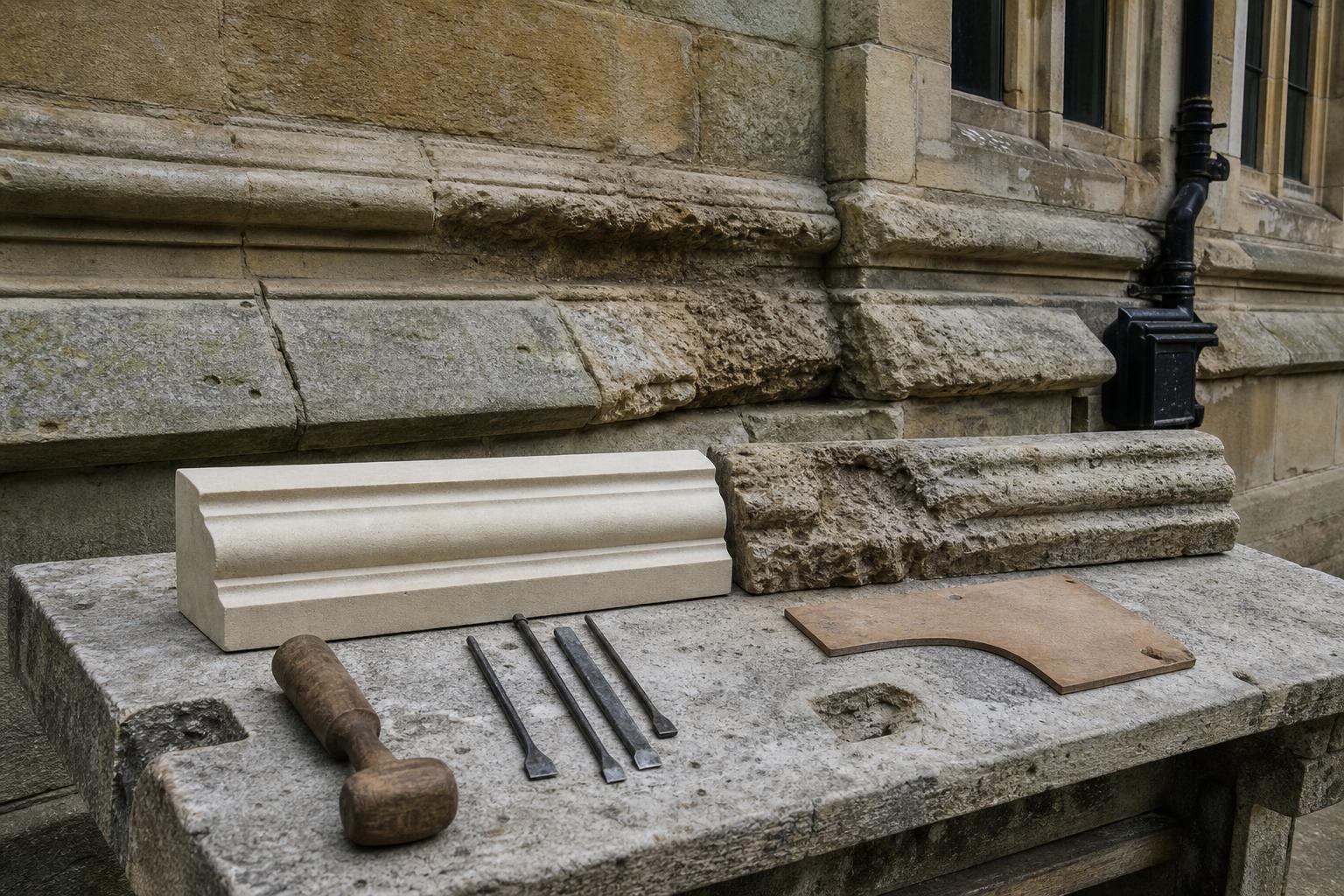
Stone decays through a small number of mechanisms — salt crystallisation, frost action, dissolution, and mechanical stress from corroding embedded iron — and almost all of them are driven by water moving through the masonry. Cement mortar and impermeable coatings make stone decay worse rather than better, by preventing evaporation through the joint and forcing it through the stone face instead. Weathered and eroded stone is normal on historic buildings and does not in itself require intervention; the conservation default is to retain decayed stone in place unless structural capacity or water shedding is compromised. Where intervention is justified, the hierarchy runs from doing nothing, through mortar repair, to indenting a new piece, to full replacement — and matching the geology of the original matters more than matching its appearance when new.
On this page
- The conservation default
- Stone types and how they behave
- How stone decays
- Iron in stone
- Diagnosis
- The intervention hierarchy
- Mortar repair
- Indenting and piecing-in
- Replacement and matching
- Repointing stonework
- Cleaning
- Consolidants and coatings
- Structural cracking and stabilisation
- Carved stone and sculpture
- Consent position
- Specification and procurement
- Common mistakes
- Find a specialist
- Frequently asked questions
The conservation default
Weathered stone is not failed stone. Erosion, surface loss, rounded arrises and lichen growth are the normal appearance of masonry that has been standing for centuries, and they carry the building’s age and character.
The default position is therefore:
- Retain decayed stone in place
- Intervene only where structural capacity is compromised, where water is no longer being shed, or where decay is actively accelerating
- Choose the least intervention that resolves the problem
- Address the cause before treating the symptom
Wholesale refacing of an eroded elevation converts a historic building into a modern replica of itself. It is also enormously expensive, and on a listed building it is frequently refused.
Stone types and how they behave
Limestone. Calcium carbonate, from soft chalks and clunch through to hard oolitic and carboniferous limestones. Decays principally by dissolution — it is soluble in acidic rainwater — and by salt crystallisation. In polluted urban environments, gypsum crusts form where sulphur dioxide reacts with the surface; these blacken in sheltered areas and spall away in exposed ones, taking the surface with them.
Bedding orientation matters greatly. Stone laid on its natural bed weathers evenly; face-bedded stone delaminates in sheets parallel to the face.
Sandstone. Quartz grains in a cementing matrix, and the matrix determines behaviour. Calcareous, ferruginous, siliceous and clay-bound sandstones all decay differently. Prone to contour scaling, case hardening and salt damage. Some sandstones are highly durable; others are notoriously not, and durability varies between beds in the same quarry.
Granite and other igneous stones. Very durable. Problems are usually at the joints, at fixings, and from staining rather than from decay of the stone itself.
Slate as a walling and cladding stone, distinct from roofing use.
Flint, cobble and rubble construction, where the mortar is doing most of the work and its condition governs the wall’s performance.
Cob and earth, a separate tradition entirely, requiring permeable renders and particular attention to the protection of the wall base and head.
The practical point. Different stones, and different beds of the same stone, have different porosity, strength and durability. A repair specified without knowing what the stone is will frequently be wrong.
How stone decays
Salt crystallisation. The dominant decay mechanism. Soluble salts — from soil, from de-icing salt, from historic uses, from cement, from sea air — move through the stone in solution and crystallise as water evaporates. Crystallisation pressure breaks down the stone at or just beneath the surface. Where evaporation is prevented at the joint, it happens in the stone face.
Frost action. Water in the pore structure expands on freezing. Saturated stone is vulnerable; well-drained stone is much less so.
Dissolution. Limestone dissolving in acidic rainwater. Slow, and part of normal weathering.
Gypsum crust formation and spalling, particularly on limestone in areas of historic air pollution.
Contour scaling and case hardening, particularly on sandstone, where a hardened surface layer separates from a softened zone behind it.
Biological growth. Lichens, algae and higher plants. Lichens on stone are usually harmless and sometimes protective; higher plants with roots in joints are not.
Mechanical stress from embedded iron. See Part 4.
Inappropriate previous work. Cement pointing and render, impermeable coatings, abrasive cleaning, and hard repair mortars — each accelerating decay in the surrounding stone.
Iron in stone
Corroding embedded ironwork is one of the most damaging and most commonly overlooked causes of stone failure.
Iron cramps, dowels, ties, railings, brackets, hinge pins and fixings were used extensively. Iron oxide occupies several times the volume of the metal it forms from, and the expansion splits the surrounding stone apart. The visible symptoms are cracking radiating from a fixing, rust staining, and displaced or spalled stone.
Points to note:
- The damage is often well advanced before it is visible
- Historic fixings were commonly run in lead, which is soft and tolerant; later repairs in cement accelerate the problem considerably
- Removing and replacing the ironwork in non-corroding material is normally the correct remedy, but removal itself can damage the stone and requires care
- Where the ironwork is significant, the choice between retention and replacement is a conservation judgement, not just a technical one
- Never fix new ferrous metal into historic masonry
This is covered further in the companion guide Historic Ironwork: Railings, Gates and Architectural Castings.
Diagnosis
Establish, before specifying:
- What the stone is — type, and ideally source and bed. Geological identification is inexpensive and prevents mismatched repair.
- Whether the stone is face-bedded, which explains delamination.
- Where the water is coming from. Failed rainwater goods, defective copings and cills, failed flashings, raised ground levels, cement render.
- Whether salts are present, and their likely source.
- Whether embedded iron is involved. Look for cracking patterns radiating from points, and rust staining.
- Whether decay is active or historic. Much erosion happened long ago and has stabilised.
- Whether structural capacity is affected, which is the threshold for intervention on load-bearing masonry.
- What previous interventions have been made, and whether they are contributing.
Record before intervention. Photograph, and where the elevation is significant, measure or scan. Stone-by-stone survey drawings are standard on significant buildings and are what allow a schedule to be priced accurately.
The intervention hierarchy
In order:
- Do nothing. Record and monitor. Appropriate for stable weathering.
- Address the cause. Fix the gutter, lower the ground, remove the cement render. Frequently this is the whole job.
- Shelter coat or sacrificial render, where appropriate — a thin lime coating that weathers away in place of the stone.
- Mortar repair (plastic repair), for localised loss.
- Indenting, letting in a new piece of matching stone.
- Replacement of the whole unit.
- Refacing, which should be exceptional.
Move down the list only when the level above will not do. Each step removes more historic fabric than the one before.
Mortar repair
A lime-based repair mortar, matched to the stone in colour, texture and porosity, applied to a prepared face.
Appropriate for:
- Localised loss where cutting out for an indent would remove sound stone
- Areas where matching stone cannot be sourced
- Repairs where minimising loss of original material is the priority
Requirements:
- The repair must be weaker and more permeable than the stone, so it is sacrificial. A repair harder than the stone damages the surrounding material.
- Aggregate should be selected to match the stone’s colour and texture — crushed stone of the same type is often used.
- Preparation — cut back to sound material, undercut for key, and dampen appropriately.
- Build in layers where the repair is deep, allowing each to set.
- Finish to match the surrounding surface, without spreading over adjacent sound stone.
- Protect during curing, and observe seasonal constraints.
Mortar repair has a finite life — typically decades rather than centuries — and should be understood as maintenance rather than permanent. That is not an objection; it is the point of a sacrificial repair.
Poor plastic repair is conspicuous and is one of the most visible forms of bad conservation work. It requires skill and a good eye.
Indenting and piecing-in
Cutting out decayed stone and letting in a new piece, bedded in lime mortar.
Appropriate where:
- Loss is deep enough that mortar repair would be too thick
- Structural capacity is affected
- Water shedding is compromised — cills, copings, string courses
- The detail requires cutting rather than modelling
Requirements:
- Cut out to sound stone, with a rectilinear opening and adequate depth
- Match the stone — type, bed, colour, texture and porosity
- Match the bedding orientation to the original
- Bed in lime mortar compatible with the stone
- Work the surface to match the adjacent tooling
- Remove no more sound stone than necessary
Match the geology, not the appearance when new. New stone weathers to match over years if it is the right stone; the wrong stone of the right initial colour will diverge, and will decay at a different rate.
Replacement and matching
Full unit replacement where the stone is structurally spent or so far decayed that indenting is impractical.
Sourcing is the difficulty. Many historic quarries are closed. Options:
- Reopening or extracting from the original quarry, occasionally possible on major projects
- Identifying a geologically equivalent stone from a working quarry
- Salvage, which gives genuine matching but variable quality and limited quantity
- Building stone databases and geological advice, which exist to assist with matching
Lead times are often long, particularly for cut and carved work, and should be in the programme from the start.
Record and retain what is removed, at least representatively. Removed stone carries tooling evidence and, in carved work, may be worth retaining entire.
Repointing stonework
The same principles apply as to brickwork, with additional points specific to stone.
- Mortar must be softer and more permeable than the stone. Cement pointing on stone causes the stone to decay in preference to the joint, exactly as with brick.
- Joint widths vary enormously — from fine ashlar joints to wide rubble joints — and mortar specification differs accordingly.
- Do not repoint sound joints. Survey and map.
- Rake out by hand. Disc cutters widen joints and damage arrises, and on ashlar the damage is glaring.
- Match the original finish and profile, flush or slightly recessed in most cases.
- Do not spread mortar over the stone face. On ashlar this is particularly destructive of appearance.
- In rubble work the mortar is structural, and its condition governs the wall.
- Deep voids in rubble walls may need grouting before pointing, which is a specialist operation.
Mortar analysis of the original is inexpensive and removes guesswork.
Cleaning
Ask why first. Soiling is usually cosmetic. Cleaning always removes some surface, and the surface is the most weathered, most durable and most historically informative part of the stone. Tooling marks, historic paint traces and patina are all vulnerable.
Do not use:
- Dry abrasive blasting — removes surface permanently, roughens the stone, and accelerates subsequent soiling and decay
- High-pressure water — drives water into the wall, erodes joints, and mobilises salts
- Strong acids on limestone — dissolves it
- Any method not first proven on a trial area
Gentler approaches, always with an agreed trial:
- Low-pressure water with soft brushing, over extended periods
- Nebulous or misting systems for delicate surfaces
- Steam or hot water at low pressure
- Poultices for specific stains and for salt reduction
- Latex or chemical poultice systems for gypsum crusts, applied by specialists
Gypsum crusts on limestone are a particular case. In sheltered areas they can be thick and black, and their removal is a specialist operation. Removing them can also remove the surface beneath, and in some cases retaining them is the conservation decision.
Cleaning on a listed building requires consent, supported by a method statement and trial.
Consolidants and coatings
Water-repellent coatings and stone consolidants should be approached with real caution on historic masonry.
The problems:
- Water repellents reduce absorption at the surface but do not prevent water entering from elsewhere. Water that enters behind the treated zone cannot evaporate through it, so it evaporates deeper in — carrying salts, and causing decay behind the treated layer.
- Treated and untreated zones create a boundary at which decay concentrates.
- Consolidants can create a hardened outer layer over a softer substrate, which is the mechanism of contour scaling.
- Most treatments are irreversible, and re-treatment compounds the problem.
- Efficacy claims frequently exceed the evidence, particularly for proprietary systems marketed to owners.
Where consolidation is genuinely being considered — usually on sculpture or highly significant carved work — it should be specified by a stone conservator on the basis of testing, not applied as a general protective measure.
The alternatives that work are the unglamorous ones: fix the water, remove the cement, restore evaporation, maintain the building.
Structural cracking and stabilisation
Cracking in masonry may be historic and stable or may indicate active movement.
- Monitor before intervening, over at least a full seasonal cycle, to distinguish seasonal from progressive movement
- Establish the cause — foundation movement, tree roots, water, load changes, alteration, decayed embedded timber, corroding iron
- Address the cause before repairing the crack
- Repair techniques include stitching, grouting of voids, and localised rebuild, and should be specified by an engineer with conservation experience
- Avoid rigid interventions that transfer stress into adjacent fabric
- Underpinning is rarely the answer on historic buildings and frequently causes new problems by creating differential stiffness
Carved stone and sculpture
Carved and sculptural stone is a distinct conservation discipline.
- Record before anything else. Photogrammetry or scanning produces a permanent record of the surface as it is now, which is valuable irrespective of what is done.
- Retention in place is the default, even where heavily eroded. Eroded sculpture retains its position, its context and its evidential value.
- Removal to shelter with a replica in position is sometimes the right answer for highly significant work in an exposed position, and is a major decision.
- Recarving requires evidence. Where the original form is not known, recarving is invention.
- Stone conservators, not masons, for sculptural work. The skills are different.
- Never clean sculpture without specialist advice.
Consent position
On a listed building, replacing stone, refacing, cleaning, repointing in a different mortar, and applying coatings all normally require Listed Building Consent.
Points that recur:
- Like-for-like repointing in matching lime is often maintenance, but authorities frequently want the mortar specification
- Repointing in cement is alteration and normally refused
- Cleaning requires consent, a method statement and a trial
- Stone replacement requires justification that repair was not achievable
- Refacing an elevation is a major intervention and is usually resisted
- Removing or replacing historic ironwork embedded in masonry requires consent
- Water-repellent treatments require consent and are frequently refused
The broader framework is covered in Listed Building Consent: What Needs It, What Does Not.
Specification and procurement
State:
- A stone-by-stone survey drawing, with the intervention specified for each unit
- Stone identification, and the source specified for any new stone
- Bedding orientation for new stone
- Repair mortar specification by binder, aggregate and proportions, with a requirement that it is weaker and more permeable than the stone
- Pointing mortar specification separately, with joint profile
- Raking out method, with disc cutters prohibited
- Sample panels and trial areas, approved before general work
- Surface tooling to be matched, described
- Cleaning method and trial, where included
- Treatment of embedded ironwork
- A prohibition on cement, ferrous fixings and water-repellent coatings
- Recording requirements, including retention of removed stone
- Seasonal constraints and curing protection
- Lead times for cut and carved stone
- A contingency for concealed decay
Common mistakes
| Mistake | Consequence |
|---|---|
| Treating weathering as failure | Wholesale refacing; historic fabric lost; consent refused |
| Cement pointing on stone | Stone decays in preference to the joint |
| Repair mortar harder than the stone | Damage transferred into the surrounding stone |
| Wrong stone used for indenting | Differential weathering and decay; permanent mismatch |
| Face-bedding new stone | Delamination within years |
| Ferrous fixings into masonry | Rust jacking; split stone |
| Ignoring embedded iron | Damage advances unseen until stone is displaced |
| Abrasive or high-pressure cleaning | Surface, tooling and patina removed permanently |
| Water-repellent coatings | Decay driven deeper; irreversible |
| Repointing sound joints | Loss of historic mortar; unnecessary cost |
| Disc cutters on ashlar | Widened joints and damaged arrises, glaringly visible |
| Recarving without evidence | Invention presented as restoration |
| Intervening before monitoring cracks | Unnecessary or harmful structural work |
| Late ordering of cut stone | Programme delay, sometimes of months |
Find a specialist
The Building Restoration Index lists vetted specialists in historic stonework:
- Stone and Stonework — masonry repair, indenting and conservation
- Masonry Cleaning — conservation cleaning specialists
- Mortars and Renders and Lime Mortars and Plaster — lime specialists
- Metalwork — treatment of embedded historic ironwork
- Structural Repairs and Stabilisation — cracking and movement
- Structural Engineers — conservation-experienced structural assessment
- Materials Analysts — stone and mortar identification and analysis
- Fine Art Conservators — sculptural and carved stone conservation
- Wood Carvers — associated decorative work
- Cob and Earth — earth-built structures
- Architectural Salvage — matching salvaged stone
- 3D Scanning — recording of carved and sculptural work
- Architects and Heritage Consultants — significance and consent
Related guides in the library: Historic brickwork, Lime plaster and decorative plasterwork, Damp in historic buildings. The full set is on the Technical Library page of the Building Restoration Index.
Frequently asked questions
My stonework is badly eroded. Does it need replacing?
Usually not. Weathered stone is normal and retains structural capacity. Intervene only where capacity or water shedding is compromised.
What is the correct order of intervention?
Do nothing and monitor; fix the cause; sacrificial coating; mortar repair; indent; replace; reface. Move down only when the step above will not do.
Why is cement pointing bad on stone?
It is harder and less permeable, so water evaporates through the stone face instead of the joint, causing salt and frost damage.
What is a plastic or mortar repair?
A lime-based repair mortar matched to the stone, used for localised loss. It must be weaker and more permeable than the stone, and it is sacrificial.
How long does a mortar repair last?
Typically decades rather than centuries. It is maintenance, and that is by design.
What is indenting?
Cutting out decayed stone and letting in a new matching piece, bedded in lime. Used where loss is too deep for mortar repair.
How do I match the stone?
Match the geology, not the colour when new. The right stone weathers in; the wrong stone diverges and decays differently.
What is face-bedding and why does it matter?
Stone laid with its natural bed vertical rather than horizontal. It delaminates in sheets parallel to the face. Never face-bed new stone.
What causes cracks radiating from a point in the stone?
Usually corroding embedded iron. Iron oxide expands to several times the metal’s volume and splits the stone.
Should I clean my stonework?
Consider whether you need to. Cleaning always removes some surface, and the surface carries tooling, patina and historic evidence.
Can I sandblast or pressure wash stone?
No. Both remove surface permanently, roughen the stone, and accelerate subsequent soiling and decay.
Should I apply a water-repellent treatment?
Generally no. Water entering elsewhere cannot evaporate through the treated zone, so decay moves deeper. Most treatments are irreversible.
Is lichen damaging my stone?
Usually not, and it can be protective. Higher plants with roots in the joints are a different matter.
What should I do about a crack in a stone wall?
Monitor over a full seasonal cycle before intervening, establish the cause, and address that first. Get conservation-experienced engineering advice.
Should eroded carvings be recarved?
Only with evidence for the original form. Without it, recarving is invention. Retention in place is the default.
Do I need consent to repoint stonework on a listed building?
Like-for-like in matching lime is often maintenance, but the authority will frequently want the specification. Cement repointing is normally refused.
How long does new cut stone take to obtain?
Often a long time, particularly for cut and carved work. Order early and build it into the programme.