
Historic Stonemasonry: The Complete Guide to Repairing Stone Walls on Listed and Period Buildings
A free, independent reference from the Building Restoration Index. It explains how historic stone walls work, why they decay, and how to repair them with lime, matching stone and good maintenance, on listed buildings, churches and period homes.
In summary
Historic stonework should be repaired with materials that are weaker and more permeable than the stone itself, which almost always means lime mortar rather than cement, and with as little loss of original stone as possible. Most traditional walls were built to absorb some moisture and let it dry out again through the joints. Decay usually follows when that balance is upset: by hard cement pointing, by impermeable coatings, or by water arriving in the wrong place from failed gutters, hoppers and downpipes. Good practice is to find and cure the cause first, then repoint in a matched lime mortar, repair damaged stones with lime-based mortars where they are sound enough, and replace stones only where they have lost their structural or protective role. On a listed building, check with the local planning authority before any work that goes beyond like-for-like repair.
On this page
- Who this guide is for
- How a traditional stone wall works
- Why historic stonework decays
- Water: the first thing to fix
- Lime mortars explained
- Repointing historic stonework
- Repairing or replacing damaged stone
- Cleaning stonework
- Cracks, movement and structural repairs
- Dry stone walling
- Consent, standards and guidance
- Common mistakes
- Typical cases
- Finding a stonemason
- Frequently asked questions
Who this guide is for
This guide is for architects, surveyors, conservation officers, contractors, church wardens and owners who need to commission or approve work to historic stonework. It assumes you know what a listed building is. It does not assume you know the difference between an air lime and a hydraulic lime, or why a stone laid on the wrong bed fails.
We are Tuscan Foundry Products. We have supplied cast iron rainwater goods for listed and traditional buildings since 1893, and we maintain the Building Restoration Index as a free directory of heritage trades and suppliers. We are not stonemasons. We have written this guide because the masonry and the rainwater goods on a historic building succeed or fail together. A great deal of the stone decay we are shown on site starts with a blocked hopper or a cracked downpipe.
How a traditional stone wall works
A traditional stone wall manages moisture rather than excluding it. Rain is absorbed by the stone and, especially, by the soft lime joints, and it evaporates again when the weather dries. The wall stays healthy as long as water can leave as easily as it arrives.
Most pre-1919 masonry in Britain and Ireland was bedded and pointed in lime mortar. Lime mortar is weaker and more porous than almost any building stone. That is deliberate. Moisture, soluble salts and small seasonal movements are concentrated in the joints, so the mortar weathers first and is renewed every few generations, while the stone itself is spared.
Walls also come in different constructions, and repairs must respect them:
- Ashlar: finely dressed blocks laid in thin, regular joints, usually as a facing to a rubble or brick core.
- Coursed and random rubble: roughly shaped stones in wider joints, often with small pinning stones packed into the mortar.
- Solid rubble walls with a core: two faces of masonry with a fill of smaller stone and mortar between them, sometimes tied with through-stones.
- Dry stone: stone laid without mortar at all, relying on the skill of the waller and gravity for stability.
The stone type matters as much as the construction. Sandstones, limestones, granites, slates and flints behave very differently when wet, frozen or exposed to salts. A repair that suits Cotswold oolitic limestone may be wrong for Pennine gritstone or Shropshire sandstone.
Why historic stonework decays
Almost all stone decay is driven by water, and most of the rest is driven by incompatible repairs. Weathering is natural and slow. Rapid decay usually has a cause that can be found and stopped.
| What you see | Likely cause | What to check first |
|---|---|---|
| Stone face flaking or blistering in layers | Salt crystallisation, frost, or face-bedded stone | Source of persistent wetting; bedding direction of the stone |
| Stone eroding behind hard, proud pointing | Cement pointing forcing moisture out through the stone | Mortar type; whether pointing is harder than the stone |
| Green staining, moss and algae in a vertical band | Leaking gutter joint, cracked downpipe or overflowing hopper | Rainwater goods directly above |
| Open, washed-out joints low on the wall | Splashback, raised ground levels, defective drainage at the foot of a downpipe | Gullies, shoes and ground levels |
| Rust staining and spalling around fixings | Expanding corrosion of embedded iron or steel | Cramps, dowels, railings and bracket fixings |
| Diagonal or stepped cracking | Structural movement or settlement | Whether the crack is live; advice from a conservation engineer |
Face-bedding deserves special mention. Sedimentary stone has a natural bed, the plane in which it was laid down. Stone set with its bed vertical and parallel to the wall face tends to delaminate in sheets. It is one of the most common causes of failure in later replacement work, and good masons check it on every stone.
Water: the first thing to fix
Before any stone is repaired or repointed, the water that caused the damage should be dealt with, or the new work will fail in the same way. On most historic buildings that means the roof, the parapets and copings, and the rainwater goods.
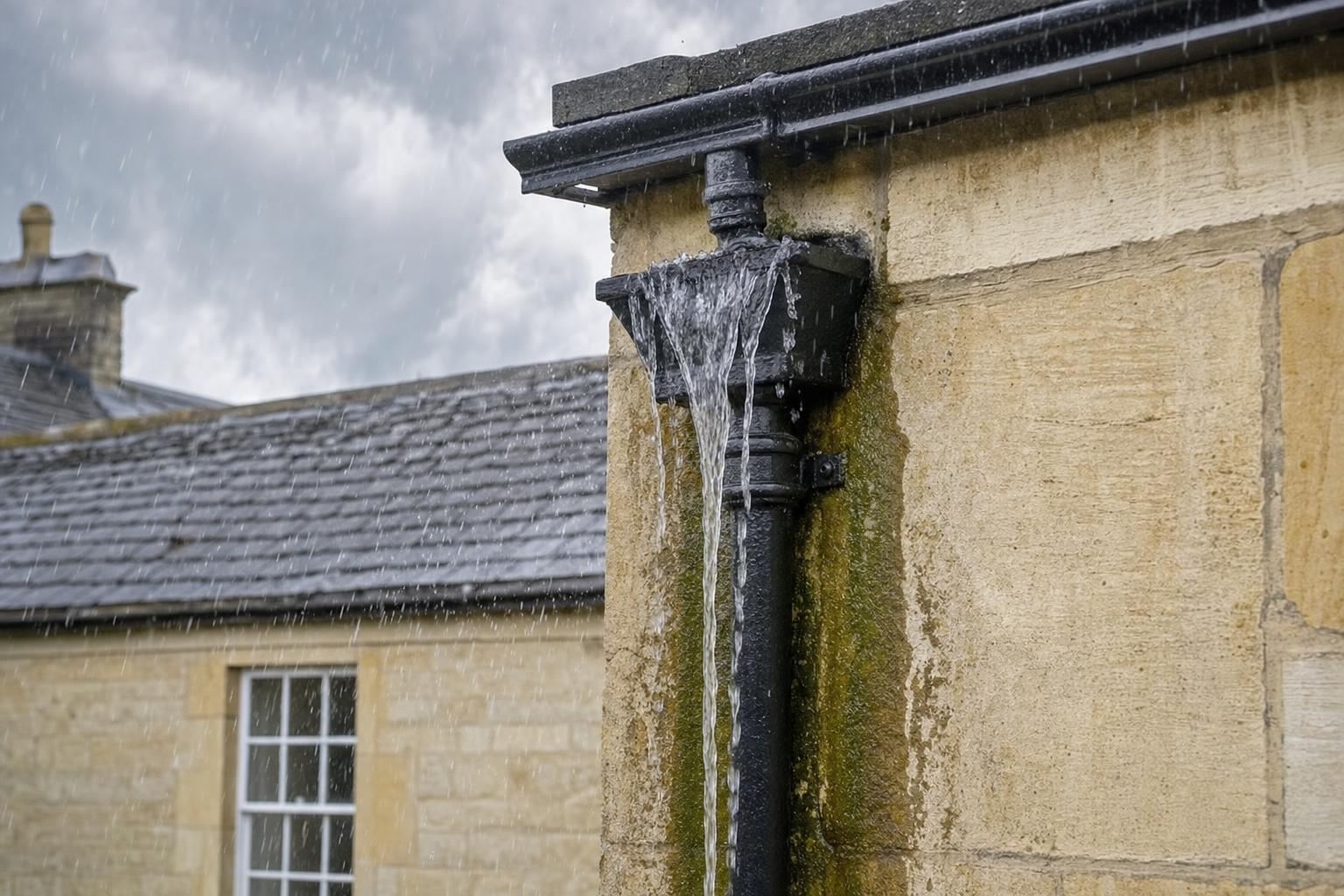
A gutter that leaks at a joint, a hopper choked with leaves or a downpipe cracked at the back will concentrate water on one patch of wall, often for years before anyone notices. The results are predictable: saturated masonry, frost damage, mobilised salts, washed-out joints, and damp and decay inside. Northern Ireland’s Department for Communities notes in its roof drainage guidance that a badly functioning rainwater system can do more harm than none at all.
When stonework is being repaired, we recommend that the rainwater system is inspected at the same time, ideally while the scaffold is up:
- Clear gutters, hopper heads and downpipes, and check that water runs freely to the drain.
- Check gutter joints, outlets and falls, and look for cracked or slipped sections.
- Check that downpipes stand off the wall on their ears or spacers, so the wall behind can dry and be decorated.
- Check the back of each downpipe, where cracks are hidden and most common.
- Check that shoes and gullies discharge clear of the wall foot.
- Consider whether gutters and downpipes are large enough for modern rainfall intensities.
On listed buildings, cast iron is normally repaired or replaced like for like. Where a profile or hopper is no longer made, it can be reproduced by copy casting from a surviving original, which typically takes 8 to 10 weeks. Allow for that in the programme so the scaffold is not standing idle. A site survey is worth considering on complex or badly damaged systems. Once refitted, cast iron should be finished properly; linseed oil paint is a well-suited heritage finish.
Lime mortars explained
Lime mortar is the default material for bedding and pointing historic stonework, because it is softer, more flexible and more permeable than the stone it protects. The right lime and mix depend on the stone, the original mortar, the exposure and the season.
All building limes start as limestone burnt to make quicklime. What happens next decides the type of mortar:
| Type | How it sets | Typical uses | Points to note |
|---|---|---|---|
| Air lime (non-hydraulic), as putty | Slowly, by absorbing carbon dioxide from the air | Fine ashlar joints, sheltered work, plasters and limewash | Very soft and permeable; vulnerable to frost while curing |
| Hot-mixed lime | Quicklime slaked directly with damp sand, then carbonating | Pointing and bedding rubble masonry, harling, matching historic mortars | Sticky, workable and full-bodied; good early stiffening; needs a skilled hand and proper safety precautions |
| Natural hydraulic lime (NHL 2, 3.5, 5) | Partly by reaction with water, partly by carbonation | Exposed elevations, copings, chimneys, winter work | Higher grades are stronger and less permeable; choose the weakest grade that will survive the exposure |
| Cement or cement-gauged mortar | Hydraulic set | Not generally suitable for historic masonry | Usually harder and less permeable than the stone, which pushes decay into the stone |
Hot-mixed mortars have seen a revival in recent years. Analysis of surviving historic mortars, with their characteristic lumps of unmixed lime, shows that most traditional mortar in Britain and Ireland was made this way. Historic Environment Scotland has published technical guidance on specifying hot-mixed lime mortars, and Historic England is researching how they perform. They are not automatically right for every job, but on many rubble buildings they are the closest match to the original.
The aggregate matters as much as the binder. A well-graded sharp sand gives strength and permeability, and its colour largely sets the colour of the finished joint. Where a close visual match is needed, a sample of the historic mortar can be analysed to identify the binder, the aggregate and the proportions.
Repointing historic stonework
Repoint only where joints have failed, using a lime mortar matched to the original, finished flush or slightly recessed and never spread over the stone. Sound historic pointing should be left alone, even if it is not pretty.
Historic England’s guide Repointing Brick and Stone Walls is the standard reference in England. The essential sequence is:
- Assess. Identify which joints have actually failed. Record the existing mortar’s colour, texture and joint profile.
- Rake out carefully. Remove loose and failed mortar by hand to a depth of roughly two to two-and-a-half times the joint width, without widening joints or damaging arrises. Angle grinders should not be used on historic joints.
- Clean and dampen. Brush out dust and wet the joint so the masonry does not draw water out of the new mortar too quickly.
- Fill in layers. Deep joints are filled in stages, each allowed to firm up before the next, using pinning stones where the original wall has them.
- Finish to match. Once the mortar has stiffened, the surface is typically beaten back with a stiff bristle brush to compact it and expose the aggregate.
- Protect and cure. Shield new work from sun, wind, rain and frost with hessian or sheeting, and keep it damp as it cures. Lime work in frosty months carries real risk and is best avoided.
Ribbon, strap and weather-struck pointing are later fashions, rarely appropriate to historic stonework, and they shed water across the stone face rather than letting the joint do its job. They usually draw objections from conservation officers.
Repairing or replacing damaged stone
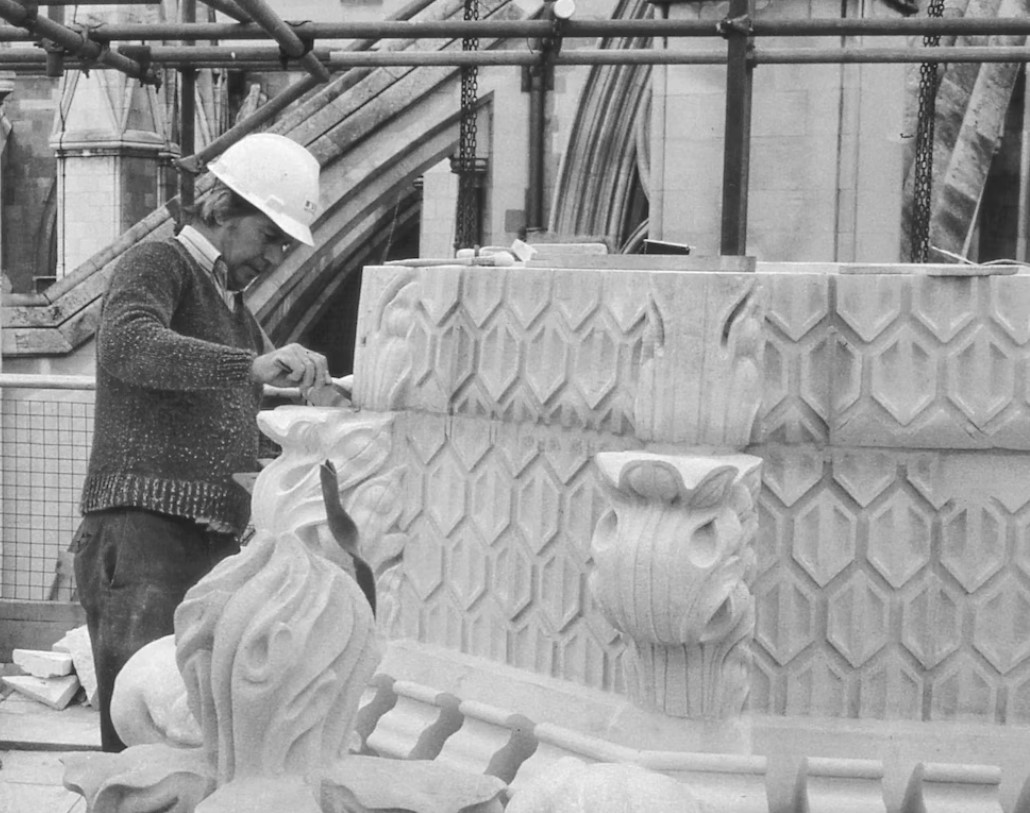
The guiding principle is to keep as much original stone as possible: repair where you can, replace only where a stone has lost its structural or protective function. A weathered stone that is still sound is part of the building’s history and should usually be left.
There are three broad options, often used together on the same elevation.
Leave it alone
Many weathered stones are stable and doing their job. Removing them destroys original fabric and the craftsmanship that went into it. Monitoring is often the right answer.
Mortar repair (“plastic repair”)
Where a stone has lost its face but its core is sound, it can be built back with a lime-based repair mortar matched for colour and texture, sometimes reinforced with non-ferrous armatures. Historic Environment Scotland’s guidance favours lime-based repair mortars for most stone, because they stay vapour-permeable and sacrificial to the stone around them. Mortar repairs are generally best for shallow losses and need protecting from the weather while they cure. They are skilled work, not filler.
Indenting and replacement
Where a stone is structurally compromised, very soft, or decayed too deeply for a mortar repair, it is cut out and a new stone of matching type is indented or the whole stone replaced. Points to get right:
- Match the stone, not just the colour. The new stone should match the original geologically and physically, as well as in appearance. Historic England’s Sourcing Stone for Historic Building Repair sets out how to identify the original and find a compatible source.
- Bed it correctly. Set sedimentary stone on its natural bed, never face-bedded, except where an established detail such as a cornice requires otherwise.
- Match dimensions, coursing and tooling, so the new stone reads as a repair within the wall rather than a patch.
- Avoid ferrous fixings. Use stainless steel or other non-ferrous cramps and dowels.
- Take out no more sound stone than necessary to accommodate the new piece.
| Condition of the stone | Usual approach |
|---|---|
| Weathered but sound and stable | Leave and monitor |
| Shallow surface loss, sound core | Lime-based mortar repair |
| Deep loss, or carved detail missing | Mortar repair or indent, depending on depth and exposure |
| Cracked through, unstable or very soft | Replace with matching stone |
| Earlier repair in cement or resin, causing damage around it | Carefully remove and repair in compatible materials |
Cleaning stonework
Clean historic stonework only where there is a clear reason, using the gentlest method that works, after trial panels. Patina is part of a building’s age and character, and aggressive cleaning can remove the protective outer skin of the stone.
BS 8221-1:2012 is the code of practice for cleaning natural stone, brick, terracotta and concrete. In general, low-pressure water, steam, poultices and carefully controlled fine abrasives are preferred to high-pressure jetting, coarse grit blasting or strong chemicals. Cleaning can need listed building consent, and staining should always be traced to its cause, which is often a rainwater defect above. There are specialist masonry cleaning firms listed in the Index.
Cracks, movement and structural repairs
A crack is a symptom, so the first question is whether it is historic and stable or still moving. Many old buildings carry long-settled cracks that need only repointing.
Live or significant cracking needs advice from a structural engineer with conservation experience before repair. Typical traditional remedies include stitching across cracks with stainless steel bars set in lime-based grout, consolidating loose rubble cores by grouting, rebuilding bulged sections on a like-for-like basis, and dealing with the underlying cause, whether that is failed drainage, tree roots, overloading or a corroding embedded fixing. Rigid repairs in cement or resin tend to move the problem elsewhere. Specialists are listed under structural repairs and stabilisation.
Dry stone walling
Dry stone walls are built without mortar and should be repaired without it, using the local walling style and stone. They are a living regional craft, and their construction varies from district to district.
Typical failures are bulging and collapse from frost, root action, livestock, vehicle strikes or the loss of coping stones. Repair normally means taking down the failed length to sound work and rebuilding with the original stone, its two faces tied with throughstones and the centre packed with hearting. Adding cement to a dry stone wall changes its character and often its drainage. Many boundary walls in conservation areas, national parks and on listed properties are protected, so check before rebuilding in a different style.
Consent, standards and guidance
Like-for-like repair to a listed building often does not need listed building consent, but anything that changes materials, appearance or historic fabric usually does, so ask the local planning authority before starting. Carrying out unconsented works to a listed building is a criminal offence in each UK nation.
| Territory | Heritage body | Consent route |
|---|---|---|
| England | Historic England | Listed building consent from the local planning authority |
| Wales | Cadw | Listed building consent from the local planning authority |
| Scotland | Historic Environment Scotland | Listed building consent from the planning authority |
| Northern Ireland | Historic Environment Division | Listed building consent |
| Republic of Ireland | National Monuments Service | Planning permission for works affecting the character of a protected structure (Record of Protected Structures) |
| Church of England and other exempt denominations | Diocesan Advisory Committee or equivalent | Faculty or the denomination’s own system under the ecclesiastical exemption |
Works typically likely to need consent include repointing in a different mortar or joint style, replacing stones in a different material, cleaning, removing render or limewash, and rebuilding. Scheduled monuments need scheduled monument consent instead.
Standards and guidance most often cited in masonry specifications:
- BS 7913:2013, Guide to the conservation of historic buildings.
- BS 8221-1:2012, Code of practice for cleaning natural stone, brick, terracotta and concrete.
- BS 8221-2:2000, Code of practice for surface repair of natural stones, brick and terracotta, including repointing and mortar selection.
- BS EN 459-1, the specification for building limes, which defines the NHL grades.
- Historic England, Repointing Brick and Stone Walls and Sourcing Stone for Historic Building Repair, and the Practical Building Conservation volumes on stone and mortars.
- Historic Environment Scotland, INFORM guides and technical papers on lime mortars, hot-mixed mortars and restoration mortars.
- SPAB technical advice and its annual National Maintenance Week, which focuses heavily on gutters, pointing and keeping water out.
Common mistakes
Most damaging masonry work comes from a short list of avoidable decisions.
- Repointing in cement. Hard, impermeable pointing drives moisture and salts into the stone, which then decays around the joints.
- Repointing before curing the water problem. New lime pointing beneath a leaking gutter will wash out within a few winters.
- Raking out with a grinder. It widens joints, cuts arrises and changes the look of the wall permanently.
- Smearing mortar over the stone face, or finishing joints proud in ribbon or strap pointing.
- Replacing sound stone for neatness, or using the wrong stone because it is cheaper or easier to get.
- Face-bedding replacement stone.
- Using ferrous fixings, which will rust, expand and crack the stone.
- Applying water-repellent or “breathable” sealants to historic stone without specialist advice. They can trap moisture and salts behind the treated surface.
- Working lime in frost, or failing to protect and cure it.
- Taking the scaffold down without checking the gutters, hoppers and downpipes.
Typical cases
The following are representative situations of the kind conservation professionals meet regularly. They are composites, not accounts of particular buildings.
A Grade II* parish church, sandstone tower
A band of crumbling sandstone ran down one face of the tower beneath a parapet outlet. Earlier repairs in cement mortar had failed twice. Investigation found a cracked cast iron rainwater head and a downpipe split at the back. The rainwater goods were reinstated in cast iron, the cement was carefully removed, the worst stones were indented in matching sandstone and the rest was repointed in hot-mixed lime. With the water redirected, the repairs have stayed sound.
A Georgian limestone terrace in a conservation area
Ashlar fronts had been repointed in hard, grey, ribbon-struck cement in the 1970s. The stone arrises around the joints were eroding. A lime putty mortar in fine joints, with aggregate matched to surviving original pointing, was approved under listed building consent. The cement was cut out only where it would release without damaging the stone, and elsewhere left until it failed of its own accord.
A rubble-built farmhouse in mid-Wales
Damp patches inside the gable followed heavy rain. The wall had been cement-rendered, trapping water in the rubble core. Removing the render revealed open joints and a gutter that discharged straight onto the wall. The wall was repointed in a hydraulic lime suited to the exposure, finished with limewash, and the missing gutter and downpipe were reinstated to carry the water away.
A Victorian civic building with carved detail
Carved string courses and capitals had lost detail through salt decay. Rather than replace the carving wholesale, sound stones were consolidated and built up with lime-based repair mortar, and only fractured units were recarved in new stone. Corroding iron cramps found during the work were replaced in stainless steel.
Finding a stonemason
Choose a mason with demonstrable experience on historic buildings, ask to see similar completed work, and make sure they will use lime and matching stone as a matter of course. Good questions to ask:
- What mortar would you use here, and why? Can you match the existing mortar?
- Will you rake out by hand?
- Where would you source replacement stone, and how will you match it?
- How will you protect new lime work from the weather?
- Have you worked with conservation officers or under a faculty before?
- Do you hold relevant qualifications or heritage skills accreditation, such as a Heritage CSCS card?
The Building Restoration Index lists specialist firms under stone and stonework, lime mortars and plaster and structural repairs and stabilisation. Listings are free and are not endorsements, so check references and insurance as you would for any contractor. Specialists can apply to be listed.
Frequently asked questions
Can I use cement mortar to repoint a stone listed building?
Generally no. Cement mortar is usually harder and less permeable than historic stone, so moisture and salts are forced out through the stone instead of the joints and the stone decays around them. Lime mortar is the normal choice for historic masonry, and using cement on a listed building is likely to be refused by the conservation officer.
Do I need listed building consent to repoint a listed building?
Not always. Like-for-like repointing of small areas in a matching lime mortar often does not need consent, but changing the mortar type, colour or joint style, or repointing whole elevations, usually does. Always check with the local planning authority before starting, because unauthorised works to a listed building are a criminal offence.
What is hot lime pointing?
Hot lime pointing uses a mortar made by slaking quicklime directly with damp sand, rather than mixing sand with ready-slaked lime. The mix heats as it slakes and produces a sticky, workable mortar that closely matches most historic British and Irish mortars. It is widely used for pointing and bedding rubble masonry, and should be made by people trained to handle quicklime safely.
What is the difference between NHL 2, NHL 3.5 and NHL 5?
They are grades of natural hydraulic lime defined in BS EN 459-1, with the number indicating minimum compressive strength. NHL 2 is the weakest and most permeable, NHL 5 the strongest. The usual rule is to use the weakest lime that will survive the exposure, keeping stronger grades for copings, chimneys and very exposed work.
How long does lime pointing last?
Well-executed lime pointing in a sheltered position commonly lasts many decades, and much historic pointing is far older. Life is shorter on exposed elevations and where water is concentrated, for example beneath a leaking gutter. Lime pointing is designed to weather sacrificially, so periodic renewal of failed joints is part of normal maintenance.
Should damaged stone be repaired or replaced?
Repair where you can and replace only where you must. Weathered stones that are still sound are best left. Shallow losses can often be built back with lime-based repair mortar. Stones that are cracked through, unstable or decayed too deeply are replaced with matching stone set on its natural bed.
Why is my new stone flaking after a few years?
The most common reasons are face-bedding, where the stone’s natural layers run parallel to the wall face, a poor match between the new and old stone, hard cement pointing around it, or continued wetting from a defect above. Each needs a different remedy, so the cause should be identified before the stone is replaced again.
Can blocked gutters really damage stonework?
Yes. Leaking or overflowing gutters, hoppers and downpipes concentrate water on small areas of wall, causing saturation, frost damage, salt decay, washed-out joints and internal damp. Clearing and repairing rainwater goods is often the most cost-effective masonry repair there is, and it should come before repointing.
How often should gutters on a stone building be cleared?
At least twice a year, typically in late autumn after leaf fall and again in spring, and more often under trees. Check hoppers and the backs of downpipes at the same time, as cracks there are easily missed and do the most damage to the wall behind.
Is it safe to clean historic stonework with a pressure washer?
Usually not. High-pressure water and coarse abrasives can strip the protective surface of the stone, open joints and drive water deep into the wall. BS 8221-1 sets out gentler approaches, and trial panels should be carried out first. Cleaning a listed building may also need consent.
Should I seal or waterproof old stone walls?
Not without specialist advice. Sealants and water repellents can trap moisture and salts behind the treated surface and accelerate decay. In most cases the better approach is to cure the water source, repoint in lime and let the wall dry naturally.
When is the best time of year for lime work?
Spring to early autumn, avoiding frost, heavy rain and hot, drying wind. Lime mortars cure slowly and are vulnerable to frost while curing, so winter work needs careful protection and is usually best avoided, particularly with air lime and the weaker hydraulic limes.
Should the gutters be replaced at the same time as stone repairs?
They should at least be inspected, and repaired or replaced if needed, while the scaffold is up. Scaffold is often one of the largest costs of masonry work. On listed buildings cast iron is normally replaced like for like, and non-standard profiles or hoppers can be copy cast, which typically takes 8 to 10 weeks.