
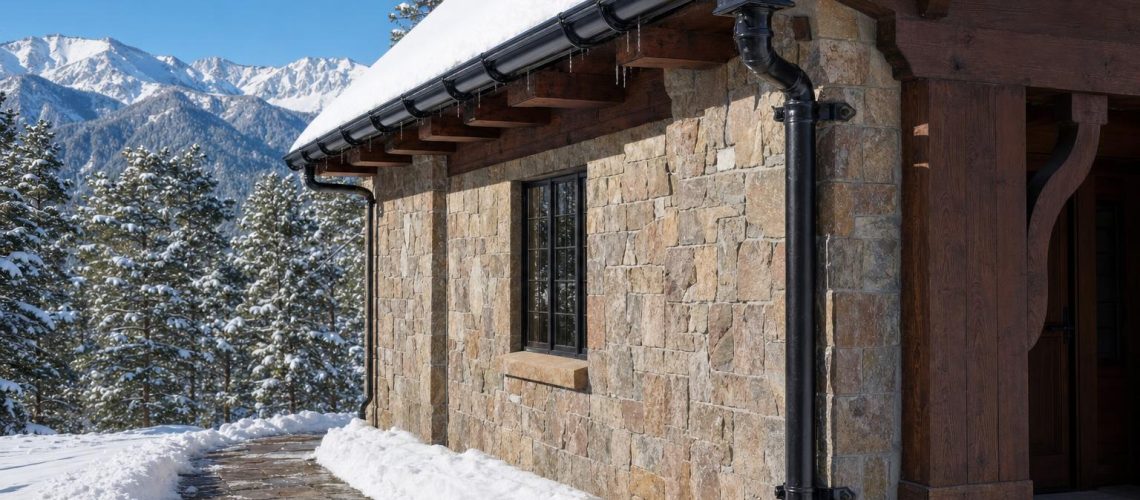
From Colorado ski country to the White Mountains of New Hampshire, American buildings in cold and exposed places ask more of their rainwater systems than most. This guide explains why cast iron gutters, downspouts and leader heads stand up to snow load, ice, wide temperature swings, impact and metal theft, where their limits lie, and how to specify them to last.
In brief
Cast iron gutters and downspouts suit cold, mountainous and vandal-prone sites because they are rigid, heavy-walled, slow to move with temperature and resistant to denting, crushing and bending. They also carry little scrap value, which makes them far less attractive to metal thieves than copper. Cast iron is not indestructible: water that freezes inside a blocked downspout can split it, and a hard impact can crack grey iron. Specify strong brackets at reduced centres, keep outlets and leaders clear, protect the lowest pipe section in public places, and maintain a sound paint system such as linseed oil.
Why cast iron is chosen for cold, mountain and high-risk sites
Cast iron gutters and downspouts perform well in cold climates, mountain regions and vandal-prone places because they are rigid, heavy and slow to move with temperature, so they resist the snow loads, sliding ice, impacts and temperature swings that bend, dent and distort lighter systems. That robustness is a property of the material, but it only delivers decades of service when the system is sized, fixed and maintained for the conditions it faces.
Two kinds of American enquiry have become increasingly common for us. The first comes from owners and architects building or restoring houses, lodges and inns in snow country: the Rocky Mountains, the Sierra Nevada, the Adirondacks, northern New England and the Upper Midwest. We have shipped cast iron rainwater goods to mountain regions where formed aluminium gutters had been torn away by sliding snow or crushed by ice. The second comes from managers of churches, schools, parks and civic buildings who are tired of replacing downspouts that have been kicked in, levered off the wall or stolen for scrap.
This guide covers both. It explains how cast iron behaves under snow, ice and freeze-thaw, what mountain exposure demands, why cast iron deters vandalism and theft, and, just as importantly, where its limits lie. If you are new to British terminology, our UK and US rainwater terminology guide translates downpipes, hopper heads and brackets into downspouts, leader heads and hangers.
What makes cast iron robust: the material science
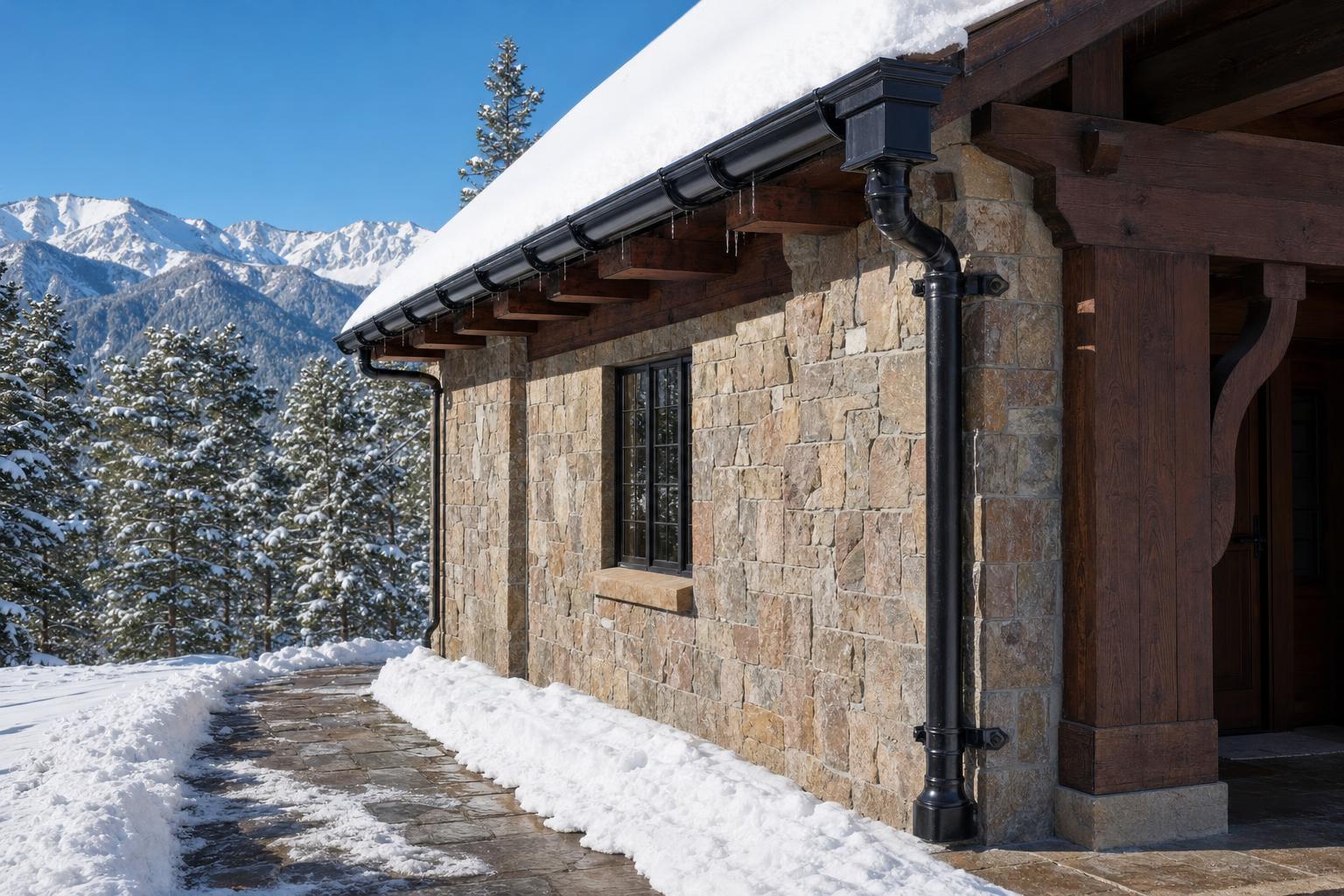
Cast iron’s performance comes from its wall thickness, its rigidity and its low thermal expansion, not from any special treatment. A cast iron gutter or downspout is a solid casting several times heavier than a formed sheet-metal equivalent of the same size, so it holds its shape under load and in impact.
- Rigidity. Grey cast iron is stiff. It does not sag between brackets under snow, it does not dent when a ladder is leant against it, and a downspout cannot be bent or flattened by hand.
- Weight and section. The mass that makes cast iron demanding to fix is also what makes it stable in high wind and hard to prise from a wall once its ears are fixed into masonry.
- Low thermal movement. Cast iron expands less with heat than aluminium, zinc or copper. On a mountain site where a sunlit roof edge can swing through a wide temperature range in a single day, that means less movement at joints and less work for the sealant. Our article on thermal movement in cast iron rainwater systems explains the mechanics.
- Non-combustibility. Cast iron does not burn and has a far higher melting point than aluminium, a point we return to below for wildfire-exposed sites.
| Material | Approximate linear expansion (×10⁻⁶ per °C) | Movement of a 30 ft (9.1 m) run over a 100 °F (56 °C) swing |
|---|---|---|
| Grey cast iron | 10.0–10.8 | about 0.2 in (5–5.5 mm) |
| Architectural copper | 16.0–18.0 | about 0.32–0.36 in (8–9 mm) |
| Titanium zinc | 22.0–23.0 | about 0.44–0.46 in (11–12 mm) |
| Aluminium | 23.0 | about 0.46 in (12 mm) |
The coefficients are the same figures we give in our technical article on thermal movement; the movement column is rounded and shows the relative difference, not a design calculation. The honest counterpart to rigidity is that grey cast iron is brittle under a sharp, concentrated blow. It will shrug off kicks and knocks that would crumple sheet metal, but a vehicle striking the base of a downspout or a hammer blow can crack it. Good specification plans for that, as we explain below.
Snow load, sliding snow and ice at the eaves
In heavy-snow regions, set cast iron gutters low enough that sliding snow passes over them, fix them with strong brackets at reduced centres, and treat ice dams as a roof insulation problem rather than a gutter problem. Gutters are damaged in snow country by three things: the weight of packed snow and ice sitting in them, snow sliding off the roof and striking them, and ice building up at the eaves.
Gutter position and snow guards
A gutter whose front edge projects above the line of the roof slope acts as a catch for sliding snow and will eventually be torn away. In snow country, set the gutter so that a straight edge laid on the roof slope clears its front lip. On steep slate, tile and metal roofs, snow guards (snow brakes) hold the snow in place until it melts. The National Park Service notes that snow guards were appearing on New England slate and metal roofs by the late 1800s, precisely to prevent snow sliding off in dangerous masses and banking at the eaves.
Brackets and fixings
Cast iron gutters are strong in themselves, so in snow country the weak point is usually the fixing. We recommend rafter brackets, which sit under the roof covering and transfer load directly into the rafters, wherever the eaves detail allows. Our standard guidance is a maximum of 3 ft (900 mm) bracket centres with brackets within 6 in (150 mm) of every joint and outlet; for heavy-snow sites we advise reducing centres and will recommend a spacing for your project. Our bracket spacing guide sets out the principles, and our fall and outlet guide covers fixing to timber and stone.
Ice dams
Ice dams form when heat escaping through a roof melts the underside of the snow; the meltwater runs down to the cold eaves and refreezes, building a ridge of ice that backs water up under the roof covering. No gutter, of any material, prevents an ice dam. The cure is insulation, air sealing and ventilation of the roof space. What cast iron does offer is resilience: it will carry the weight of ice that forms in it without deforming, provided the fixings are sound. Where owners choose to install self-regulating heat cable in gutters and downspouts, it should be designed and installed by an electrician and fixed without damaging the paint system.
Freeze-thaw: the one risk cast iron cannot ignore
The main cold-weather threat to cast iron is water freezing inside a blocked downspout, socket or leader head, because ice expands with enough force to split any pipe material. This is a maintenance and detailing issue, not a weakness peculiar to cast iron, and it is entirely preventable.
The damage usually happens over winter and is discovered in spring as a vertical split in a downspout or a cracked socket. Leaves, pine needles and grit collect at the outlet or in the head; water ponds behind the blockage; a hard frost turns it to ice. Our detailed guide to freeze-thaw and cast iron explains the mechanism and the pre-winter checks. The essentials for American cold-climate sites are these.
- Keep outlets and leaders clear. Clean gutters after leaf and needle fall and before the first hard frost. Guard the gutter outlet, not the downspout or head.
- Never let water stand. Check falls so gutters drain completely. Our guide to downpipe maintenance and blockages explains how standing water damages both the system and the building.
- Watch the base. Where a downspout runs into a below-grade drain that freezes, water backs up into the pipe. Consider a discharge shoe or an inspectable connection on sites where drains freeze.
- Size generously. Larger leaders and leader heads are less easily blocked. Our guide to hopper head capacity and downpipe sizes explains how outlets, heads and pipes work together.
- Maintain the paint. Breaks in the paint let moisture reach the iron; rust and ice together accelerate damage at joints and ears.
Mountain and high-altitude exposure
Mountain sites combine heavy snow with intense sunshine, strong winds, wide daily temperature swings and, in the American West, wildfire risk, and cast iron addresses each of them. Its low thermal movement copes with sun-to-shade swings, its weight resists wind uplift, and its rigidity copes with snow and ice.
Ultraviolet exposure increases with altitude and ages paint faster, so we recommend a maintained paint system rather than a coating left to fend for itself. Linseed oil paint weathers gradually by chalking rather than flaking, and can be refreshed with a clean and recoat rather than stripping back to bare metal, which makes it practical on remote buildings where maintenance visits are infrequent.
In wildfire-prone areas, gutters filled with dry needles and leaves can become an ignition point for embers. Cast iron is non-combustible and does not soften or melt at the temperatures that can distort aluminium, but the real protection is keeping gutters clear. Where local fire codes require gutter covers or particular details, follow them and tell us at quotation so we can advise on compatibility. Delivery to mountain sites also needs planning: tell us about access roads, seasonal closures, and whether a pallet can be offloaded on site.
Vandal resistance and metal theft
Cast iron downspouts resist vandalism because they cannot be dented, bent or flattened, are hard to prise from a wall once fixed by their ears, and have little scrap value compared with copper, which removes the main motive for theft. For churches, schools, parks and civic buildings, that combination often decides the specification.
Copper downspout theft is a persistent problem across the United States, and churches are frequent targets because they are large, often unattended and rich in copper. In one widely reported case, thieves removed thirteen copper downspouts from Saint Mary’s Episcopal Church in Wayne, Pennsylvania, overnight between Christmas and the following day. Beyond the cost of replacement, the building is left discharging water against its walls until new pipes are fitted. Cast iron offers thieves little reward for a great deal of effort, and on historic buildings a like-for-like cast iron replacement can also be the right preservation answer. Our churches and ecclesiastical buildings page sets out how we support places of worship.
Where cast iron still needs protection
Because grey iron is brittle under a sharp, concentrated blow, the lowest section of a downspout in a car park, service yard or busy street needs thought. On public and high-traffic sites we recommend the following.
- Protect the base. A heavy cast iron boot or shoe at ground level, or bollards and kerbs where vehicles manoeuvre, keeps impact away from the pipe.
- Fix through the ears into sound masonry. Our round cast iron downpipes carry cast ears for fixing; use fixings that are hard to remove with common tools on vulnerable elevations.
- Consider climbing. A rigid, well-fixed pipe can offer a hand-hold. Where roof access by intruders is a concern, route downspouts away from low roofs and windows or add anti-climb measures in line with local regulations.
- Inspect after incidents. A cracked section is simple to replace like for like; leaving it allows water and frost to finish the job.
Historic buildings in cold regions: the preservation view
On historic buildings in cold climates, the preservation approach is to repair cast iron where it is sound and replace failed sections in kind, matching material, profile and detail. That aligns with the Secretary of the Interior’s Standards, which favour repair over replacement and, where replacement is necessary, new work that matches the old.
The National Park Service’s Preservation Brief 27, on the maintenance and repair of architectural cast iron, notes that water penetrating hollow cast iron elements can freeze and crack them, and that long-term preservation depends on timely repair and a regular maintenance programme. Both points apply directly to leaders, leader heads and gutters in snow country. Where a historic system has lost sections to frost or impact, we can copy cast matching components from photographs, a measured drawing or a surviving piece shipped to us, and keep the pattern for future repairs. In a local historic district, check whether a Certificate of Appropriateness is needed before replacing any visible rainwater goods; like-for-like cast iron is usually the simplest route to approval.
Specifying cast iron for demanding American sites
Match the specification to the exposure: the material stays the same, but the fixing, sizing, finish and detailing change with the site. The table summarises our starting recommendations, which we refine for each project.
| Site condition | Main risks | Our recommendations |
|---|---|---|
| Heavy snow (Rockies, Sierra, northern New England) | Snow load, sliding snow, ice | Rafter brackets at reduced centres; gutter set below roof line; snow guards on the roof; larger outlets |
| Severe freeze-thaw (Upper Midwest, Great Lakes) | Ice in blocked pipes and heads | Generous leader and head sizes; outlet guards; pre-winter cleaning; inspectable base connections |
| High altitude and strong sun | UV ageing, wide temperature swings, wind | Maintained linseed oil paint system; sound fixings into structure |
| Coast and cold together (Maine, Massachusetts) | Salt air plus freeze-thaw | Our coastal specification with full maintenance plan |
| Wildfire-exposed (mountain West) | Ember ignition of gutter debris | Non-combustible cast iron; keep gutters clear; follow local fire code details |
| Public, unattended or high-traffic | Impact, prising, theft | Eared pipes fixed into masonry; protected base; route away from low roofs |
For coastal cold sites, our coastal specification adds enhanced preparation and paint build. Our guide to corrosion protection and paint systems explains why humidity and salt matter. Profiles and sizes for every component are listed in our product catalogue, and leader heads in our cast iron rainwater heads range.
Lead times, freight and site information
Standard stock items are available for prompt despatch, and we confirm current availability with every quotation. Bespoke and copy-cast items typically take 12–14 weeks, and sea freight to the USA can add up to three months, so order well before a mountain site’s construction season closes. Our international supply and shipping page explains freight, duties and paperwork. Our measure-up checklist sets out what we need for a quotation; for complex or damaged historic systems, a site survey or visit is a chargeable service we can discuss, or we can review a measured survey prepared by a local architect.
Common mistakes in cold and high-risk settings
Most failures in snow country and on public sites come from weak fixings, poor gutter position and neglected maintenance, not from the cast iron itself. Each of these is avoidable.
- Fixing heavy gutters to trim boards. Brackets must reach rafters or structure.
- Setting the gutter above the roof line. Sliding snow will strip it off.
- Expecting gutters to cure ice dams. Insulate and ventilate the roof.
- Fitting a balloon or grating in the leader head. It blocks quickly and traps water to freeze; guard the gutter outlet instead.
- Leaving the base unprotected in car parks. Use a heavy boot or bollards.
- Letting the paint lapse. Rust and ice together shorten service life. Our list of ten signs your guttering is failing helps owners spot problems early.
Historic buildings: cold, high and exposed: lessons from American landmarks
The buildings below face some of the most demanding conditions in the United States. None is cited as one of our projects; each illustrates the challenges rainwater systems face in cold, high and exposed places.
The Stanley Hotel, Estes Park, Colorado
F. O. Stanley, co-founder of the Stanley Motor Carriage Company, built this Georgian Revival hotel between 1907 and 1910, opening it on 4 July 1909 a few miles from what is now Rocky Mountain National Park. Listed as a National Register historic district in 1977, it faces Rocky Mountain snow, strong sun and wide daily temperature swings. Buildings like it show why rainwater systems at altitude need rigid materials, sound fixings and a well-maintained paint system.
Mount Washington Hotel, Bretton Woods, New Hampshire
Charles Alling Gifford designed this Spanish Renaissance-style hotel for Joseph Stickney, completed in 1902 beneath Mount Washington, whose summit is famous for extreme weather. A National Historic Landmark since 1986, its long roofs and octagonal towers shed heavy White Mountains snow. It demonstrates the principles of snow country: gutters set clear of sliding snow, strong brackets, and leaders sized so meltwater drains before it can refreeze.
Vermont State House, Montpelier, Vermont
Designed by Thomas Silloway and essentially complete by 1859, the Greek Revival State House is built of Barre granite with a gilded copper-sheathed dome, incorporating a portico that survived the fire of 1857. It was restored in the 1990s. Vermont’s long winters and freeze-thaw cycles test every joint in a building’s water-shedding system, which is why regular clearance of outlets and leaders matters as much as the original materials.
Montana State Capitol, Helena, Montana
Begun in 1896 to George R. Mann’s approved design and completed in 1902 by Charles Bell and John Kent, with wings added in 1911–12, the Neoclassical Capitol is built of sandstone and granite beneath a copper dome. It was repaired after the 1935 earthquake. Helena’s cold winters and dry, sunny climate combine freeze-thaw with intense UV, conditions in which rigid, low-movement rainwater goods and durable paint systems prove their worth.
Saint Mary’s Episcopal Church, Wayne, Pennsylvania
Thieves removed thirteen copper downspouts from this church overnight over Christmas, an incident investigated by Radnor Township police and widely reported. Cases like this recur across the country because copper carries high scrap value. Beyond replacement costs, a church without downspouts discharges water against its walls and foundations. Where like-for-like is not required, cast iron offers thieves little reward and gives the building a robust, long-lived alternative.
Frequently asked questions
Are cast iron gutters good for areas with heavy snow and ice?
Yes. Cast iron gutters are rigid and heavy-walled, so they do not sag or deform under packed snow and ice. Fix them with rafter brackets at reduced centres, set them below the line of the roof slope so sliding snow passes over, and fit snow guards on steep roofs.
Do cast iron downspouts crack in freezing weather?
Not from cold alone. Cracks happen when water trapped behind a blockage freezes and expands, which can split any pipe material. Keeping gutter outlets, leader heads and downspouts clear before winter prevents almost all freeze-thaw damage.
What are the best gutters for a mountain home in Colorado or Montana?
For a mountain home, rigid cast iron gutters and downspouts with strong rafter brackets, generous outlets and a maintained paint system cope well with snow, sun and wide temperature swings. Cast iron is also non-combustible, which helps in wildfire-prone areas if gutters are kept clear.
Will cast iron gutters stop ice dams?
No gutter prevents ice dams, because they are caused by heat escaping through the roof and melting snow that refreezes at the eaves. The cure is roof insulation, air sealing and ventilation; cast iron simply carries the weight of any ice that forms without deforming.
Are cast iron downspouts vandal-proof?
They are highly vandal-resistant rather than vandal-proof. Cast iron cannot be dented or bent and is hard to prise off a wall, but a sharp blow or vehicle impact can crack it, so protect the base with a heavy boot or bollards in car parks and public places.
How do I stop thieves stealing copper downspouts from a church?
Replacing stolen copper with cast iron removes most of the incentive, because cast iron has little scrap value. On historic churches, check whether like-for-like replacement is required by the local preservation commission before changing material.
How long does it take to get cast iron gutters shipped to a mountain site in the USA?
Stock items are available for prompt despatch and bespoke items typically take 12–14 weeks, with sea freight adding up to three months. Order well before the site’s building season closes, and tell us about access roads and offloading at quotation.
About Tuscan Foundry Products
Cast iron earns its reputation in snow country and on exposed public buildings because it is rigid, heavy, slow to move and of little interest to thieves. It lasts longest where it is fixed into structure, positioned clear of sliding snow, kept free of blockages before winter, protected at the base where vehicles and crowds pass, and finished with a paint system that is maintained rather than forgotten.
We are Tuscan Foundry Products, a British cast iron business established in 1893, supplying traditional rainwater goods to historic and new buildings across the United Kingdom, the United States and worldwide, including mountain regions where lighter systems have failed. We supply cast iron gutters, downspouts and leader heads to BS 460, cast bespoke and copy-cast components to order, and finish them in linseed oil paint or our coastal specification. To discuss a cold-climate, mountain or high-risk site, send drawings or photographs through our contact page or call +44 333 987 4452. For older American properties, see also our guide to cast iron gutters and leader heads in America.