
Established 1893 | BS 460:2002 Certified | UK & International Supply | Expert Technical Support | 0333 987 4452
Cast iron gutters and downpipes do not crack because winter is cold. They crack because water is allowed to sit in them when it freezes. This guide explains how frost damage happens, why it so often goes unnoticed until spring, and the checks, repairs and paint upkeep that stop it, written for owners of listed and period properties first and the contractors who look after them second.
Technical summary. Frost damage to cast iron rainwater goods is almost always caused by trapped water. When a blocked downpipe, a choked hopper head or a sagging gutter holds water and it freezes, the ice expands by roughly nine per cent and pushes outwards on a material that is very strong in compression but comparatively weak and brittle in tension. Sockets split, downpipes crack lengthwise (very often at the back, against the wall), and hopper heads open at their corners. The damage usually shows in spring, when the ice melts and the first heavy rain finds the crack. Prevention is unglamorous: clear outlets, hoppers and gullies before the first frost, restore lost fall, re-make failed joints, and keep paint sound on every face, including the back. A split length should be replaced like for like as a single length, not the whole run. Matching standard items are quick to obtain; unusual profiles may need copy casting, with a lead time of 12–14 weeks from pattern approval.
Cast iron gutters and downpipes crack in winter because water trapped inside them freezes, expands and splits the iron from within; keep the water moving and the iron will see out the frost. A well-maintained cast iron system will go through decades of hard winters without a mark. A neglected one can lose a socket, a downpipe length or a hopper head in a single cold night.
The real exposure is not the cost of one length of pipe. It is what follows a split nobody has noticed: water discharged down the face of a solid wall for weeks, saturated brick or stone, damp inside, decayed lintels and joist ends, and, on a listed building, the added risk of a hurried replacement in the wrong profile or material that the conservation officer then asks to be put right.
This guide is a supporting technical guide to our autumn checklist, Ten Signs Your Cast Iron Guttering Is Failing. That article tells you what to look for from the ground. This one goes deeper into a single cause, frost, and explains how it does its damage, how to stop it, and how to repair it properly when it has already happened.
Cast iron is rigid, heavy and very strong when it is squeezed, but it has little tolerance for being stretched; ice forming inside a closed or part-closed section stretches it, and the iron cracks rather than bends. That single property explains nearly every frost failure we see.
Water expands by roughly nine per cent in volume as it turns to ice. In an open gutter with a clear outlet, that expansion has somewhere to go: the ice simply rises. In a downpipe blocked at the shoe, in the annular gap of a socket, or in a hopper head full of wet leaves, the water is confined. As it freezes from the outside inwards, the outer skin of ice locks the remaining water in, and the pressure on the surrounding walls climbs until something gives.
Grey cast iron, the material traditional rainwater goods are made from, is considerably stronger in compression than in tension. Its internal structure contains flakes of graphite, which make it excellent to cast and very stable in service, but which also act as tiny internal notches when the metal is pulled. Steel or lead would stretch, bulge and perhaps survive. Cast iron, put into tension by expanding ice, cracks suddenly and cleanly. The crack is often fine, sometimes almost invisible, and it does not close up again when the ice melts.
This is not a defect. It is the same rigidity that keeps cast iron runs straight for a century, and the reason its joints stay tight for so long. It simply means that cast iron depends on the system being kept clear and draining.
A single frost does not always crack anything. What it does is open joints a little, lift paint a little and push water a little further into any existing flaw. On the next thaw, more water gets in. On the next frost, it freezes again. This ratchet is why a fault left over one winter is usually worse by spring, and why the least costly time to fix any rainwater defect is before November.
Frost damage concentrates where water can be held and confined: downpipe sockets, the length of a blocked pipe, hopper heads, gutter joints and any stretch of gutter that holds standing water. Knowing these points lets you inspect efficiently.
The socket is the enlarged end of each downpipe length that receives the plain spigot of the length above. It is the commonest frost failure on a cast iron system. Silt, moss and leaf debris collect in the gap between socket and spigot, hold water against the iron and freeze. Because the socket is a ring, ice inside it puts the whole circumference into tension, and it splits, typically with a single vertical crack and sometimes with a piece breaking out. Sockets with ears cast on are restrained further by their fixings, which adds to the stress.
When a downpipe is blocked low down, usually at the shoe, an offset or a bend, water backs up the pipe. If it freezes, the whole column becomes an ice plug, and the pipe splits lengthwise. In our experience these splits are very often at the back of the pipe, against the wall. That is the face nobody paints properly, where rust has been quietly thinning the wall for years, and where the crack will not be seen from the garden.
Hopper heads (rainwater heads) are open-topped boxes, and they collect everything that comes off the roof. A hopper half full of leaves and silt is a sponge. When it freezes solid, the flat sides bow outwards and the corners, where the casting changes direction, crack. Ornamental and dated hopper heads are among the most significant castings on a period building and the hardest to replace. Our cast iron rainwater heads page shows the range of patterns involved.
Open gutters are less vulnerable than pipes because ice can rise out of them. The damage comes at the joints, where water held in a failed joint freezes and forces the two lengths apart, and at outlets, where an ice plug turns the gutter into a trough that fills and freezes along its length. Ogee gutters fixed directly to the fascia or onto a stringcourse are more exposed than half-round gutters in brackets, because water held at the back cannot drain away.
Frost is the trigger, but the cause is almost always something that was wrong before the cold arrived: a blockage, a failed joint, a gutter that has lost its fall, or rust thinning the iron where nobody looks. Fix these and the frost has nothing to work with.
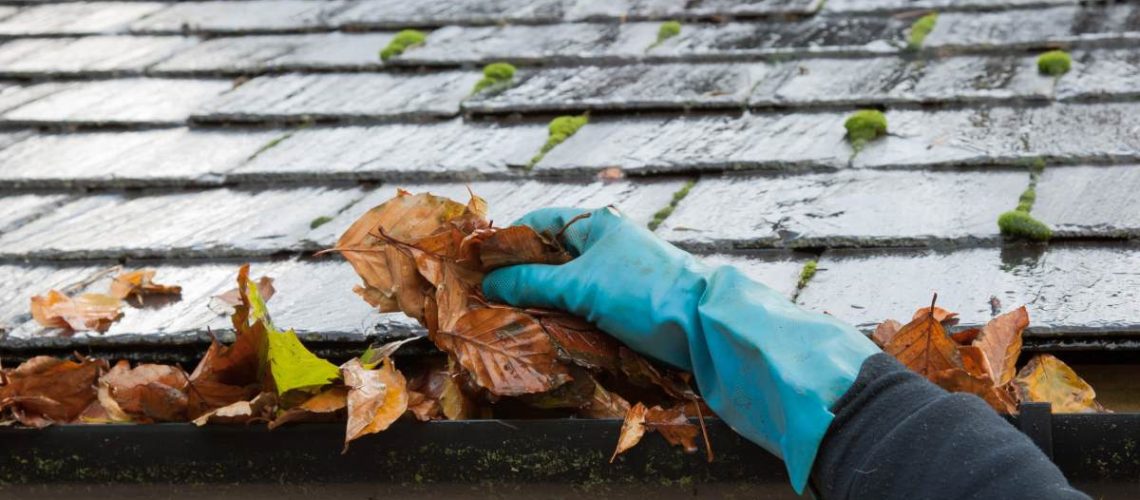
Leaf fall peaks just as the first frosts arrive. Leaves, moss, silt and nesting material collect at outlets, in hopper heads and at the foot of downpipes. A blocked gully at ground level will back water up the shoe and into the bottom length of pipe. Our guide on how blocked rainwater systems damage historic buildings covers the wider consequences; for frost, the point is simple: a blockage creates the confined water that ice needs.
Cast iron gutter joints are bedded in a jointing compound and bolted. As the compound ages it dries, shrinks and cracks, and water finds its way into the joint. Each frost then opens the joint a little more. Downpipe sockets that have been rigidly filled with hard mortar or cement in some past repair are worse still: the joint can no longer move at all, and the stress goes straight into the socket.
A gutter should fall gently towards its outlet. When a bracket drops or a fixing pulls out of a rotten fascia, the run sags and holds a line of standing water. In winter that water freezes into a strip of ice that adds weight, loads the brackets further and freezes into the nearest joint. Restoring fall is a bracket and fixing repair, not a reason to replace the gutter.
On almost every period building we are asked about, the backs of the downpipes have been painted less often than the fronts, or not at all. Downpipes fixed tight to the wall, or with spacers that have been lost or flattened over the years, cannot be reached with a brush. Rust there goes unseen, thins the pipe wall and leaves a weak line exactly where a frost split will run. Our article on cast iron corrosion protection explains how this corrosion progresses.
Heavy snow and ice add weight a gutter system was never meant to carry for long, and an ice dam at the eaves can drive meltwater back over the gutter and into the wall head. Brackets and fixings take that load, and where they are already weakened, they fail.
An ice dam forms when snow on a roof melts during the day, runs down to the colder eaves and refreezes in the gutter or at the outlet. Successive days build up a ridge of ice. Meltwater arriving behind it has nowhere to go but over the back of the gutter, down the fascia and into the top of the wall. On a solid-walled period house, that is the most vulnerable place for water to enter. Ice dams are most likely on north-facing slopes, behind parapets and in valleys where the sun never reaches.
Packed snow and ice in a gutter weigh a great deal more than water flowing through it. Half-round gutters sit in brackets fixed to rafter feet or fascia; ogee gutters are screwed through their backs into the fascia. If the brackets are corroded, too widely spaced after an earlier repair, or fixed into soft timber, a heavy load can bend them, pull the fixings or crack a gutter length across. Snow sliding off a steep roof as a single mass can strike the front edge of a gutter hard enough to break it.
Frost splits are usually made in the coldest weeks of winter but discovered weeks later, because the ice holds the crack closed and plugs the pipe until it melts, and because the split is often on the back of the pipe where it cannot be seen. By the time the leak is obvious, it may have been discharging down the wall for some time.
While the pipe is frozen, nothing flows, so nothing leaks. The cold spells that cause splits are often dry, so the crack waits for the next heavy rain. And many splits are hairline and on the wall side of the pipe. The first sign is often not the crack itself but a damp patch, a green streak on the brickwork, or a wet stain inside at first-floor level that appears in March or April.
That is why we recommend an inspection in rain soon after any prolonged hard frost, and again in early spring, rather than waiting for symptoms indoors. The longer a frost split leaks, the more the repair grows beyond the cost of a single length of pipe.
The most effective protection against frost damage is a thorough clear and check in late autumn, once most leaves are down and before the first sustained frost. Most of it can be observed from the ground; the clearing and close inspection should be done by a competent contractor working from a safe platform.
| Check | What you are looking for | Why it matters in frost |
|---|---|---|
| Gutters and outlets | Leaves, moss, silt, vegetation; standing water after rain | Standing water freezes into joints and outlets |
| Hopper heads | Debris more than a hand’s depth; plants growing out | A packed hopper freezes solid and splits at the corners |
| Downpipes | Water flowing freely from shoe in rain; no overflow at sockets | A blocked pipe becomes an ice plug and splits lengthwise |
| Shoes and gullies | Gully gratings clear; shoe not buried in soil or gravel | A blocked gully backs water up into the bottom length |
| Gutter joints | Drips, rust stains or old sealant smeared over joints | Water held in joints freezes and forces them apart |
| Fall and brackets | Sags, back-fall, dropped or bent brackets | Standing water and extra load from ice and snow |
| Downpipe sockets | Cracks, rust bloom, hard mortar packed into the joint | The socket is the commonest frost failure |
| Backs of pipes | Rust, flaking paint, pipe tight to the wall | Thinned iron is where a split will run |
| Paint condition | Blistering, bare metal, rust bleed on any face | Bare iron corrodes and fails sooner under frost |
| Fixings | Loose ears, missing spacers, corroded nails or screws | Ice and snow loads find weak fixings |
Our measure-up checklist for cast iron rainwater goods sets out what to record if a length or fitting needs replacing, so that the correct profile and size can be identified first time.
After a hard frost, let the ice thaw naturally, then inspect in the first rain: look at every socket, the backs of the pipes and the hopper heads, and act quickly on anything that is leaking against the wall. Do not try to force the ice out.
If the cause is not obvious, or damage is found on several elevations, a structured inspection is worth commissioning before anything is ordered. Our chargeable site survey and visit service identifies profiles, sizes, failures and causes, and a proportion of the survey fee is credited against a subsequent supply order. It is the start of the process that protects the project, not an extra.
A frost-split cast iron length should be replaced as a single length, matched to the existing profile and size; the rest of a sound run should be kept. Cracks in cast iron cannot be reliably sealed, and replacing a whole run because one length has split discards historic fabric unnecessarily.
Fine cracks in cast iron do not close and do not respond well to fillers or sealants, which fail at the first movement or the next frost. Cast iron can be welded or stitched by specialists, but this is skilled workshop work, not something to attempt on a wall. It is usually reserved for ornamental or historically significant pieces, such as a dated hopper head, where the casting itself carries value.
Conservation practice is to retain as much original fabric as possible and replace only what is beyond repair. On a frost-damaged downpipe that usually means one length, sometimes two; on a gutter, one length and its joints. The neighbouring components come off carefully, the new length is fitted, and joints are re-made. Our guide to cast iron guttering and our product catalogue set out the standard profiles and sizes.
The replacement must match the original in profile, size, socket and ear detail. Common round downpipe sizes and the main gutter profiles (half-round, ogee, beaded and moulded) are standard items. Older buildings, however, often have pre-metric sizes, rectangular or ornamental pipes, cast ears in unusual positions, or decorated sockets, which standard patterns do not reproduce exactly.
Where no standard pattern matches, we can copy cast from a surviving original, a good fragment or accurate measured drawings. Our bespoke castings page explains the process.
| Item | Typical lead time |
|---|---|
| Stock items | 5–7 working days |
| Non-stock standard items | 7–10 working days |
| Bespoke and copy casting | 12–14 weeks from pattern approval |
| Radius gutters | 12–14 weeks |
| Linseed oil paint finish | Adds 6–7 weeks |
The practical lesson is timing. A frost split discovered in March on an unusual downpipe, finished in linseed oil paint, is a summer installation. Identifying damage early, and ordering promptly, keeps the building watertight sooner.
Sound paint on every face of the casting, including the back of each downpipe and the back of each gutter, is the long-term defence against the rust that makes cast iron vulnerable to frost. A thinned, pitted pipe splits far more readily than a sound one.
When rainwater goods are repainted, the front is usually done well and the back badly. Where a downpipe can be taken down carefully for painting, that is the best opportunity to treat the back and the inside of the socket properly. Where it cannot, a contractor should work a brush behind the pipe as far as possible, and the gap from the wall should be reinstated (see the next section) so that future maintenance can reach it.
Inspect the paint every year and touch in damage before winter. Full redecoration intervals depend on exposure and on the paint system; a sheltered elevation will last much longer than a south-west-facing wall near the coast. What matters for frost is that bare metal is never left exposed through a winter.
Linseed oil paint is the traditional finish for cast iron and remains the heritage-appropriate choice for listed and period buildings. It penetrates and adheres well to prepared iron, stays flexible rather than becoming brittle, and weathers gradually by chalking at the surface rather than failing in sheets. That makes maintenance simpler: a weathered linseed finish can usually be cleaned and recoated without stripping back to bare metal. We apply our linseed oil paint finish in our Mid Wales workshop before despatch, so that every face, including the backs and the insides of sockets, is properly coated before the casting goes on the wall.
Downpipes should stand clear of the wall on spacers or bobbins, so that the back can be painted, air can circulate, and any leak runs down the pipe rather than into the masonry. A downpipe fixed tight to the wall cannot be maintained properly and is the one most likely to split unseen.
Traditional cast iron downpipes are fixed through cast ears on the socket, with a spacer (often called a bobbin or distance piece) behind each ear holding the pipe off the wall. Over the years, spacers are lost during repainting or left out when a pipe is refixed. The pipe ends up hard against the brick or stone, the back becomes inaccessible and permanently damp, and rust begins.
When a frost-damaged length is replaced, or a run is taken down for repainting, reinstate the spacers and use non-ferrous or stainless fixings into sound joints. Choose a gap that allows a brush to reach behind the pipe, while keeping the pipe in line with any hopper above and shoe below. Pipes without ears are held in separate holderbats, which also set the distance from the wall.
Electric trace heating in gutters and downpipes can stop ice forming at a specific problem point, but it does not address the cause of frost damage, adds visible equipment to a historic elevation, and is not a conservation answer in most cases. It has a narrow and specific place.
Some buildings have a genuine, recurring ice problem that maintenance alone cannot solve: a north-facing valley or parapet gutter that never sees the sun, an internal box gutter discharging through a long concealed pipe, or a hopper serving a large roof area in an exposed upland location. In those cases, a carefully designed, discreetly routed, self-regulating system installed by a qualified electrician may be a reasonable measure, provided the conservation officer has been consulted and the work is reversible.
Our position is that the first answer is maintenance, sound joints and good fall. Where a building still has a persistent ice problem after that, the conversation should involve the owner, the conservation officer and a qualified electrician, not a quick purchase.
Like-for-like repair of cast iron rainwater goods, including replacing a frost-split length with an exact match in cast iron, generally does not need Listed Building Consent, but the local planning authority’s conservation officer is the person who decides, and you should check with them before work starts. Changes in material, profile, size, colour or position usually do need consent.
In England, the relevant guidance comes from Historic England and is applied by the local planning authority; in Wales, Cadw provides the national guidance and the local planning authority administers consent. Carrying out unauthorised works to a listed building is a criminal offence, so the cost of getting this wrong goes well beyond the price of a pipe. The risk is greatest when frost damage is found in a hurry and a contractor proposes a quick, non-matching substitute.
A short email to the conservation officer, with photographs of the damage, a note of what is to be replaced and confirmation that the replacement will match in cast iron, is usually all that is needed. Our guide to what needs Listed Building Consent covers the wider framework.
Most frost damage is avoidable, and most frost repairs that go wrong do so through haste. These are the mistakes we see most often.
The following are representative scenarios drawn from the kinds of enquiry we receive. They describe typical buildings and problems; they are not accounts of specific named projects.
Case study: Georgian terrace, northern England
A Grade II listed terrace house had a downpipe that had been refixed tight to the brickwork years earlier. After a cold January, a damp patch appeared in a first-floor bedroom in March. Inspection found a lengthwise split on the back of one length, invisible from the street. The length was replaced with a matching round pipe in cast iron, spacers were reinstated, and the conservation officer confirmed by email that no consent was needed for the like-for-like repair.
Case study: Village church, Mid Wales
A listed parish church had two ornamental hopper heads serving a large nave roof. Both filled with leaves each autumn, and one cracked at a corner after a hard frost. No standard pattern matched. The surviving hopper was used as the pattern for a copy casting, with 12–14 weeks allowed from pattern approval plus time for a linseed oil finish. The church introduced an annual autumn clear of all hoppers, recorded in its logbook.
Case study: Victorian villa, Midlands
An ogee gutter on a period villa had lost its fall after a fascia board softened. Standing water froze along the run, opened two joints and cracked one length at the outlet. The fascia was repaired, the run re-bracketed to fall, the joints re-made and the single cracked length replaced. The rest of the original gutter was retained and repainted, including the back face against the fascia.
Case study: Farmhouse, upland Pennines
A stone farmhouse at altitude suffered ice dams at a north-facing eaves each winter. Meltwater ran over the back of the gutter into the wall head. The owner had been advised to fit heating cable. A site survey instead found a choked outlet and a downpipe blocked at an offset, so meltwater had no route out. Clearing both, re-making the outlet joint and adding the gutter to an autumn clearing routine resolved most of the problem without any electrical equipment.
Case study: Coastal town house, south-west England
A painted downpipe on an exposed seafront elevation split at two sockets after a rare hard frost. The pipe had been painted at the front only for many years, and rust had thinned the sockets from behind. Both lengths were replaced in matching cast iron supplied with a linseed oil finish to every face, and the owner set a two-yearly inspection and touch-in cycle for the elevation.
| Question | Answer |
|---|---|
| Why do cast iron downpipes crack in winter? | Cast iron downpipes crack in winter when water trapped inside them freezes and expands by roughly nine per cent. Cast iron is strong in compression but brittle in tension, so the expanding ice splits sockets and pipe lengths rather than bending them. The water is almost always trapped by a blockage lower down. |
| Can frost damage cast iron gutters as well as downpipes? | Yes, but open gutters are less vulnerable than pipes because ice can rise out of them. Damage usually occurs at failed joints, at blocked outlets and along sagging runs that hold standing water, where ice forces joints apart or cracks a length. |
| How do I stop my cast iron gutters freezing and cracking this winter? | Clear gutters, outlets, hopper heads, downpipes and gullies in late autumn, re-make any weeping joints, restore fall to any sagging runs and touch in bare metal before the frost. Water that drains away cannot freeze inside the iron. |
| Why did my cast iron downpipe only start leaking in spring? | Frost splits usually happen in the coldest weeks but stay hidden while the pipe is frozen, during dry spells and when the crack is on the back of the pipe. The leak appears when the ice melts and the first heavy rain arrives. |
| Can a cracked cast iron downpipe be repaired or does it need replacing? | A cracked length should be replaced. Cracks in cast iron cannot be reliably sealed with fillers or tape, which are only temporary measures. Specialist welding is possible in a workshop but is normally reserved for significant ornamental pieces. |
| Do I need to replace the whole run if one length of cast iron pipe has split? | No. Replace the damaged length only, matched to the existing profile and size, and keep the rest of the sound run. Retaining original fabric is good conservation practice and avoids unnecessary cost. |
| How long does it take to get a replacement cast iron downpipe length? | Stock items are typically despatched in 5–7 working days and non-stock standard items in 7–10 working days. Bespoke and copy cast components take 12–14 weeks from pattern approval, and a linseed oil paint finish adds 6–7 weeks. |
| What if my downpipe or hopper head is an unusual pattern that is no longer made? | We can copy cast it from a surviving original, a good fragment or accurate measured drawings. Allow 12–14 weeks from pattern approval, plus 6–7 weeks if a linseed oil paint finish is required. |
| Should I pour hot water on a frozen cast iron downpipe? | No. Pouring boiling water on cold cast iron causes sudden local heating that can stress the casting, and the water often refreezes further down. Let the ice thaw naturally and inspect in the first rain afterwards. |
| Why should cast iron downpipes be spaced away from the wall? | Spacers or bobbins hold the pipe off the wall so the back can be painted, air can circulate and any leak runs down the pipe rather than into the masonry. A pipe fixed tight to the wall rusts unseen at the back and is more likely to split in frost. |
| Is heat tape a good idea for cast iron gutters on a listed building? | Rarely. Trace heating treats the symptom rather than the cause, adds visible cables and fixings that may need consent, and needs power and maintenance. It may be justified at a specific persistent ice point once blockages, fall and joints have been put right, and only after consulting the conservation officer. |
| Do I need Listed Building Consent to replace a frost-damaged cast iron gutter or downpipe? | Like-for-like repair in matching cast iron generally does not need Listed Building Consent, but the local planning authority's conservation officer decides. Check with them before work starts. Changes in material, profile, size, colour or position usually need consent. |
| How often should cast iron rainwater goods be painted to prevent frost damage? | Inspect the paint every year and touch in any bare metal before winter. Full redecoration intervals depend on exposure, but every face should be kept sound, including the backs of downpipes and gutters. |
| Is linseed oil paint suitable for cast iron gutters and downpipes in cold climates? | Yes. Linseed oil paint stays flexible, adheres well to prepared iron and weathers gradually rather than failing in sheets, which makes it well suited to exposed and cold locations and simpler to maintain. |
| Can snow damage cast iron gutter brackets? | Yes. Packed snow and ice are far heavier than flowing water, and snow sliding off a roof can strike the front edge of a gutter. Corroded, widely spaced or poorly fixed brackets can bend or pull out under that load. |
| When should I get a site survey for frost-damaged cast iron rainwater goods? | Commission a survey when damage is found on several elevations, when the cause is unclear, when components are unusual or ornamental, or when access is difficult. Our site survey is chargeable, with a proportion credited against a subsequent supply order. |
Frost does not damage a cast iron rainwater system that drains. The practical recommendations follow directly from that:
Where a length or fitting needs replacing, we supply matching cast iron rainwater goods to BS 460:2002, from standard stock through to copy casting of unusual patterns, with our linseed oil paint finish applied in our Mid Wales workshop where required. We are a supply-only business: we do not install, but we give technical and application advice to your contractor. Where the cause or scope of the damage is unclear, our chargeable site survey establishes it before money is spent.
For advice on a frost-damaged gutter, downpipe or hopper head, contact us or call 0333 987 4452.