
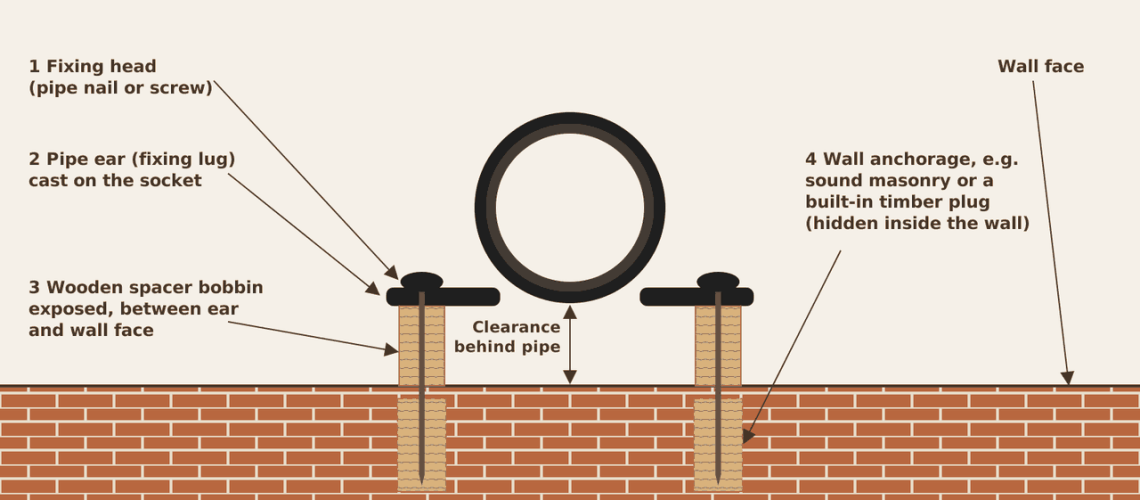
How wooden spacer bobbins, pipe ears, pipe nails and holderbats work together to hold cast iron downpipes clear of historic walls, and what to check before you repair or replace them.
Technical summary
A wooden downpipe bobbin is a short, pre-drilled timber spacer that sits between the fixing ear of a cast iron downpipe (or a suitable bracket foot) and the face of the wall. The pipe nail or screw passes through the ear and the bobbin before it engages a sound anchorage in the wall. The bobbin does one job: it holds the pipe clear of the masonry, which makes the back of the pipe easier to inspect, clean and paint and keeps the rainwater goods separated from the building fabric. It is not a wall plug, it does not anchor anything, and it cannot compensate for a failed fixing. On soil stacks it is never, on its own, a support system.
Contents
A wooden downpipe bobbin is a pre-drilled timber spacer fitted between the ear of a cast iron downpipe and the wall face, so that the pipe stands clear of the masonry. The fixing passes through the ear, through the bobbin and into a sound anchorage in the wall. The bobbin spaces; it does not anchor. Getting that distinction right is the difference between a sound repair and one that only looks traditional.
This guide is written for owners of period and listed buildings, conservation architects and surveyors, contractors and rainwater installers, and anyone trying to understand a pipe-fixing detail they have found on site. It explains what bobbins are called, where they sit, how they are fitted, why the gap matters, when a bobbin is the wrong answer, and what historical evidence actually tells us. We supply wooden pipe bobbin spacers alongside the cast iron downpipes and fixings they are used with, and the questions in this article are ones we are asked every week.
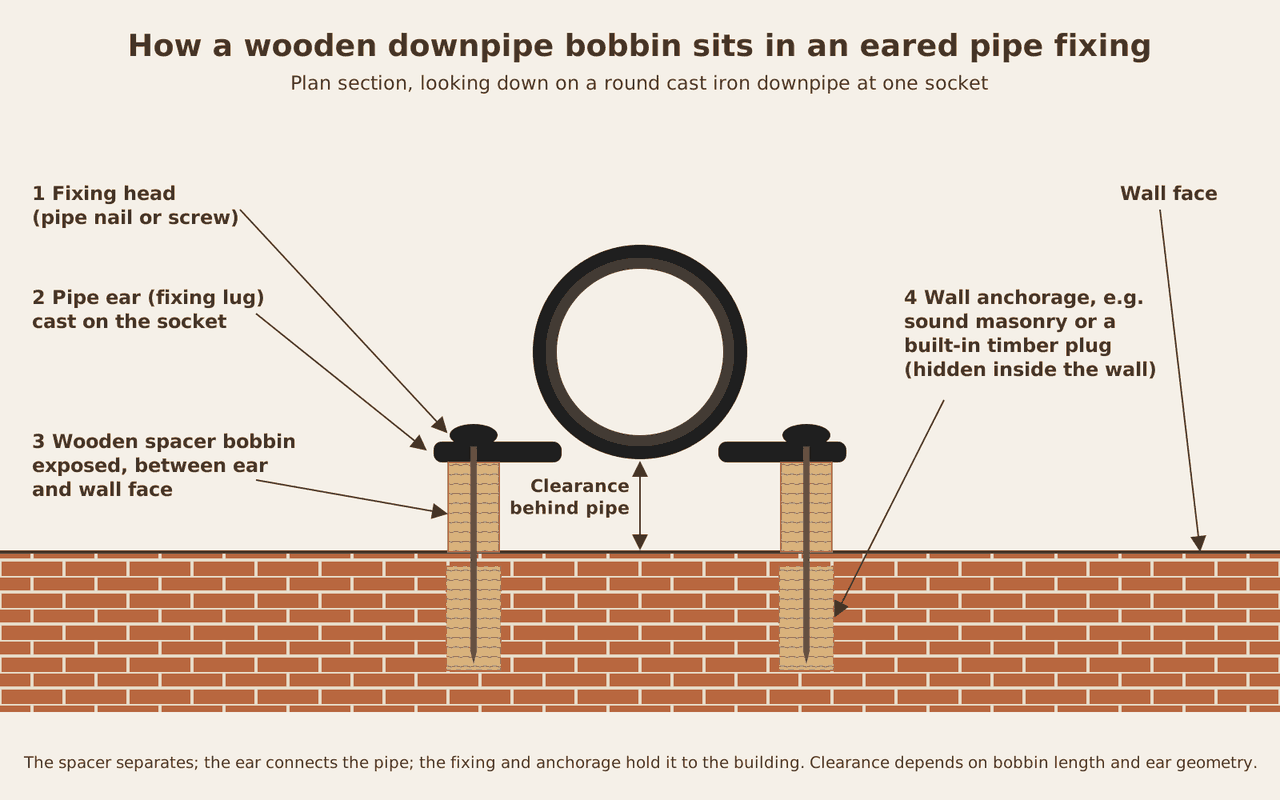
A wooden downpipe bobbin is a short cylinder of timber with a hole bored through its centre. It is placed behind each fixing ear of an eared cast iron rainwater pipe, or behind the foot of a suitable separate pipe clip, so that when the fixing is driven home the pipe is held a set distance off the wall.
Three separate components are at work at every fixing point, and each has its own job:
A bobbin is therefore a spacing component. It is not a pipe joint, it is not a seal and it is not a substitute for an adequate bracket or a sound wall fixing.
Its nominal length is not the same as the finished clearance behind the pipe. The gap between the back of the pipe and the wall depends on the bobbin length and on where the ears are cast on the socket, which varies between patterns and between round, square and rectangular pipe. Our current wooden pipe bobbin spacer is listed with a 30mm projection, but the clearance you achieve on site should be judged against the actual pipe and ear you are fixing.
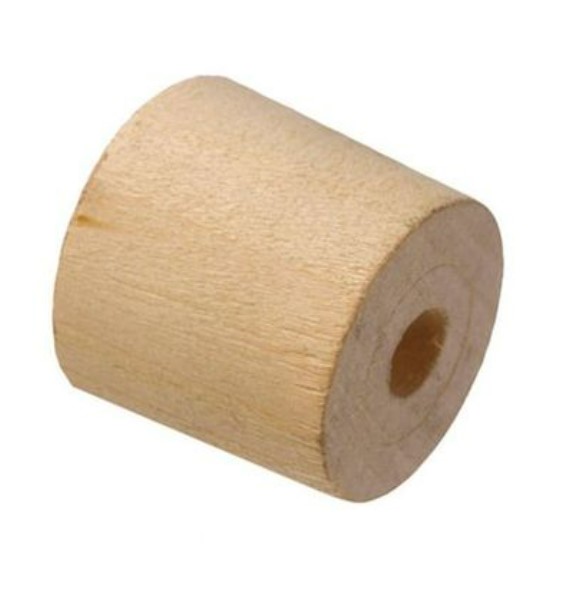
The same component goes by several names in specifications, catalogues and on site. All of the following normally describe the exposed spacer itself:
You will sometimes see “hardwood bobbin” in specifications. Hardwood should only be written into a specification where the timber species has actually been verified; it is not a safe assumption about any particular product, old or new.
Related terms describe different components and should not be used as synonyms for a bobbin:
| Term | What it is | Role |
|---|---|---|
| Pipe ear (fixing lug) | A flat lug cast on the pipe socket with a fixing hole | Connects the pipe to its fixing |
| Eared pipe | Pipe whose socket carries cast ears | Fixed directly through the ears, often on bobbins |
| Uneared (plain) pipe | Pipe with a plain socket and no ears | Needs a separate bracket or support |
| Earband | A separate casting that fits around the pipe socket and carries ears | Bracket for plain pipe, often decorative |
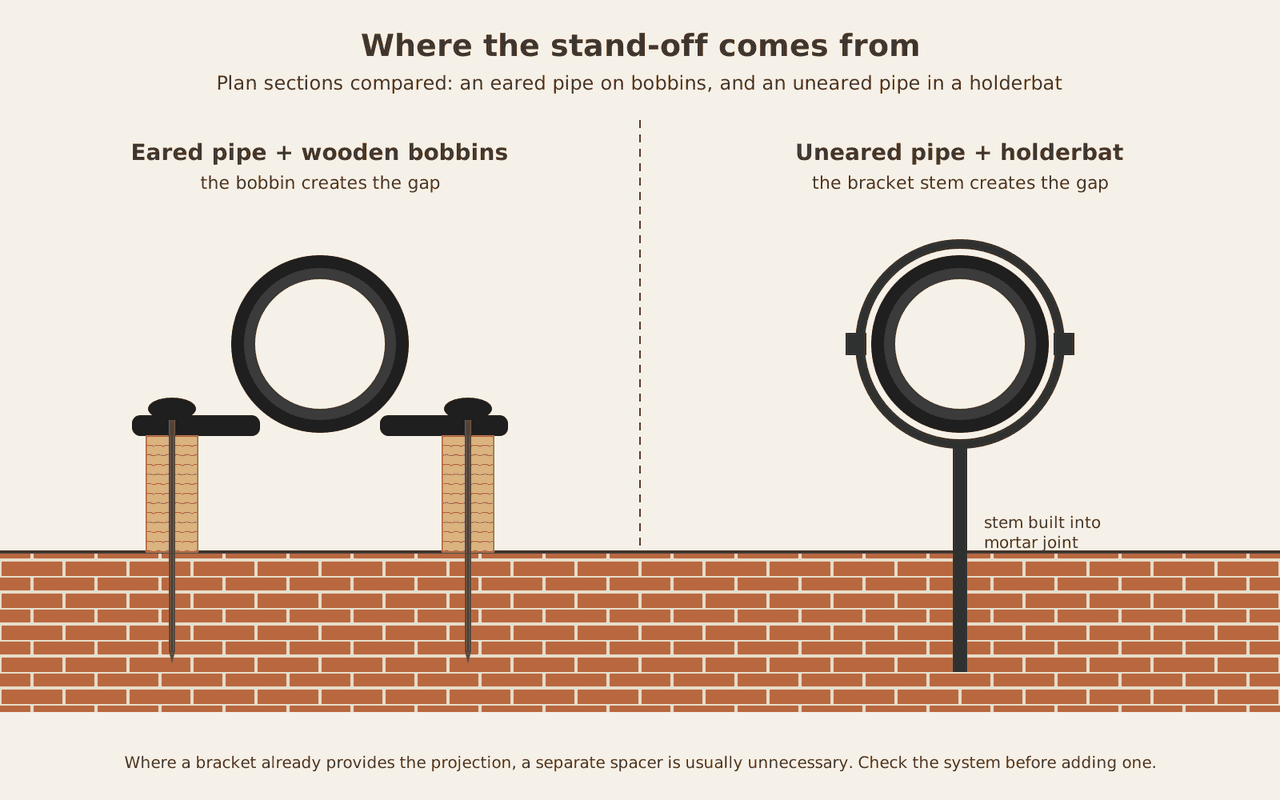
| Holderbat | A two-part ring around the pipe on a stem, built into the wall or screwed to it | Bracket that also provides stand-off |
| Holdfast | A spike with a collar, driven or built into a mortar joint | Support for suitable plain pipe |
| Drive-in spike | A spike-type support driven into a joint | Support for suitable plain pipe |
| Screw-to-wall pipe bracket | A bracket with a back plate screwed to the wall | Bracket and stand-off |
| Pipe nail | A large-headed nail passed through the ear | The fixing |
| Wooden wall plug / timber fixing block | Timber built into or set in the wall | The anchorage for a nail or screw |
Key distinction: a wooden spacer bobbin is normally an exposed component between the ear or bracket and the wall face. A wooden wall plug or built-in timber block is embedded in the wall and gives the nail or screw something to hold. They look similar off the wall, but they are different components with different purposes. A spacer bobbin is not driven into the wall.
On an eared pipe the fixing passes through the ear, through the pre-drilled bobbin, across the wall face and into the anchorage. Read from the outside in, the order is always the same:
Fixing head → pipe ear → wooden bobbin → wall face → anchorage within the wall.
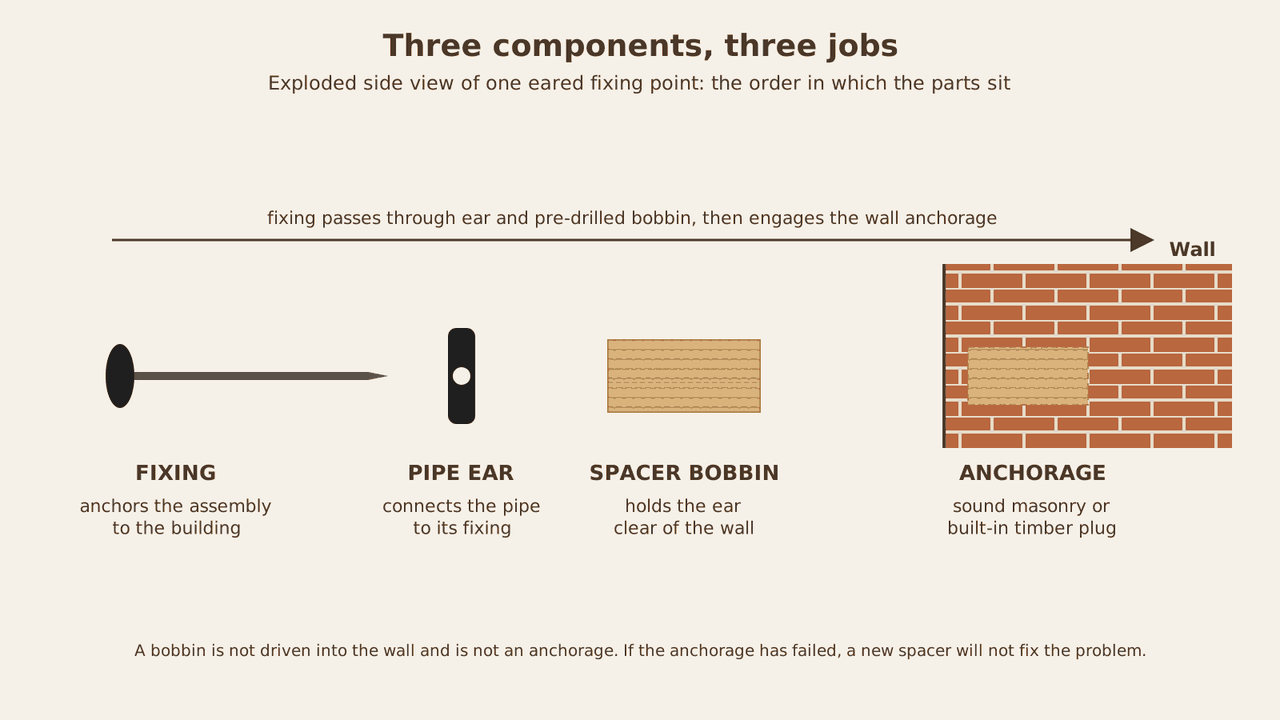
Where a bobbin is used behind the foot of a separate pipe clip rather than an integral ear, the arrangement is the same: fixing head, bracket foot, bobbin, wall face, anchorage. Not every bracket is designed to be spaced in this way, so check before assuming it is.
Several points apply to every installation:
Order of work matters too. On most runs we recommend fixing from the shoe upwards, so that each length bears on the one below; our guide to fixing cast iron rainwater pipes bottom-up or top-down explains why.
The main practical value of the bobbin is access: the gap it creates lets the back of the pipe be inspected, cleaned and painted. A secondary value is separation, keeping the rainwater goods off the wall so that defects are less likely to wet the fabric directly.
Cast iron lasts as long as its paint system does. The surfaces facing the wall are the hardest to reach and are where coatings are most often neglected. The Georgian Group’s note on historic rainwater goods observes that the back plates of early cast iron heads were often difficult to keep painted once fitted, and corrosion there is a common failing. A modest gap behind a pipe improves access to those surfaces for a brush, for cleaning out debris and for inspection with a torch or mirror. It does not give unrestricted access to every surface without dismantling, and on many runs the back of the pipe will still be best painted when it is off the wall. Our advice on linseed oil paint for cast iron guttering and pipes covers the coating itself.
Conservation guidance has long favoured rainwater goods that stand clear of the wall. The article A Cast Iron Solution, written for The Building Conservation Directory by Paul Trace of Tuscan Foundry Products, notes that rainwater goods should ideally project clear of the fabric so that leaks or blockages do not bring water into contact with it. A bobbin helps achieve that. It does not prevent damp, stop leaks or guarantee that water cannot bridge the gap, and a leaking joint will still wet a wall whether or not the pipe is spaced.
Projecting brick plinths, string courses, rendered bands and other local details sometimes require the pipe to stand further off the wall than usual. The required stand-off is set by the actual installation: the line of the pipe from outlet to shoe, the projections it has to pass and the fittings available. Stacking several bobbins or packing pieces is not automatically an acceptable answer; an offset, a different bracket or a purpose-made component may be the sounder solution.
Where a building retains a spaced, eared fixing detail, replacing failed bobbins with a matching arrangement keeps the shadow line and the rhythm of the pipework as they were. That is a good reason to match what is there. It is not a reason to add bobbins to every historic building, and it would be wrong to assume that every old downpipe was originally fixed on them.
Wooden bobbins are appropriate where an eared pipe or a suitable bracket needs to be held off the wall and nothing else in the system provides that clearance. Typical cases include:
A separate bobbin is often unnecessary, or the wrong component, where:
Above all, a rotten plug, friable masonry or a loose fixing calls for investigation and repair. Fitting a new spacer in front of a failed anchorage changes how the pipe looks and nothing else. Where the cause is not clear, or several fixings have failed together, our chargeable site survey and visit service can establish what is happening before anything is specified.
Historical sources tell us a good deal about timber anchorages and iron pipe nails. They tell us much less about external spacer bobbins, and the two should be kept apart.
The SPAB Technical Advice Note Conservation of Decorative Leadwork describes how lead rainwater heads and pipes were usually fixed: wrought-iron pipe nails were driven through purpose-made lead ears into wooden blocks built into the brick or stonework, or, less satisfactorily, into the mortar joints. The lead was cut long enough to be folded back over the nail heads once they were driven. The Georgian Group’s account of Georgian rainwater goods records the same arrangement, with a lead flap concealing the wrought-iron fixings.
That is good evidence for built-in timber anchorages and iron pipe nails. It is not, by itself, evidence that exposed wooden spacer bobbins were used in those installations. SPAB also notes the maintenance consequence: the iron nails corrode and the timber blocks rot, until the downpipe is left carrying the rainwater head and begins to buckle. Where such leadwork is repaired, SPAB suggests the opportunity can be taken to replace corroded wrought-iron nails with stainless steel fixings.
Cast iron rainwater goods were introduced in the late eighteenth century as a mass-produced alternative to lead and predominated by the mid-nineteenth century, according to A Cast Iron Solution in The Building Conservation Directory. The same article gives large-headed pipe nails as the typical fixing for eared rainwater pipe, with rawl bolts or coach screws as alternatives, and drive-in spikes, built-in holderbats or earbands for uneared pipe.
Large-headed cast iron pipe nails into wooden wall plugs became a familiar arrangement for eared pipe, and wooden bobbins remain a recognised traditional accessory used with pipe nails. We know of no documentary evidence that would fix a date of introduction for the bobbin, a standard historic size or a standard timber species, and we would treat any such claim with caution. Nor is it accurate to describe the bobbin as a specifically Georgian or Victorian invention.
Pipes without integral ears need separate supports: earbands, holderbats, holdfasts, spikes or brackets. Many of these establish their own wall clearance through a stem, collar or back plate, which is why a plain pipe in a holderbat normally needs no separate wooden spacer. Our guide to fixing and holding cast iron downpipes illustrates the main bracket types.
Every arrangement below can be appropriate in the right place. None is right everywhere, and each should be judged on compatibility, anchorage, corrosion resistance and the condition of the substrate.
| Arrangement | Function and context | Points to assess |
|---|---|---|
| Large-headed pipe nail into a timber plug | Traditional fixing for eared pipework | Condition of the timber, the nail and the surrounding masonry |
| Historic iron fixing through lead ears | Traditional leadwork support | Corrosion, condition of the lead, adequacy of support |
| Coach screw with a suitable wall anchorage | Alternative fixing for eared pipework | Compatibility, anchorage and corrosion resistance |
| Drive-in spike or holdfast | Support for suitable uneared pipework | Condition of the masonry and suitability of the support |
| Holderbat or earband | Separate support around the pipe | Fit, projection and condition |
| Screw-fixed bracket | Modern or traditional-pattern support | Fixing substrate and the system’s own requirements |
| Resin-fixed anchorage | A possible specialist approach | Suitability for the masonry and the conservation implications |
Corrosion resistance matters because a fixing buried in masonry cannot be painted. A Cast Iron Solution recommends stainless steel fixings, since rusting steel buried in masonry can crack it. That is a sound principle, but it does not mean one grade or one fixing type suits every wall, and mixing metals needs thought: our article on galvanic corrosion and fixings explains the risk. Resin anchors have a place in specialist hands but are not the default answer for weak historic masonry, where repair of the background is often the better first step.
Other spacer types exist. Plastic bobbins and metal spacer plates are generic alternatives, and we supply a metal pipe bobbin and a downpipe spacer plate as well as timber bobbins. We make no claim that timber is stronger, more durable, more sustainable or more breathable than these; the right choice is the one that suits the pipe, the fixing and the evidence on the building.
Traditional cast iron rainwater and soil pipework can look alike, but they carry different duties and have different installation requirements. A spacer does not establish an adequate support system for a soil stack.
Soil stacks may be eared or uneared. Eared soil pipe can be fixed through its ears with nails or screws; plain soil pipe is supported by separate brackets such as holderbats or a soil holdfast, as the particular system requires. Whatever is used must suit the weight of the stack, its joints and its connections.
Joints differ as well, and must not be treated as equivalent. Traditional cast iron soil pipework was jointed with a gaskin (yarn) packing and caulked lead, whereas vertical rainwater pipes were often left unsealed. A Cast Iron Solution notes that rainwater pipe joints need not be sealed because the upper pipe sits inside the socket of the lower, and SPAB records that lead downpipe joints were not usually caulked, so that water escaping at an open joint would reveal a blockage below. That is historical context, not an instruction for contemporary work. Current soil installations must follow the instructions for the chosen system and the applicable requirements. Our comparison of Traditional Express and LCC soil pipe and the LCC soil range set out what each system needs.
A short visual inspection, done from safe access, will tell you most of what you need to know. Look for:
Visible defects can have more than one cause. A loose pipe should not automatically be diagnosed as a failed bobbin; the ear may be cracked, the nail corroded, the plug rotten or the joint below disturbed. Do not remove fixings from cast iron pipework that is not otherwise supported. Cast iron is heavy and brittle, and pipework needs appropriate support during repairs. Our guide to cast iron downpipe maintenance covers blockages and routine care.
We make no recommendation on treating the timber of existing bobbins. Where a bobbin has decayed, replacement with a matching component is usually simpler and more reliable than attempting to consolidate it.
Before ordering, confirm the following:
A bobbin that is nominally similar is not automatically suitable. On historic buildings, assess the surviving evidence and the wider repair approach before changing the material or the visible fixing detail. Whether the work needs Listed Building Consent depends on the building and the extent of the change, and is a question for the local planning authority rather than for a general guide.
Where a pipe, ear or earband is missing or broken and no standard pattern matches, a replacement can be copy cast from a surviving section, a measured drawing or good photographs through our bespoke and copy casting service. Bespoke work typically takes 8–10 weeks, so it is worth raising early in the programme. Standard stock items, including bobbins and pipe nails, are available for prompt despatch; we are happy to confirm current availability.
We supply wooden pipe bobbin spacers, pipe nails, coach screws for fixing pipes and the wider range of cast iron gutter and pipe accessories, together with eared and plain round and rectangular cast iron downpipes and their brackets. We recommend choosing the spacer as part of the complete fixing arrangement rather than as an isolated accessory. Explore our wooden pipe bobbin spacers and traditional rainwater accessories, checking the component dimensions and fixing arrangement against the requirements of your project, or contact us with photographs of the existing detail and we will help you identify what is there.
The buildings below are examples, not our projects unless stated. Each shows something about how rainwater pipes and their fixings were made, and what that means for repair.
Haddon Hall, listed Grade I, holds what SPAB describes as the finest historical series of decorative lead rainwater heads in England, dating from about 1580 to 1670. Heads of this period were typically secured by wrought-iron nails through lead ears into timber blocks built into the masonry. For anyone repairing work of this kind, the lesson is to record the existing fixing method before disturbing it, and to check whether corroded nails or decayed blocks have left the downpipe carrying the head.
The rainwater heads in Stone Court at Knole, a Grade I house in the care of the National Trust, are dated 1605 and carry elaborate tinned decoration. SPAB uses them to illustrate pierced and tinned leadwork of the highest quality. Fixings on heads like these are part of the historic fabric. Where repair is unavoidable, SPAB suggests corroded wrought-iron pipe nails can be replaced with stainless steel, leaving the visible leadwork and its folded ears as undisturbed as possible.
On the south front of Canons Ashby, a Grade I house now cared for by the National Trust, two sets of lead rainwater heads and downpipes are dated 1710, with a floral motif at each pipe socket. It is a reminder that sockets and their fixings form part of the visible design of a downpipe. Any change to how a pipe is held, including adding or removing spacers, alters the shadow line and the rhythm of the elevation and should follow the evidence on the building.
The Georgian Group’s survey of rainwater goods illustrates a restrained lead rainwater head with a lion’s mask, about 1813, from the rear elevation of Sir John Soane’s Museum, a Grade I building in Lincoln’s Inn Fields. It belongs to the Regency years, when lead remained in use for high-status work even as cast iron spread. Buildings of this period can carry lead and cast iron side by side, each with its own fixing tradition, and repairs should respect both.
Hove Museum & Art Gallery, a Grade II listed villa, had guttering of an unusual profile that could not be removed for copying. As recorded in The Building Conservation Directory, Tuscan Foundry Products copied the pattern in situ from an accurate template so that replicas could be cast (our project record). The same principle applies to downpipe ears and earbands: where a historic component cannot be matched from stock, careful survey and copy casting preserve the detail rather than replacing it with something approximate.
A wooden downpipe bobbin is a pre-drilled timber spacer that sits between the fixing ear of a cast iron downpipe and the wall. The fixing passes through the ear and the bobbin into the wall, so the pipe is held clear of the masonry. Its job is spacing, which improves access for painting and inspection; it does not anchor the pipe.
It goes behind each fixing ear, between the back of the ear and the face of the wall, or behind the foot of a suitable separate pipe clip. The order from the outside is fixing head, pipe ear, bobbin, wall face and then the anchorage inside the wall.
No. A spacer bobbin is an exposed component outside the wall that holds the ear away from it. A wooden wall plug or built-in timber block is embedded in the wall and gives the nail or screw something to grip. They have different purposes, and a spacer bobbin is not driven into the wall.
A bobbin can space an eared soil pipe where the system allows, but it never provides the support on its own. Soil stacks need fixings and brackets suited to their weight and joints, and current work must follow the instructions for the chosen soil system and the applicable requirements.
Often, yes. Coach screws with a suitable wall anchorage are a recognised alternative to pipe nails. What matters is compatibility with the ear and bobbin, a sound anchorage, enough length for the whole fixing stack and corrosion resistance. On a listed building, consider the visible detail and the evidence on the building before changing it.
There is no single correct figure. The clearance depends on the bobbin length and on where the ears are cast on the pipe socket, and it may need to be greater to clear plinths or string courses. Judge it on the actual pipe and wall, and match a surviving historic detail where one exists.
Standard stock items such as wooden bobbins, pipe nails and coach screws are available for prompt despatch, and we can confirm current availability. Bespoke or copy-cast ears, earbands and pipe sections typically take 8 to 10 weeks, so it is worth raising them early in the programme.
Wooden downpipe bobbins are small components with a clear and limited purpose: they hold a pipe ear or bracket clear of the wall so that cast iron can be maintained and kept apart from the fabric it protects. Treated as part of a complete fixing arrangement, with a sound anchorage, a compatible fixing and an honest reading of what the building shows, they are a straightforward and effective detail. Treated as a cure for loose pipes or a universal heritage feature, they are neither.
At Tuscan Foundry Products we have supplied traditional cast iron rainwater goods for period and listed buildings since 1893, as successor to Richards. We supply wooden and metal pipe bobbins, pipe nails, coach screws, eared and plain downpipes, holderbats and earbands, and we arrange bespoke and copy casting where a historic pattern cannot be matched from stock. Where a fixing problem is not straightforward, our chargeable site survey service helps establish the cause before anything is specified. Call us on 0333 987 4452 or send us photographs of your existing pipework, and we will help you get the detail right.
Sources: A Cast Iron Solution, The Building Conservation Directory; SPAB, Conservation of Decorative Leadwork; The Georgian Group, Historic Details: Rainwater Goods.