
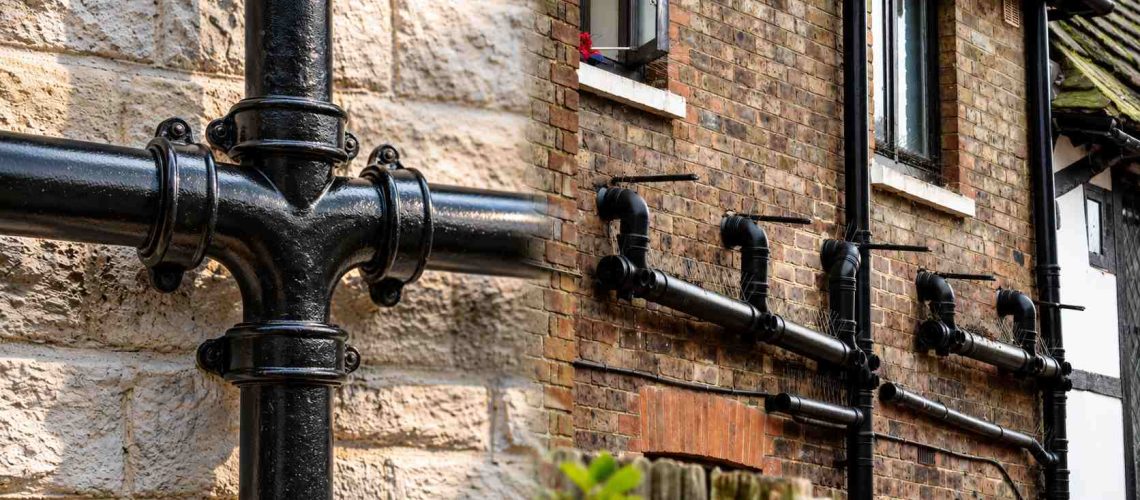
For a side-by-side comparison of all five cast iron soil and drainage systems, including mechanical BS 416 and socketless EN 877, see our guide to choosing a cast iron soil pipe system.
Push-fit or caulked? A specifier’s guide to the two traditional cast iron soil pipe systems used on heritage elevations — how Traditional Express (TX) and LCC soil pipe are made, jointed and fixed, the benefits and drawbacks of each, and how to decide between them on a listed building.
Technical summary: Traditional Express (TX) and LCC are both cast iron soil pipe systems made to BS 416 for external soil and waste stacks on period buildings, and once fixed they read almost identically. The difference lies in the joint. LCC is a socket and spigot system made to original imperial dimensions and jointed by caulking — traditionally yarn and molten lead, today more often caulking cord and a cold sealant — in diameters from 50 mm to 150 mm. TX uses plain-ended pipes joined by cast iron push-fit sockets carrying twin EPDM gaskets, and is made in 50 mm and 100 mm only. LCC is the like-for-like choice for repairing surviving historic stacks and for non-standard sizes; TX is usually the more practical choice for new or wholly replaced 100 mm stacks, where the appearance of the stack matters more than the method of jointing it.
Soil stacks are rarely the first thing anyone notices on a listed building, yet they are among the most frequently altered elements of it. Every bathroom added to a Georgian terrace, every flat carved out of a Victorian villa and every institutional building converted to homes has needed somewhere to discharge. For heritage work, the choice is usually between two cast iron soil pipe systems that look much the same once fixed — the traditional caulked LCC system and the push-fit Traditional Express (TX) system — and the right one depends on whether you are repairing historic fabric like-for-like or installing a new stack, where the visual character matters more than the jointing method.
We supply both, alongside the coupling-jointed Tuscan Mechanical BS416 range, and we are asked to compare them more often than almost any other pair of products in our cast iron soil pipe range. This guide is written for conservation architects, surveyors, conservation officers and heritage contractors. It explains how each system is made and jointed, what each does well and less well, where specification mistakes tend to occur, and how we approach the choice on real buildings.
External cast iron soil stacks became standard on British buildings in the second half of the nineteenth century, as the water closet spread and sanitary reform pushed drainage out of basements and onto the outside of buildings. The Public Health Act 1875, and the model bylaws that followed it, established the principle of soil pipes ventilated to open air, and the cast iron socket and spigot pipe fixed to the elevation became the default way of achieving it.
Joints were made by packing tarred yarn into each socket to centre the pipe, running molten lead in above it, and caulking the lead tight with irons. Done well, these joints lasted generations, and many are still sound. Our short history of cast iron soil pipes traces the development of the systems in more detail.
Those surviving stacks are now part of the history of the buildings that carry them. A Victorian or Edwardian soil stack is a legible record of how a building was adapted to modern sanitation, and conservation practice — as articulated by SPAB and by Historic England, Cadw and Historic Environment Scotland — favours repair over replacement wherever historic fabric survives. Where it does not, cast iron remains the material that sits correctly against stone, brick and lime render. Grey iron is quiet in use because the graphite flakes in its microstructure damp vibration; it resists impact and distortion, is non-combustible, and is fully recyclable at the end of a service life that can exceed a century. Our guide to cast iron as a building material covers the metallurgy and the sustainability case for cast iron in more depth.
LCC is the traditional cast iron socket and spigot soil system, made to BS 416 and to the original imperial dimensions, and jointed by caulking in the same manner as the historic pipework it repairs or replaces.
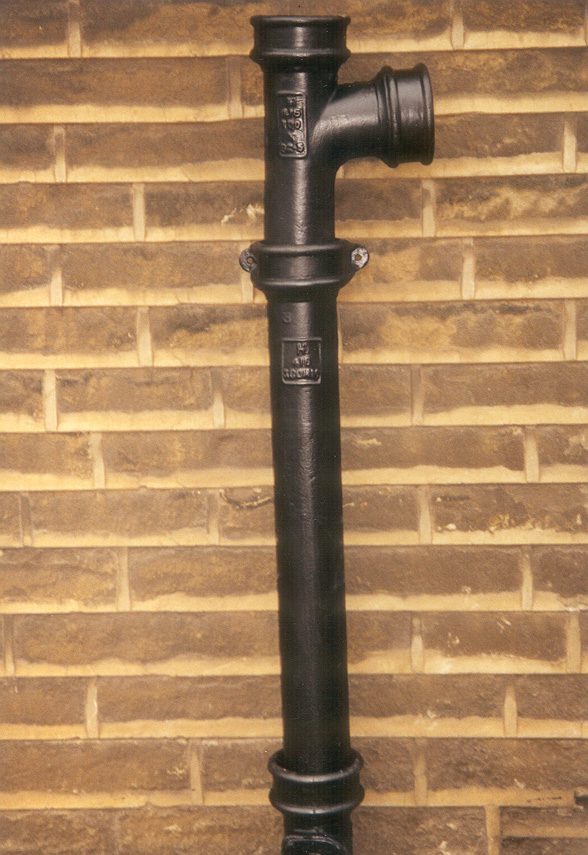
Our Traditional LCC soil range covers 50 mm (2″), 65 mm (2½”), 75 mm (3″), 90 mm (3½”), 100 mm (4″) and 150 mm (6″) diameters, with pipes in 914 mm, 1219 mm and 1829 mm lengths, both plain and eared. The fitting range is deep: bends, single and equal branches, bends and branches with access doors, P traps, shoes, diminishing pieces, socket reducers, loose sockets, cowls, wire balloons, strap-on bosses and built-in holderbats. Loose ears can be added where a fitting needs fixing but has none cast on. Because the dimensions are imperial, LCC pipes and fittings mate directly with surviving Victorian and Edwardian pipework — the single most important point in its favour on repair work.
LCC is supplied with a black bitumen coating, in accordance with BS 416. It is a durable and historically appropriate finish. If a colour other than black is required, it must be changed with a bitumen paint: conventional, gloss or oil-based paints applied over bitumen will bleed and fail. Settle the colour at specification stage rather than on site. There are two accepted jointing methods:
Either way, every joint is made by hand, and its quality depends entirely on the skill of the person making it.
Traditional Express is a push-fit cast iron soil system, made to BS 416-2, that reproduces the appearance of a caulked LCC stack without any caulking or sealing on site.
Instead of a socket cast onto each pipe, TX uses plain-ended double-spigot pipes joined by separate cast iron push-fit sockets. Each socket carries two EPDM sealing gaskets to BS EN 681-1 and a central register: the pipe on each side is lubricated and pushed home until it meets the register. The joint is made in moments, needs no specialist training, and presents the profile of a traditional caulked socket to the street.
Our Traditional Express range is made in 50 mm and 100 mm diameters; 100 mm pipes come in 1.8 m and 3 m lengths, and 50 mm pipes in 1.5 m and 3 m. Sockets are available plain, eared and as an eared slip socket, which has no central register and can be slid along a pipe — the standard way to cut a new branch into a stack or repair a damaged length. Fittings include short and long radius bends, single, double and radius curve branches (with or without access doors), access pipes, boss pipes tapped 2″ BSPT, offsets, a 100 × 50 mm taper, blank ends, cowls and adjustable brackets.
TX is supplied factory-finished in black gloss, ready to fix, and the manufacturer quotes a service life of more than 100 years when correctly installed and maintained. Pipes are lighter than their LCC equivalents, which makes a real difference when handling 3 m lengths on a scaffold.
The two systems share a material, a standard and an appearance; they differ in jointing, size range, compatibility with historic pipework, finish and the skill needed to install them.
| Criterion | Traditional LCC | Traditional Express (TX) |
|---|---|---|
| Standard | BS 416 | BS 416-2; gaskets to BS EN 681-1 |
| Jointing | Caulked socket and spigot — hot lead, or cord and cold sealant | Push-fit cast iron socket with twin EPDM gaskets |
| Diameters | 50, 65, 75, 90, 100 and 150 mm | 50 and 100 mm |
| Pipe lengths | 914, 1219 and 1829 mm | 1.5 m (50 mm), 1.8 m (100 mm) and 3 m |
| Fit with historic pipework | Direct — original imperial dimensions | Via eared slip socket; confirm outside diameters on site first |
| Standard finish | Black bitumen (recolour with bitumen paint only) | Factory black gloss |
| Handling | Heavier, shorter lengths, more joints | Lighter, longer lengths, fewer joints |
| Installer skill | Trained caulker; every joint hand-made | Minimal; consistent factory-controlled seal |
| Hot works | Yes, if lead-caulked | None |
| Joint behaviour | Rigid | Gaskets accommodate small movement |
| Typical role | Like-for-like repair; non-standard sizes; Grade I and II* | New or wholly replaced 100 mm stacks; conversions |
LCC wins on authenticity, size range and direct compatibility with historic pipework; TX wins on speed, consistency, handling and freedom from hot works. Neither is the better system in the abstract — each is the better system for particular buildings and particular tasks.
Start with what survives. If a historic stack is being repaired or partly renewed, LCC is almost always correct; if a 100 mm stack is new, or is being replaced in its entirety, TX is usually the more practical choice, provided the conservation officer is content.
| Situation | Our usual recommendation | Reason |
|---|---|---|
| Repairing or extending a surviving Victorian or Edwardian caulked stack | LCC | Imperial dimensions and the same joint as the original |
| 65, 75, 90 or 150 mm diameter required | LCC | TX is not made in these sizes |
| Grade I or II* building where traditional jointing is expected | LCC, hot or cold caulked as agreed | Authenticity of method as well as appearance |
| New 100 mm stack on a Grade II building or in a conservation area | TX | Correct appearance, consistent joints, lower installation cost |
| Timber-framed, thatched or fire-sensitive building | TX, or cold-caulked LCC | Avoids molten lead and hot works |
| Cutting a new branch into an existing stack | TX eared slip socket or LCC loose socket, after survey | Depends on the size and condition of the existing pipe |
| Soil stack to match painted rainwater goods | LCC recoloured in bitumen paint, or TX in factory gloss | LCC’s bitumen coating accepts only bitumen paint; TX arrives finished in black gloss |
| Internal runs, or where a coupling-jointed system suits | Tuscan Mechanical BS416 | Designed for internal and above and below ground installation |
Avoid mixing systems mid-elevation in full view. Where TX must meet an existing caulked stack, place the transition at a natural break — a branch, an offset or a string course — so the change is not read against the wall. Consent matters too. Replacing a soil stack on a listed building, or adding a new one, may well require Listed Building Consent, depending on the extent of the work and its effect on character; discuss the system and the route of the stack with the conservation officer early. Our listed buildings FAQ covers the questions we are asked most often.
Because we supply all three systems, our advice is not tied to one product: we treat TX and LCC as alternatives to each other rather than rivals, and recommend whichever is right for the building.
Where LCC has been specified but is impractical — no competent caulker available, hot works ruled out, or a programme that cannot absorb hand-made joints — TX is the honest alternative for a 100 mm stack, and we will say plainly where it is not, such as against surviving historic pipework on a Grade I elevation. Where TX has been specified but the building calls for an intermediate imperial size, or for authenticity of method, LCC is the alternative. For internal runs, and for situations where a mechanically coupled joint is more appropriate, our Tuscan Mechanical BS416 Soil range completes the picture.
Historic stacks often include fittings that are no longer made — an unusual branch, a doored bend of a particular pattern, an ornamental offset. Rather than redesign the stack around stock parts, we can copy cast the original from a surviving sample, photographs or measured drawings through our bespoke commissions service. Standard stock items are available for prompt despatch; bespoke and copy cast items typically require 8 to 10 weeks from pattern confirmation, so they need to be identified early in the programme.
On complex or sensitive stacks we recommend a site survey or site visit. It is a chargeable service, and it protects the outcome: we confirm diameters and whether existing pipework is imperial, assess the condition of joints and fixings, record any specials for copy casting, and identify where a transition between systems can sit discreetly. Our article on the importance of on-site surveys explains what the process involves.
Finally, soil stacks rarely stand alone. They share elevations with cast iron rainwater pipes and gutters and hopper heads, and specifying them together keeps profiles, fixings and finishes consistent. Where rainwater goods are finished in our linseed oil paint system and the soil stack is expected to match, raise it at specification stage. LCC can only be recoloured with a bitumen paint, while Traditional Express arrives factory-finished in black gloss, so the system and colour should be agreed together before castings are ordered; our paints and finishes page sets out the options.
Both systems depend on correct support and a sound base: every vertical length must be fixed through an eared socket, eared pipe or holderbat, and the stack must rise from a properly supported connection to the below-ground drain.
Most of the problems we see stem from treating TX and LCC as interchangeable in every respect, when they are interchangeable only in appearance.
The following examples illustrate how the TX or LCC decision plays out on different kinds of historic building. They are representative of the situations specifiers face rather than records of particular works.
The Royal Crescent, Bath — Grade I
John Wood the Younger’s crescent, built between 1767 and 1774, predates the water closet, and like most Georgian terraces its rear elevations have absorbed generations of sanitary alterations. On buildings of this significance, surviving Victorian caulked stacks form part of the record of change, and repairs are expected to be like-for-like. LCC, made to original imperial dimensions and caulked in the traditional manner, is the natural specification; a push-fit system would be difficult to justify against historic fabric of this calibre.
Edinburgh New Town — Category A and B listed tenements
The tenements and terraces of Edinburgh’s New Town, part of a World Heritage Site and widely listed by Historic Environment Scotland, carry tall communal soil stacks on their rear elevations, often serving five or six storeys. Repairs mean long runs worked from scaffold in exposed weather. Where a stack is replaced in its entirety at 100 mm, Traditional Express offers consistent joints and lighter 3 m lengths; where historic sections survive, LCC preserves continuity with the original pipework and its imperial dimensions.
Saltaire, West Yorkshire — Grade II listed terraces
Sir Titus Salt’s model village, begun in the 1850s and now a World Heritage Site, survives as street after street of listed workers’ terraces whose character depends on uniformity. Bathroom upgrades have repeatedly raised the question of rear soil stacks. Across a terrace, consistency matters as much as authenticity: a well-fixed black TX stack, matched house to house, can sit more comfortably than a patchwork of systems, provided the conservation officer agrees the approach for the terrace as a whole.
Albert Dock, Liverpool — Grade I
Jesse Hartley’s fireproof warehouses, opened in 1846, form the largest group of Grade I listed buildings in the country and now house apartments, offices, museums and hotels. Conversion on this scale demands new sanitary provision, and stacks on such robust masonry elevations call for cast iron that matches the buildings’ engineering character. Larger 150 mm stacks are available only in LCC, and where hot works are restricted, cold-caulked joints keep the traditional appearance without molten lead at height.
Llandudno’s Victorian seafront terraces, Conwy
Llandudno’s sweeping promenade terraces, laid out from the 1850s under the Mostyn estate, include many buildings listed by Cadw within a conservation area, and have been converted into hotels and flats many times over. Salt-laden air makes coating integrity critical, and repeated conversions have left elevations crowded with pipework. Rationalising stacks into fewer, properly supported cast iron runs — TX for new 100 mm stacks, LCC where earlier pipework survives — improves both the elevation and long-term maintenance.
Both are cast iron soil systems made to BS 416 and look very similar once fixed. LCC is a traditional socket and spigot system made to imperial dimensions and jointed by caulking with lead, or with caulking cord and sealant. Traditional Express uses plain-ended pipes joined by cast iron push-fit sockets with twin EPDM gaskets, so no caulking is needed on site.
Yes, in many cases. Traditional Express was developed for heritage and conservation work and reproduces the appearance of a caulked stack. It is widely accepted for new or wholly replaced 100 mm stacks on Grade II buildings, but on Grade I and II* buildings, or where historic pipework survives, a conservation officer may expect LCC. Agree the system before ordering.
Often it can, using an eared slip socket, but it depends on the outside diameter and condition of the existing pipe. Victorian stacks are imperial, so measure before specifying. Where historic pipework is being repaired rather than replaced, LCC usually gives the cleaner, like-for-like result. A site survey removes the guesswork on complex stacks.
No. Lead caulking is the traditional method and is still used where authenticity of method is required, but LCC joints can also be cold caulked: caulking cord is driven into the socket and the top 30 mm or so is filled with a black joint sealant. This avoids hot works while giving the appearance of a traditional caulked joint.
Our LCC range is available in 50, 65, 75, 90, 100 and 150 mm diameters, matching the imperial sizes found on older buildings. Traditional Express is made in 50 mm and 100 mm only. If you need an intermediate or larger size, LCC is the system to specify.
They can, but the route depends on the system. LCC is supplied with a black bitumen coating, so its colour can only be changed with a bitumen paint; conventional and oil-based paints will bleed through and fail. Traditional Express arrives factory-finished in black gloss. If your rainwater goods are finished in linseed oil paint or a colour other than black, talk to us before ordering so the soil stack is finished to match.
Standard stock LCC and Traditional Express items are available for prompt despatch, subject to current availability. Bespoke and copy cast fittings, such as a discontinued branch or doored bend reproduced from a surviving sample, typically take 8 to 10 weeks from pattern confirmation, so identify them early in the programme.
Traditional Express and LCC are not competing answers to the same question; they are the right answers to different ones. Where historic pipework survives, or where the building calls for imperial sizes and traditional jointing, specify LCC and decide early between hot and cold caulking. Where a 100 mm stack is new or being replaced in full, Traditional Express gives the correct appearance with consistent, quick and fire-safe joints. In both cases, support every length properly, settle the finish before ordering, keep transitions between systems out of sight, and bring the conservation officer in at the outset. Specify the joint, not just the pipe.
Tuscan Foundry Products has supplied heritage cast iron since 1893, and from our base in Mid Wales we work with architects, conservation officers, surveyors and contractors across the UK and internationally. We supply both Traditional LCC and Traditional Express soil systems, together with Tuscan Mechanical BS416, so our advice follows the building rather than the product. Where a stack includes fittings that are no longer made, we copy cast them; where a project is complex, our chargeable site surveys establish exactly what is on the wall before anything is ordered; and where soil stacks sit alongside our rainwater goods, we help ensure the whole elevation is finished as one. If you are specifying cast iron soil pipe for a listed or historic building, contact us or call 0333 987 4452 — we would be glad to talk it through.