
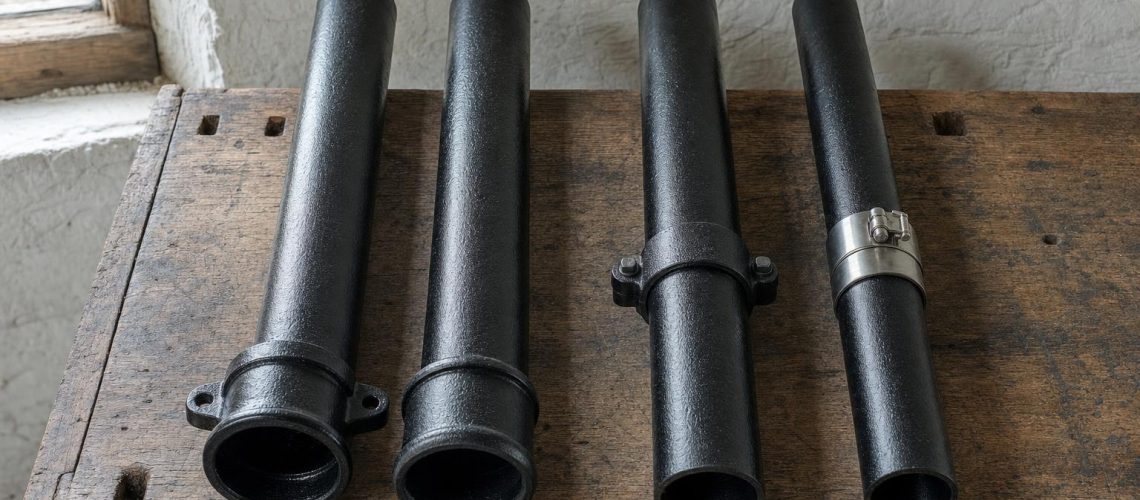
Five cast iron soil and drainage systems, one decision. This guide sets out how socketed LCC, push-fit Traditional Express, coupling-jointed BS 416 mechanical pipe and socketless EN 877 soil and drain differ, and which one belongs on which building, for architects, conservation officers, surveyors and contractors.
Technical summary: The right cast iron soil pipe system depends on the building and where the pipe runs. For like-for-like replacement of an original Victorian or Edwardian stack, specify Traditional LCC socket-and-spigot pipe. Where the same socketed appearance is wanted with faster push-fit jointing and a paintable finish, use Traditional Express. To repair or extend an existing LCC stack, the mechanical BS 416 range joins to it through conversion couplings. For new internal or external stacks, particularly on larger or taller buildings, socketless EN 877 soil pipe gives a slim coupled line from 50mm to 300mm. Below ground and for suspended drainage, use EN 877 drain. All five are cast iron, non-combustible and long-lived; they differ in jointing, appearance, size range and how they meet existing work.
The choice of cast iron soil pipe system decides how a stack looks, how it is jointed, and whether it can be joined cleanly to the pipework already on the building. Getting it right at specification stage avoids awkward transitions on site, mismatched appearance on a principal elevation, and difficult conversations with the conservation officer.
We supply five cast iron soil and drainage systems from our soil pipes range: Traditional LCC, Traditional Express, Tuscan Mechanical BS416 Soil, Tuscan EN877 Soil and Tuscan EN877 Drain. They are all cast iron, and all share the durability, weight and fire performance that make the material the right one for period buildings. Where they differ is in jointing method, appearance, size range and the job each was designed for.
This guide is written for architects, conservation officers, building surveyors, heritage contractors and owners of listed property. It explains the background to each system, compares them side by side, and sets out a practical way to decide. Mistakes in soil pipe specification are common because the systems can look interchangeable on a drawing. They are not interchangeable on site.
Cast iron became the standard material for soil and waste stacks in Britain during the second half of the nineteenth century, as indoor sanitation spread through towns and cities. The sanitary reforms of the Victorian period, and the building byelaws that followed, required waste to be carried away in sealed pipes ventilated to the open air. Cast iron was strong, readily cast into bends and branches, and could be jointed watertight.
Early stacks were socket-and-spigot: each pipe had an enlarged socket at one end that received the plain spigot of the next. The joint was packed with tarred yarn and sealed, traditionally with run lead, later with other caulking compounds. Pipes were usually given a protective coating of pitch or bitumen. This is the pattern that survives on thousands of Victorian and Edwardian terraces, villas, schools, chapels and civic buildings, and it is what most conservation officers expect to see on an original elevation.
The twentieth century brought standardisation. BS 416 set out dimensions for cast iron spigot-and-socket soil, waste and ventilating pipe, which is why modern socketed and mechanical systems built to those dimensions can still meet older work. Later still, the European standard BS EN 877 defined socketless cast iron pipe and fittings for discharge from buildings, jointed with couplings rather than sockets. That standard underpins most new cast iron soil and drainage installations today. Understanding this lineage explains why each of our five systems exists, and why the oldest pattern is still the right answer on many historic buildings. For more on the material itself, see our guide to cast iron as a building material.
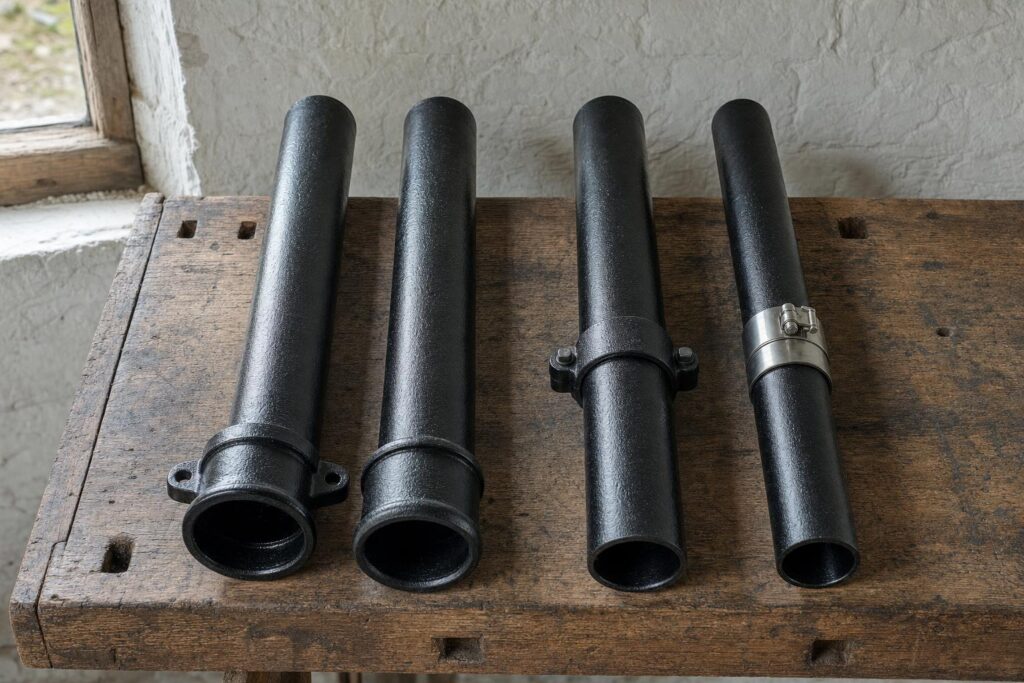
In short: LCC and Traditional Express are socketed and look traditional; the mechanical BS 416 range and EN 877 are socketless and coupled; EN 877 Drain is for below-ground and suspended drainage. The table below compares them on the points that usually decide a specification.
| System | Jointing | Appearance | Sizes | Typical use |
|---|---|---|---|---|
| Traditional LCC | Socket and spigot, caulked and sealed | Banded sockets, optional ears and ornamental earbands | 50mm to 150mm | Like-for-like replacement of original stacks on listed and period buildings |
| Traditional Express TX | Socketed, push-fit with seals | Traditional socketed look | 50mm and 100mm | Period appearance with faster installation; paintable |
| Tuscan Mechanical BS416 Soil | Plain ends, bolted ductile iron couplings | Slim coupled joints | 50mm to 150mm | Repairs and extensions to existing LCC stacks; new stacks |
| Tuscan EN877 Soil | Plain ends, stainless or ductile iron couplings | Slim, continuous line | 50mm to 300mm | New internal and external soil, waste and rainwater stacks |
| Tuscan EN877 Drain | Plain ends, bolted couplings | Not usually visible | 100mm to 300mm | Below-ground and suspended drainage, with chambers and gullies |
These are general characteristics. On any specific project, check fittings availability for the sizes and junctions you need on the relevant product pages, or ask us to check a schedule.
Traditional LCC is the like-for-like choice for an original cast iron soil stack. It is socket-and-spigot pipe made to BS 416 dimensions, supplied with a bitumen coating, and jointed in the traditional way with caulking cord and a joint sealant.
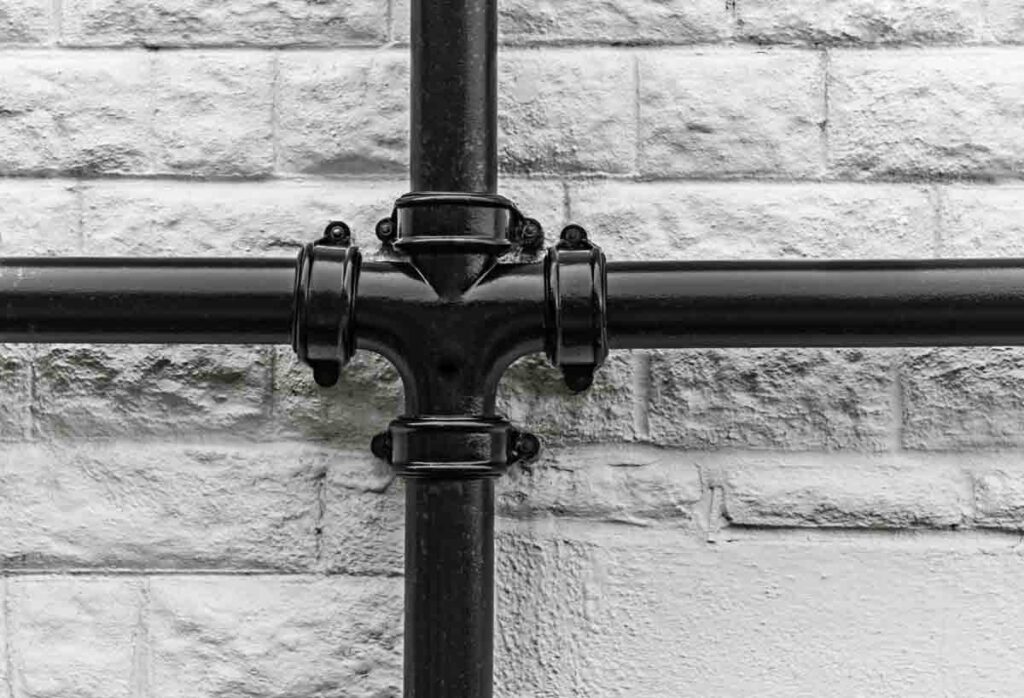
Pipes come plain or eared, in lengths from 610mm to 1829mm, with double-socket pipes for awkward runs. The fittings range covers bends, single and double branches, access pipes, offsets, P traps, expanding and diminishing pieces, bossed pipes, holderbats and holdfasts. Ornamental earbands in several patterns allow decorative banding to be matched where it survives. Sizes run from 50mm to 150mm, including the 65mm and 90mm sizes found on older buildings.
Because LCC reproduces the profile, socket proportions and fixing details of historic work, it is the system most likely to satisfy a conservation officer on a principal elevation. The trade-off is installation time: caulked joints take longer than push-fit or coupled joints, and the work needs a contractor who understands traditional jointing.
Traditional Express keeps the socketed appearance of a period stack but replaces caulked joints with push-fit sockets and seals. It is faster to install, and the finish can be painted, which makes it popular where a stack must sit alongside painted rainwater goods.
The range covers pipes in 50mm and 100mm, plain and eared sockets, slip sockets for making up runs, couplings, bends, branches, access pipes, offsets, bosses and brackets. We compare Traditional Express and LCC in detail in our guide Traditional Express vs LCC. In brief: choose LCC where the joint detail itself is part of the significance, and Traditional Express where the appearance matters but the programme or budget favours quicker jointing.
Tuscan Mechanical BS416 Soil is a coupling-jointed cast iron system, dimensionally compatible with BS 416 pipe, that joins to existing socketed LCC stacks through conversion couplings. That makes it the practical way to replace a cracked length or add a branch to an old stack without stripping out sound original pipe.
Pipes and fittings have plain ends and are joined with bolted ductile iron couplings with EPDM gaskets, with continuity versions where electrical continuity is required. The range runs from 50mm to 150mm and includes short and long radius bends, bends with access doors, equal and unequal branches, branches with bosses, access pipes, offsets, boss pipes, taper pipes, P traps, blank ends, a bellmouth and puddle flange, and coated brackets. Conversion couplings are available in 70mm and 100mm.
Coupled joints can be undone. A damaged fitting can be removed and replaced later without disturbing the pipe either side, which is useful on stacks inside listed buildings where access is limited and finishes are sensitive.
Tuscan EN877 Soil is socketless cast iron soil, waste and rainwater pipe made to BS EN 877, in sizes from 50mm to 300mm. Pipes are cut to length on site and joined with stainless steel rapid connect or ductile iron couplings, giving a slim, continuous line.
It is the natural specification for new stacks: new bathrooms in a converted building, rebuilt service risers, extensions, and larger or taller buildings where the size range and support system matter. The range includes bends from 15° to 88°, long radius and long tail bends, equal and unequal branches at 45°, 69° and 88°, corner and double branches, access pipes, P traps, boss and compression boss pipes, taper pipes, high pressure stainless couplings for the base of tall stacks, and a full set of brackets, stack supports and consoles.
Cast iron is non-combustible, which matters where a stack passes through compartment floors, and its mass makes it noticeably quiet in use. Both points carry weight in refurbishment projects in occupied historic buildings, such as colleges, hotels and civic buildings.
Tuscan EN877 Drain is socketless cast iron drainage made to BS EN 877 for below-ground runs and suspended drainage in basements, undercrofts, car parks and plant areas. It covers 100mm to 300mm and includes inspection chambers, gullies, puddle flanges, traps and long radius bends with heel rests for the foot of a stack.
Cast iron drainage is rigid and resists crushing and root ingress, which suits shallow cover and runs beneath or within buildings. Where new drainage has to pass through a historic cellar or beneath a listed structure, a rigid, non-combustible system that can be supported from the structure is often the most robust answer.
All five systems share the performance that makes cast iron the reference material for soil and drainage in historic buildings: it is non-combustible, quiet, rigid and very long-lived. The differences between them lie in jointing and size range, not in the material.
Cast iron does not burn, soften or drip in a fire. Where a soil stack passes through a compartment floor, as it does in almost every conversion of a historic building into flats, a non-combustible pipe simplifies fire stopping and removes a route for fire to spread. Building control officers and fire engineers are familiar with cast iron stacks for this reason, and it is one of the main reasons EN 877 is specified in multi-occupancy refurbishments.
The mass of cast iron damps the noise of water discharging down a stack. In occupied buildings with bedrooms beside service risers, such as hotels, student accommodation, flats and care settings, this is a practical benefit that clients notice. Stacks should still be isolated from the structure with suitable brackets; the rubber-lined heavy duty bracket in the EN 877 range is designed for this.
Original Victorian cast iron stacks still in service after well over a century are the best evidence of the material’s life expectancy. Cast iron is also fully recyclable at the end of its life. For a wider discussion, see our article on the sustainability and strength of cast iron.
Soil and drainage work must meet the Building Regulations, principally Approved Document H for drainage and waste disposal in England and Wales, with equivalent requirements in Scotland and Northern Ireland, and Approved Document B where stacks pass through fire-separating elements. Pipe sizing, ventilation, access and gradients follow the relevant British and European standards for sanitary pipework and drainage. Our systems are made to BS 416 dimensions (LCC and the mechanical range) and BS EN 877 (EN 877 soil and drain), and the designer or installer remains responsible for the overall design meeting the regulations.
On a listed building, replacing a cast iron soil stack like for like is often treated as repair, but any change of material, route, profile or jointing that alters the building’s character may need Listed Building Consent. Always discuss the proposal with the local planning authority’s conservation officer before work starts.
The relevant body depends on where the building is: Historic England in England, Cadw in Wales, Historic Environment Scotland, the Historic Environment Division in Northern Ireland, and the National Monuments Service and local authority Record of Protected Structures in the Republic of Ireland. Each takes the same broad view: retain and repair historic fabric where possible, and where replacement is needed, match the original in material and detail.
In practice that points to LCC or Traditional Express on principal elevations where the original was socketed, the mechanical BS 416 range where a sound original stack needs a repair or a new connection, and EN 877 for new internal work or concealed runs. Our page on cast iron gutter and pipe questions on listed buildings covers the consent questions we are asked most often.
Start with what is there, where the new pipe will run, and how visible it will be. The table below turns those questions into a recommendation.
| Situation | Recommended system | Why |
|---|---|---|
| Original socketed stack on a principal elevation, to be replaced | Traditional LCC | Matches profile, sockets and joint detail of the original |
| Period appearance wanted, painted finish, tighter programme | Traditional Express | Socketed look with quicker push-fit jointing |
| Cracked length or new branch on a sound original LCC stack | Tuscan Mechanical BS416 | Conversion couplings join new to old without replacing sound pipe |
| New internal stack or service riser in a refurbishment | Tuscan EN877 Soil | Slim coupled line, wide fittings range, non-combustible |
| Tall stack or large building, sizes above 150mm | Tuscan EN877 Soil | Sizes to 300mm, stack supports and high pressure couplings |
| Below-ground drainage or suspended drainage in a basement | Tuscan EN877 Drain | Rigid cast iron drainage with chambers and gullies |
Where a building has a mixture of original and later pipework, more than one system may be right. A common pattern is LCC on the street elevation, mechanical BS 416 for repairs to a rear stack, and EN 877 for new internal work. The systems are designed to coexist.
A good soil pipe specification names the system, the sizes, every junction and the fixings, and states how the new work meets the old. The meeting point with existing pipework is where most site problems start.
Where the existing stack is complex, partly concealed or in poor condition, a site visit before specification is usually worth it. Our site survey service is chargeable, and it protects the project from ordering the wrong fittings for a building we have not seen.
Prices for every item are shown on our product pages, excluding VAT and delivery. Stock items are usually dispatched within 5 to 7 working days, and non-stock sizes within 7 to 10 working days. For a full schedule, call us on 0333 987 4452 or contact us.
A cast iron soil stack needs little maintenance, but a short annual inspection catches the small faults that become expensive ones. The most common failures on historic stacks are frost cracks, failed joints, corroded brackets and blocked access points, and all are easier to deal with early.
When a crack or failed joint is found, the repair approach follows the system. On LCC, a single failed length can be replaced like for like, or cut out and replaced with a mechanical BS 416 section and conversion couplings where re-caulking in place is impractical. On mechanical and EN 877 systems, couplings can be released and the damaged fitting replaced directly. Below ground, CCTV survey through the access points is the usual first step before excavation.
Most soil pipe problems on historic buildings come from treating the systems as interchangeable. These are the mistakes we see most often.
The scenarios below are illustrative, not records of specific projects. They show how the choice between the five systems usually plays out on different building types.
Original socketed stacks on a rear elevation have cracked in places, and the conservation officer wants like-for-like replacement of failed pipe with sound sections retained. Failed lengths are replaced in Traditional LCC with matching ears. Where a new bathroom needs a branch, a short mechanical BS 416 section with conversion couplings can be inserted, so the whole stack does not have to come down.
New internal stacks rise through several storeys, and fire separation and acoustic performance between flats are the main concerns. Socketless EN 877 cast iron in the service risers suits this, with stack supports at the base. An original external socketed stack on the main elevation is retained and repaired, so the historic appearance is unchanged.
A later soil stack clashes with painted downpipes, and the owners want a socketed look that can be painted to match. Traditional Express gives the socketed appearance and takes paint well, so it can be finished with the rainwater goods. Any visible change on a listed building should be agreed with the local planning authority first.
New facilities in a former vestry need drainage below the floor and out beneath the churchyard path. EN 877 cast iron drain, with an inspection chamber at the change of direction, keeps excavation narrow and gives a robust, rodable route close to sensitive fabric. See our guidance for churches and ecclesiastical buildings.
Refurbishment uncovers an original 90mm soil stack. Because 90mm is not part of the socketless ranges, the size should be confirmed by survey before ordering. Renewing the visible length in Traditional LCC at the original size avoids a mismatch that would show at every joint.
For like-for-like replacement of an original socketed stack, Traditional LCC socket-and-spigot pipe matches the historic joints and finish. Traditional Express gives the same socketed look with push-fit joints and can be painted. Where new pipe must join a sound original stack, the mechanical BS 416 range connects to it with conversion couplings. Always agree the approach with the conservation officer.
LCC is socket-and-spigot pipe to BS 416 dimensions, jointed by caulking, with the banded look of a period stack. EN 877 is socketless pipe with plain ends joined by couplings, giving a slimmer line and a wider size range up to 300mm. LCC suits original elevations; EN 877 suits new stacks and concealed runs.
Yes. The Tuscan Mechanical BS416 range includes 70mm and 100mm conversion couplings that join to existing socketed LCC pipe, so a cracked length can be replaced or a branch added without stripping out sound original pipe.
Like-for-like replacement in the same material and pattern is often treated as repair, but any change in material, route, profile or jointing that affects the building’s character may need consent. Check with the local planning authority’s conservation officer before starting work.
Yes. Traditional Express is designed to be painted, and factory-coated mechanical and EN 877 pipe can be overpainted where it is visible. Traditional LCC is supplied with a bitumen coating, which suits a traditional black stack.
Yes. Tuscan EN877 Drain is socketless cast iron drainage for below-ground and suspended runs from 100mm to 300mm, with inspection chambers, gullies, traps and puddle flanges. It is rigid and resists crushing and root ingress.
Traditional LCC covers 50mm, 65mm, 75mm, 90mm, 100mm and 150mm. Traditional Express is 50mm and 100mm. The mechanical BS 416 range is 50mm, 70mm, 100mm and 150mm. EN 877 soil runs from 50mm to 300mm, and EN 877 drain from 100mm to 300mm.
It is the original material on most period buildings, so it matches historic fabric. It is also non-combustible, quiet in use because of its mass, and very long-lived when maintained.
Cut out the damaged length and insert a new section using mechanical BS 416 pipe and conversion couplings to the existing LCC pipe either side. Check the pipe size first, as older stacks may be 65mm or 90mm.
Both are socketed and look traditional. LCC is jointed by caulking and supplied bitumen coated; Traditional Express uses push-fit sockets with seals, is quicker to install and can be painted. Our dedicated comparison article covers the detail.
Cast iron is heavy, and its mass damps the noise of water flowing through the stack, which is why it is often chosen for flats, hotels and other occupied buildings where noise matters.
Yes. Provide access pipes or bends with doors at changes of direction and near the base of the stack so that it can be rodded. All five of our systems include access fittings.
Properly installed and maintained cast iron soil pipe regularly lasts well beyond a century, as the many original Victorian stacks still in service show. Periodic inspection and repainting of visible pipe extend its life further.
Stock items are usually dispatched within 5 to 7 working days, and non-stock sizes within 7 to 10 working days. For a full schedule or delivery to site, call 0333 987 4452.
Yes. For complex, concealed or deteriorated stacks we offer a chargeable site survey before specification, so sizes, junctions and the connection to existing pipe are confirmed before anything is ordered.
The right cast iron soil pipe system follows from the building. Match the original where it is significant and visible: Traditional LCC, or Traditional Express where a painted finish and quicker jointing suit the project. Keep sound original pipe and repair it with the mechanical BS 416 range and conversion couplings. Use socketless EN 877 for new stacks and concealed work, and EN 877 drain below ground and for suspended runs.
We supply all five systems, with prices for every item on our soil pipes pages and advice based on the building rather than the product. As a specialist in heritage rainwater and soil systems, we would rather help you specify the right system once than sell you the wrong one. For a schedule, a site survey or a second opinion on an existing stack, call 0333 987 4452 or contact our team.