
A field guide for architects, conservation officers and surveyors to reading, dating and interpreting historic hopper heads. We explain how material, method of manufacture, fixings, ornament, cast dates, initials and devices combine to date a rainwater head, why a date can mislead, which buildings carry which kinds of head, and how to record, repair, copy cast and date new work so the evidence survives for the next generation.
In summary
Historic hopper heads, also called rainwater heads, are among the few parts of a building that routinely carry a date. Read carefully, they can date a phase of building work to the year. In Britain, decorative lead heads survive from the mid-sixteenth century, peaked between about 1580 and 1720, became restrained in the Georgian period and gave way to cast iron from the late eighteenth century, when foundry catalogues made dated, crested and Gothic heads available to every class of building. A head is best dated by reading four kinds of evidence together: material, manufacture and fixing, ornament, and any date, initials or device. A cast date records an episode of work, not necessarily the building’s origin, and repairs, reuse and replicas can all mislead. Record before you repair, keep heads in situ, and when copy casting, record the date of the new work.
On this page
A historic hopper head can usually be dated to within a few decades by reading four kinds of evidence together – its material, how it was made and fixed, its ornament, and any date, initials or device it carries – but a cast date records a moment of work on the building, not necessarily when the building, or even that particular head, was made. Treating the numerals as the whole answer is the most common error we see in heritage statements and condition surveys.
Very few external components were ever dated. Datestones, sundials and the occasional weathervane apart, the rainwater head is often the only place on an elevation where a year, a pair of initials or a family device is fixed into the fabric. That makes hopper heads valuable evidence for building historians phasing a country house, for conservation officers assessing significance, and for the surveyors and architects who must decide whether a head is repaired, copied or left alone. It also makes them vulnerable: a head that is misread as Victorian can be replaced without a second thought, and a replica that copies an original date without record can mislead everyone who comes after.
This guide is written for that professional audience. It builds on our earlier articles on the historical significance of rainwater hopper heads and on armorial and monogrammed hopper heads, and concentrates on one practical question: what is this head, when was it made, and what should we do with it?
British hopper heads fall into a clear sequence: elaborate lead heads from the mid-sixteenth to the early eighteenth century, restrained lead boxes through the Georgian period, and cast iron from the late eighteenth century onwards, with lead revived for high-status and Arts and Crafts work. Each phase has a recognisable vocabulary of form and ornament.
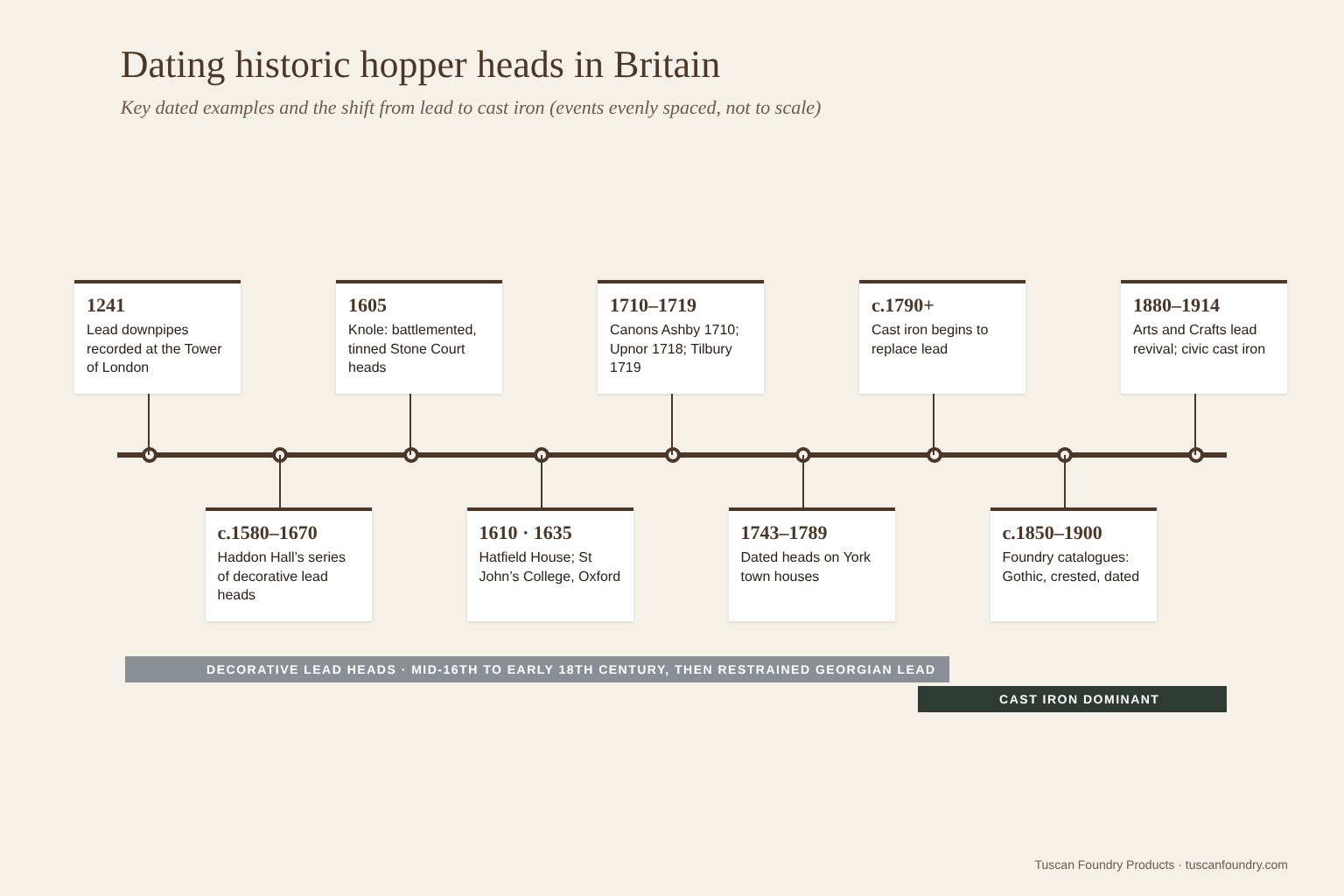
Lead downpipes are recorded at the Tower of London as early as 1241, when Henry III ordered pipes to protect the newly whitewashed walls, but the oldest surviving decorative heads date from the mid-sixteenth century. The Dissolution of the Monasteries released large quantities of salvaged roof lead, and over the following century the lead rainwater head became a distinctly English art, developed, as W. R. Lethaby observed in 1893, to a degree without parallel abroad.
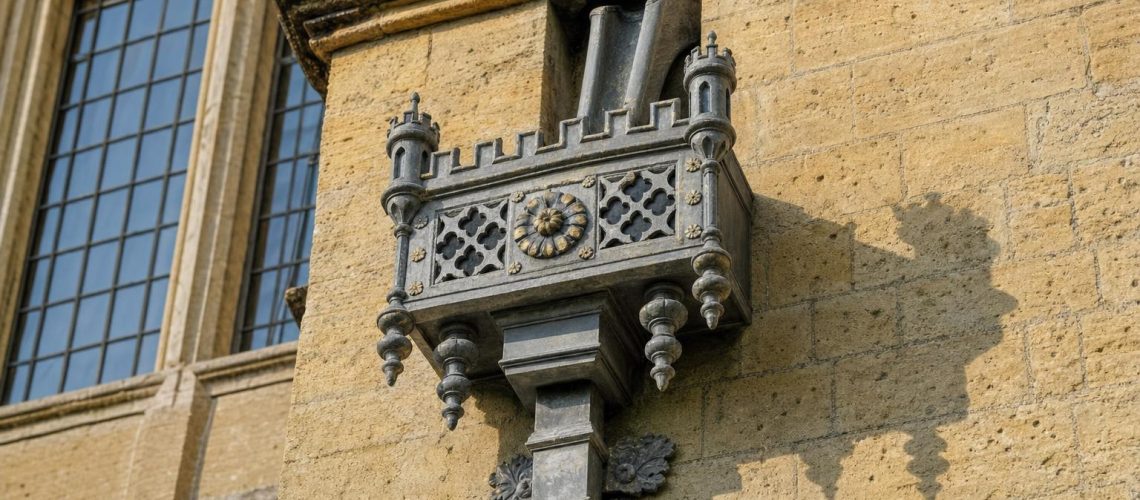
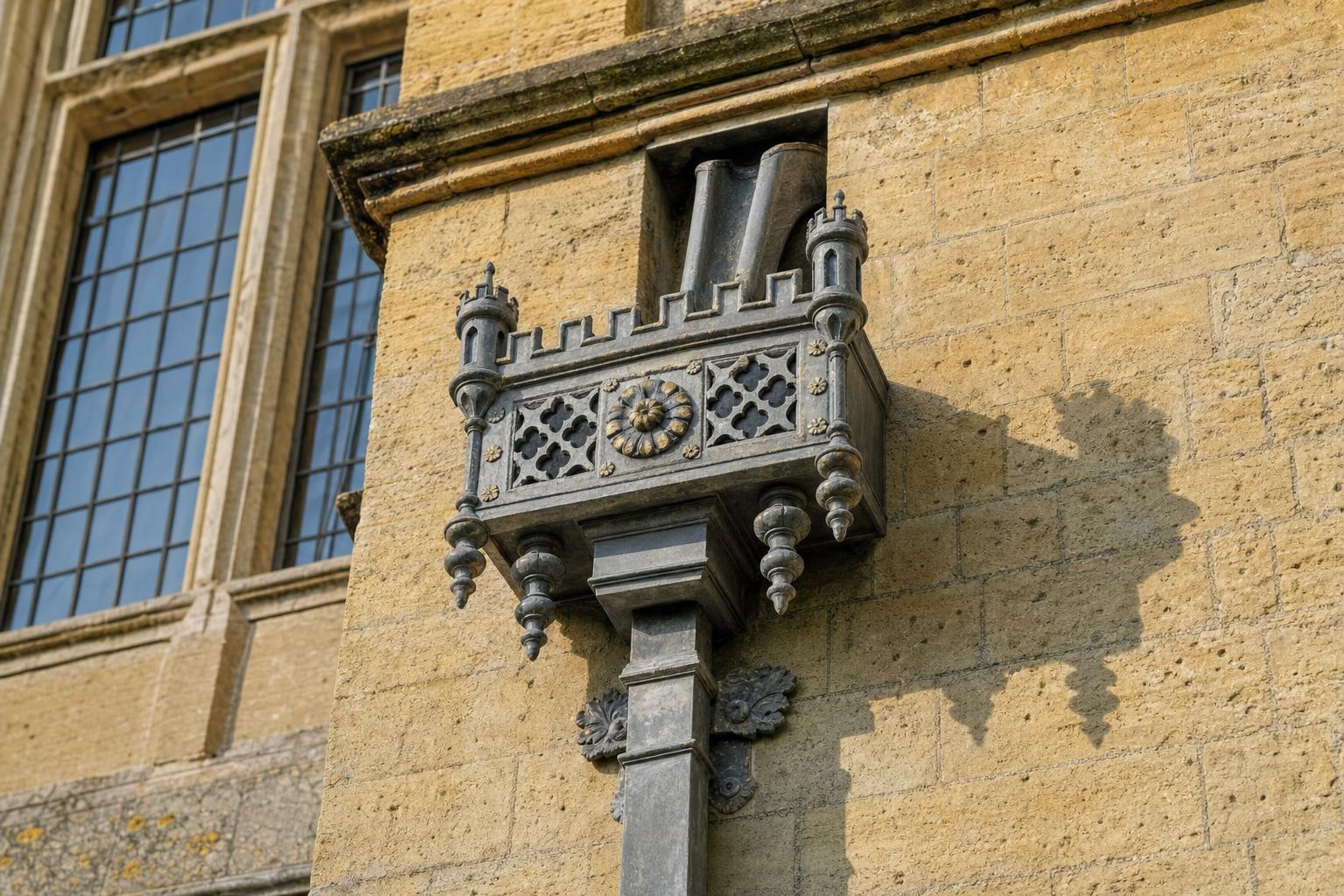
The Society for the Protection of Ancient Buildings (SPAB) identifies Haddon Hall in Derbyshire as having the finest historical series of decorative heads in England, spanning roughly 1580 to 1670: the earliest with repoussé work and miniature battlemented turrets (bartizans), the later ones with elaborate pierced tracery. Securely dated examples follow at Knole in Kent (1605), Hatfield House in Hertfordshire (1610), St John’s College, Oxford (1635), Canons Ashby in Northamptonshire (1710), and the military establishments at Upnor Castle (1718) and Tilbury Fort (1719).
| Period | Usual material | Typical form | Characteristic embellishment |
|---|---|---|---|
| Tudor and Elizabethan (c.1540–1603) | Sand-cast sheet lead | Shallow boxes and cisterns on high-status houses, colleges and palaces | Repoussé, simple cresting, early dates and initials |
| Jacobean and Caroline (1603–c.1660) | Sand-cast lead with chill-cast enrichments | Deep heads with bartizans, battlements and pendants | Pierced strapwork and tracery, arms and crests, tinning, gilding |
| Restoration to Queen Anne (c.1660–1714) | Lead | Large, shaped heads with ogee or bowed fronts | Masks, cherub heads, cartouches, triads of initials, dates |
| Georgian (1714–c.1800) | Lead; cast iron appears late in the century | Neat rectangular or bowed cisterns, square pipes | Fluting, moulded rims, occasional dates; growing restraint |
| Regency and early Victorian (c.1800–1850) | Cast iron increasingly common | Small, classical heads; round pipes | Lion masks, paterae, Greek key, simple beading |
| High Victorian (c.1850–1900) | Cast iron from foundry catalogues | Gothic, Italianate and Elizabethan Revival patterns | Tracery, crenellation, shields, corporate initials, cast dates |
| Arts and Crafts and Edwardian (c.1880–1914) | Hand-worked lead revived; cast iron for civic work | Plain or richly modelled heads designed by the architect | Dates, owners’ initials, borough arms, naturalistic ornament |
| Twentieth century | Cast iron, some lead | Neo-Georgian and civic patterns | Dates and institutional devices continue on public buildings |
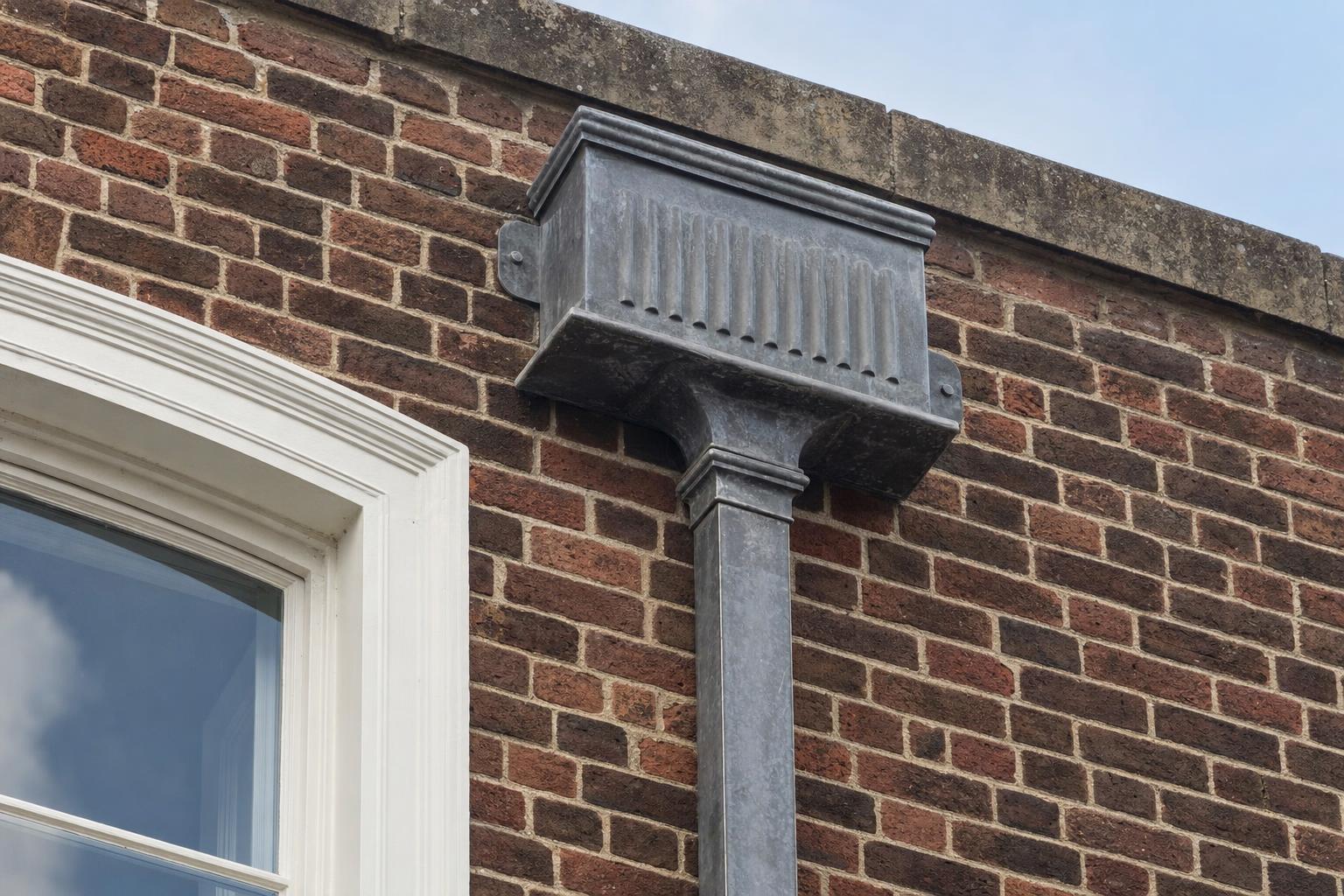
Through the eighteenth century, classical taste reduced the exuberance of the Stuart head to something quieter: a rectangular or bowed cistern with a moulded rim, perhaps fluted, sometimes still dated. In London, the building legislation of the early eighteenth century is generally credited with requiring rainwater to be brought down in pipes rather than thrown into the street from spouts, which made the hopper a standard feature of the Georgian terrace.
Cast iron began to replace lead at the end of the eighteenth century, first on smaller houses and then everywhere. By the mid-Victorian period, foundries such as Walter Macfarlane & Co.’s Saracen Foundry in Glasgow published catalogues running to hundreds of pages, and a school board, railway company or borough council could order a Gothic, Italianate or crested head by pattern number. The Arts and Crafts movement reacted by reviving hand-worked lead, and architect-designed heads of the 1880s to 1914 are among the finest of any period.
The ornament on a hopper head is a period vocabulary: dates, initials, heraldry and architectural motifs each changed over time, and together they usually narrow a head to a generation even before any date is read. The key is to read the style of the ornament, not just its content.
Cast numerals are the most valuable single clue, and their form is itself datable. Seventeenth-century plumbers cast numerals individually in chill moulds and soldered them on, often with flourishes, reversed or idiosyncratic figures, and uneven spacing; that irregularity is a mark of authenticity rather than poor workmanship. Victorian cast iron numerals are integral with the casting, crisper, evenly spaced and usually in a standard foundry typeface, because they were formed by loose numeral pieces set into the pattern. A head with machine-regular numerals claiming a seventeenth-century date deserves a second look.
Initials record ownership, not just construction. On seventeenth- and eighteenth-century work, initials are often arranged as a triad: the surname initial placed above, and the first initials of husband and wife below, the same convention found on contemporary datestones and lead cisterns. A triad with a date may record a marriage or the start of a joint building campaign. Entwined Victorian monograms, by contrast, tend to belong to a single owner or institution. Comparing the initials with the ownership history in the list entry, estate papers or a county history will often fix both the date and its meaning.
Arms, crests and badges place a head within a family or institution and can date it through changes in the arms, such as a new quartering, a coronet or a peerage. Royal cyphers appear on palaces and Crown buildings, and from the nineteenth century corporate initials and borough arms appear on railway, civic and educational buildings. Retaining and repairing an existing armorial head is straightforward; casting new heads with someone’s arms requires the right to use them, which we cover in detail in our guide to armorial and monogrammed hopper heads.
Battlements, bartizans and pierced strapwork belong to the decades either side of 1600. Cherub heads, masks, cartouches and bold ogee fronts are typical of the later seventeenth and early eighteenth centuries. Fluting and moulded rims are Georgian. Lion masks, paterae and Greek key belong to the Regency and early Victorian years, while cusped tracery, crenellation and blank shields mark the Gothic Revival. Because hopper heads are seen from the ground at a steep angle, the best designs of every period use bold, deep relief; fine, shallow detail on a head is often a sign of later work.
High-status lead heads were rarely plain grey. SPAB records tinning, a bright pattern of lead-tin solder applied through a masking of “plumber’s black”, as the most common treatment, alongside oil gilding and painting in heraldic colours. The heads at Knole carry tinned chequers, chevrons and stars, and those at St John’s College, Oxford, have been gilded and painted many times since 1635. Cast iron, too, was rarely painted black in the past. Evidence of an original scheme usually survives only in crevices and under later paint, so paint sampling should come before any cleaning or stripping.
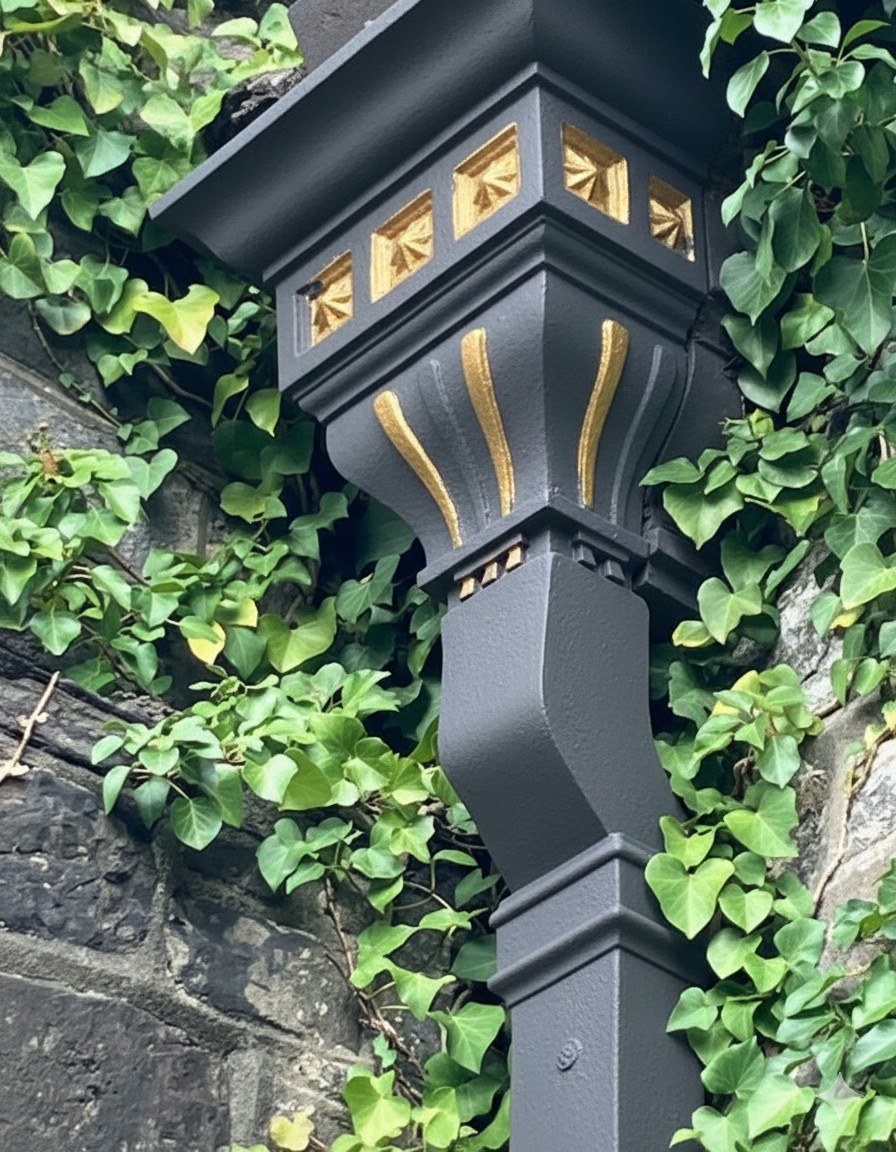
How a head was made and fixed is often more reliable than what it says: lead or iron, sand-cast sheet or foundry casting, soldered or burned joints, and the form of the ears, pipe and fixings each point to a period and are hard to fake. A competent survey records all of them.
Start with the material, which is not always obvious under decades of paint. A small magnet is the simplest test: cast iron is magnetic, lead is not. Lead heads are also heavier-looking for their size, softer at the edges, and often show creep or distortion; cast iron is rigid, and fractures rather than bends. Traditional lead sheet was sand-cast, giving a smooth face and a rough underside, while milled lead became available towards the end of the seventeenth century. Decorative enrichments were usually chill-cast and soldered on, and joints were wiped with solder; leadburning (lead welding) became common in building leadwork only from the late nineteenth and early twentieth centuries, so burned seams on a supposedly Stuart head suggest repair or replacement.
On cast iron, look for the casting itself: section thickness, crispness of detail, flash lines, and any cast foundry name, pattern number or registered design mark on the back, base or ears. Many Victorian foundries numbered their patterns, and a catalogue number can sometimes be matched to a surviving trade catalogue. Fixings tell their own story: lead heads were typically fixed with wrought iron nails or spikes through decorative lead “ears” folded over to hide them, often into timber blocks; cast iron heads have cast lugs or ears for spikes or bolts. The section of the downpipe below is another clue, since square and rectangular lead pipes generally precede round cast iron ones.
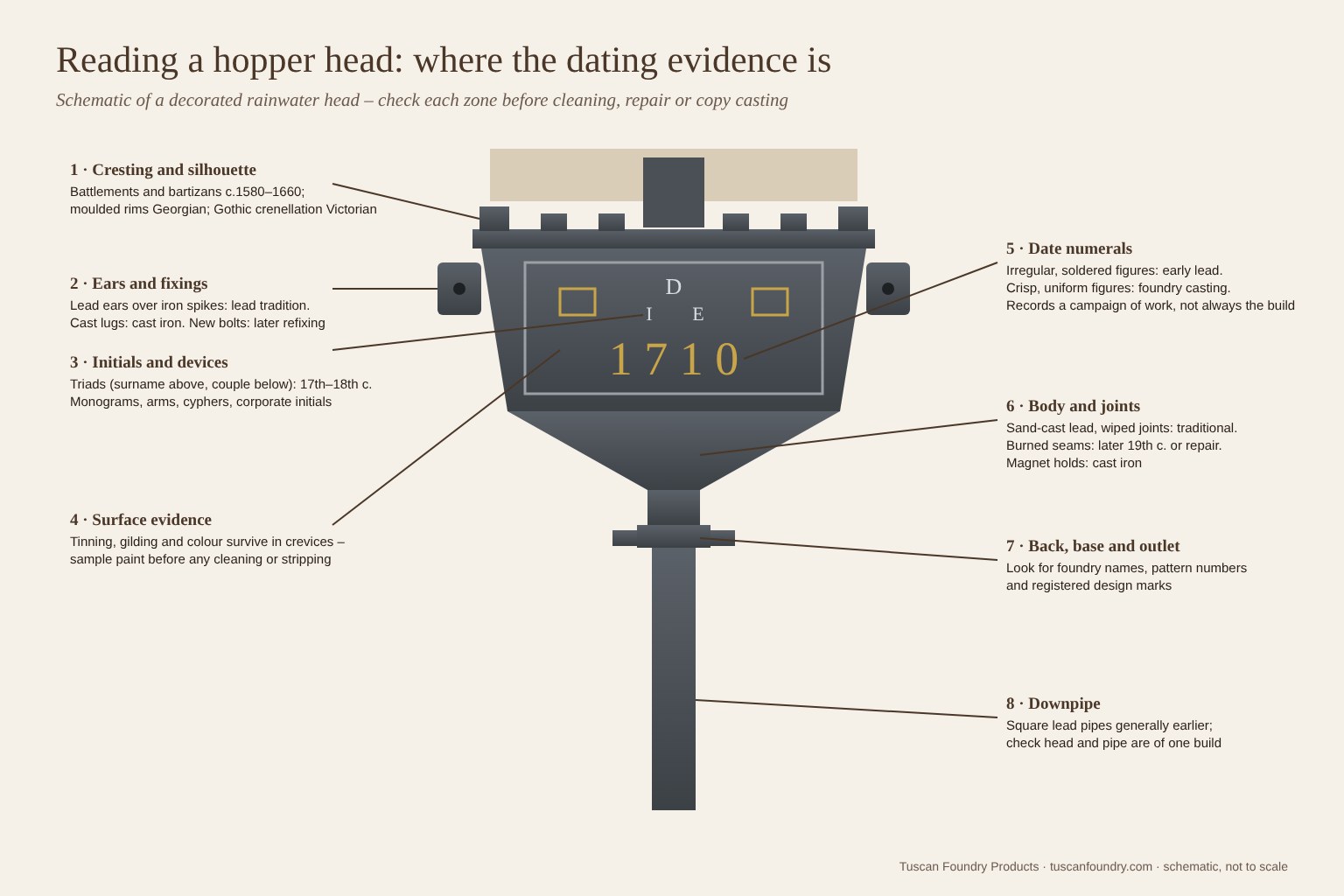
| Clue | What to look for | What it usually suggests |
|---|---|---|
| Magnet test | Magnet holds or falls away | Holds: cast iron (late 18th century or later). Falls: lead (or rarely copper) |
| Lead sheet | Rough, sandy underside; uneven thickness | Sand-cast lead, typical before the 18th century and in conservation work |
| Joints | Wiped solder joints or burned (welded) seams | Wiped: traditional. Burned: c.1900 or later, or a repair |
| Enrichments | Separately cast, soldered numerals and ornaments | Hand-made lead head, 16th–18th century or Arts and Crafts |
| Numerals | Irregular and individual, or crisp and uniform | Irregular: early lead. Uniform: foundry casting, 19th century onwards |
| Marks | Foundry name, pattern number, registered design mark | Victorian or later casting; a diamond mark dates a registered design to 1842–1883, and “Rd No.” numbers follow from 1884 |
| Fixings | Lead ears over iron spikes; cast lugs; bolts | Ears: lead tradition. Cast lugs: cast iron. Modern bolts: later refixing |
| Pipe below | Square or rectangular lead; round or rectangular cast iron | Square lead pipes generally earlier; check whether head and pipe match |
| Paint layers | Number and type of coatings; traces of gilding or tinning | Long service history; possible original decorative scheme |
A cast date is evidence of intention at a moment in time, and it can record a repair, a remodelling, a marriage or a replica as easily as an original build. Most dating errors come from reading the numerals without asking what they commemorate.
Five traps recur. First, the date of a later campaign: many heads record a refronting, a new wing or a reroofing rather than the building’s origin. Second, the antiquarian copy: Victorian restorers sometimes cast earlier-looking dates and initials to lend age and continuity to new work. Third, relocation: heads have been moved around estates, reused on new wings, and sold through the reclamation trade, so a head may be older or younger than the wall it hangs on. Fourth, the unrecorded replica: a faithful copy cast that reproduces the original date, with nothing to say when it was made. Fifth, symbolic dates: a marriage, an inheritance or a jubilee, which may sit years away from any building work.
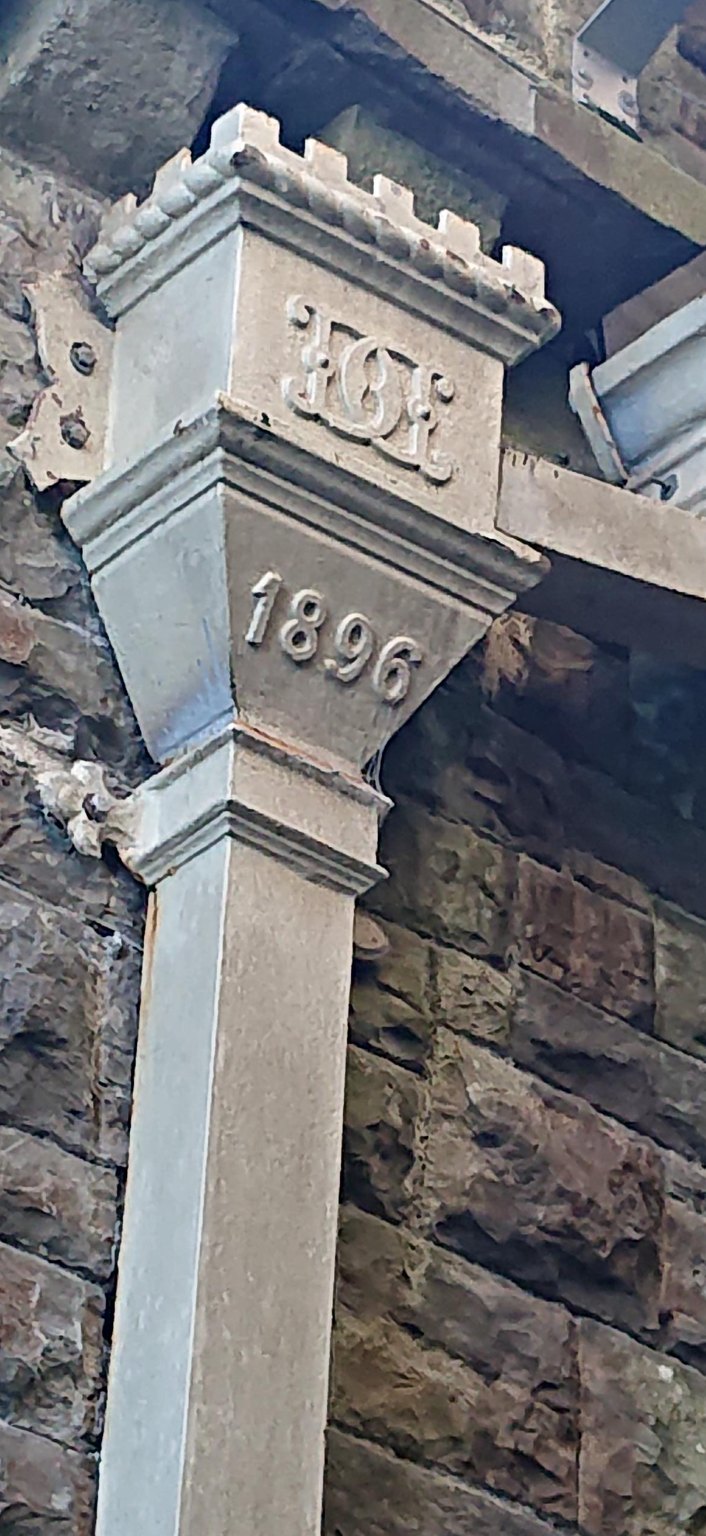
A good illustration of the first trap can be seen on the Dinefwr estate in Carmarthenshire, where a cast iron head bears the date 1896 with an entwined monogram. Newton House at Dinefwr was built in the 1660s and recased in Victorian Gothic by Richard Kyrke Penson in 1856–57, yet the head records neither: its date coincides with the billiard room added in 1896, four decades after the recasing. Read correctly, it adds a phase to the building’s history; read carelessly, it could misdate an entire elevation.
Hopper heads sit wherever water has to change direction or volume: below parapet outlets, at the discharge of valley and box gutters, where several gutters meet, and at the head of every downpipe on a parapeted elevation. Their position is part of their meaning.
On a symmetrical classical front, paired heads frame the composition and often carry the date and initials; on service wings and rear ranges the heads are usually plainer and later. Heads on the principal elevation were the ones worth embellishing, so a richly decorated head in an obscure position may have been moved. Hydraulically, the hopper acts as an open junction that receives a fast, concentrated flow from a parapet or valley and, if the pipe blocks, overflows visibly rather than backing water into the roof; we explain the sizing in detail in our guides to hopper head capacity and downpipe sizes and hopper heads below a parapet.
That dual role matters for dating. A head that is undersized for its roof may have been enlarged, supplemented by an additional pipe, or replaced in a later century, and the evidence of those changes, such as blocked outlets, redundant fixings or patched masonry, is as much part of the record as the numerals.
The type of building is one of the best predictors of what a hopper head will look like and what it will say: country houses carry dynastic heads, colleges and institutions carry devices, Victorian civic and railway buildings carry corporate initials and dates, and terraces carry catalogue patterns. Knowing what to expect helps identify what is out of place.
| Building type | Typical period of surviving heads | What you are likely to find |
|---|---|---|
| Country houses and manor houses | 16th–18th century lead; Victorian cast iron on later wings | Dates, owners’ initials and triads, arms and crests, tinning and gilding |
| Oxford and Cambridge colleges, schools, almshouses | 17th century onwards | Founders’ or donors’ arms, college devices, polychrome finishes |
| Churches and cathedrals | All periods; many Victorian restorations | Dates of restoration, churchwardens’ initials, Gothic Revival patterns |
| Palaces and Crown and military buildings | 17th–18th century lead | Dated, gilded and painted heads, as at Upnor Castle (1718) and Tilbury Fort (1719) |
| Georgian townhouses and terraces | 18th century lead; 19th century cast iron replacements | Plain or fluted cisterns, occasional dates, square pipes |
| Town halls, libraries, baths and courts | Victorian and Edwardian cast iron | Borough arms, dates of opening, Gothic or Baroque Revival detail |
| Railway stations, board schools, hospitals | Victorian cast iron | Company or board initials, dates, standard catalogue patterns |
| Mills, warehouses and breweries | 19th century cast iron | Large plain heads, sometimes the firm’s initials or date of building |
| Estate cottages and model villages | 19th and early 20th century | Estate initials or crest repeated to unify the estate |
| Arts and Crafts houses | c.1880–1914 | Architect-designed lead or simple cast heads with dates and initials |
Churches deserve particular care, because Victorian restoration so often replaced medieval and post-medieval rainwater arrangements; a dated head may record the restoration rather than anything earlier. On estates, the repetition of a crest across house, lodges and cottages is a deliberate statement of unity, and a single replacement in the wrong pattern breaks it. On residential period homes and terraces, catalogue heads should be matched to the pattern originally used along the street, not to whatever is currently available.
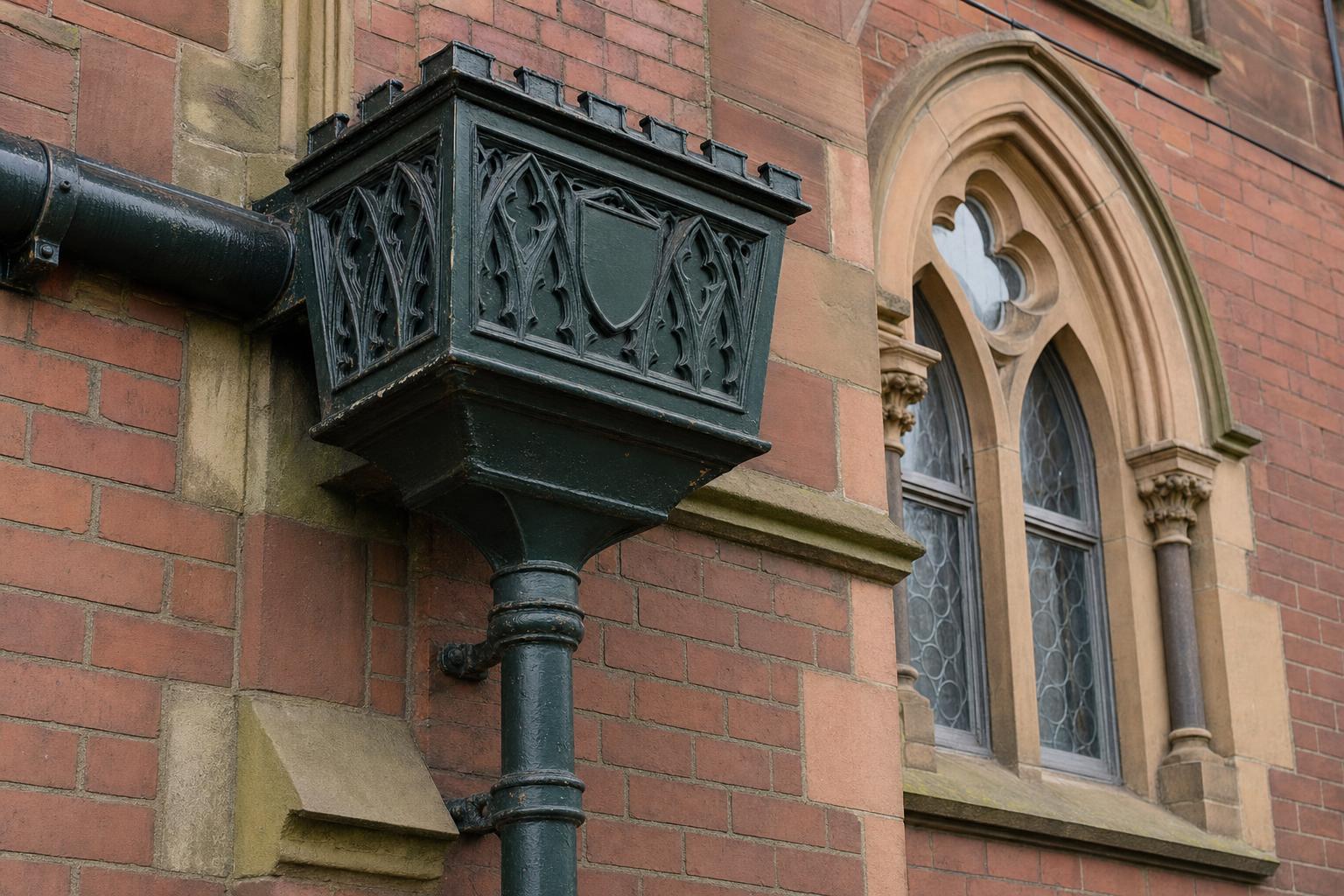
Record first, repair second and replace last: a dated or decorated head should be photographed, measured, sampled and recorded in situ before any work, repaired wherever possible, and copied only when it cannot reasonably be saved. This sequence follows SPAB, Historic England and Cadw guidance and protects both the building and the evidence.
Where heads are ornate, damaged, partly missing or out of reach, we recommend a site survey and visit. This is a chargeable service, and it is the surest way to establish what survives, what the heads are made of, and what reference material can be taken for pattern-making before anything is ordered. Bespoke and copy cast hopper heads typically take 8 to 10 weeks from pattern approval, so the survey should come early in the programme.
Every repair and replica we make today becomes evidence for future historians, so new work should be honest about its date: SPAB advises that new leadwork should complement, not parody, the original, and notes that it is often desirable to show the date of new work. The same principle serves cast iron.
When copy casting a dated head, the visual integrity of an elevation may make it right to reproduce the original numerals on the face, particularly where the head is one of a matched set. In that case the date of the new casting should be recorded discreetly, for example on the back or underside of the head, and in the project record and the Historic Environment Record. Where a head is entirely new, on an extension or a reinstated wing, it can carry its own date, in the long tradition of heads that recorded each campaign of building.
We see a growing number of commissions that continue the tradition deliberately: dated heads marking the completion of a major restoration, estate initials on new farm buildings and cottages in a conservation area, commemorative heads for jubilees and anniversaries, and institutional devices for schools, colleges and livery companies. Each needs the right to use the device and, on a listed building, consent. Good design keeps the ornament bold enough to read from the ground and the hopper large enough for today’s rainfall.
Three further pressures will shape future projects. Heavier rainfall means some historic heads are now undersized, and the conservation answer is usually an additional pipe, a larger outlet or a discreet overflow rather than the loss of a significant head. Lead theft continues to remove dated heads from churches and country houses, which makes good photographic and measured records essential for faithful reinstatement. And measured survey techniques such as photogrammetry and 3D scanning are increasingly used to capture ornate heads, giving pattern-makers and future conservators a precise record. Our team also works on heritage projects overseas, where the same heads are known as leader heads or conductor heads, and the same principles of recording and honest dating apply.
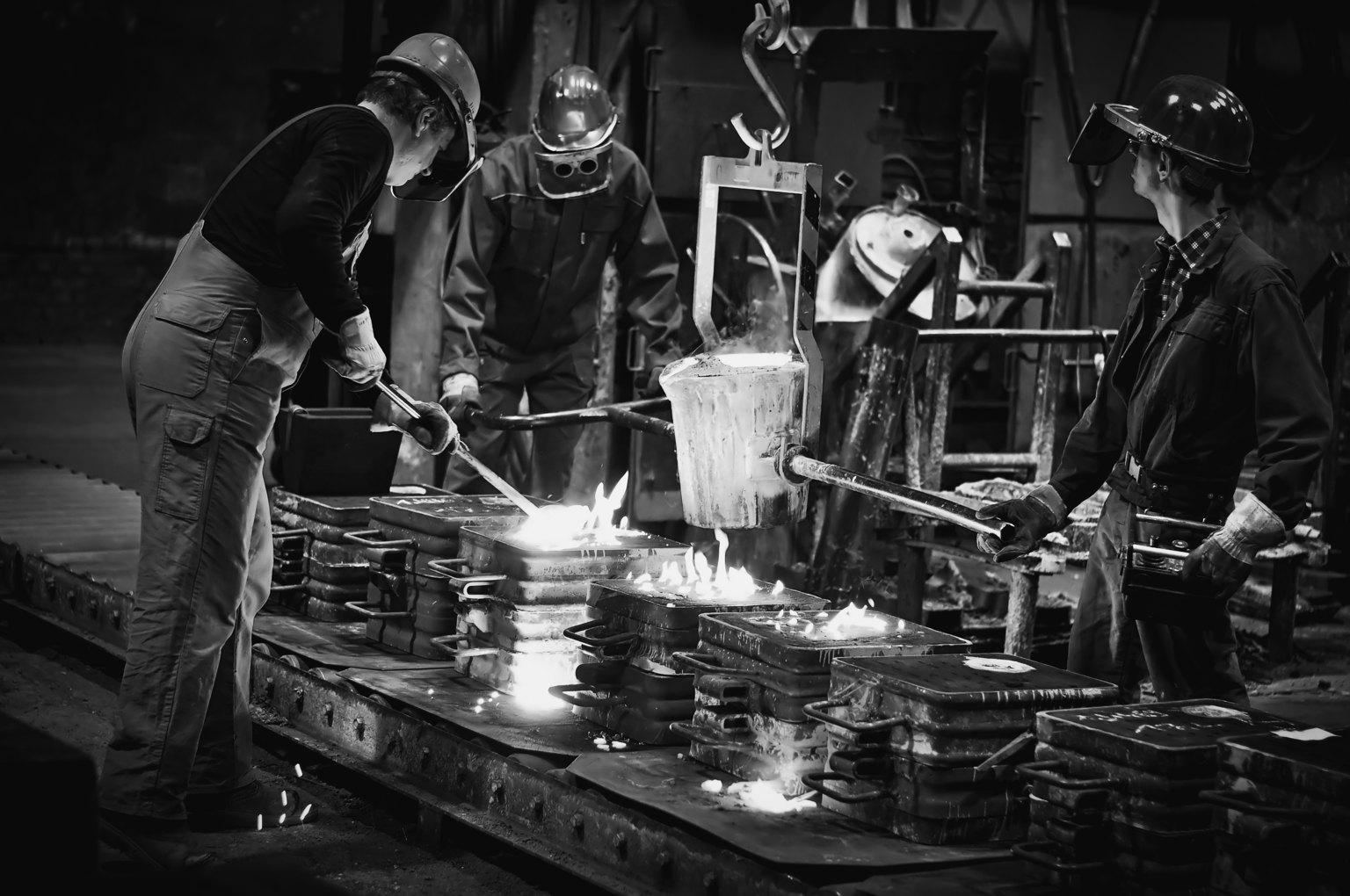
Most mistakes with dated hopper heads come from reading too little evidence, acting too quickly, or replacing without recording. The consequences are permanent: once a head is scrapped or stripped, its evidence cannot be recovered.
Knole, Sevenoaks, Kent (Grade I)
Thomas Sackville, 1st Earl of Dorset, transformed Knole in the first years of the seventeenth century, and the lead rainwater heads in the Stone Court record that campaign. Dated 1605, they carry eight battlemented bartizans, with the date, initials, crest and Sackville leopard cast separately and soldered on, while other heads around the house are enriched with tinned chequers, chevrons and stars. They show how precisely a head can date a phase of work, and why surface decoration must be recorded before any cleaning.
Canterbury Quadrangle, St John’s College, Oxford (Grade I)
Built between 1631 and 1636 under Archbishop William Laud, the Canterbury Quadrangle belongs to the period of St John’s celebrated lead heads, dated 1635 and, as SPAB records, gilded and painted many times since. Lethaby noted that the heads at St John’s have cast coats of arms in wreaths “brightly emblazoned in gold and colours”, and SPAB illustrates a gilded unicorn cut from sheet lead and set forward for depth. They demonstrate that colour was part of the original design intent, and that redecoration of high-status heads should follow paint analysis rather than habit.
Canons Ashby House, Northamptonshire (Grade I)
Home of the Dryden family and now in the care of the National Trust, Canons Ashby was extended around 1590, embellished around 1632, and remodelled in 1708–10. Its fine lead rainwater heads and pipes are dated 1710, and SPAB suggests they may well be the work of the leadworker John van Nost. Here the head and the documented building history agree, and the head becomes independent corroboration of the early eighteenth-century remodelling.
Stonegate to Castlegate, York
York’s town houses show that dated heads were not confined to country seats. The Royal Commission’s inventory of the city illustrates lead heads ranging from 1590 at 23 Stonegate, through 1743 and 1758 on High Ousegate, 1763 on St Saviourgate and 1772 on Low Petergate, to 1789 at 7 Castlegate. A short walk spans two centuries of change, and in a city of rebuilt and refronted houses a dated head can be the clearest surviving evidence of when that work took place.
Cadoxton Lodge, Neath, Wales (demolished)
Cadoxton Lodge, home of the Tennant family until 1931, had remarkable seventeenth-century leadwork: a cistern showing Father Time with his scythe, baskets of fruit and flowers and a face of the Wind, and heads and pipes with an armorial panel of about 1690. To save it, the leadwork was removed in 1946 and passed to the National Museum of Wales; the house was demolished around 1966. In 1992 the stored lead was destroyed by fire at St Fagans. It is a sobering argument for recording thoroughly and keeping leadwork in situ.
Read four kinds of evidence together: the material (a magnet will hold to cast iron but not to lead), how it was made and fixed, the style of its ornament, and any date, initials or device. Lead heads with soldered enrichments generally pre-date about 1800 or belong to the Arts and Crafts revival, while catalogue cast iron heads are usually Victorian or later. A site survey and the building’s list entry will usually confirm the period.
Not necessarily. A cast date records a moment of work, which may be the original build but is just as often a new wing, a refronting, a reroofing, a restoration or even a marriage. Heads have also been moved and copied. Always check the date against the list entry, documentary history and the physical evidence before relying on it.
The quickest test is a small magnet: it will hold to cast iron and fall away from lead. Lead heads also tend to show soft, rounded edges, distortion or creep, and soldered joints, while cast iron is rigid, crisply detailed and may show cast lugs, foundry marks or fractures rather than bends. Thick paint can disguise both, so test in several places.
Like-for-like repair often does not, but altering, removing or replacing a historic hopper head in a way that affects the building’s special character does require Listed Building Consent, and a dated or armorial head is likely to be a significant feature. Unauthorised works are a criminal offence, so agree the approach with the conservation officer before starting.
Yes. We can copy cast from the original head, a sound matching head elsewhere on the building, measured drawings or photographs, reproducing dates, initials and devices where the right to use them is established. Bespoke and copy cast hopper heads typically take 8 to 10 weeks from pattern approval, and we recommend a chargeable site survey for ornate, damaged or inaccessible heads.
Where the head is one of a matched set on an elevation, reproducing the original date on the face is often appropriate, but the date of the new casting should be recorded discreetly on the back or underside and in the project record. SPAB notes that it is often desirable for new work to show its date, so that future surveyors are not misled.
Yes. New dated, monogrammed and commemorative heads continue a long tradition, marking a restoration, an extension or an estate building. We design them to read clearly from the ground and to suit modern rainfall, and we will advise on the permissions needed for any arms or institutional device and on consent where the building is listed.
A historic hopper head is a document as well as a drain. Its material, manufacture, fixings, ornament and inscriptions together can date a phase of a building to the year, identify the family or institution behind it, and reveal original colour schemes long since painted over. That evidence is easily lost: by misreading a date, by stripping before sampling, by storing a head away from its wall, or by making a faithful copy that no one can later distinguish from the original. The sound approach is consistent: record first, repair second, replace last, and when new work is needed, make it accurate and honest about its own date.
At Tuscan Foundry, we have worked with heritage rainwater systems since 1893, and dated, crested and decorative hopper heads are some of the most rewarding work we do. We supply a wide range of standard cast iron hopper heads for prompt dispatch, and our bespoke and copy casting service reproduces lost or damaged heads from originals, drawings or photographs, typically within 8 to 10 weeks. Our chargeable site surveys help architects, conservation officers and contractors establish what survives before specification, and our linseed oil paint systems give the finished head a breathable, repairable finish. If you are recording, repairing or commissioning a dated hopper head, please contact us or call 0333 987 4452 to discuss your project.