
Established 1893 | BS 460:2002 Certified | UK & International Supply | Expert Technical Support | 0333 987 4452
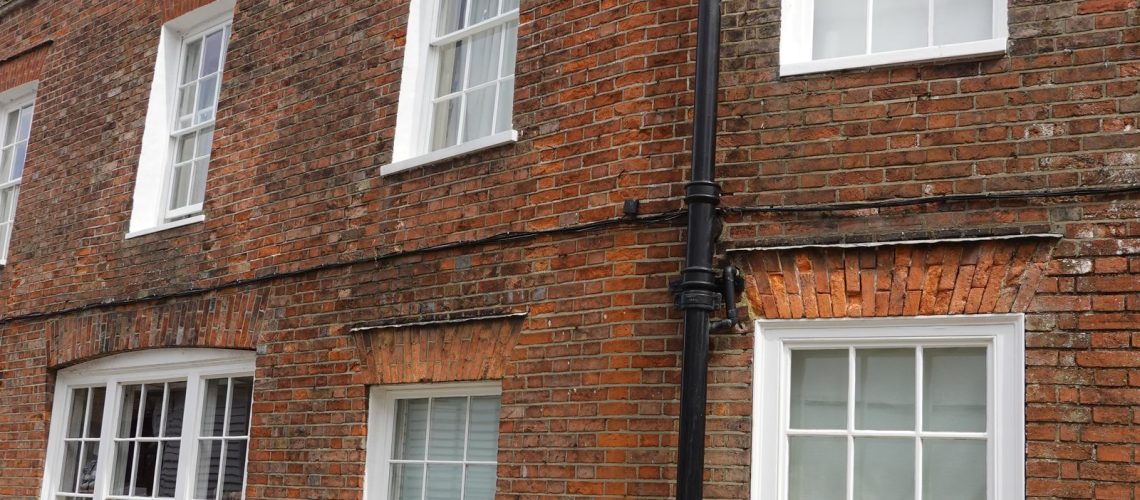
Gutters, hoppers and downpipes are among the quickest things to check during a viewing and among the most expensive to get wrong after completion. This guide is for buyers of listed and period homes in England and Wales, and for the surveyors and solicitors advising them: what to check from the ground, what to ask the seller, how to read the list entry, and when a specialist rainwater survey is worth commissioning before you exchange.
Technical summary. On a listed or period house, failing rainwater goods are rarely just a gutter problem: they are the most common route by which water reaches solid walls, timber lintels, joist ends and roof timbers. Before exchange, a buyer should (1) commission the right RICS survey, usually a Level 3, and read its limitations; (2) carry out their own ground-level check for staining, vegetation, leaning or missing sections, mismatched profiles and blocked gullies; (3) ask the seller for maintenance history, painting dates and any Listed Building Consent for previous rainwater work; (4) read the list entry on the National Heritage List for England or Cadw’s Cof Cymru; and (5) where the survey or viewing raises doubts, commission a specialist rainwater survey so the findings can inform the price. Unauthorised works to a listed building can be enforced against the current owner, so that last step matters more than it first appears.
Before you exchange on a listed or period house, check the rainwater goods as carefully as the roof, because on an old building a failing gutter, hopper or downpipe is the most common cause of damp, timber decay and masonry damage, and it is often the least costly of those problems to fix if it is caught early. A blocked hopper in November can be a stained wall by February and a rotten bressummer or lintel end within a few years.
Older buildings handle water differently from modern ones. Solid masonry walls laid in lime mortar have no cavity and no damp-proof course in the modern sense. They manage moisture by absorbing it and letting it evaporate again. That works well when the wall gets wet occasionally and dries quickly. It fails when a leaking socket or an overflowing gutter soaks the same patch of wall every time it rains.
The consequences tend to follow a predictable order:
Rainwater goods are also a visible part of the building’s character. On a listed house the gutter profile, the hopper heads and the way the downpipes are arranged are part of what was listed. Getting them wrong has a consent dimension as well as a practical one, which is why we treat a pre-purchase check as two questions: is the system working, and is it the right system for this building?
A RICS Home Survey Level 3 is the appropriate survey for most listed and older period houses, but like every RICS home survey it inspects the outside of the building from ground level, so it will usually record that the rainwater goods are defective without being able to tell you exactly why, or what the right repair is. That limitation is not a criticism of surveyors; it is the scope of the service.
RICS currently publishes three levels of home survey under its Home Survey Standard, which has been mandatory for RICS members carrying out residential surveys in the UK since 2021:
| Survey | What it is | Suitability for listed and period homes |
|---|---|---|
| RICS Home Survey Level 1 | A basic condition report using condition ratings, with no advice on repairs | Generally not suitable for an older or listed property |
| RICS Home Survey Level 2 | An intermediate survey with condition ratings and some advice; available with or without a valuation. Often still called a “HomeBuyer Report” | Suitable for conventional houses in reasonable condition; limited for older, altered or listed buildings |
| RICS Home Survey Level 3 | The most detailed home survey, describing defects, their likely causes and repair options. Still widely called a “building survey” | The usual recommendation for listed buildings, older properties, unusual construction or houses that have been significantly altered |
RICS consulted in 2025 on a second edition of the Home Survey Standard and has said it intends to publish it in 2027. Until the new edition takes effect, surveyors work to the current standard and the level names above remain the ones in use. If your surveyor’s terms describe the service differently, ask them to confirm which RICS level they are providing.
The published RICS description of the Level 3 service says the surveyor inspects the outside of the building standing at ground level from within the property boundary and from adjoining public property where accessible, using binoculars where needed. Ladders are used only for low flat roofs and hatches no more than 3 m above ground, and only where it is safe. The surveyor does not open up the fabric of the building without the owner’s consent.
For rainwater goods that means:
A Level 3 report that says the rainwater goods are “in need of overhaul” or “showing signs of leakage” is doing its job. The next question, how much overhaul, of what, and whether consent is needed, is where a specialist survey fits. For context on how a full condition survey of a historic building is organised, see our guide to the condition survey of a historic building.
You can learn a great deal about a house’s rainwater goods from the ground on a second viewing, ideally in or just after rain: look for staining, vegetation, leaning or missing sections, mismatched profiles and gullies that are blocked or missing. Take binoculars and a phone camera, walk every elevation including the back and the outbuildings, and photograph anything that looks wrong so you can show it to your surveyor.
Our article on the ten signs cast iron guttering is failing shows what each of these looks like in practice. None of them alone means the system needs replacing; most cast iron can be repaired. What they tell you is where to direct the surveyor and what to ask the seller.
Ask the seller, through your solicitor, for the maintenance history of the gutters and downpipes, when they were last cleared and painted, and copies of any Listed Building Consent, planning permission or correspondence with the council for previous work to the rainwater goods or roof. The answers, and the absence of answers, are as useful as anything you will see on a viewing.
The seller’s property information form (the Law Society’s TA6, used in England and Wales) asks about building works, alterations and consents, but the questions are general. For a listed or period house it is worth raising specific enquiries:
| Question | Why it matters |
|---|---|
| When were the gutters and hoppers last cleared, and by whom? | Annual clearing is the single most important maintenance task; gaps of several years explain a great deal |
| When were the rainwater goods last painted, and with what? | Cast iron relies on its paint system; unknown or very old paint means corrosion may be hidden |
| Have any sections been replaced? In what material and profile? | Identifies non-original replacements and piecemeal repair |
| Was Listed Building Consent obtained for that work? Please supply copies | Consent for previous work protects you from inheriting an enforcement problem |
| Has the council, Historic England or Cadw ever raised concerns about the building? | Any history of correspondence or notices should be disclosed and examined |
| Have there been any leaks, damp or timber repairs? Where? | Internal problems often trace back to a specific gutter or pipe |
| Are any of the gutters or pipes shared with a neighbour? | Common on terraces and semi-detached houses; affects who can repair what |
| Are there any guarantees or invoices for roof or rainwater work? | Shows scope, date and contractor |
Two cautions. First, “it was all done ten years ago” is not an answer; ask for invoices and consents. Second, if the seller cannot say whether consent was obtained, treat that as a question to resolve before exchange, not after.
If previous owners altered a listed building without the consent that was needed, including by replacing original cast iron rainwater goods with non-original replacements of a different material or profile, the council can require the current owner to put it right, and there is no time limit on listed building enforcement. You do not inherit criminal liability for someone else’s unauthorised works, but you can inherit the cost of reversing them.
It helps to separate the two kinds of liability:
In England the framework is the Planning (Listed Buildings and Conservation Areas) Act 1990. In Wales, the Historic Environment (Wales) Act 2023 came fully into force on 4 November 2024 and now contains the listed building provisions that previously sat in the 1990 Act; the practical position for a buyer is the same. Your solicitor is the right person to advise on the legal detail for a particular property, and we would always encourage buyers to raise the question with them directly.
Whether replacing rainwater goods needed consent depends on what was done. Like-for-like repair, in matching cast iron and the same profile, generally does not. Changing the material, profile, size, colour or arrangement on a listed building usually does. Our guide to what needs Listed Building Consent sets out the principles; the local planning authority’s conservation officer has the final word.
Buyers are often offered a listed building indemnity policy to cover the risk of enforcement over past unauthorised works. These policies can satisfy a lender, but they cover the financial consequences of specific enforcement action only, and they commonly become void if the owner approaches the council about the breach. They do not reinstate anything, and they can make it harder to regularise the position later. Discuss the terms carefully with your solicitor before relying on one.
Before exchange, read the full list entry for the house: in England on the National Heritage List for England (NHLE), maintained by Historic England, and in Wales on Cof Cymru, Cadw’s online record of designated historic assets. The entry confirms the grade, the date of listing and a description of the building. Both registers can be searched online by address or list entry number.
What the list entry can tell you about the rainwater goods:
What the list entry does not tell you is what is protected. Listing covers the whole building, inside and out, together with objects and structures fixed to it and, in many cases, older structures within its curtilage. The description exists to identify the building, not to inventory protected features. A rainwater head that is not mentioned is still protected. Some more recent entries in England do state that particular features are excluded from the listing; read the entry to the end.
For a period house that is not listed, check with the local planning authority whether it sits in a conservation area and whether an Article 4 direction removes permitted development rights for alterations to elevations. In some conservation areas, changing rainwater goods on a front elevation needs planning permission. Our listed buildings page summarises how we approach rainwater work on designated buildings.
The cost of putting a listed or period house’s rainwater goods right depends on four main factors: the profile and size, whether the components are standard or bespoke, the access needed, and the finish. Rather than guessing at a figure from a viewing, use those factors to understand which way the estimate is likely to move, and get a properly scoped quotation before you agree a price.
| Factor | What pushes the cost down | What pushes the cost up |
|---|---|---|
| Profile and size | Standard half-round, ogee or beaded profiles in common sizes | Large, deep or unusual profiles; moulded box gutters |
| Standard or bespoke | Components available from stock | Copy-cast hoppers, ornamental heads, non-standard angles and outlets, radius gutters on bays or curved walls |
| Access | Two-storey eaves reachable from a tower or ladder | Three storeys or more, parapets, valley and parapet gutters, scaffold over conservatories or neighbouring land |
| Extent | Overhaul and repainting of sound cast iron | Wholesale replacement after years of neglect |
| Finish | Primed for site painting | Factory finish, particularly linseed oil paint |
| Consents | Like-for-like repair needing no consent | Reinstating original profiles where non-original replacements were fitted, which may need consent and drawings |
Access is often the largest single element. Where the roof also needs work, scaffolding is shared, and it makes sense to coordinate the two; see our article on the true cost of cast iron gutters on listed buildings for how whole-life cost compares with repeated patch repairs.
Lead times also belong in the budget conversation, because they affect when work can be done:
If the house needs a copy-cast hopper or a radius gutter, it is unlikely to be fitted in the first few weeks after completion. Plan temporary protection accordingly.
Commission a specialist rainwater survey before exchange when the RICS survey recommends further investigation of the gutters or downpipes, when your own viewing shows mismatched profiles, missing hoppers or significant staining, or when the house is listed and the seller cannot evidence consent for past rainwater work. The survey turns an open-ended worry into a defined scope that you can price, negotiate on and plan for.
The fear most buyers have is simple: inheriting a hidden problem, at height, on a protected building, with a consent question attached. A general building survey identifies the symptom. A rainwater survey answers the follow-up questions:
Our site survey service is chargeable, on time and mileage depending on location, and a proportion of the survey fee is credited against a subsequent supply order. We survey from the ground and, where access is arranged, at height. The output is a written record with photographs and a schedule of the rainwater goods, which you, your surveyor and your solicitor can use. We are a supplier, not an installer, so we have no interest in recommending more work than the building needs; we give technical and application advice to whichever contractor you appoint.
Practical points before exchange:
Use rainwater findings in negotiation by converting them into a scoped, quoted schedule of work, distinguishing urgent repairs from planned maintenance, and putting the evidence in front of the seller through your agent. A vague “the gutters need work” is easy to dismiss. A schedule showing that two original hoppers need copy casting, that a non-original replacement on the principal elevation will need consent to reverse, and that a run of gutter is leaking into a joist end is not.
How buyers typically approach it:
Your solicitor and agent should handle the formal side; our role is to provide accurate technical information about the rainwater goods themselves.
In the first autumn and winter after completion, clear every gutter, hopper and gully, check the system in heavy rain, fix active leaks before anything else, and record what you find so that larger repairs can be planned and, where needed, consented. A house that has had years of light maintenance will show you its weak points in the first serious rain.
| When | What to do |
|---|---|
| Within a month of completion | Clear all gutters, hoppers and gullies; check outlets and downpipes run clear; photograph every elevation |
| First heavy rain | Walk round with a torch and an umbrella. Note overflows, drips, wet patches and pipes that back up |
| Before the first frost | Make safe any cracked sockets or split pipes; water held in a cracked socket can freeze and widen the split |
| Late autumn | Clear again after leaf fall, particularly near trees |
| Winter | Monitor inside: first-floor wall surfaces, ceilings below eaves, timber at window heads |
| Spring | Commission scoped repairs; apply for consent if reinstatement or alteration is needed; order long-lead components |
| Summer | Repair, overhaul and repaint in dry weather; plan a regular inspection cycle |
Our guide to downpipe maintenance and how blocked systems damage historic buildings covers the routine in more detail, and our residential page explains how we support private owners of period homes.
When cast iron is overhauled or replaced, the paint system matters as much as the casting. We finish our cast iron in heritage linseed oil paint in our Mid Wales workshop. Linseed oil paint penetrates and adheres well, remains flexible, and is maintained by cleaning and re-oiling or overcoating rather than stripping. It suits listed buildings where a traditional, vapour-permeable finish is expected. For colour, our guide to heritage colours by period explains what is appropriate for Georgian, Victorian and Edwardian houses.
The most common mistake is treating the rainwater goods as a maintenance item to sort out after moving in, when on a listed or period house they can carry a consent liability and be the root cause of more expensive damp and timber problems. The others follow from that.
The following are representative scenarios based on the situations buyers and surveyors typically bring to us. They are not descriptions of specific properties or of our projects.
Case study: Grade II Georgian town house, mismatched front elevation
A buyer’s Level 3 report on a Grade II terraced town house noted “defective rainwater goods”. From the street, the front had an original ogee gutter on one half and a later non-original replacement in a different profile on the other, with a missing hopper. The seller had no record of consent. A specialist survey identified the original profile and hopper pattern from the neighbouring house, scheduled the reinstatement, and the buyer’s solicitor used the schedule to negotiate a price reduction rather than accept seller-arranged works.
Case study: Victorian villa, damp traced to a hidden socket
A buyer noticed vertical green staining behind a downpipe on the rear elevation of an unlisted Victorian villa in a conservation area, and damp on the corresponding first-floor wall inside. The surveyor recommended further investigation. Close inspection found a cracked socket at the back of the pipe, never reached by paint, discharging into the wall at each rainfall. The pipe was replaced like-for-like in cast iron in the first autumn, before the damp reached the floor timbers.
Case study: Welsh farmhouse, list entry mentions a dated rainwater head
A buyer of a Grade II listed farmhouse in Wales read the full Cof Cymru record and found it mentioned a dated cast iron rainwater head that was no longer on the building. The seller’s replies showed it had been removed during roof works. The buyer raised the question through their solicitor, obtained historic photographs, and planned a copy-cast replacement from the photographs and a surviving head of similar pattern, allowing for the 12–14 week lead time from pattern approval.
Case study: Edwardian semi, shared gutter and blocked gully
A buyer’s ground-level check of an Edwardian semi-detached house found the party gutter overflowing at the shared outlet and a silted gully at the foot of the shared downpipe. The seller’s information form confirmed the gutter was shared but gave no maintenance history. The buyer’s solicitor raised an enquiry about responsibility, and after completion both owners cleared and overhauled the shared run together, with cracked lengths replaced in matching cast iron.
Case study: Grade II* manor, scope defined before exchange
On a Grade II* country house with parapet gutters, large moulded hoppers and three storeys of downpipes, the buyer’s surveyor advised that the rainwater system could not be assessed from the ground. A specialist rainwater survey, including inspection at height arranged with the seller, scheduled which components could be overhauled, which needed copy casting and which outlets were undersized. The buyer exchanged with a defined scope, a budget and a realistic programme.
| Question | Answer |
|---|---|
| What should I check about the gutters before buying a listed house? | Check for staining on walls below gutters and joints, vegetation in gutters, sagging or leaning sections, missing hoppers, mismatched profiles, non-original replacements and blocked gullies. Then ask the seller for maintenance records and any Listed Building Consent for previous rainwater work. |
| Which RICS survey do I need for a listed or period house? | A RICS Home Survey Level 3 is usually the right choice for a listed building, an older property, an unusual construction or a house that has been significantly altered. A Level 2 survey is generally better suited to conventional houses in reasonable condition. |
| Does a RICS Level 3 survey check the gutters properly? | A Level 3 survey inspects the outside from ground level and adjoining public property, using binoculars where needed. It will usually identify visible defects in gutters and downpipes, but it cannot normally see inside gutters or check fixings at height, so it may recommend further specialist investigation. |
| Do I become liable for unauthorised works done by the previous owner of a listed building? | You do not inherit criminal liability for an offence someone else committed, but the local planning authority can serve a listed building enforcement notice on the current owner requiring unauthorised works to be reversed. There is no time limit on listed building enforcement, so the cost of putting it right can pass to you. |
| Is there a time limit on listed building enforcement? | No. Unlike ordinary planning breaches, which become immune from enforcement after a set period, unauthorised works to a listed building can be subject to enforcement action at any time. |
| How do I find the listing description for a house in England? | Search the National Heritage List for England on the Historic England website by address or list entry number. The entry gives the grade, the date of listing and a description of the building. |
| How do I find the listing description for a house in Wales? | Search Cof Cymru, Cadw’s online record of designated historic assets, by address or reference number. It gives the grade, date and description of the listed building. |
| If the list entry does not mention the gutters, are they still protected? | Yes. Listing protects the whole building, including fixtures such as gutters, hoppers and downpipes, whether or not the description mentions them. The description identifies the building rather than listing every protected feature. |
| Do I need Listed Building Consent to replace cast iron gutters on a listed house? | Like-for-like repair in matching cast iron and the same profile generally does not need consent. Changing the material, profile, size, colour or arrangement of rainwater goods on a listed building usually does. Confirm with the local planning authority’s conservation officer before work starts. |
| Will listed building indemnity insurance protect me? | Indemnity insurance can cover the financial consequences of specific enforcement action, but it does not put anything right and policies commonly become void if you approach the council about the breach. Discuss the terms with your solicitor before relying on one. |
| How much does it cost to replace cast iron guttering on a period house? | The cost depends on the profile and size, whether components are standard or bespoke, the access and scaffolding needed, the extent of work and the finish. A scoped schedule and quotation is the only reliable basis for a figure. |
| Should I get a specialist gutter survey before I exchange contracts? | Yes, if the RICS survey recommends further investigation, if you have seen mismatched profiles, missing hoppers or significant staining, or if the house is listed and the seller cannot show consent for past rainwater work. A specialist survey gives you a defined scope you can price and negotiate on. |
| Does Tuscan Foundry charge for a site survey? | Yes. Our site surveys are chargeable on time and mileage depending on location, and a proportion of the survey fee is credited against a subsequent supply order. |
| How long does it take to get replacement cast iron hoppers made? | Stock items typically take 5–7 working days and non-stock standard items 7–10 working days. Bespoke and copy-cast components typically take 12–14 weeks from pattern approval, and a linseed oil paint finish adds 6–7 weeks. |
| Can I use problems with the gutters to negotiate the price of a house? | Yes, if the findings are turned into a scoped and priced schedule of work that separates urgent repairs from ordinary maintenance. Your agent and solicitor can then put the evidence to the seller and agree a price reduction, a retention or specified repairs. |
| What should I do with the gutters in my first winter in an old house? | Clear every gutter, hopper and gully soon after completion, walk round the house in heavy rain to see where water goes, make safe cracked sockets before the first frost, and record what you find so that larger repairs can be planned and consented for the following spring and summer. |
On a listed or period house, the rainwater goods deserve the same attention before exchange as the roof and the structure. Commission a RICS Home Survey Level 3 and read its limitations. Walk every elevation yourself, ideally in rain. Ask the seller specific questions and ask for consents, not assurances. Read the list entry on the NHLE or Cof Cymru, and remember that listing protects the whole building. Where doubts remain, a specialist rainwater survey turns them into a defined scope that you can price, negotiate on and plan for. Then use your first winter to learn how the house behaves in rain.
Tuscan Foundry Products has supplied cast iron rainwater goods for period and listed buildings since 1893. We supply cast iron guttering, downpipes, hoppers and fittings to BS 460:2002, offer copy casting for components that cannot be bought from stock, and finish in linseed oil paint in our Mid Wales workshop. We are supply only and work alongside your surveyor and contractor. If you are buying a listed or period house and want the rainwater goods assessed before you exchange, contact us or call 0333 987 4452.