
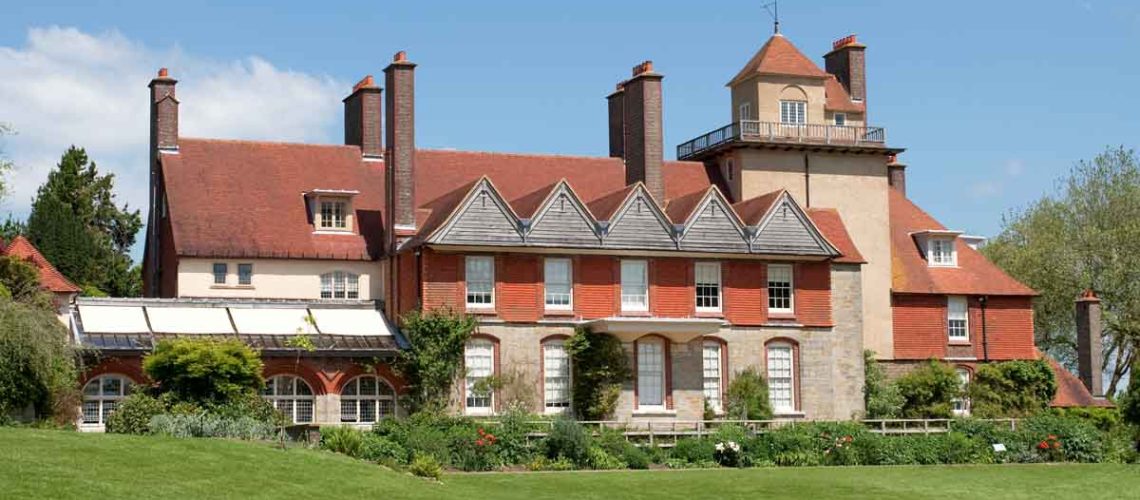
From ogee profiles to galvanic corrosion and linseed oil finishes, we set out the conservation-grade approach to repairing, fixing and maintaining the cast iron gutters, downpipes and hopper heads that define Arts and Crafts architecture.
Arts and Crafts architects treated rainwater goods as ornament rather than afterthought, and that legacy shapes how we approach every conservation project we undertake today. Conserving Arts and Crafts cast iron rainwater systems means retaining original profiles, specifying galvanically compatible fixings and using breathable linseed oil paint, rather than reaching for modern alternatives that compromise appearance and performance. We supply and specify cast iron guttering, downpipes and hopper heads for listed buildings across the UK, and the movement’s founding philosophy — that function and craftsmanship are inseparable — remains the starting point for every repair, replacement or hydraulic upgrade we recommend.
Arts and Crafts architects treated gutters, hoppers and downpipes as expressive architectural details rather than functions to conceal, using the fluid casting qualities of iron and lead to harmonise rainwater goods with hand-made brick, stone and tile elevations.
Philip Webb’s Red House in Bexleyheath established this approach in 1859, rejecting classical revival in favour of honest, regional vernacular detailing in which every fitting, including the rainwater goods, formed part of a single artistic whole. Later designers such as Mackay Hugh Baillie Scott at Blackwell in Cumbria, and metalworkers including Francis W. Troup and George Percy Bankart, extended this philosophy into elaborate hopper heads bearing dates, crests and naturalistic motifs. This same reverence for craftsmanship led William Morris and Webb to found the Society for the Protection of Ancient Buildings (SPAB) in 1877, establishing the principle of conservative repair that still guides our own approach to Arts and Crafts building conservation today.
This philosophy extended well beyond the great country houses. Vernacular cottages, village halls and estate buildings across the movement’s heartlands in Surrey, the Cotswolds and the Lake District received the same careful attention to rainwater detailing as their grander neighbours, with half-round gutters carried on custom-forged brackets that echoed the hand-made character of the surrounding brick and stone. Understanding this context matters for conservation professionals today, because a rainwater system installed with genuine artistic intent should never be treated as a purely functional component when repair or replacement becomes necessary.
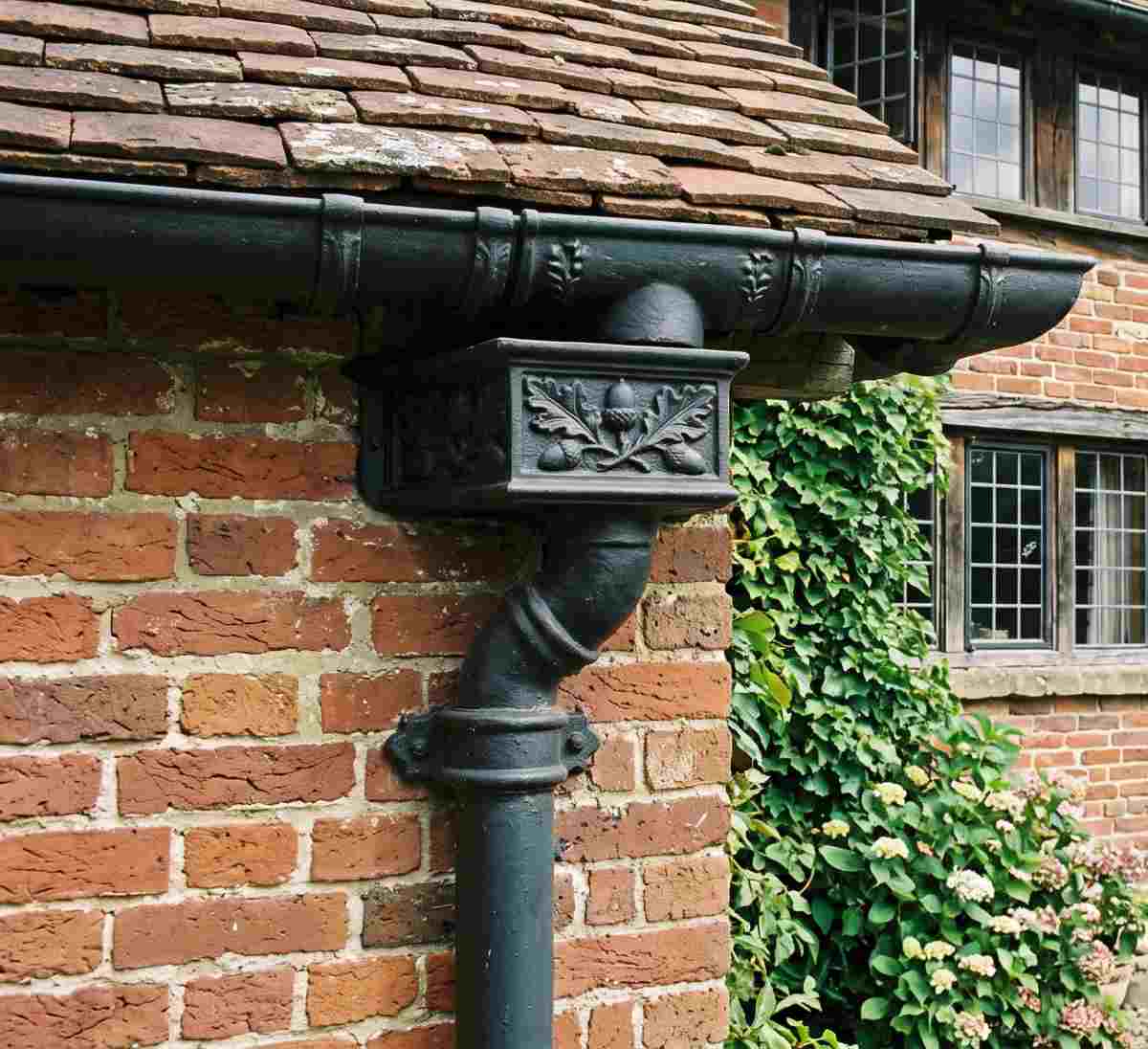
Selecting the correct gutter profile is essential, as the shadow line at the eaves directly affects a facade’s proportions; the three profiles most relevant to Arts and Crafts buildings are the Victorian Ogee, the deeper Moulded Ogee (G46), and the Notts Ogee or half-round.
The standard Victorian Ogee gutter echoes the classical cyma recta moulding and suits suburban villas and standard terraces. The Moulded Ogee (G46) is deeper and box-like, offering significantly greater hydraulic capacity, and was widely specified on large Arts and Crafts country houses and estates with steep-pitched slate roofs. Simple half-round profiles, often carried on custom-forged rafter-arm brackets, suit vernacular cottages and agricultural buildings where a plainer, hand-crafted aesthetic is appropriate. Matching the original profile precisely, rather than substituting the nearest modern equivalent, is fundamental to retaining a building’s architectural integrity.
Any alteration, repair or replacement of rainwater goods on a Grade I or Grade II* listed building requires Listed Building Consent, and Historic England consistently advocates a like-for-like material replacement policy, even where proposed works appear minor.
Cast-iron-effect PVC-U is frequently proposed on cost grounds, but its high coefficient of thermal expansion degrades joint seals over time, and its functional lifespan of 25 to 30 years compares poorly with a properly maintained cast iron system, which can perform for well over a century. Polyester powder-coated cast aluminium is sometimes accepted as a compromise on inaccessible high-level runs, but it lacks the visual mass and subtle surface irregularities of genuine sand-cast iron. For standard listed building applications, cast iron remains the only fully compliant material, and we do not recommend synthetic alternatives on heritage projects.
Conservation officers will typically want to see confirmation that a replacement gutter or downpipe matches the original in material, profile, wall thickness and jointing method, so specification drawings and, where possible, a physical sample or photograph of the surviving original should accompany any application. Where original cast iron survives but is damaged, repair or copy casting should always be considered as the first option ahead of wholesale replacement, in line with SPAB’s conservative repair principles.
Fixing cast iron gutters to stainless steel brackets creates a severe galvanic risk; the electrochemical potential difference between the two metals is more than four times the safe threshold, causing rapid, localised pitting of the cast iron at every bracket junction.
Support brackets and fixings should be manufactured from heavy-gauge mild steel that has been zinc-plated or hot-dip galvanised, since zinc and mild steel sit adjacent to cast iron on the galvanic series and eliminate the electrochemical hazard entirely. Where stainless steel brackets are structurally unavoidable, such as in marine or heavily polluted environments, the stainless steel must be completely electrically isolated from the cast iron using neoprene, EPDM or nylon washers and sleeve bushings at every contact point. Downpipe fixings driven into historic masonry should always be stainless steel, set using breathable lime mortar rather than Portland cement, which traps moisture and causes freeze-thaw spalling of the surrounding stonework.
Traditional linseed oil paint is the premier conservation finish for Arts and Crafts cast ironwork because it remains fully breathable and permanently flexible, unlike modern polyurethane or alkyd gloss paints, which form a rigid, impermeable skin.
Linseed oil saturates the micro-porosity of sand-cast iron, forming an intimate bond with the metal surface that expands and contracts with the building through thermal movement, without cracking or blistering. Rather than requiring a destructive strip-and-recoat cycle, linseed oil paint for cast iron guttering and pipes weathers slowly by self-chalking and needs only periodic washing and a light rejuvenating application. Where modern paint systems are specified instead, we recommend a rigorous five-coat build: two zinc-rich priming coats, a micaceous iron oxide undercoat, and two alkyd gloss top coats, always applied over bare metal that has been correctly prepared and never over existing rust.
Meteorological projections point to significantly heavier winter rainfall across the UK, and where a hydraulic calculation to BS EN 12056-3 shows an existing system is undersized, the solution is rarely to fit larger, standard-profile gutters that alter the building’s appearance.
Instead, we look for design bottlenecks at the transition points — the outlet, hopper head or downpipe connection — rather than along the gutter run itself. A bespoke deeper-rear gutter can retain the identical front profile while increasing internal volume invisibly from ground level, and a tapered, aerodynamic bespoke hopper head significantly increases discharge velocity into the downpipe. These adaptations are best carried out during planned conservation works, when other scaffolding or access is already in place.
A twice-yearly inspection, timed to follow autumn leaf-fall and to precede spring storms, is the single most effective way to prevent water damage to historic masonry and timber, and the most reliable diagnostic method is to inspect the system from ground level during heavy rain.
Gutters, hoppers and gullies should be hand-cleared of leaves, silt and bird nests, with wire balloon guards fitted above outlets rather than plastic mesh, which traps debris and hinders cleaning. Cast iron downpipes are prone to splitting along their rear seam, so a hand mirror should be used to inspect the stood-off space behind the pipe. For complex Arts and Crafts elevations with hidden valleys or parapet junctions, we recommend a formal on-site survey before specification is finalised — a chargeable service, but one that consistently protects the outcome of the project. Our team can be reached via our contact page to discuss survey timings and lead times.

Red House, Bexleyheath, Kent — Grade I Listed
Designed by Philip Webb for William Morris in 1859–60, Red House established the founding principle of Arts and Crafts design: that every element, including rainwater fittings, should form part of a single artistic whole. Its unadorned red brick elevations and high-pitched tile roofs relied on carefully integrated metalwork rather than concealed drainage. The house remains the movement’s conceptual starting point, and its approach to honest, exposed ironwork continues to guide conservation-grade specification on comparable Arts and Crafts buildings today.
Standen, West Sussex — Grade I Listed
Built by Philip Webb between 1891 and 1894, Standen incorporated an ambitious water harvesting network, directing rainwater from extensive roof surfaces through lead-lined pipes into slate-lined storage tanks before pumping it to a dedicated water tower. This scale of integration illustrates how functional rainwater infrastructure was woven directly into the domestic fabric of major Arts and Crafts houses. Conserving a system of this complexity today demands the same attention to hydraulic performance and material authenticity that Webb applied at the time of construction.
Blackwell, Windermere, Cumbria — Grade I Listed
Mackay Hugh Baillie Scott’s 1900 design for Blackwell features highly ornate, hand-crafted rainwater gutters and decorative hopper heads adorned with naturalistic flora and fauna motifs drawn from the Lake District landscape. The rainwater system here functions as a prominent decorative asset rather than a hidden utility. Conserving such elaborate detailing requires bespoke pattern-matching and careful colour analysis to ensure any replacement casting reproduces the precise depth and character of the original ornament.
St John’s College, Oxford — Grade I Listed
The seventeenth-century lead hoppers at St John’s College were restored by Arts and Crafts architect Francis W. Troup, who recovered elaborate painted and gilded chevron bands, royal crests and heraldic blazons beneath later overpainting. Troup’s meticulous, research-led approach — documenting historic colour schemes before any repainting — remains the correct methodology for significant listed rainwater goods today, particularly on Grade I and II* buildings where original decorative schemes may survive beneath later paint layers.
Former Grammar School, Chard, Somerset — Listed Building
This former grammar school retains a highly detailed lead rainwater hopper dated 1593, among the earliest surviving examples of organised vertical drainage in England. Predating the widespread adoption of cast iron by two centuries, it demonstrates how rainwater goods carried decorative and status significance long before the Arts and Crafts movement. Its survival underlines why conservative repair, rather than wholesale replacement, should always be the starting position for any historic rainwater fitting of this age and rarity.
Yes. Under the Planning (Listed Buildings and Conservation Areas) Act 1990, any alteration, repair or replacement of rainwater goods on a listed building requires Listed Building Consent, even where the works appear localised or minor, and Historic England expects a like-for-like material approach.
Galvanic corrosion occurs when two dissimilar metals are in electrical contact in the presence of moisture. Cast iron and passive stainless steel sit far apart on the anodic index, so the cast iron corrodes rapidly and locally at every bracket junction unless zinc-plated fixings or electrical isolation are used.
Linseed oil paint remains breathable and flexible, allowing it to move with the metal through thermal expansion without cracking, and it weathers by gentle self-chalking rather than failing suddenly. Modern polyurethane and alkyd gloss paints form a rigid skin that traps moisture and cracks over time.
We recommend a minimum of twice a year, following autumn leaf-fall and again in early spring, in line with SPAB’s National Maintenance Week guidance. Inspecting the system from ground level during heavy rain is the most reliable way to identify hidden defects.
Yes. Bespoke gutters can be cast with an identical front ogee profile but an extended, deeper rear wall, increasing hydraulic capacity while remaining visually unchanged from ground level. Tapered hopper heads can similarly improve discharge velocity without altering the visible profile.
Bespoke and copy cast items typically take 8 to 10 weeks, while radius or curved gutters generally take 12 to 14 weeks. Standard stock profiles are available for prompt despatch. We always confirm current lead times at the point of enquiry.
No. PVC-U is not considered an acceptable like-for-like replacement on listed buildings. It has a functional lifespan of only 25 to 30 years, degrades under UV exposure, and its joint seals fail under thermal movement, whereas properly maintained cast iron can perform for over a century.
Since 1893, we have supplied and specified cast iron rainwater systems for the historic and listed buildings that depend on them, and the Arts and Crafts movement’s insistence that every detail matters sits comfortably alongside our own approach to conservation-grade work. Whether a project calls for standard stock profiles from our product catalogue, a bespoke copy cast hopper head reproducing lost heraldic detail, or a full hydraulic reassessment of a struggling Victorian system, we bring the same attention to material authenticity, galvanic compatibility and traditional finishing that first-generation Arts and Crafts craftsmen would recognise. Get in touch with our team to discuss a survey, a specification, or a bespoke casting for your next Arts and Crafts conservation project.