
Established 1893 | BS 460:2002 Certified | UK & International Supply | Expert Technical Support | 0333 987 4452
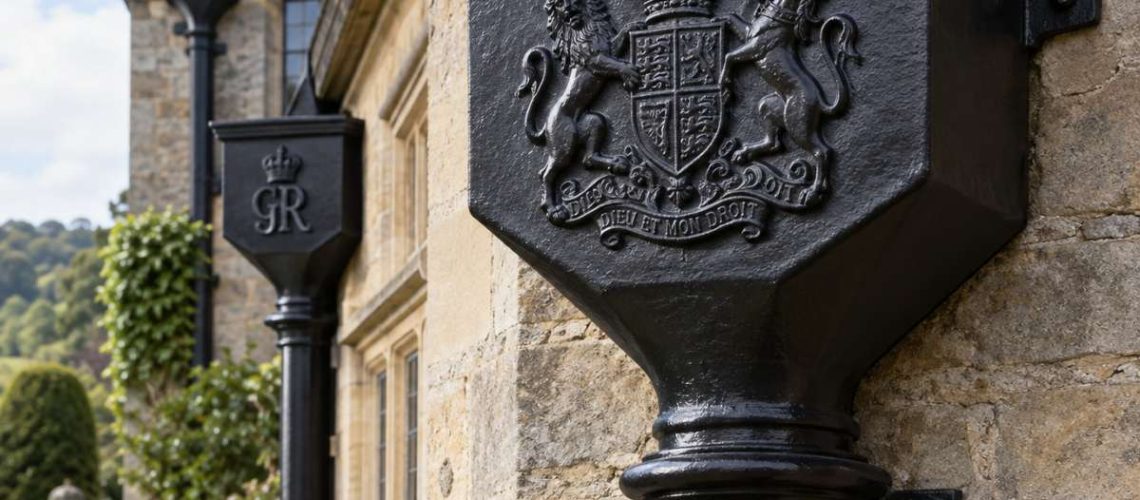
A hopper head is the one component of a rainwater system that is looked at rather than looked past. On estates, institutions and buildings of standing, it has carried arms, initials, dates and emblems for four centuries — and it still can.
In short: An armorial or monogrammed hopper head combines a working rainwater component with a piece of architectural identity: it collects discharge from one or more sources, provides a visible point where a blockage announces itself, and carries a crest, cypher, date or emblem at the height where it can be read from the ground. Producing one means developing a pattern — from a surviving original, a measured drawing, or new artwork — and casting from it. Before any design work begins, the right to use a coat of arms, institutional emblem or registered mark must be established, because a grant of arms belongs to a person or corporate body and not to a surname, a family or a house. #LABEL# Contents #TOC# 1. What a hopper head does 2. Why hopper heads matter visually on historic and high-status buildings 3. Armorial, monogrammed, dated and commemorative detail: the tradition 4. How an estate, institution or owner might use a device 5. Permissions: heraldry, intellectual property and institutional marks 6. Reproducing an existing hopper head, or creating a new design 7. Source material: what we can work from 8. Design considerations 9. Coordination with gutters, downpipes, brackets and elevations 10. Material, finish, painting and long-term maintenance 11. Quality control, approval drawings, prototypes and samples 12. Conservation considerations when adding new decorative detail 13. Practical constraints: budget, lead time, access and installation 14. The bespoke casting process, step by step 15. Comparing the four routes 16. How to prepare for a bespoke project 17. Buildings where identity is built into the fabric 18. Frequently asked questions
Most of a rainwater system is designed to be unnoticed. The hopper head is the exception. It sits at first-floor level or above, projects from the wall, catches light on its moulded faces, and is the one component that people actually look at — which is precisely why, from the seventeenth century onwards, it became the place where a building declared who it belonged to.
A hopper head is a functional component first: it receives discharge from one or more gutters or pipes, slows and collects the flow into a single downpipe, and gives a point at which a blockage shows itself by overflowing rather than backing up unseen. That it can also carry arms, initials, a date or an emblem is a considerable bonus, and one that estates, colleges, institutions, local authorities and owners of distinguished buildings continue to make use of.
This article sets out how bespoke hopper heads are developed and cast, what design decisions they involve, what source material is needed, and — importantly — what permissions may need to be in place before anything is drawn. We have written separately on how the hopper defines the character of a heritage façade.
A hopper head collects rainwater from one or more inputs and delivers it into a single downpipe. It is a junction, a collecting point and — properly used — a maintenance feature.
Its practical value is greatest where a downpipe serves more than one source: two gutter runs meeting, a valley or parapet gutter discharging at high level, a lower roof draining into a main pipe, or an overflow from a concealed gutter. Without a hopper, those flows have to be combined inside pipework, where a blockage is invisible until water appears somewhere it should not.
There are two further functional benefits worth stating, because they are frequently forgotten when a hopper is treated as decoration. First, the open top means a blockage announces itself — the hopper overflows visibly at high level rather than backing water up into a concealed gutter and over a parapet into the building. Second, it provides physical access to the head of the downpipe, which is where blockages concentrate and where they are otherwise hardest to reach.
On a historic elevation the hopper is one of a very small number of projecting three-dimensional objects between the eaves and the ground, and it reads accordingly. Its scale, profile and position are part of the composition whether anyone intended them to be or not.
Consider what else is on a typical stone or brick elevation at that height: windows set flush or slightly recessed, string courses, perhaps a cornice. The hopper projects, catches raking light, casts a shadow, and interrupts the vertical line of the downpipe with a horizontal emphasis. On a symmetrical façade a pair of hoppers becomes part of the symmetry; a single one becomes a focal point.
That is why the wrong hopper is so conspicuous. A plain box on a Jacobean elevation looks like what it is. An oversized decorative hopper on a modest cottage looks pretentious. And a hopper positioned to suit the drainage rather than the elevation will draw the eye to exactly the place the architect did not want it drawn. Our note on decorative hopper heads in architectural detailing covers the design relationship in more detail.
Decorated rainwater heads are one of the oldest surviving forms of architectural dating and identification in Britain, beginning in lead and continuing in cast iron. They exist because they combined a practical necessity with an opportunity that builders and owners were not going to waste.
The tradition began with lead. From the sixteenth and seventeenth centuries, lead rainwater heads on great houses and palaces were cast with dates, initials, cyphers, heraldic devices and ornamental strapwork — often the only place on a building where a construction or alteration date was recorded, and consequently a resource that architectural historians still rely on. Cast iron inherited the convention wholesale in the eighteenth and nineteenth centuries, when foundry production made decorative detail affordable on a far wider range of buildings.
What appears on them falls into recognisable categories: dates, recording construction, rebuilding or a specific event; initials and cyphers, usually of the owner or of a couple; full achievements of arms or single crests, on the buildings of armigerous families and corporate bodies; institutional devices, on colleges, hospitals, schools, railway companies and municipal buildings; and emblems and rebuses, from estate motifs to trade symbols. On some buildings the hopper is the only surviving evidence of an earlier owner or an earlier phase.
A bespoke hopper is worth considering wherever a building has an identity worth recording and a rainwater system that needs replacing anyway. The marginal cost of a decorated hopper over a plain one is small relative to the cost of the works around it.
The situations we are asked about most often:
The general principle worth applying is restraint. One well-designed armorial hopper on a principal elevation carries more weight than a dozen repeated around the building, and on a listed building a lighter touch is also considerably easier to get approved.
This section comes before the design section deliberately. A coat of arms is granted to a specific person or corporate body and their lawful descendants or successors — it does not belong to a surname, a family in general, or a house. Establishing the right to use a device is the first step, not a formality to be dealt with later.
The College of Arms, which has jurisdiction in England, Wales and Northern Ireland, is unambiguous on the point: there is no such thing as a coat of arms for a surname. To have a right to arms, a person must either have had them granted, or be descended in the legitimate male line from someone to whom arms were granted or confirmed. Many people sharing a surname will be entitled to entirely different arms, and many others to none at all. The “family coat of arms” sold by heraldry shops and genealogy websites is generally not evidence of any right.
In Scotland the position is governed separately. Arms are recorded in the Public Register of All Arms and Bearings in Scotland, and the Court of the Lord Lyon exercises jurisdiction over their use. Anyone proposing to display arms on a Scottish building should confirm the position with Lyon Court before proceeding.
Two further points arise regularly:
Our position is straightforward. We can cast what a client is entitled to use, working from source material they provide or approve, and we will ask about permissions as part of the brief. We are not heraldic authorities and we cannot advise on entitlement — that is a question for the College of Arms, Lyon Court, the institution concerned, or a solicitor. Where a client is unsure, the sensible sequence is to resolve entitlement first and commission the pattern afterwards, because a pattern is not a cheap thing to make twice.
There is a real difference between copying something that exists and designing something that does not, and it affects cost, programme, approval and conservation acceptability.
Reproduction takes a surviving original — intact, damaged or fragmentary — and reproduces it. The design decisions have already been made; the work is in accurate pattern-making and in resolving what to do about detail that has been lost. On a listed building this is generally the most straightforward route to approval, because the outcome is a like-for-like replacement rather than an addition.
Adaptation takes an existing pattern or an existing hopper design and modifies it — changing the size, altering the outlet position, or substituting a different device within an established frame. It is a middle route: less design work than starting fresh, and often a good answer where the original is an ordinary catalogue pattern with a bespoke panel.
New design starts from the building and the brief. It offers the most control and requires the most work, and on a historic building it needs the most careful justification. It is the right route for a genuinely new building, for a commemorative piece, or where nothing survives to copy.
The quality of the source material determines the quality of the casting more than anything else in the process. What is genuinely useful, in descending order:
Where the existing component is inaccessible, badly damaged or at height, a site survey is usually the efficient route to the information. Site surveys and site visits are a chargeable professional service; on a bespoke commission they routinely prevent far greater cost later. Our approach to copy casting and pattern replication sets out how we work from each of these sources.
A decorative hopper has to work as a rainwater component, as an object seen from below at an angle, and as a casting. Those three requirements pull in different directions, and reconciling them is the design work.
Scale. The hopper must suit the building and the elevation, not the drawing it is designed on. A device that looks well balanced at A4 may be illegible at eight metres, or may dominate a modest frontage. Consider the viewing distance and the viewing angle, which is almost always steeply upwards.
Relief and legibility. Detail is read from below, in raking light, usually against a shadowed background, and after several coats of paint have softened every edge. That argues for bolder relief and simpler forms than a graphic designer would naturally choose. Fine hatching, thin lines and small lettering disappear. Heraldic tinctures, which depend on colour and on hatching conventions, cannot be reproduced in relief alone — a decision has to be made about whether the device is cast in monochrome relief or painted in its colours.
Proportion and framing. The device needs a field to sit in. Most successful historic examples place the device within a moulded frame or cartouche that gives it edges and separates it from the functional body of the hopper.
Function first. The inlet arrangement must accept the flows it is designed for, the outlet must align with the downpipe below, the capacity must be adequate, and the internal form must not create ledges where debris collects. Decoration that compromises any of these is a mistake, and it will be found out in the first autumn.
Fixing. How the hopper is supported, what it fixes into, and whether it can be removed for maintenance without dismantling the pipe run.
Castability. Undercuts, very fine detail and abrupt changes of section all create difficulties in a sand casting. Good decorative design for casting works with the process rather than against it, which is why historic examples share a family resemblance in the depth and character of their relief.
A hopper is part of a system, and specifying one in isolation produces a component that does not fit what it joins. Coordinate it with everything it touches.
The connections to resolve: the gutter outlet or outlets discharging into it, with their profile, size and position; the downpipe below, its section — round, square or rectangular — and diameter, and whether the hopper outlet matches it directly or requires a transition; the fixing arrangement and the bracket or holderbat immediately below; and the alignment of the whole assembly on the elevation.
That last point deserves attention. The hopper, the pipe and the shoe form a single vertical line on the façade, and any misalignment between them is glaring. Where the pipe has to offset around a plinth or string course, the offset should be designed rather than improvised. Where the elevation is symmetrical, the hopper position is part of the symmetry.
Profile family matters too. A hopper should belong visually to the gutter profile it serves — a heavily moulded hopper below a plain half round run reads as a component from a different building.
A decorative hopper is a rainwater component that happens to be beautiful, and it needs the same protection as any other. The decoration in fact makes maintenance more demanding, not less.
Cast iron rainwater goods are supplied primed, with finishing coats applied in the works or on site. For heritage work we recommend a linseed oil paint system: it is historically appropriate for architectural ironwork, vapour-permeable, and it weathers by gradual surface erosion rather than by blistering and delamination, so it can be maintained by cleaning down and recoating rather than by stripping.
Three maintenance points specific to decorative hoppers:
Bespoke work needs approval points built into the programme, because every stage is more expensive to correct than the one before it. Agree who approves what, and when, before work starts.
The sensible sequence of approvals:
On a listed building or a grant-funded project, add the conservation officer, the Diocesan Advisory Committee or the funder to the relevant stages, and allow for their review periods in the programme. Approval time is not delay; unallowed-for approval time is.
Introducing new decorative detail to a historic building is a different proposition from restoring what was there, and it needs to be approached as such. Conservation practice does not forbid it, but it does ask for honesty and justification.
The questions a conservation officer will reasonably ask: is there evidence that decorative hoppers existed here previously, and if so what did they look like? If nothing survives, is the proposal appropriate to the building’s period, status and character, or is it aggrandising a building beyond what it ever was? Does the new work read as new, or does it pretend to be original? Is the intervention reversible? And is any historic fabric lost or damaged in the process?
The general conservation principle — that new work should be identifiable as new on close inspection while sitting comfortably with the old — is directly applicable. A dated hopper carrying the year of the restoration satisfies it neatly: it is honest about what it is, it continues a genuine tradition, and it will be useful evidence to whoever works on the building in a century’s time. A newly invented “seventeenth-century” armorial on a building with no armorial history satisfies it much less well.
Consent is likely to be required for a listed building, and the determination rests with the local planning authority. Discuss it with the conservation officer early. Our note on planning requirements for gutter repair and replacement on listed buildings covers the general position.
Bespoke casting is not the expensive part of most projects, but it is the part with the least flexibility once it has started. Plan around its constraints rather than against them.
Budget. The pattern is a one-off cost, largely independent of how many castings come from it. That changes the arithmetic considerably for an estate ordering hoppers for several buildings, or for a phased programme where the same pattern will be used again in future. Where a pattern already exists from earlier work, the position is different again — which is a strong argument for recording pattern-making in a building’s maintenance file.
Lead time. Bespoke and copy cast items typically require 8 to 10 weeks from pattern confirmation to delivery. That is from confirmation — design development, artwork, drawings and approvals all come before it, and on a listed building conservation sign-off comes before it too. Radius gutters, where a bespoke hopper forms part of a curved-eaves scheme, typically require 12 to 14 weeks. Standard stock items are available for prompt despatch subject to confirming availability.
Access. Hoppers are heavy, awkward and fragile in impact, and they are installed at height. Scaffold or platform access needs to coincide with delivery, and the component needs protecting from the moment it arrives until practical completion.
Installation. The hopper must be properly supported — it carries concentrated load and flow — with the fixing suited to the substrate, fastener metals chosen to avoid galvanic corrosion, and alignment with the pipe run below established before anything is finally fixed.
| Route | When it applies | Source material needed | Design and approval effort |
|---|---|---|---|
| Reproduction hopper head | An original survives, intact or damaged, and like-for-like replacement is wanted | The original component, a fragment, a template, or measured drawings with square-on photography | Lowest. Design decisions already made; approval usually straightforward as like-for-like |
| Adapted historic pattern | An existing pattern or catalogue design suits, with modification to size, outlet or panel | The pattern or design, plus dimensions of what it must fit | Moderate. Modification drawings and approval of the change |
| New monogrammed design | Initials, cypher, date or house name on a new or restored building | Vector artwork or agreed lettering, plus the elevation and functional requirements | Moderate to high. Design development for legibility at height; conservation justification if listed |
| Armorial or heraldic design | Granted arms or a crest, for an armigerous family or corporate body | Evidence of entitlement, the blazon, and an approved rendering; plus functional information | Highest. Entitlement must be established first; rendering approved; conservation justification if listed |
The more of the following is settled before the first conversation, the shorter and cheaper the process will be.
The buildings below illustrate the range of contexts in which architectural identity appears on the exterior of a building. They are given as representative examples of the design question rather than as project references.
Hatfield House, Hertfordshire
Grade I listed, built between 1607 and 1611 for Robert Cecil, 1st Earl of Salisbury, and still the seat of the Cecil family, Hatfield is a building in which dynastic identity and architecture were conceived together. On a Jacobean house of this status the design question for a rainwater head is not whether decoration is appropriate but what register it should occupy — the scale, relief and framing that will sit correctly against elaborate brick and stone rather than competing with it.
Chatsworth, Derbyshire
Grade I listed, the Derbyshire seat of the Cavendish family, Chatsworth sits at the centre of an estate whose buildings — lodges, farms, estate cottages and the model village at Edensor — read as a single holding. Estates of this kind illustrate the strongest practical argument for bespoke casting: a pattern is a one-off cost largely independent of quantity, so a device repeated across a group of buildings over a phased programme is a very different proposition from a single one-off component.
Keble College, Oxford
Grade I listed, William Butterfield’s college of 1868 to 1882 is among the boldest Victorian Gothic compositions in Britain, built in patterned polychrome brick at a time when Oxford was almost entirely stone. Institutional buildings raise a distinct set of questions: granted arms belong to the corporate body rather than to any individual, usage is generally governed by the institution itself, and any emblem or badge may additionally be protected as a trade mark — so written approval from the institution is the starting point.
Penrhyn Castle, Gwynedd
Grade I listed and in the care of the National Trust, Thomas Hopper’s neo-Norman castle of 1820 to 1837 is one of the most complete expressions of nineteenth-century architectural invention in Wales. It illustrates the conservation question that new decorative work raises: where a building’s character is itself a nineteenth-century construction of an older idiom, new detail must be honest about being new rather than adding another layer of invention. In Wales, consent runs through Cadw and the Welsh planning system.
Manchester Town Hall
Grade I listed, Alfred Waterhouse’s town hall of 1877 is the outstanding Victorian Gothic civic building in England, and one where civic heraldry — the city’s arms and its worker bees — is integral rather than applied. Civic buildings show the commemorative use of decorative rainwater goods at its most legitimate: arms that unambiguously belong to the corporate body, on a building that body owns, recording a restoration date for the benefit of whoever works on it next.
We can cast a device you are entitled to use, but entitlement has to be established first. The College of Arms is clear that there is no such thing as a coat of arms for a surname — arms are granted to a specific person or corporate body and pass to their lawful descendants or successors. Many people sharing a surname are entitled to entirely different arms, and many to none. Confirm the position with the College of Arms, or the Court of the Lord Lyon in Scotland, before commissioning a pattern.
Reproduction works from a surviving original and reproduces it, so the design decisions are already made and approval on a listed building is usually more straightforward, being a like-for-like replacement. A new design starts from the building and the brief, offers more control, requires considerably more design development, and on a historic building needs a clearer conservation justification.
In descending order of usefulness: the original component, even damaged; a physical fragment or an existing pattern; a template taken on site; accurate dimensioned measured drawings; square-on photographs with a scale in the same plane, plus oblique shots to record relief depth; and for new designs, vector artwork. For an armorial device we also need the blazon and, critically, an approved rendering of it.
Bespoke and copy cast items typically require 8 to 10 weeks from pattern confirmation to delivery. That is from confirmation — design development, artwork, drawings and approvals all come beforehand, and on a listed building conservation sign-off does too. Where the hopper forms part of a curved-eaves scheme with radius gutters, allow 12 to 14 weeks. Build the review period for each approval stage into the programme.
The pattern is a one-off cost and is largely independent of how many castings come from it, so the arithmetic depends heavily on quantity. A single hopper for one building carries the full pattern cost; a device repeated across estate buildings, or reused in a later phase of the same programme, spreads it. Where a pattern already exists from earlier work it may be reusable — which is a good reason to record pattern-making in a building’s maintenance file.
Very probably, since introducing new decorative detail affects a listed building’s appearance and may affect its special interest. The determination rests with the local planning authority. A like-for-like reproduction of a surviving original is generally more straightforward than an entirely new decorative element. Speak to the conservation officer early, and expect to justify new decoration in terms of the building’s period, status and existing character.
Only if it is designed for it. Detail on a hopper is read from below, at a steep angle, in raking light, and through successive coats of paint that soften every edge over decades. Fine hatching, thin lines and small lettering disappear. Bolder relief and simpler forms read far better at height, which is why surviving historic examples share a recognisable character in the depth of their relief.
Not by casting alone — relief cannot convey tincture. The device can be cast in monochrome and painted with the rest of the system, or picked out in its heraldic colours. Picking out is more striking and considerably more maintenance, since it means detailed work at height at every redecoration, and on a listed building the colour treatment may itself need agreement.
Buying a building does not confer any right to the arms of a previous owner. A historic armorial on a building is a legitimate record of who built or held it, and it stays. Commissioning fresh castings of those arms as your own is a different matter entirely, and would need to be resolved with the College of Arms or the Court of the Lord Lyon. A date, monogram or house name carries the same architectural presence without the question.
With the written approval of the body that owns it. Institutional emblems, badges and logos frequently belong to the institution, may be governed by published usage rules, and may additionally be protected as registered trade marks or by copyright — quite separately from any heraldic question. Obtaining that approval, and any usage guidelines, is the first step rather than the last.
It must, and function should govern the design. The inlet arrangement has to accept the flows it serves, the outlet must align with and suit the downpipe, capacity must be adequate for the catchment, and the internal form must not create ledges where debris collects. Decoration that compromises any of those will be found out in the first autumn.
As any cast iron rainwater component, with two additions. The rear face sits against the wall, dries slowest and is never seen, so it should be fully prepared and painted before fixing, ideally in the works. And thin, properly worked coats matter more than usual, because successive heavy redecorations gradually fill moulded detail until a fine relief becomes a soft lump. Clear the hopper of debris after autumn leaf fall.
The decorative hopper head survives because it solved two problems at once. It collected water where several flows met and gave somewhere to reach a blockage, and it gave a building a place to say who it belonged to and when it was built. Four centuries of surviving examples suggest that combination was worth the trouble.
It still is. Where a rainwater system is being replaced anyway, the marginal cost of a well-designed hopper over a plain one is small, and the result is the one component of the installation anyone will notice. The conditions for doing it well are straightforward: establish the right to use the device before anything is drawn; design for the viewing angle and for the casting process rather than for the page; let function govern; build the approval stages into the programme; and treat it as a rainwater component that happens to be handsome rather than an ornament that happens to carry water.
We supply cast iron hopper heads, gutters, downpipes and fittings for conservation and restoration projects, and bespoke castings where nothing standard will do. We can work from a surviving original, a fragment, a template, measured drawings or approved artwork, develop patterns, and produce components with the approval stages built in — see our guide to bespoke pattern matching and copy casting. Where a building is complex or the existing component is out of reach, we would recommend a site survey first — a chargeable professional service. We are not heraldic authorities and cannot advise on entitlement to arms; we will ask about permissions as part of the brief, and we would encourage anyone in doubt to resolve that question before a pattern is commissioned. To discuss a project, call 0333 987 4452 or contact us.