Black railings, black gutters and black downpipes are so familiar on British streets that most people assume they are original. They are not. This guide traces the history of paint on period buildings — the linseed oil and lead chemistry that protected Georgian and Victorian ironwork, the colours it was actually painted, how paint analysis recovers lost schemes, and what all of this means when you specify a finish for cast iron rainwater goods on a listed building today.
Technical Summary: Before the mid-twentieth century, architectural ironwork in Britain was rarely black. Georgian railings, gutters and downpipes were usually painted stone colours, lead greys or the dark “Invisible Green” popularised by Humphry Repton; Victorian ironwork moved to deep greens, chocolate browns, reds, faux bronze and, on civic castings, gilded polychrome schemes. These paints were linseed oil bound and lead pigmented, which made them flexible, tough and vapour-permeable over red lead or red ochre primers. Black became the default in the twentieth century through standardisation and convenience, not tradition. For listed and period buildings today, the conservation-appropriate approach is to establish the building’s own evidence, use a breathable linseed oil paint system over a rust-inhibiting primer, and choose a colour supported by the building’s period and paint history.
Historic ironwork on British period buildings was traditionally painted in colour — stone, lead grey, deep green, brown, red and bronze — using linseed oil paints, and the now-ubiquitous black finish is largely a twentieth-century convention. That single fact changes how gutters, downpipes, hopper heads, railings and gates should be specified on listed and period buildings.
We have written this guide for conservation architects, conservation officers, surveyors, heritage contractors, church wardens and owners of listed buildings. It draws together the history of the paints themselves, the chemistry that made them durable, the colours used in each period, and the scientific methods now used to recover original schemes. Mistakes in this area are common because the visible top layer — almost always modern black gloss — is taken as evidence of what the building has always looked like. In most cases it is the most recent, and least representative, layer in a long sequence.
By the end of this guide you will understand why traditional paint systems performed so well, which colours belong to which periods, when paint analysis is worth commissioning, and how to translate that history into a practical, consent-ready specification for cast iron rainwater goods.
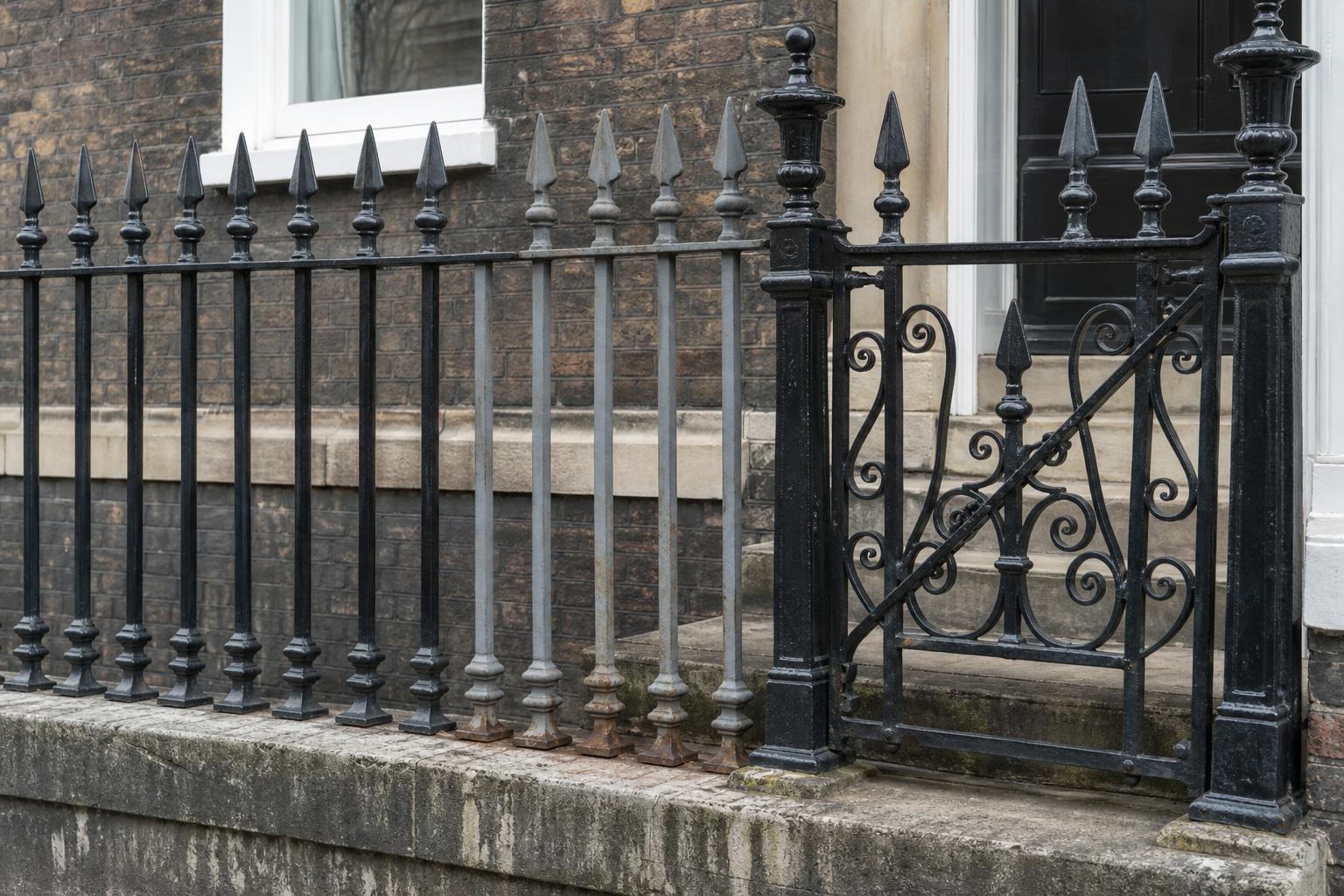
There is no evidence that Queen Victoria ordered ironwork to be painted black in mourning for Prince Albert, and before the mid-twentieth century black was one colour among many rather than the norm. The story is persistent, but paint research on railings, gates, bandstands, conservatories and fountains consistently finds earlier coloured schemes beneath later black layers.
Black took over for practical rather than historic reasons. Through the twentieth century, factory-made paints in standardised colour ranges replaced colours mixed by the painter on site. Black was cheap, readily available, hid soot and dirt in smoke-polluted towns, and required no decision. After the Second World War, large public maintenance programmes repainted railings and rainwater goods across whole districts, and black became the default specification. Within two or three repainting cycles, the earlier colours had disappeared from view and from memory.
The consequence for conservation is significant. A black finish applied over a Georgian lead grey or a Victorian chocolate brown changes how ironwork reads against masonry, stucco and joinery, often making delicate castings look heavier than intended. That does not make black wrong everywhere — it was used historically, and on some later buildings it is the documented scheme — but it should be a conclusion drawn from evidence, not an assumption.

Repainting historic ironwork like-for-like in the existing colour does not normally need consent, but changing the colour of a listed building’s external features, or painting a surface that was never painted, usually requires Listed Building Consent. The deciding question is whether the work affects the building’s character as a structure of special architectural or historic interest.
Conservation officers are concerned with two things: colour and material. An unsympathetic colour can harm the significance of a listed building or the character of a conservation area, whilst modern impermeable coatings can trap moisture and accelerate decay. On masonry this means spalling stone and failing lime mortar; on ironwork it means corrosion developing unseen beneath a hard, unbroken film.
| Situation | What normally applies | Consent route |
|---|---|---|
| Listed building (Grade I, II* or II in England and Wales; Category A, B or C in Scotland) — repaint in existing colour and paint type | Generally treated as maintenance | Usually none, but confirm with the conservation officer |
| Listed building — change of colour or change to a different paint type on external features | Likely to affect character | Listed Building Consent |
| Listed building — painting a surface never previously painted | Rarely acceptable where original detail would be obscured | Listed Building Consent, often refused |
| Conservation area, no Article 4 Direction, unlisted house | Repainting is normally permitted development | None |
| Conservation area with an Article 4 Direction | Colour changes to front elevations may be controlled | Planning permission may be required |
| Scheduled monument | Unauthorised works are a criminal offence | Scheduled Monument Consent |
In England and Wales, applications for Listed Building Consent carry no application fee. In Wales the relevant national body is Cadw; in Scotland, Historic Environment Scotland; in Northern Ireland, the Historic Environment Division. Lead paint is a special case: in England, Historic England approves the supply and use of lead paint, which is restricted to work on Grade I and Grade II* listed buildings, scheduled monuments and certain pre-1992 works of art, following a declaration and a three-week notification period. For most projects, a lead-free linseed oil paint system is the practical heritage-appropriate choice.
Cast iron and wrought iron behave differently, and both need protecting with a coating that stays flexible and allows moisture to escape. Understanding the metal explains why traditional paint systems were formulated as they were.
Wrought iron is worked hot by hammering and rolling. Its fibrous structure, created by threads of iron silicate slag, makes it ductile and ideal for the scrolls and overthrows of Georgian gates and railings. Those slag inclusions also slow the spread of corrosion compared with modern mild steel.
Cast iron is made by pouring molten iron into sand moulds. It has high compressive strength and can reproduce fine, repetitive ornament — which is why it became the material of choice for gutters, downpipes, hopper heads, columns and civic fountains. It is, however, crystalline and brittle: it cannot be bent or forged, and it can crack under impact or sudden heat. Ornamental castings also present a practical painting challenge, because water collects in crevices, sockets and joints, and that is where corrosion almost always begins. We explain the material’s properties in more depth in our guide to cast iron as a building material.
Traditional exterior paint for ironwork combined a linseed oil binder with white lead pigment, and the chemical reaction between the two produced a film that was elastic, tough and vapour-permeable. That combination explains why some historic paint layers have survived for centuries.
Linseed oil is a drying oil. It does not dry by evaporation; it cures by absorbing oxygen from the air and cross-linking into a solid polymer film known as linoxyn. The process is slow — typically one to two weeks to reach initial hardness — and is helped by warmth and daylight. Because the oil penetrates the surface before it cures, it grips the substrate rather than sitting on top of it.
Basic lead carbonate, or white lead, contains a proportion of lead hydroxide. In linseed oil this reacts with free fatty acids to form lead soaps, partly saponifying the oil. The result is a film that remains flexible as iron expands and contracts with daily and seasonal temperature changes, resisting the micro-cracking that lets water in. The film is also microporous: any moisture that does reach the metal can escape as vapour, instead of building up beneath the coating and lifting it in blisters, as happens with many modern film-forming paints.
White lead is highly toxic, and its use declined through the twentieth century as regulation tightened. Titanium dioxide, developed commercially in Norway in the early twentieth century, eventually replaced it as the standard white pigment. Titanium white is chemically inert in oil: it does not form lead soaps, so modern linseed oil paints rely on careful oil preparation and formulation rather than lead chemistry for their performance. Properly formulated and correctly applied, a lead-free linseed oil system still offers the flexibility, breathability and ease of maintenance that historic ironwork needs. We set out how we apply it in our linseed oil paint for cast iron guttering and pipes guide.
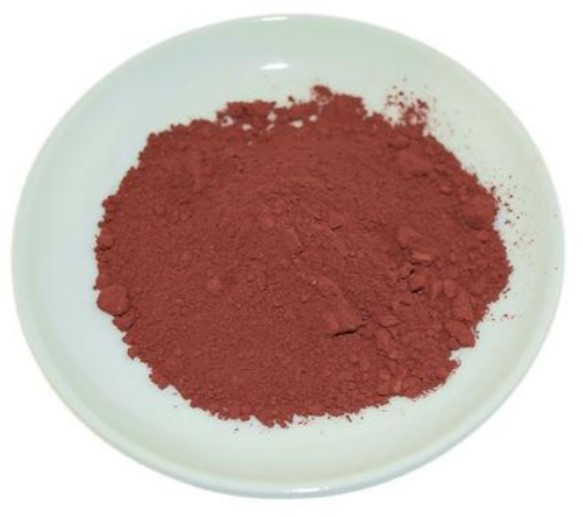
The primer was the most important coat on historic ironwork: red ochre in the seventeenth and early eighteenth centuries, and red lead from the mid-eighteenth century onwards. Every later colour scheme depended on it.
Early primers used red ochre — often called “Spanish brown” — sometimes mixed with a little white lead. Earth pigments gave a stable base but offered no active protection. Red lead, lead tetroxide, became the standard anti-corrosive primer through the late Georgian and Victorian periods because it actively inhibits corrosion at the metal surface. Its characteristic orange is often the first layer found in a cross-section of historic ironwork.
Before painting, surface flaws and water traps were filled. Historic fillers included red lead and white lead putties, pitch-based compounds and “Beaumont’s egg”, a hard-setting stopping made with iron filings. On heavy engineering such as bridges, piers and aqueducts, coal tar, pitch and bitumen coatings were used instead of decorative oil paints because of their water resistance.
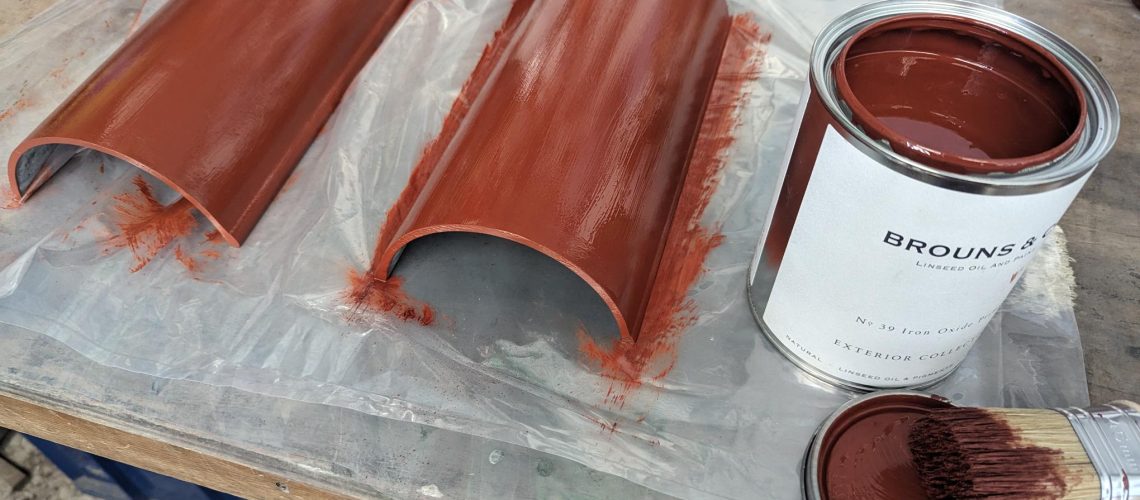
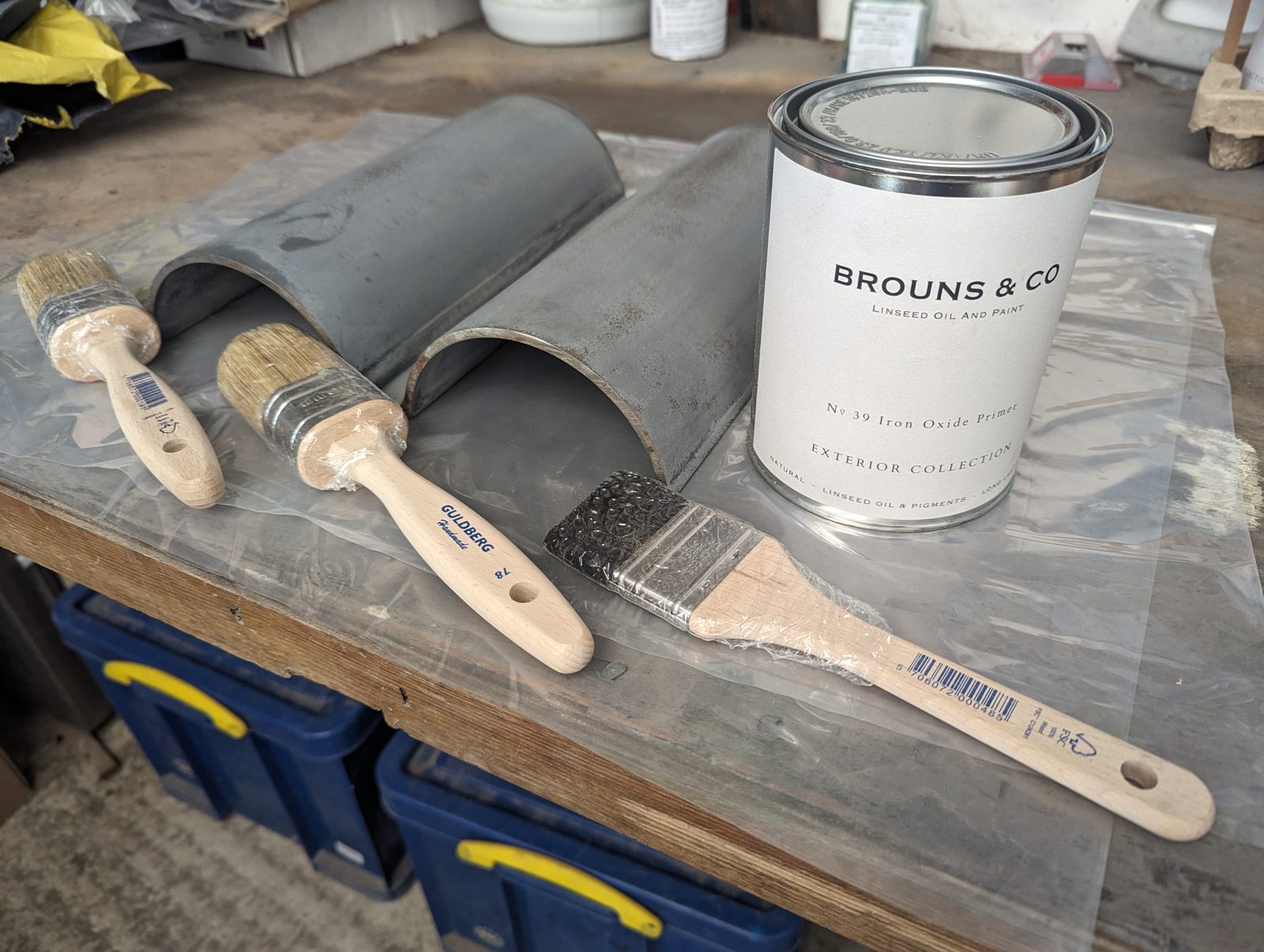
Today’s equivalent for cast iron rainwater goods is a linseed oil red oxide primer, which follows the historic logic of a rust-inhibiting first coat bound in the same oil as the finish. Our factory-applied system uses two coats of linseed red oxide primer followed by three topcoats.
Georgian ironwork was mostly stone-coloured, lead grey or dark green; Victorian ironwork was richer and darker, in greens, browns, reds and faux bronze; and twentieth-century standardisation gradually reduced the palette to black. Pigment cost, architectural taste and urban pollution drove each change. Our companion guide to heritage colours for cast iron gutters by period matches each period to specific colours on our chart; this section sets out the history behind those choices.
Georgian colour was restrained and governed by price. Eighteenth-century colourmen sold “common colours” cheaply, whilst greens commanded a premium. The most widespread exterior colour was “stone” — a family running from the warm honey tones of sandstone to the cooler greys of limestone — which allowed ironwork and joinery to sit quietly against the masonry. Lead grey was common on high-status urban ironwork: paint research on the 1765 railings of the Countess of Huntingdon’s Chapel in Bath found that they were first painted grey.
The defining colour of the late Georgian and Regency period was “Invisible Green”. The landscape designer Humphry Repton (1752–1818), whose “Red Books” showed clients the before-and-after effect of his proposals using hinged overlays, argued that art in the landscape should be concealed so that the scene appeared entirely natural. Where a fence or railing was unavoidable, it was to be painted a dark, shadowy green — mixed from yellow ochre, black and white lead — so that it receded into the planting. By 1808 the Bath colourman James Crease listed “Invisible Green” as a standard colour for gates and rails in parks and pleasure grounds.

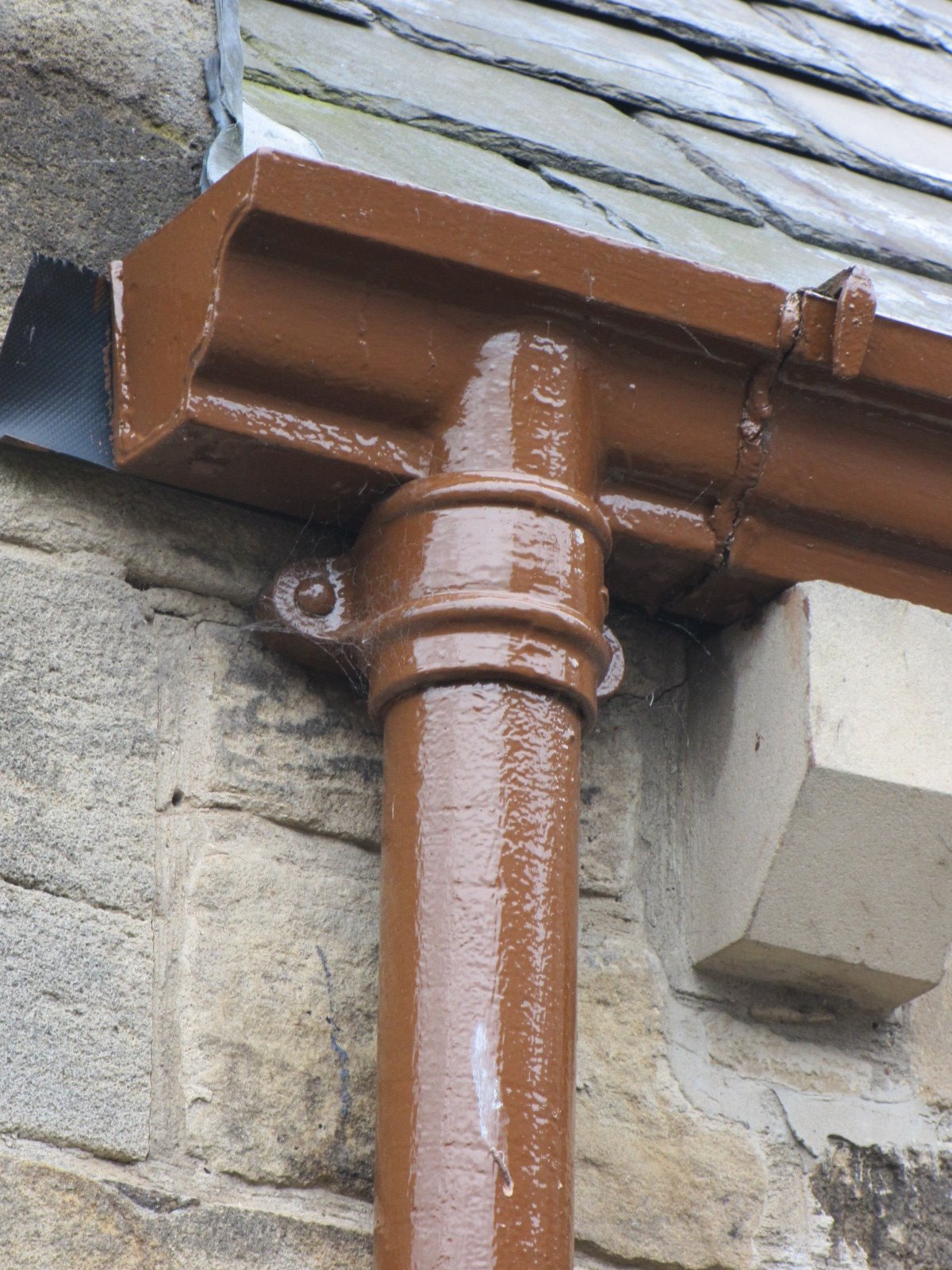
Industrial pigment production and mass-produced ornamental castings brought a far wider palette. Green remained popular, joined by dark blue, deep red and chocolate brown. Cast iron was often painted to imitate more expensive materials: stone colours on castings set against masonry, and “bronze” finishes produced by dusting copper or gold powder onto a tacky green ground.
Scottish foundries shaped Victorian street furniture throughout Britain and the Empire. Walter Macfarlane & Co.’s Saracen Foundry, founded in Glasgow in 1850 and later moved to a large site at Possilpark, sold directly to architects through illustrated catalogues of columns, verandahs, fountains, bandstands, rainwater goods and sanitary ware. Its civic castings were conceived as decorated objects, with coloured schemes and gilded highlights, not as single-colour ironwork.
Later in the century, smoke and soot in industrial towns degraded flat oil finishes quickly. Gloss oil paints became standard on exterior joinery, stucco and ironwork because a smooth, hard surface shed dirt and could be washed.
Edwardian taste moved towards lighter, airier schemes, and the inter-war years brought cleaner, paler colours. The more important change was industrial: paint increasingly arrived in tins in fixed colour ranges, and national colour standards such as BS 381C (first published in 1930) and later building colour ranges fixed what was available. The historian Patrick Baty’s The Anatomy of Colour charts this shift from site-mixed colours to standardised products. By the 1950s, black had become the routine choice for railings and rainwater goods.
| Period | Typical ironwork colours and finishes | What drove the choice |
|---|---|---|
| Georgian and Regency (1714–1837) | Stone colours, lead grey, off-whites, “Invisible Green” | Harmony with masonry; cost of pigments; Repton’s concealment of boundaries |
| Early and mid-Victorian (1837–c.1870) | Deep greens, dark blue, chocolate brown, deep red, faux bronze and faux stone | Industrial pigments; mass-produced castings; taste for rich colour |
| Late Victorian (c.1870–1901) | As above, increasingly in gloss; gilded and polychrome civic castings | Urban smoke and soot; washable finishes |
| Edwardian and inter-war (1901–1939) | Lighter greens, creams, off-whites, paler schemes | Reaction against Victorian darkness; factory-made paint |
| Post-war (1945 onwards) | Black becomes the default | Standardisation, low cost and convenience of maintenance |
Historic interiors used breathable, often reversible finishes such as soft distemper, whilst joinery was painted or woodgrained rather than stripped, and leadwork was frequently gilded or painted. The same principles of breathability and evidence-led colour apply throughout the building.
Reliable evidence of an original colour comes from microscopic cross-section analysis of paint samples, not from scraping back layers and matching by eye. Scraping produces a sloping crater in which thin layers merge, primers are mistaken for finishes, and the effects of ageing are ignored.
In professional analysis, small samples are taken through the full depth of paint down to the metal, timber or plaster. Each is set in clear resin, cut and polished to reveal the layers in section, and examined under a microscope. The sequence reads like an archaeological record. A typical example from historic railings shows an orange red lead primer, two schemes of grey, then cream, stone and sky blue — with black appearing only as the most recent, twentieth-century layer.
Two refinements matter. First, linseed oil yellows and darkens with age, especially out of daylight, so blues can look green and whites look cream. Exposing the polished sample to ultraviolet light for a period reverses much of that yellowing before the colour is measured. Second, paint layers help date the fabric itself: a feature whose earliest layer matches a later scheme found elsewhere on the building is likely to be a later addition — useful evidence when assessing whether a gutter run, downpipe or hopper head is original.
For a listed building where colour is likely to be questioned, commissioning paint analysis before the consent application is a sound investment. It turns a matter of taste into a matter of evidence, which is what conservation officers want to see.
Establish the evidence, choose a breathable linseed oil system over a rust-inhibiting primer, keep cleaning to the minimum necessary, and agree the colour before ordering. The steps below apply to gutters, downpipes, hopper heads and other cast iron rainwater goods on listed and period buildings.
Our step-by-step linseed oil paint application guide for heritage buildings covers application on site in detail, and our guide to paint systems for exterior historic metalwork compares the options.
| Method | Suitability for historic cast iron | Main risks |
|---|---|---|
| Hand tools (wire brush, scraper) | Safest for local rust removal | Slow; may leave rust in deep crevices |
| Needle gun | Useful on heavier corrosion if used with care | Can bruise or fracture thin castings |
| Chemical stripping (alkaline or solvent gels) | Controllable method for full removal of oil paint | Residues must be fully neutralised and washed off before priming |
| Low-pressure fine abrasive blasting | Acceptable in experienced hands | Can erase casting detail and maker’s marks |
| Flame cleaning | Generally not recommended | Thermal shock can crack cast iron |
| High-pressure water | Not recommended on assemblies | Drives water into joints; can force apart gutter and downpipe joints |
| Power grinding | Avoid | Removes metal and detail |
| Task | Frequency |
|---|---|
| Clear gutters, outlets and hopper heads | Twice a year, typically late autumn and spring |
| Inspect for rust spots, cracks and joint leaks | Twice a year |
| Spot-treat breakdowns (wire brush, prime, touch up) | As found |
| Wash down with clean water and a soft brush | Annually |
| Maintenance coat on linseed oil systems when the surface chalks | Every 5–8 years, sooner on coastal or south-facing elevations |
| Full repaint of two linseed topcoats | Every 8–12 years |
Applying paint to new castings in controlled conditions gives the best start. We factory-apply our linseed oil system in our Mid Wales workshop in any of the 38 colours on our chart, which runs from lead greys and stone colours through to deep greens, browns and oxide reds. A linseed oil finish adds 6 to 7 weeks to an order. Standard stock is available for prompt despatch — please confirm current availability on enquiry — whilst bespoke and copy cast items typically require 8 to 10 weeks from pattern confirmation. Where original components are damaged or missing, our copy casting service reproduces them from photographs, measured drawings or physical fragments.
On complex or significant buildings, we recommend our chargeable site survey service before specification is finalised. A survey identifies original profiles, records surviving paint evidence and avoids the most expensive mistake of all: ordering the wrong components or the wrong finish for a listed building and having to correct it once scaffolding is up.
The most common mistakes are assuming black is original, using impermeable modern paints over oil-based layers, and stripping or blasting too aggressively. Each one either misrepresents the building or shortens the life of the ironwork.
The examples below are well-documented buildings that show how paint history informs conservation decisions. They are included for illustration and are not Tuscan Foundry projects.
The Piece Hall gates, Halifax (Grade I)
The Piece Hall’s ornate gates were made in 1871 by George Smith & Co. of Glasgow, with cast iron panels set in a wrought iron frame. During their recent conservation, corrosion was surveyed and mapped before repair. Rather than defaulting to black, the new colour scheme was developed with reference to documented historic ironwork schemes of the 1870s, so that the gates once again read as Victorian decorative ironwork rather than generic black railings.
Countess of Huntingdon’s Chapel, Bath
The chapel’s railings date from 1765 and are a valuable reference point for Georgian practice. Cross-section analysis found that the earliest scheme was a pale lead grey, not black. The finding illustrates the Georgian preference for quiet, stone-toned and grey ironwork that sat comfortably beside Bath stone, and it is often cited as evidence when specifiers choose grey rather than black for Georgian railings, gutters and downpipes.
Albert Bridge, London (Grade II*)
Completed in 1873 to the design of Rowland Mason Ordish, the bridge combines suspension cables with cast iron towers and wrought iron stays. In 1992 it was repainted in a distinctive non-historic scheme of pink, blue and green to make it more visible to river traffic in poor light. It is a reminder that colour decisions on historic structures sometimes balance historic evidence against present-day function, and that such decisions should be explicit.
The Saracen Fountain, Glasgow (Category A)
Cast in 1901 by Walter Macfarlane & Co.’s Saracen Foundry for the Glasgow International Exhibition, the fountain now stands in Alexandra Park. Its scale and dense cast ornament show how Scottish founders designed civic ironwork as decorated objects. Fountains of this kind were conceived for colour and gilding, and a single-colour black finish strips away much of the intended effect.
These are the questions architects, conservation officers and owners most often ask us about historic paint and ironwork. Each answer is self-contained.
| Question | Answer |
|---|---|
| Was Victorian ironwork painted black in mourning for Prince Albert? | No. There is no evidence that Queen Victoria ordered ironwork to be painted black after Prince Albert’s death in 1861. Victorian ironwork was commonly painted deep green, chocolate brown, dark blue, red or bronze, and black became the default only in the twentieth century. |
| What colour were Georgian railings and gutters originally painted? | Georgian ironwork was usually painted stone colours, lead grey, off-white or a dark “Invisible Green”. These colours let railings, gutters and downpipes sit quietly against the masonry. Paint analysis of the 1765 railings at the Countess of Huntingdon’s Chapel in Bath, for example, found an original grey scheme. |
| What is Invisible Green paint? | Invisible Green is a very dark, muted green used on Georgian and Regency fences, gates and railings so that they receded into the surrounding planting. It was promoted by the landscape designer Humphry Repton and listed as a standard colour by the Bath colourman James Crease in 1808. |
| Why is so much historic ironwork in the UK painted black today? | Black became the default through twentieth-century standardisation. Factory-made paints in fixed colour ranges, the low cost of black, its ability to hide urban soot, and large post-war maintenance programmes made it the routine choice, gradually covering earlier coloured schemes. |
| Do I need Listed Building Consent to change the colour of cast iron gutters on a listed building? | Usually, yes. Repainting in the existing colour and paint type is generally treated as maintenance, but changing the colour of external features on a listed building is likely to affect its character and normally needs Listed Building Consent. Confirm with your conservation officer before ordering. |
| Can I still use lead paint on a listed building? | Only in limited cases. In England, Historic England approves the supply and use of lead paint for work on Grade I and Grade II* listed buildings, scheduled monuments and certain pre-1992 works of art, following a declaration and a three-week notification period. For most projects a lead-free linseed oil system is the practical choice. |
| Why was linseed oil paint used on historic ironwork? | Linseed oil paint cures into a flexible, vapour-permeable film that moves with iron as it expands and contracts and lets trapped moisture escape. Combined historically with white lead, it formed lead soaps that made the film exceptionally tough, which is why some historic layers have survived for centuries. |
| What primer was used on historic cast iron and wrought iron? | Red ochre, often called Spanish brown, was used in the seventeenth and early eighteenth centuries. From the mid-eighteenth century red lead became the standard anti-corrosive primer. Today a linseed oil red oxide primer follows the same principle without lead. |
| How do conservators find the original paint colour on historic ironwork? | They use cross-section paint analysis. Small samples taken through every layer are set in resin, polished and examined under a microscope, then exposed to ultraviolet light to reverse the yellowing of the oil before the colour is measured. Scraping back layers by eye is not reliable. |
| Should I strip all the old paint off historic cast iron before repainting? | Usually not. Conservation practice is to remove loose rust and failing paint back to sound material and keep well-adhered historic layers, which protect the metal and hold evidence of earlier schemes. Full stripping is reserved for coatings that have failed throughout, using controlled chemical methods rather than flame cleaning or aggressive blasting. |
| Can I paint modern gloss over old linseed oil paint on cast iron gutters? | It is not recommended. A hard, impermeable modern gloss over flexible oil-based paint is prone to cracking and peeling, can trap moisture against the iron, and may pull older layers away with it. Use a compatible linseed oil system instead. |
| How long does it take to get linseed oil painted cast iron gutters from Tuscan Foundry? | A factory-applied linseed oil finish adds 6 to 7 weeks to an order. Standard stock is available for prompt despatch, subject to confirming current availability, whilst bespoke and copy cast items typically require 8 to 10 weeks from pattern confirmation. Call 0333 987 4452 to confirm timings for your project. |
| How often should painted cast iron rainwater goods be maintained? | Clear and inspect gutters, downpipes and hopper heads twice a year, wash them down annually, apply a linseed maintenance coat every 5 to 8 years when the surface chalks, and plan a full repaint of two topcoats every 8 to 12 years, sooner on exposed coastal or south-facing elevations. |
The history of paint on period buildings shows that ironwork was coloured, that traditional linseed oil systems performed because they were flexible and breathable, and that the right finish for a listed building should be chosen from evidence rather than habit. In practice, our recommendations are:
Tuscan Foundry Products has supplied cast iron rainwater goods for historic buildings since 1893. We manufacture and copy cast heritage products for period and listed buildings, including churches and ecclesiastical buildings, and we factory-finish them in linseed oil paint in colours drawn from the historic palette described above. If you are specifying gutters, downpipes or hopper heads for a period building and want the colour and finish to be right first time, call us on 0333 987 4452 or contact our team for colour swatches, specification advice or a site survey.