Established 1893 | BS 460:2002 Certified | UK & International Supply | Expert Technical Support | 0333 987 4452
When it comes to finishing cast iron gutters, rainwater pipes, and hoppers on historic buildings, the choice of paint is far from a cosmetic afterthought. It is a conservation decision — one that affects the longevity of the ironwork, the authenticity of the building’s appearance, and, in the case of listed properties, compliance with the requirements of Listed Building Consent. Modern synthetic paints may offer a convenient off-the-shelf solution, but they are fundamentally ill-suited to the behaviour of cast iron in a heritage context.
Linseed oil paint has been applied to iron and timber on buildings across northern Europe for many hundreds of years. Its continued relevance is not nostalgia. It is chemistry. Unlike film-forming paints that sit on the surface and trap moisture beneath, linseed oil penetrates the substrate, polymerises within it, and creates a breathable, flexible coating that moves with the metal through cycles of thermal expansion and contraction. It does not crack. It does not peel. And when maintained correctly, it does not need to be stripped and replaced — only refreshed.
At Tuscan Foundry, we supply our cast iron rainwater systems ready-primed, and we can also supply components with a full linseed oil paint finish applied at our foundry. For clients and contractors applying the finish on site, the process described here represents our recommended approach — one built on the method used in our own workshop and aligned with the guidance of specialist suppliers, including Brouns & Co, who are widely regarded as one of the foremost authorities on linseed oil paint in the UK and internationally.
For those working on listed buildings and conservation projects, specifying paint finishes is rarely a matter of personal preference. Conservation officers, Historic England, and Cadw all expect that materials used in the repair and maintenance of designated buildings will be appropriate to the building’s character and period. The Society for the Protection of Ancient Buildings (SPAB) is explicit in its guidance that breathable, traditional materials should take precedence over modern alternatives wherever practicable.
Linseed oil paint sits squarely within that tradition. It was the standard finish for structural ironwork throughout the Georgian, Victorian, and Edwardian periods. Using it today is not an affectation — it is historically accurate. More importantly, it is functionally superior for the environment in which heritage cast iron is expected to perform: exposed to the elements, subject to temperature fluctuations, and, in many cases, receiving limited maintenance over long periods between inspections.
The breathability of linseed oil paint is its single most important conservation characteristic. Cast iron components — particularly gutters, downpipes, and rainwater heads — are frequently installed against masonry walls, in conditions where moisture movement is continuous. A film-forming paint that traps moisture beneath it will eventually blister, crack, and fail, leaving bare metal exposed to corrosion. Linseed oil paint allows moisture to migrate freely through the coating, preventing this cycle of failure entirely.
No paint system, however good, can compensate for inadequate preparation. For cast iron being repainted — whether newly cast or from an existing installation — the surface must be thoroughly cleaned, dry, and free of grease, loose rust, and any old paint that has failed or is flaking. A wash with a mild detergent solution will remove grease and surface contamination. Any persistent rust should be treated with a proprietary rust converter to halt active corrosion before painting begins.
For new castings, the surface should be clean and sound. Our foundry supplies components with a grey primer coat applied as standard, which provides a working base for the subsequent linseed oil system. Where bare metal is exposed — either on new components or following preparation of existing ironwork — it is essential to apply the primer coat without delay. Bare cast iron left unpainted will rapidly oxidise, particularly in damp conditions.
The primer for a linseed oil paint system on cast iron should be a pure linseed red oxide primer. Red oxide is the traditional and correct primer for ferrous metals — it inhibits rust, enhances adhesion of subsequent coats, and has been used in this role on ironwork for well over a century.
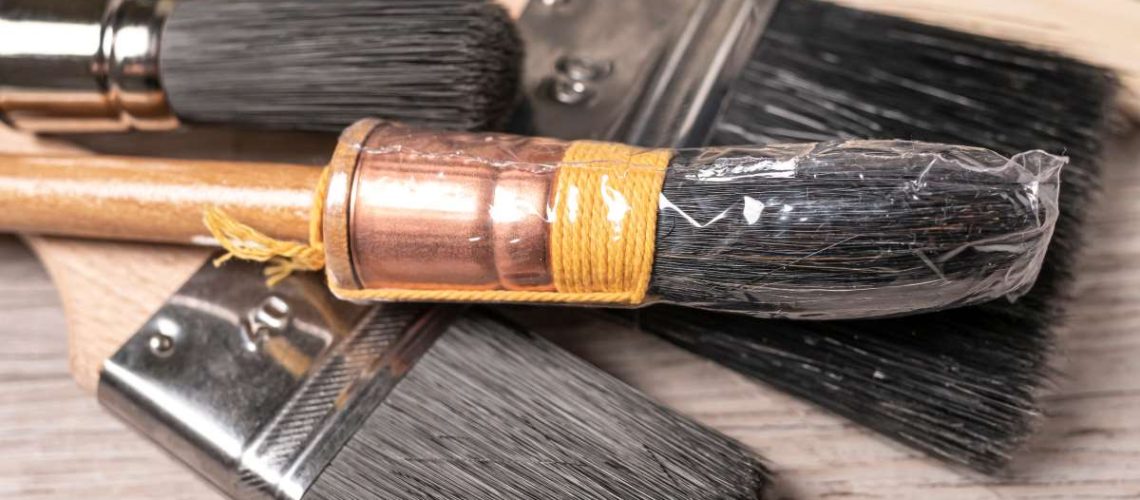
Apply two full coats of red oxide primer, working the paint well into any recesses, mouldings, and joints in the casting. Linseed paint is relatively thin in consistency — an advantage for coverage and penetration — but it requires careful application to ensure full, even coverage without runs or missed areas. Use a good-quality natural bristle brush; synthetic brushes are less well-suited to linseed oil paints.
Allow each primer coat to cure fully before applying the next. Linseed oil paint cures by oxidation in the presence of ultraviolet light rather than simple evaporation, so cure times will vary with conditions. In reasonable weather — a dry day with moderate temperature and some UV — allow a minimum of 24 to 48 hours between coats. In cold, dull, or damp conditions, allow longer. Do not rush this process; an under-cured coat beneath will compromise the durability of the system above it.
Once the primer coats are fully cured, apply a minimum of three topcoats of linseed oil paint in the chosen colour. Three coats is the standard for external cast iron in an exposed location; on more sheltered elements or where a build-up of material is less critical, two topcoats over a sound primer may suffice, but we recommend three as the correct standard for all rainwater goods.
Apply each topcoat thinly and evenly. Linseed paint does not benefit from being applied thickly — thin, well-worked coats provide better adhesion, better penetration, and a more durable result than heavy applications. If the paint feels too stiff for easy application — particularly on a very absorbent or complex surface — it can be thinned sparingly with raw linseed oil for the first coat, or with balsam turpentine as a drying accelerant where conditions are slow.
Allow each topcoat to cure fully before applying the next. The final topcoat, once cured, will present with a natural, low-sheen finish that is neither flat nor glossy—the characteristic matte quality of linseed oil paint, entirely appropriate to the aesthetic of historic ironwork. This is a feature, not a limitation. The slightly matte, depth-rich surface of properly applied linseed paint reads far more convincingly as an authentic historic finish than the plastic-looking sheen of modern gloss coatings.
Linseed oil paint is derived from flaxseed — a renewable, natural raw material — and contains no synthetic solvents, binders, or emulsifiers. It contains only trace levels of volatile organic compounds (VOCs), making it one of the most environmentally benign paint systems available for exterior ironwork. This is a meaningful consideration for projects in ecologically sensitive locations, near waterways, or subject to environmental planning conditions.
The sustainability benefits of cast iron as a material are well established — cast iron gutters and pipes last many decades, even generations, when correctly maintained, avoiding the cycle of replacement and landfill waste associated with shorter-lived alternatives. Linseed oil paint extends and amplifies those benefits. A correctly applied linseed paint system will outlast most modern synthetic coatings several times over. When maintenance is eventually required, it does not need to be stripped back to bare metal. A preparatory clean and a refresher topcoat are typically all that is needed—a far simpler, lower-impact maintenance regime than the full strip-and-repaint cycles demanded by film-forming paints.
The finish itself deserves particular note. The natural, slightly matte surface of linseed oil paint is aesthetically correct for heritage ironwork, unlike modern gloss finishes. Gloss paint on cast iron guttering reads as synthetic and incongruous on historic buildings — the surface sheen is too hard, too uniform, and too reflective for ironwork that should recede quietly into the architecture rather than draw attention to itself. Linseed paint’s characteristic low sheen, with its slight depth and variation of tone, is entirely consistent with how these components would have appeared when originally installed. Conservation officers and heritage consultants familiar with both finishes will recognise the difference immediately.
Brouns & Co, whose linseed oil paints are used extensively on National Trust properties, Buckingham Palace, Windsor Castle, and Hampton Court Palace, offers a range of historically accurate colours well-suited to the specification of heritage cast ironwork. The standard colour for rainwater goods is black, but where the original installation used a coloured finish — or where a conservation specification requires a specific tone — their palette provides an appropriate starting point.
We recognise that for many projects, applying a full linseed oil paint system on site is not always practical — particularly when scaffolding time is limited, weather windows are short, or the project programme requires components to arrive ready for installation. For these situations, we can supply our cast iron rainwater systems with a full factory-applied linseed oil paint finish — two coats of red oxide primer followed by three topcoats of linseed paint in the specified colour, applied under controlled conditions at our foundry in Mid Wales.
For projects where site application is preferred or required, we are happy to advise on the specification and are familiar with the full range of linseed oil paint products suitable for cast iron. Where a project involves complex profiles, bespoke castings, or components that are difficult to access once installed, we would also suggest considering our on-site survey service before finalising the specification. This chargeable service allows us to assess conditions, confirm profiles, and ensure the paint specification matches the building’s actual exposure and maintenance conditions.
Standard stock items are available for prompt dispatch. Where bespoke or copy cast components are required, the typical lead time is 8 to 10 weeks — please allow for this in project programming. Contact us on 0333 987 4452 or through our contact page to discuss your project requirements.
St Mary’s Church, Stamford, Lincolnshire — Grade I Listed
The ogee cast iron gutters serving the nave and chancel aisles of this medieval church had been overpainted multiple times with modern gloss paint, resulting in a build-up that had cracked and was trapping moisture against the ironwork. During conservation works, the old paint system was carefully stripped to bare metal, two coats of linseed red oxide primer applied, followed by three topcoats in traditional black. The resulting finish, low-sheen and depth-rich, was entirely sympathetic to the stonework and received commendation from the local conservation officer.
The Old Library, Cardiff — Grade II* Listed
This late-Victorian civic building in Cardiff’s commercial centre features extensive cast-iron rainwater pipework, including ornamental hopper heads and large-diameter downpipes. As part of a wider restoration programme, the entire external rainwater system was stripped, treated for corrosion, and refinished using a full linseed oil paint system in an historically documented black-green tone. The project was completed with factory-applied primer and two site topcoats, reducing scaffolding time and ensuring a consistent finish across the elevation.
Hardwick Hall, Derbyshire — Grade I Listed (National Trust)
Hardwick Hall’s extraordinary Elizabethan roofline poses significant challenges for rainwater management. Cast-iron guttering installed during Victorian-era repairs has been maintained with linseed oil paint for decades, a practice the National Trust has continued and formalised across its estate. The finish’s breathable, flexible nature is particularly valued here, where thermal movement in the ironwork is considerable, and the building’s Grade I status demands materials of demonstrable historic appropriateness.
Terrace Row, Clifton, Bristol — Grade II Listed
A run of Georgian terraced properties in Clifton’s conservation area presented a common challenge: the rainwater goods had been painted with incompatible modern finishes over many years, leading to paint failure and isolated rust spots. The conservation architect specified a return to linseed oil paint throughout. Components were cleaned and reprimed on-site, with three topcoats applied in a deep Georgian black. The resulting finish is correct to the period and should require only periodic refresher coats rather than wholesale repainting for many years.
Balmoral Estate, Aberdeenshire — Category A Listed (Historic Environment Scotland)
The exposed Highland setting of the Balmoral Estate demands exceptional performance from all external finishes. The cast-iron rainwater system serving several of the estate’s principal buildings has been maintained with linseed oil paint for many years, valued for its resistance to the combination of extreme cold, high winds, and heavy rainfall characteristic of the Cairngorm foothills. The finish’s natural wicking properties ensure that moisture absorbed during the wet season can evaporate freely, preventing the corrosion cycle that has compromised lesser finishes on comparable properties in similar exposures.
Yes, linseed oil paint can be applied over existing paint, but the surface must be properly prepared. Clean the existing paint thoroughly, remove any loose or peeling paint, and lightly sand the surface to improve adhesion. For best results on bare cast iron, apply a red oxide primer first.
Typically, two to three coats are recommended for optimal protection and finish. Apply a primer coat (red oxide) first, then two topcoats of linseed oil paint. Allow proper drying time between coats — usually 24-48 hours depending on temperature and humidity.
Linseed oil paint typically takes 7-14 days to fully cure, depending on environmental conditions like temperature, humidity, and ventilation. During this period, avoid contact with the painted surface. Full hardness is achieved once curing is complete.
Yes, linseed oil paint is excellent for listed buildings. It’s a breathable, natural finish that complies with Listed Building Consent requirements. It allows moisture to move through the coating, preventing trapped moisture that can damage historic masonry and metalwork.
Regular inspection is key. Look for signs of wear or damage and touch up as needed. Clean surfaces annually with mild soap and water. Recoat every 5-7 years depending on exposure and weathering. Proper maintenance extends the life of the finish significantly.
Linseed oil paint offers breathability, flexibility, and natural durability. It works with the metal’s natural expansion and contraction, preventing cracking. It’s also more sustainable, historically appropriate for heritage buildings, and creates a more authentic aesthetic than synthetic paints.
Yes, linseed oil paint works on all cast iron gutters, downpipes, and hoppers. It’s particularly effective for heritage and listed building applications. Ensure the cast iron is clean and properly primed with red oxide before applying the topcoats.