
Condensation on Conservation Rooflights: Causes, Cures and What Is Not a Leak
Water on the inside of a rooflight is the commonest complaint after installation, and most of it is not a leak. Condensation forms on a rooflight because it is the coldest surface at the highest point of a room, exactly where warm, moist air collects; the cure is to reduce the moisture, move the air and warm the surface, in that order. This chapter explains where the water comes from, how to tell condensation from a leak, and what to do about each.
In summary
Condensation on a conservation rooflight shows up as droplets or mist on the inside of the glass, usually along the bottom edge, in cold weather and in the morning. It comes from ordinary living: breathing, cooking, showers, drying clothes, and in a new conversion the months of moisture drying out of plaster and screed. Deal with it by extracting moisture at source, opening the rooflight briefly, keeping the room warm enough, insulating around the liner so the frame is not a cold bridge, and choosing a warm-edge spacer and a unit with a condensation channel. Misting between the panes is a failed sealed unit and is replaced under guarantee. Water arriving after rain, at the head or the corners, or running down the liner in wind, is a leak, and the flashings and the head gutter are where to look. In a traditional roof, insulation added without a vapour control layer causes condensation you cannot see, in the roof itself.
On this page
- Is it condensation or a leak?
- Why condensation forms on a rooflight first
- Where the moisture comes from
- Cures, in order
- Misting between the panes
- Condensation on the outside of the glass
- Interstitial condensation: the damage you cannot see
- Barns, chapels and other cold buildings
- Common mistakes
- Illustrative scenarios
- Where to go next
- Frequently asked questions
Is it condensation or a leak?
Condensation appears in cold, dry weather, in the morning or after showers, on the inside of the glass and mainly at its bottom edge. A leak appears during or after rain, often at the head or one corner, and usually leaves a stain on the liner or ceiling.
| Where the water is | When it appears | What it is | What to do |
|---|---|---|---|
| Inside face of the glass, bottom edge, droplets or mist | Cold mornings, after showers or cooking | Surface condensation | Reduce moisture, ventilate, warm the surface |
| On the inside of the steel frame or the liner | Cold weather | Condensation on a cold bridge | Insulate around the liner and frame; seal the vapour control layer |
| Between the two panes, cannot be wiped | Any time, worsens over months | Failed sealed unit | Replace the unit; check the glass guarantee |
| Outside face of the glass, morning dew | Clear, still, cold nights | External condensation | Nothing; it shows the glass is well insulated |
| Drip from the head or a corner, stain on liner | During or after rain, worse in wind | Leak at flashing, soaker or head gutter | Inspect and repair the flashings; clear the head gutter |
| Water running down the liner or ceiling near the frame | Heavy or wind-driven rain | Leak at the roof covering around the frame | Check slates or tiles, soakers and the apron |
| Staining spreading on the ceiling away from the rooflight | Weeks after roof insulation was added | Interstitial condensation in the roof | Check the vapour control layer and roof ventilation |
Two simple tests settle most cases. Note when the water appears against the weather: condensation follows cold and humidity, a leak follows rain. And run a hose over the roof above the rooflight on a dry day with someone watching inside; if water appears, it is a leak and the flashing detail in our installation chapter is where to start.
Why condensation forms on a rooflight first
Warm air holds more water vapour than cold air. When air touches a surface colder than its dew point, the vapour condenses on it. A rooflight is at the top of the room, where the warmest and moistest air gathers, and its glass and frame are in contact with the outside, so it is the coldest surface up there.
Three features of rooflights make them worse than vertical windows.
The edge of the glass. The spacer that separates the two panes conducts heat, so the glass is coldest around its perimeter, and coldest of all along the bottom edge where the cold air inside the cavity sinks. That is why the droplets start at the bottom of the glass.
The frame. Steel conducts heat well. A slim steel frame with a thin timber liner, and no insulation behind the liner, is a cold bridge from the outside into the room.
The light well. Where the rooflight sits at the top of a deep shaft through the roof space, the air in the shaft is still and cold. Still air does not carry warmth up to the glass, so the surface stays below the dew point.
None of this is a fault in the rooflight. It is physics, and the same rooflight in a drier, warmer, better-ventilated room will be dry.
Where the moisture comes from
A household produces several litres of water vapour a day from breathing, cooking, washing and bathing, and a newly converted building adds to it for months as plaster, screed, mortar and timber dry out.
Everyday sources. A shower, a kettle, pans without lids, clothes drying on radiators, an unvented tumble dryer, houseplants and people. Bathrooms and kitchens are the obvious rooms; bedrooms are the surprising ones, because two people breathing for eight hours in a closed room with a rooflight above the bed will mist it every winter morning.
Construction moisture. A barn conversion or a re-plastered house can take a year or more to dry. Lime plaster, screeds and new masonry release water steadily, and the first winter is usually the worst for condensation. This improves on its own if the building is heated and ventilated.
Traditional fabric. Solid walls, lime mortar and unfired earth floors are meant to breathe; they hold and release moisture with the seasons. Sealing a traditional building tightly without ventilation traps that moisture inside, and the rooflight is where it shows.
Unheated or intermittently heated buildings. A holiday let or a chapel that is warm at weekends and cold in the week has cold surfaces meeting warm, moist air every time it is heated up. Set-back heating that keeps the building above about 12°C, with background ventilation, is kinder than on-off heating.
Cures, in order
Start with the moisture, then the air, then the surface temperature. Most rooflight condensation is solved by the first two.
1. Extract at source. A working extract fan in the bathroom and kitchen, run for 15 minutes after use, removes most of the moisture before it reaches the rooflight. Approved Document F sets the rates. Lids on pans, a vented tumble dryer and clothes dried outside or in a ventilated room make a bigger difference than any change to the rooflight.
2. Open the rooflight. Ten minutes with the rooflight open after a shower or first thing in the morning changes the air in the room. This is the strongest argument for an opening rooflight in a bathroom or bedroom; see our fixed or opening chapter.
3. Provide background ventilation. Trickle ventilators in the vertical windows, or a whole-house mechanical ventilation system, keep air moving when nobody is opening anything. Conservation rooflights do not have trickle vents of their own.
4. Keep the room warm enough. A room that drops below about 12°C at night will condense on any glass. Low, steady heating beats bursts.
5. Insulate around the liner. The commonest fixable fault we see is a cold bridge at the liner. Insulation should return to the rooflight frame with no gap, and the vapour control layer should be sealed to the frame. This warms the frame and the liner and moves the dew point away from them. It is straightforward during installation and awkward afterwards.
6. Specify the glazing for the room. A warm-edge spacer keeps the edge of the glass warmer and is worth specifying in bathrooms and bedrooms. Low-e coatings and argon fill raise the inside surface temperature of the glass. Our glazing chapter and U-values chapter cover the options.
7. Use a unit with a condensation channel. Some conservation rooflights are made with a channel along the inside of the cill that collects droplets running down the glass and drains them out through small holes to the outside. The Rooflight Co. calls its detail the Thermoliner. It does not stop condensation forming, but it stops it dripping onto the floor.
8. Shape the light well. A deep vertical shaft holds cold, still air. Splaying the reveals opens the shaft to the room, lets warm air reach the glass and spreads the daylight; our daylight design chapter explains the geometry.
9. Manage blinds. A blind closed tight against the glass on a cold night traps a layer of still, cooling air against the pane and increases condensation behind it. Open blinds in the morning and leave a gap.
Misting between the panes
Mist or droplets between the two panes of glass, which cannot be wiped from either side, mean the seal of the double-glazed unit has failed and moist air has entered the cavity. The unit needs replacing; the frame is unaffected.
Both manufacturers in this guide guarantee their sealed units for five years, and the units are replaceable within the existing frame. Report it with photographs and the serial number of the rooflight. A unit that fails within the guarantee period is usually a manufacturing fault; one that fails much later has usually had its edge seal sitting in water, which points back to a blocked head gutter or a flashing problem.
Condensation on the outside of the glass
Dew on the outside of a rooflight on a clear, still morning is a sign of good insulation, not a problem. The outer pane is so well separated from the warm room that it cools to the temperature of the night sky and collects dew like a car roof. It clears as the sun rises. Nothing needs doing.
Interstitial condensation: the damage you cannot see
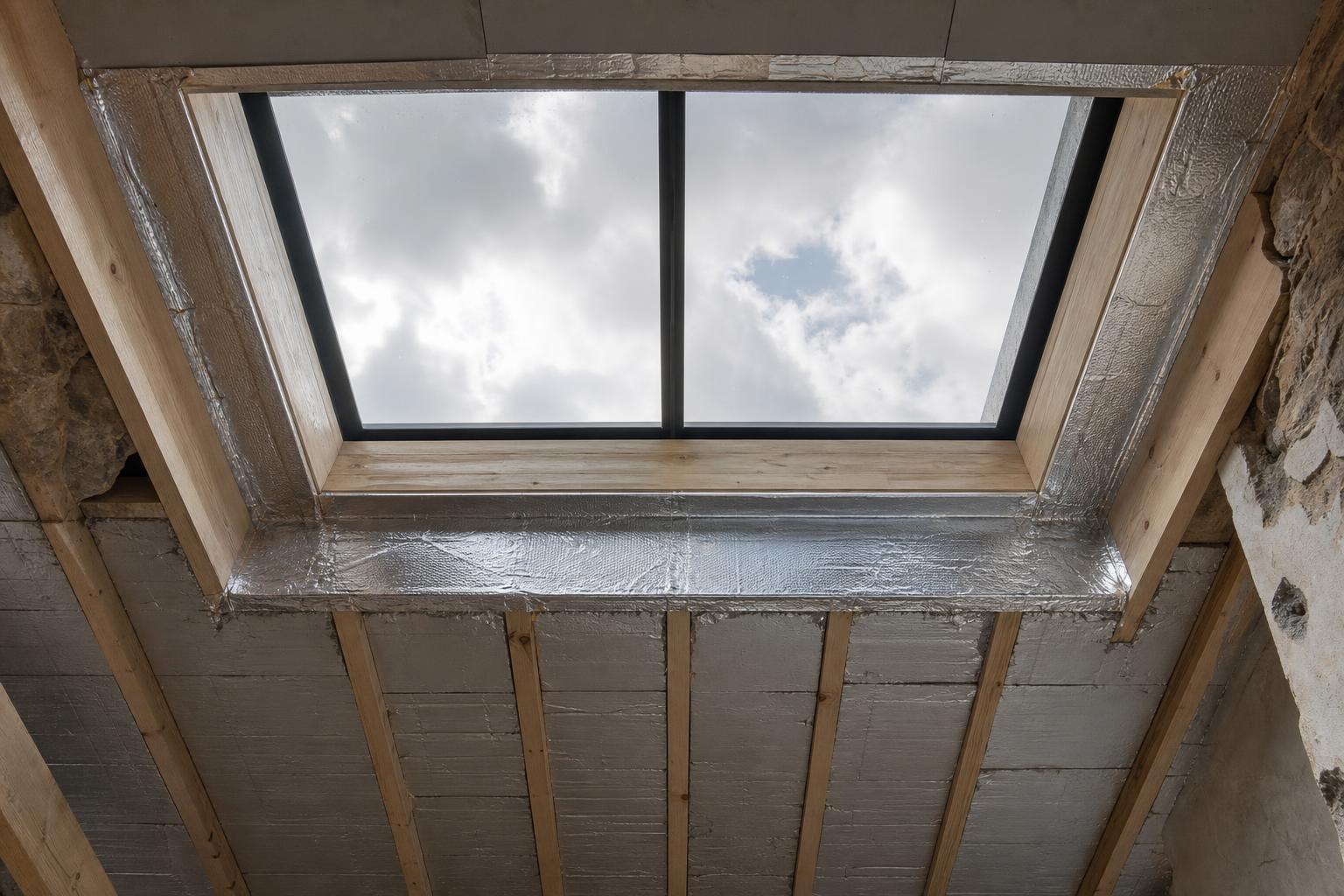
Interstitial condensation forms inside the roof construction, on the cold underside of the slates, the felt or the sarking, when warm, moist air from the house gets into the roof build-up and meets a cold surface. It rots rafters and battens, and it is a common consequence of adding roof insulation around a new rooflight without thinking about vapour.
Cold roof. Insulation at ceiling level, with a ventilated roof void above. The void needs a continuous airflow at the eaves and the ridge to carry moisture away, and the rooflight shaft through the void must be built and insulated as a warm box so that it does not leak moist air into the cold void.
Warm roof. Insulation between and over the rafters, following the roof slope. There is little or no ventilated void, so the vapour control layer on the warm side of the insulation must be continuous and sealed to every penetration, including the rooflight liner. A gap around the rooflight is the weakest point in the whole roof.
Traditional roofs. Old roofs were unsealed and breathed. Adding modern insulation and a tight ceiling changes how they dry. BS 5250, the British Standard for managing moisture in buildings, sets out the principles; the practical rule is that every layer should be more vapour-open towards the outside than the one inside it, and that a breathable underlay should sit under the slates or tiles if there is no ventilated void. Historic England’s guidance on insulating pitched roofs in traditional buildings is worth reading before any roof is insulated around a rooflight.
The signs are subtle: a musty smell in the roof space, staining on the ceiling some distance from the rooflight, damp battens seen from a loft hatch, and rooflight condensation that does not respond to ventilation. If you find them, the answer is in the roof build-up, not the rooflight.
Barns, chapels and other cold buildings
Uninsulated agricultural buildings drip. A corrugated sheet roof on a cold night condenses on its underside and rains onto whatever is beneath, and a stone barn with a single-skin roof does the same more slowly. Converting the building means insulating the roof properly, with the vapour control and ventilation described above, before any rooflight is expected to stay dry.
Chapels, churches and halls heated for a few hours a week are the hardest case. Cold stone and glass meet a sudden influx of warm, breathing people, and every window and rooflight runs. Slow, low background heating, ventilation during and after use, and, on the rooflights, warm-edge spacers and condensation channels are the practical answers. Our guide to condensation in old buildings covers the building as a whole.
Common mistakes
Calling condensation a leak and re-flashing a sound rooflight. Check the weather pattern first; condensation follows cold and humidity, leaks follow rain.
Calling a leak condensation and living with it. Water at the head or a corner after rain is a leak, and it damages timber.
Insulating the roof without a vapour control layer. The condensation moves from the glass, where you can see it, into the roof, where you cannot.
Leaving the trimmers and liner uninsulated. The frame becomes the coldest thing in the room and the liner stains.
Choosing fixed rooflights for a bathroom. There is no quick way to clear the steam.
Blocking the head gutter. Water held against the edge seal shortens the life of the sealed unit and looks like a leak at the head.
Illustrative scenarios
The scenarios below are illustrative composites drawn from typical projects. They are not specific buildings or Tuscan Foundry commissions.
A first-floor bathroom in a Victorian villa, conservation area
Droplets on the bottom edge of the rooflight every morning through the first winter. The extract fan was on a two-minute overrun and the rooflight was fixed. Setting the fan to a 15-minute overrun and drying towels elsewhere halved the problem; replacing the unit with an opening one the following spring ended it.
A brick barn conversion, Lincolnshire, unlisted
Every rooflight misted for the first six months and the owners feared the whole roof leaked. The building was drying out from new screeds and lime plaster. Steady heating and trickle ventilators in the windows carried it through; by the second winter the rooflights were dry, apart from the one over the shower, which is now motorised.
A slate-roofed cottage, Snowdonia, with newly insulated roof
The rooflight was dry, but a stain spread on the ceiling a metre from it. The roof had been insulated between rafters with no vapour control layer and no ventilated void. Water was condensing on the underside of the felt and running down the rafters. The insulation was reworked with a breathable underlay and a sealed vapour control layer, and the stain stopped growing.
A rural chapel converted to a weekend studio
Cold all week, heated on Saturday morning, and every pane ran with water by lunchtime. A low background heating setting through the week, an opening rooflight run on a timer, and warm-edge sealed units on the two rooflights over the studio reduced it to a faint mist that clears by mid-morning.
Where to go next
For the flashing details that separate a leak from condensation see the installation chapter; for cleaning and inspection routines see the maintenance chapter. All chapters are listed on the Conservation Rooflight Guide page.
Speak to the manufacturers directly
The Rooflight Co. — Bourton-on-the-Water, Gloucestershire. Makers of The Original Conservation Rooflight, the Conservation Egress side-hung escape unit and the Conservation Plateau for flat roofs. Tel 01993 833155 · hello@therooflightco.com · therooflightco.com · Index listing
Clement Windows Group — Haslemere, Surrey. Makers of the Clement Conservation Rooflight in separate slate and tile profiles, with a published size and price list and a showroom in Haslemere. Tel 01428 643 393 · info@clementwg.co.uk · clementwindows.co.uk · Index listing
Enquiries go straight to the manufacturer. Tuscan Foundry is not a rooflight supplier and receives no commission; we feature these two because their conservation ranges are made for exactly the buildings this guide covers.
Tuscan Foundry supplies cast iron gutters, downpipes and hopper heads to BS 460 for listed and traditional buildings, with an in-house linseed oil paint finish. Damp that is blamed on a rooflight is often a blocked or overflowing gutter soaking the wall below, so the same inspection should take in the rainwater goods. If the roof is scaffolded, it is the cheapest moment to repair or replace them; stock items dispatch promptly and bespoke castings take around 12–14 weeks.
Frequently asked questions
Why does my rooflight have condensation on the inside?
Because it is the coldest surface at the highest point of the room, where warm, moist air collects. Droplets along the bottom edge of the glass on cold mornings are surface condensation from ordinary living: breathing, showers, cooking and drying clothes. Extract moisture at source, open the rooflight briefly and keep the room warm enough.
How do I tell if a rooflight is leaking or condensing?
Condensation appears in cold weather and after showers or cooking, on the inside of the glass, mainly at the bottom edge. A leak appears during or after rain, often at the head or a corner, and stains the liner or ceiling. A hose test on the roof above the rooflight on a dry day will show a leak.
How do I stop condensation on a conservation rooflight?
Run extract fans in the bathroom and kitchen with a 15-minute overrun, dry clothes outside or in a ventilated room, open the rooflight for ten minutes after showers and in the morning, keep the room above about 12°C, insulate around the liner, and choose a warm-edge spacer and a unit with a condensation channel.
Is condensation between the panes normal?
No. Mist or droplets between the two panes that cannot be wiped away mean the sealed unit has failed. The glass unit needs replacing within the existing frame; both manufacturers in this guide guarantee their sealed units for five years. Check that the head gutter is not holding water against the edge seal.
Why is there condensation on the outside of my rooflight?
Because the glass is well insulated. On clear, still nights the outer pane cools to the temperature of the sky and collects dew, which clears in the morning. It is a sign the unit is working, not a fault.
Does a new barn conversion get more condensation?
Yes, for the first year or so. Screeds, plaster, mortar and new timber release water as they dry, and the first winter is usually the worst. Heat the building steadily, ventilate it, and expect the rooflights to be dry by the second winter unless there is another cause.
What is a condensation channel on a rooflight?
A channel along the inside of the cill that collects droplets running down the glass and drains them to the outside through small holes. The Rooflight Co. calls its version the Thermoliner. It stops condensation dripping onto the floor; it does not stop it forming.
Can insulating the roof cause condensation?
Yes, if the insulation is added without a continuous, sealed vapour control layer, or without ventilation of the roof void. The moisture then condenses inside the roof on the cold underside of the slates or felt. Follow BS 5250 principles and, on traditional roofs, Historic England’s guidance on insulating pitched roofs.
Should I put a blind on a rooflight that condenses?
A blind closed tight against the glass at night traps a layer of cooling air and increases condensation behind it. Fit a blind if you need one for light or heat, but open it in the morning and leave a gap so air can move across the glass.
Do conservation rooflights need trickle vents to stop condensation?
Conservation rooflights do not have trickle vents. Background ventilation for the room comes from trickle ventilators in the vertical windows or a mechanical system, and that background air movement is part of controlling condensation. An opening rooflight provides the quick purge that clears steam.
Why is the rooflight frame wet but not the glass?
The steel frame and the liner are colder than the glass because heat is bridging through them from outside. Usually the trimmers and the liner were left uninsulated. Insulation returned to the frame and a sealed vapour control layer warm the frame and move the dew point away from it.
Can damp near a rooflight come from the gutters?
Often. An overflowing or blocked gutter soaks the wall below and the damp travels up into the roof, where it is blamed on the rooflight. Check the gutters, hopper heads and downpipes on the same inspection as the rooflight flashings.