
Cast Iron Gutters in Conwy and Denbighshire: Heritage Rainwater Systems from Llandudno’s Seafront to the Vale of Clwyd
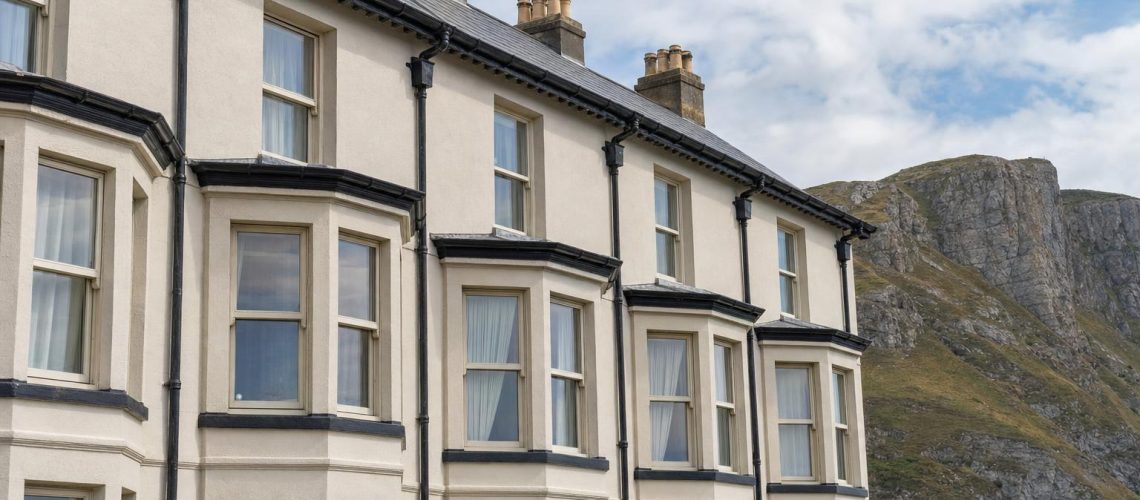
Two World Heritage Sites, an Elizabethan town house without equal, a cathedral city and Victorian Wales’s grandest resort sit within a few miles of each other in Conwy and Denbighshire. We explain how to specify cast iron gutters, downpipes and hopper heads that respect this exceptional building stock and satisfy Cadw and the two councils’ conservation officers.
Technical Summary
Cast iron is the correct rainwater material for the listed and conservation-area buildings of Conwy County Borough and Denbighshire. From medieval Conwy and the timber-framed streets of Ruthin and Denbigh to the stuccoed terraces of Llandudno and the country houses of the Vale of Clwyd, these buildings were designed with cast iron gutters, downpipes and hopper heads, or with lead later replaced in iron. Cadw guidance and both councils expect historic rainwater goods to be repaired where possible and replaced like for like in cast iron, matching profile, size, joints and fixings. Changing material or profile on a listed building normally needs Listed Building Consent from Conwy County Borough Council, Denbighshire County Council or, inside the National Park, Eryri National Park Authority. We supply standard profiles from stock for prompt despatch and copy cast or radius gutters in around 12–14 weeks.
Contents
- The Heritage Landscape of Conwy and Denbighshire
- Typical Heritage Buildings and Materials in Conwy and Denbighshire
- How Rainwater Goods Developed on North Wales Buildings
- Cast Iron on Listed and Conservation Properties in Conwy and Denbighshire
- Planning, Consent and Conservation Guidance in Conwy and Denbighshire
- Cast Iron Profiles and Products Commonly Used in Conwy and Denbighshire
- Maintaining Cast Iron on the North Wales Coast
- Common Specification Mistakes in Conwy and Denbighshire
- Landmark Buildings in Conwy and Denbighshire
- Working With Us on Conwy and Denbighshire Projects
- Frequently Asked Questions
- Conclusion
The Heritage Landscape of Conwy and Denbighshire
For listed and historic buildings in Conwy and Denbighshire, the right rainwater system is traditional cast iron, matched to the existing profile and fixed in the original way. That is how these buildings were designed, and it is what Cadw and both councils’ conservation officers expect to see.
Few parts of Wales pack so much heritage into so small an area. Conwy’s castle and town walls form part of the Castles and Town Walls of King Edward in Gwynedd World Heritage Site, and the eastern end of the Pontcysyllte Aqueduct and Canal World Heritage Site reaches into Denbighshire at Llangollen and the Horseshoe Falls. The Clwydian Range and Dee Valley National Landscape covers much of eastern Denbighshire, while the southern and western uplands of Conwy fall within Eryri National Park.
Within that setting sits a dense and varied building stock: Elizabethan town houses in Conwy and Ruthin, the medieval walled town of Denbigh, the cathedral city of St Asaph, the Victorian resorts of Llandudno, Colwyn Bay, Rhyl and Prestatyn, slate-and-stone villages in the Conwy valley, and country houses across the Vale of Clwyd. Denbigh alone has well over 200 listed buildings, and Conwy County Borough has around 25 conservation areas outside the National Park.
This guide is written for conservation architects, surveyors, contractors and owners of listed and period property across the two counties. It covers the materials and building types you will meet, what Cadw and the councils expect, which profiles suit which buildings, how to maintain cast iron on an exposed coast, and the mistakes that most often cause problems.
We supply traditional cast iron gutters, downpipes and hoppers for projects throughout Conwy and Denbighshire, from Grade I town houses to seaside terraces and chapels. We work with architects, surveyors, contractors and owners to specify authentic cast iron rainwater systems that satisfy conservation requirements.
Typical Heritage Buildings and Materials in Conwy and Denbighshire
The two counties contain four distinct building traditions: medieval and Elizabethan town buildings, Victorian seaside resorts, slate and stone vernacular in the Conwy valley and uplands, and the timber-framed and gentry buildings of the Vale of Clwyd. Each brings its own rainwater detailing.
Conwy town and the Elizabethan tradition
Inside Conwy’s walls, rubble stone and limewashed render dominate, with steep slate roofs and stepped gables. Plas Mawr, the town’s great Elizabethan house, influenced later buildings in the town, and its crow-stepped gables were copied in Victorian and Edwardian work. Rainwater goods here are typically half-round or ogee on plain brackets, with decorated hopper heads on the more important buildings.
Llandudno, Colwyn Bay and the coast
Llandudno was laid out as a planned resort from the 1850s on Mostyn estate land, and its Promenade, Mostyn Street and the streets behind retain stuccoed and painted terraces, hotels and shops. Many have parapets with concealed gutters, bay windows needing small-section or radius gutters, and the cast iron and glass verandahs that line Mostyn Street. Colwyn Bay, Rhyl and Prestatyn follow with later Victorian and Edwardian brick and render. All face salt-laden north-westerly weather.
The Conwy valley and the uplands
Llanrwst, Betws-y-Coed and the villages of the Conwy valley are built of local stone and slate. Chapels, inns and Victorian villas carry deep half-round and ogee gutters, and high rainfall in the hills makes capacity a real concern.
The Vale of Clwyd
Ruthin and Denbigh preserve some of the best timber-framed buildings in Wales, among them Nantclwyd y Dre in Ruthin, listed at Grade I. St Asaph’s cathedral and the gentry houses of the vale add sandstone and limestone ashlar, brick and render. Llangollen, in the Dee valley, is a Victorian stone town built around its bridge, canal and railway.
Cast iron complements all of these buildings because its weight and shadow line suit heavy masonry, render and timber alike. A deep moulded ogee belongs on a Llandudno hotel cornice; a plain half-round on rubble stone in Conwy or Ruthin.
How Rainwater Goods Developed on North Wales Buildings
Most surviving rainwater goods in Conwy and Denbighshire date from the nineteenth century, when cast iron replaced lead and the coastal railway brought mass-produced foundry goods to every town. Understanding that history helps identify what is original on a given building.
On medieval and Elizabethan buildings, roofs generally shed water over the eaves or into lead gutters and spouts. Lead rainwater heads and pipes appear on the grander houses from the seventeenth century, often dated or bearing initials. From the late eighteenth century, cast iron became affordable and quickly displaced lead for gutters and downpipes on all but the most prestigious work.
The opening of the Chester and Holyhead Railway along the coast in 1848 transformed supply. Foundries in the English Midlands, the North West and Scotland could now deliver standard gutters, pipes and hopper heads cheaply, and the new resorts of Llandudno, Colwyn Bay, Rhyl and Prestatyn were built with them from the outset. That is why the profiles on a Llandudno terrace are often identical along a whole street: they came from the same catalogue in the same decade.
Older buildings were frequently refitted at the same time, so a Tudor house in Ruthin or Conwy may carry Victorian cast iron that is now itself historic and part of the listing. Dated hopper heads, foundry marks and the style of brackets all help date a system; our guide to dating historic hopper heads explains what to look for. The practical lesson is that “original” means whatever historic system survives, and the starting point for any specification is a careful record of it.
Cast Iron on Listed and Conservation Properties in Conwy and Denbighshire
Cast iron is routinely specified on listed buildings in Conwy and Denbighshire because historic rainwater goods are part of the listed fabric, and the accepted conservation approach is to repair what survives and replace like for like where it cannot be saved.
In Wales a listing protects the whole building, including attached features such as gutters, downpipes and hopper heads. Cadw’s guidance on managing change to listed buildings places weight on keeping historic fabric and, where replacement is needed, matching material and detail. For rainwater goods, that means cast iron.
Profile matters as much as material. Half-round, beaded half-round, ogee, moulded ogee and box sections each read differently on the eaves. On Llandudno’s terraces, for example, a run of matching moulded gutters along a whole block is part of what gives the street its unity; replacing one house with a different profile breaks the line. Before ordering, measure the existing gutter carefully — overall width, depth, shape and joint type. Our measuring checklist for cast iron rainwater goods sets out what to record.
Conservation officers in both councils generally expect:
- Retention and repair of sound historic sections and hopper heads
- Like-for-like replacement in cast iron, matching profile, size and joint detail
- Traditional fixings appropriate to the building’s date
- Downpipes kept on their original routes
- A suitable painted finish, agreed where a street has a historic colour scheme
Conwy County Borough Council’s own planning policy has recognised that the loss of traditional windows, doors and rainwater goods has harmed the character of a number of its conservation areas. Reinstating cast iron is one of the simplest ways to reverse that. Where historic sections are damaged or missing, we can copy cast a matching profile from a surviving piece.
Planning, Consent and Conservation Guidance in Conwy and Denbighshire
Listed Building Consent is decided by Conwy County Borough Council, Denbighshire County Council or, within the National Park, Eryri National Park Authority. Like-for-like repair usually does not need consent; changes to material, profile or appearance usually do.
Do I need Listed Building Consent to replace gutters in Conwy or Denbighshire?
Replacing cast iron gutters and downpipes with identical cast iron sections, in the same profile, size and position, is normally treated as repair and does not usually need consent. Changing the material, profile, size or colour, or moving a downpipe, is an alteration and usually does. The local planning authority makes the decision, so confirm the position for your own building before work starts.
Who are the planning authorities?
Conwy County Borough Council covers the coast and the Conwy valley outside the National Park, including Llandudno, Conwy, Colwyn Bay, Abergele and Llanrwst. Eryri National Park Authority covers Betws-y-Coed, Dolwyddelan and the southern uplands. Denbighshire County Council covers Ruthin, Denbigh, St Asaph, Rhyl, Prestatyn, Llangollen and Corwen, and runs a pre-application advice service for listed buildings and conservation areas.
What do conservation officers expect in the World Heritage Sites?
Works within or affecting the setting of Conwy’s walled town or the Pontcysyllte World Heritage Site receive particular scrutiny. Like-for-like cast iron is the expected standard, and early discussion with the council is strongly advised.
Can I change the gutter profile on a listed building?
Changing the profile normally needs Listed Building Consent and is only likely to be supported where evidence shows the current profile is itself a later, inappropriate replacement. Historic photographs, surviving fragments and matching neighbouring buildings can justify reinstating the original.
Listed building law in Wales is now set out in the Historic Environment (Wales) Act 2023, supported by Planning Policy Wales, Technical Advice Note 24 and Cadw’s best-practice guidance. Conwy has also adopted conservation area management plans for Llandudno, Conwy and Colwyn Bay, which are worth reading before work on any building in those towns. Our guide to shared gutters on listed terraces covers the extra questions that arise on terraced streets.
Cast Iron Profiles and Products Commonly Used in Conwy and Denbighshire
The profile should follow the building. Half-round and beaded half-round suit most cottages, chapels and terraces; ogee and moulded ogee suit Georgian and Victorian town and resort frontages; box and valley gutters sit behind parapets on hotels, civic buildings and churches.
| Building type | Typical profile | Typical downpipe |
|---|---|---|
| Llandudno and Colwyn Bay terraces and hotels | Moulded ogee, ogee; box gutters behind parapets | Round or rectangular, often with hopper heads |
| Conwy, Ruthin and Denbigh town buildings | Half-round or ogee | Round, 65–75 mm |
| Conwy valley chapels and villas | Deep half-round or ogee | Round, 75–100 mm with hopper heads |
| Vale of Clwyd farmsteads and cottages | Beaded or plain half-round | Round, 65 mm |
| Churches and country houses | Large ogee, box and valley gutters | Round or rectangular with decorative heads |
We hold cast iron half-round gutters, deep half-round gutters, moulded ogee gutters, ogee gutters and cast iron hopper heads, together with round cast iron downpipes and fittings.
Llandudno’s bay windows and curved corner buildings often need bespoke and radius cast iron gutters made to the measured curve. Standard stock is available for prompt despatch; copy casting, bespoke profiles and radius gutters typically take around 12–14 weeks, so raise them early in the programme.
Maintaining Cast Iron on the North Wales Coast
On the coast from Llandudno to Prestatyn, salt-laden wind shortens paint life, so cast iron needs more frequent inspection and redecoration than inland. In the Conwy valley and the Vale of Clwyd, leaf fall and heavy rain are the bigger risks.
Most failures start with neglected maintenance rather than the iron itself: blocked outlets, overflowing hoppers and joints left weeping for years. Water then runs down render and stonework, causing damp and decay inside. Our guide to the ten signs that cast iron guttering is failing explains what to look for.
| Task | Coastal towns | Inland and valley sites |
|---|---|---|
| Clear gutters, outlets and hoppers | Twice a year | Annually, plus after leaf fall |
| Inspect joints, brackets and pipe ears | Annually | Annually |
| Touch in damaged paint | Every 2–3 years | As needed |
| Full redecoration | Every 4–6 years | Every 6–8 years |
On the seafront, thorough preparation and a linseed oil paint system maintained on a regular cycle give the best results, because the coating can be cleaned down and recoated without stripping. Our guide to linseed oil paint in salt-air environments covers the extra steps worth taking on exposed frontages.
Common Specification Mistakes in Conwy and Denbighshire
The most frequent mistakes are breaking a continuous terrace with a different profile, undersizing gutters for upland rainfall, and losing decorated hopper heads during repairs.
- Breaking the run — replacing one house in a uniform terrace with a different profile or colour
- Copying a later section — matching a twentieth-century replacement rather than the original evidence
- Undersizing — fitting standard sections on large chapel or hotel roofs that need deep or larger gutters
- Moving downpipes — re-routing pipes for convenience, which alters the elevation and usually needs consent
- Discarding hoppers — scrapping decorated or dated heads instead of repairing them
- Late ordering — leaving copy cast or radius items until scaffolding is up
Each is avoidable with an accurate survey and a clear specification at the outset.
Landmark Buildings in Conwy and Denbighshire
These landmark buildings show the range of rainwater challenges in the two counties. They are described for their conservation lessons and are not presented as our projects.
Plas Mawr, Conwy (Grade I)
Built between 1576 and 1585 for Robert Wynn, Plas Mawr is often described as the finest Elizabethan town house in Britain. It is in Cadw’s care and was restored in 1993–94. Its stepped gables, limewashed walls and enclosed courtyards create short runs and awkward junctions where water concentrates. Buildings of this rank show why rainwater details must be recorded and matched precisely, and why outlets in enclosed courts deserve close inspection.
St Asaph Cathedral, Denbighshire (Grade I)
Often called the smallest ancient cathedral in Britain, St Asaph has large roof areas draining through parapet gutters, hopper heads and long downpipe runs. Church and cathedral roofs combine high catchment with difficult access, so capacity, outlet sizing and secure fixings matter as much as appearance. Our churches and ecclesiastical buildings page explains how we support projects of this kind.
Kinmel Hall, near Abergele (Grade I)
Designed by W. E. Nesfield from 1868 and nicknamed the “Welsh Versailles”, Kinmel Hall stood largely empty from 2001 and featured on the Victorian Society’s list of endangered buildings. It was bought in 2021 and is now being restored. Years of vacancy show how quickly blocked gutters and failed downpipes lead to serious decay, and why reinstating sound, correctly sized cast iron rainwater goods is one of the first priorities in bringing a great house back into use.
Ruthin Gaol, Denbighshire (Grade II*)
Ruthin’s former county gaol includes a four-storey wing of 1866 built on the Pentonville model; it closed as a prison in 1916 and is now a museum. Tall, plain institutional elevations like this rely on long downpipe runs and robust fixings. Matching pipe sizes and ears, and keeping the original downpipe positions, preserves the austere character that makes the building significant.
Llandudno Conservation Area
Llandudno’s planned Victorian streets, from the Promenade to Mostyn Street, are protected by a conservation area with its own management plan. Uniform terraces and hotel frontages depend on continuous cornices and matching moulded gutters. Agreeing profile and colour across a whole block, and replacing in cast iron throughout, protects the consistency that defines the town.
We regularly supply half-round, ogee and moulded gutters, downpipes and hopper heads for listed town houses, chapels, seaside terraces and farmsteads across Conwy and Denbighshire.
Working With Us on Conwy and Denbighshire Projects
We supply cast iron rainwater systems throughout Conwy and Denbighshire, including Llandudno, Conwy, Colwyn Bay, Llanrwst, Ruthin, Denbigh, St Asaph, Rhyl and Llangollen, with delivery direct to site.
Most projects follow a simple sequence:
- Enquiry — send us photographs, drawings or a schedule of what is needed
- Identification — we help identify the existing profile, size and joint type
- Specification — we advise on sections, fixings, outlets and finishes
- Quotation — itemised, with lead times stated clearly
- Manufacture and delivery — stock items despatched promptly; copy cast, bespoke and radius items typically around 12–14 weeks
For complex restorations, difficult access, or buildings with damaged or missing components, our on-site survey service is a chargeable professional service that protects the project from costly mismatches. For copy casting, a physical sample is the most useful reference, supported by photographs and measured drawings. Our products for heritage buildings cover the full range of traditional components. On tall seafront hotels and town-centre buildings in Llandudno or Rhyl, access often dictates the programme, so we recommend confirming the full specification before scaffolding goes up, and ordering any copy cast or radius items well ahead of it.
Contact us to discuss cast iron rainwater systems for your Conwy or Denbighshire project on 0333 987 4452, or through our contact page.
Frequently Asked Questions
Do I need Listed Building Consent to replace cast iron gutters on a listed building in Conwy or Denbighshire?
Not usually, if the replacement is identical cast iron in the same profile, size and position, because that is generally treated as repair. Changing material, profile, colour or downpipe routes normally needs consent from Conwy County Borough Council, Denbighshire County Council or Eryri National Park Authority. Always confirm before work starts.
Which council handles listed buildings in Llandudno?
Llandudno is covered by Conwy County Borough Council, which also has an adopted management plan for the Llandudno Conservation Area. Its conservation officers advise on listed buildings and works in the town.
Who do I contact about listed building consent in Ruthin, Denbigh or St Asaph?
Contact Denbighshire County Council, which runs a pre-application advice service for listed buildings, conservation areas and World Heritage Site settings.
What type of cast iron guttering suits Llandudno’s Victorian terraces?
Most Llandudno terraces and hotels use ogee or moulded ogee gutters, often with box gutters behind parapets and radius sections on bay windows. Match the existing profile along the whole block to keep the street consistent.
Can cast iron gutters be used in conservation areas in Conwy and Denbighshire?
Yes. Cast iron is the traditional material across both counties’ conservation areas, and reinstating it where it has been lost is one of the most effective ways to enhance their character.
Do you supply cast iron rainwater systems to Conwy, Ruthin and the surrounding area?
Yes. We supply and deliver cast iron gutters, downpipes and hopper heads throughout Conwy and Denbighshire, including Llandudno, Conwy, Colwyn Bay, Llanrwst, Ruthin, Denbigh, St Asaph, Rhyl and Llangollen.
Can you copy cast a gutter or hopper head from a listed building in Denbighshire?
Yes. We can copy cast gutters, hopper heads and fittings from a surviving sample, supported by photographs and measurements. Copy casting typically takes around 12–14 weeks.
How long does delivery take to North Wales?
Standard stock items are available for prompt despatch and delivered direct to site. Bespoke, copy cast and radius gutters typically take around 12–14 weeks; we confirm timings at quotation.
How often should cast iron gutters be painted on the North Wales coast?
On exposed seafront buildings, plan full redecoration every four to six years with touching in between. Inland, six to eight years is typical. Good preparation matters more than the paint itself.
Are works near Conwy’s town walls treated differently?
Yes. Conwy’s castle and walls form part of a World Heritage Site, so works within the walled town or affecting its setting receive particular scrutiny. Like-for-like cast iron is the expected standard.
How long do cast iron gutters last on historic buildings?
Properly maintained cast iron gutters and downpipes routinely last more than 100 years. Regular clearing, prompt joint repairs and a sound paint system are the keys to longevity.
Is cast iron a sustainable choice for heritage buildings?
Yes. Cast iron is long-lasting, repairable and fully recyclable, and on listed buildings it avoids the repeated replacement cycles of short-life materials.
Conclusion
Specifying rainwater goods for the historic buildings of Conwy and Denbighshire rests on a few clear principles: identify and match the original profile, keep terraces consistent, retain and repair hopper heads, replace like for like in cast iron, and agree any change with the right authority — Conwy County Borough Council, Denbighshire County Council or Eryri National Park Authority — before work starts. On the coast, protect the iron with a properly prepared and maintained paint system.
At Tuscan Foundry Products, we have supplied traditional cast iron rainwater goods for heritage buildings since 1893. From our base in Mid Wales, we support architects, surveyors, contractors and owners across North Wales with stock profiles, copy casting, radius gutters and on-site surveys. To discuss your project, call us on 0333 987 4452 or visit tuscanfoundry.com.