
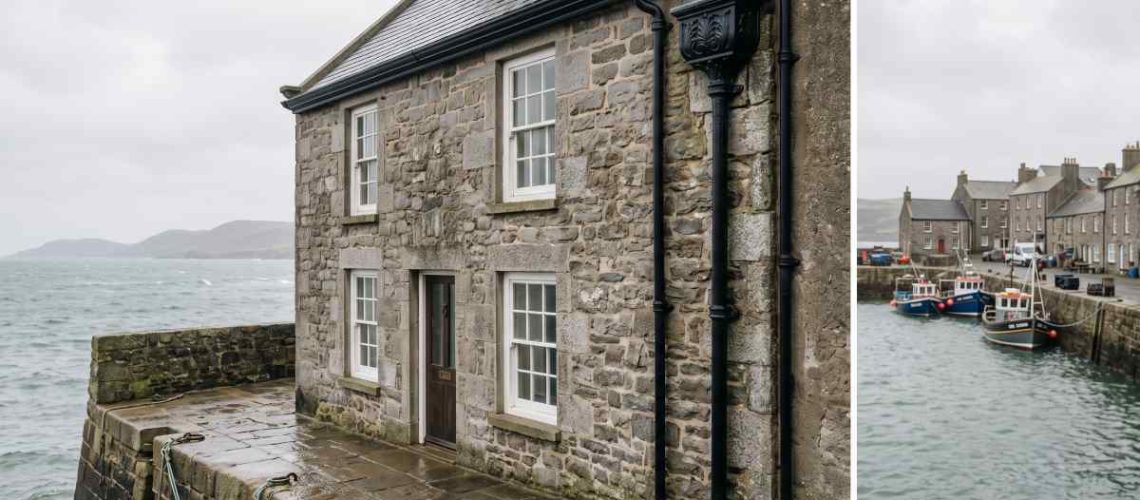
For architects and surveyors specifying rainwater systems on exposed coastal and estuarine buildings, the paint finish matters as much as the gutter profile. We explain why linseed oil paint’s breathable, self-wicking chemistry outperforms synthetic coatings in salt-laden air, and how we specify it correctly for cast iron, timber and masonry alike.
Coastal buildings face some of the harshest weathering conditions found anywhere in the United Kingdom. Wind-driven salt spray, near-constant humidity, rapid wet-dry cycling, and intense ultraviolet exposure all work together to accelerate the decay of cast iron rainwater goods, timber joinery and historic masonry alike. Linseed oil paint is the most effective coating for cast iron rainwater goods in coastal and salt-air environments because its breathable, self-wicking structure allows moisture and dissolved salts to migrate outward through the paint film, rather than becoming trapped beneath a rigid synthetic skin that eventually blisters and fails. For architects, surveyors and conservation officers specifying paint finishes on churches, terraces and country houses within reach of the sea, understanding this chemistry is central to getting the specification right first time.
Salt-laden coastal air accelerates decay because airborne chloride ions dramatically increase the electrical conductivity of any moisture reaching a substrate, speeding electrochemical corrosion in cast iron and encouraging rot in timber. In ferrous metals, this heightened conductivity turns even a thin film of surface moisture into an efficient corrosion cell. In timber, fluctuating moisture levels driven by wind-blown spray and rapid drying cause cell walls to swell and shrink repeatedly, leading to checking, warping and eventual structural rot.
Historic buildings within a few miles of the coast are further exposed to intense ultraviolet radiation, reflected off open water and unobstructed by inland tree cover, which degrades organic coatings faster than in sheltered locations. This combination of factors is why we treat coastal and estuarine sites as a distinct specification category, whether the building in question is a building constructed from cast iron as its principal rainwater material or a mixed-substrate property combining ironwork, timber and stone.
Linseed oil paint prevents osmotic blistering because it cures to a microporous, vapour-permeable film rather than the continuous plastic skin formed by acrylic and alkyd coatings. When wind-driven salt spray deposits sodium chloride on a painted surface and humidity rises, water vapour can pass through a synthetic film’s micro-fissures but cannot easily escape as liquid. This creates a classical osmotic cell: moisture is drawn in to dilute the concentrated salt solution trapped beneath the coating, hydrostatic pressure builds, and the film eventually separates from the substrate in fluid-filled blisters.
Raw linseed oil behaves quite differently. Its exceptionally low surface tension allows it to wet the substrate and penetrate deep into the microscopic pores of timber and the surface profile of cast iron, rather than merely sitting on top of it. As the oil cures through oxidative polymerisation, it expands slightly in volume, forcing the curing binder into the finest surface irregularities and creating a genuine mechanical anchor. The cured film remains viscoelastic throughout its service life, so it flexes with the thermal movement of cast iron and the seasonal movement of timber, rather than cracking under strain. Where salt-laden moisture does reach the substrate, the paint’s capillary, wicking structure draws it back out to the surface, where the water evaporates and leaves the salt to precipitate harmlessly, rather than crystallising beneath the film. This is the same principle we set out in our complete specification guide to linseed oil paint on cast iron, and it is precisely why the finish continues to outperform synthetic alternatives on exposed, salt-affected buildings.
Coastal cast iron requires a more rigorous paint specification than an equivalent inland installation, built around thorough preparation, a compatible primer, and an enhanced topcoat system. New castings must be cleared of foundry sand, release agents and mill scale by wire brushing or abrasive blasting, while existing ironwork must be taken back to sound, bare metal wherever paint has failed or rust has taken hold.
Our own process begins with a wash to remove any residual oils and grease, followed by two coats of a linseed oil-based iron oxide primer worked well into every recess, joint and profile detail. Standard inland specifications typically call for two topcoats; for cast iron facing direct salt spray, we recommend an enhanced three-topcoat system, with each coat applied thinly and allowed to cure for 48 to 72 hours before the next is applied. Rushing this stage, or applying paint too thickly, causes the surface to skin over before the coat beneath has cured, trapping uncured oil and leading to wrinkling or premature failure.
For the most extreme marine exposures — harbourside sites, cliff-top elevations and buildings taking spray directly off open water — a linseed oil system may need to be supplemented with a higher-specification factory finish. Our bespoke and copy cast components can be finished with our Extra and Coastal industrial-grade coatings where a longer maintenance interval is required, though for the majority of listed and conservation-area buildings, a correctly applied linseed oil system remains both the most historically authentic and the most sustainable specification. As with any bespoke casting work, this typically carries a lead time of 8–10 weeks, which we recommend building into project programmes early.
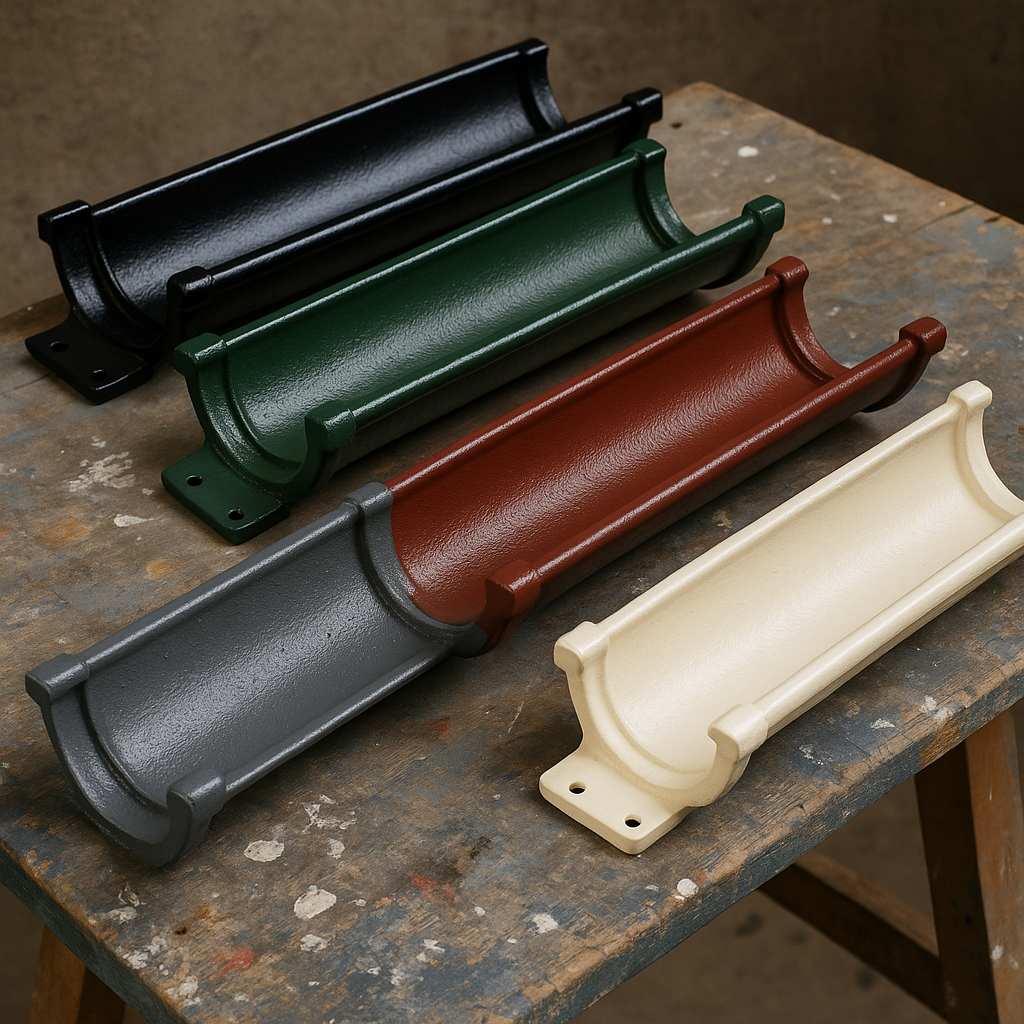
A correctly painted gutter or downpipe can still fail prematurely if the fixings and joints around it are wrong for a coastal setting. Galvanic corrosion between dissimilar metals is accelerated by salt-laden moisture in exactly the way ordinary corrosion is, so brackets, bolts and fixings should be specified and painted with the same care as the ironwork itself. We cover this in detail in our guide to galvanic corrosion and the correct choice of fixings, which applies with particular force to buildings within reach of the sea. For complex or heavily corroded coastal systems, we would generally recommend an on-site survey before specification is finalised, since access, existing profile, and the precise degree of salt exposure vary enormously even between neighbouring properties on the same stretch of coast.
Linseed oil paint performs just as well on coastal timber as it does on cast iron, but it is not the right choice for every coastal substrate. Sash windows, external doors and fascia boards benefit from the same breathable, penetrating protection, provided any existing synthetic coating is fully stripped back first, since linseed oil paint applied over a residual acrylic or alkyd film cannot reach the timber beneath and will only be as durable as the weaker layer underneath it.
Masonry and render are a different matter. Uncarbonated lime render and new brickwork are highly alkaline, and this alkalinity can saponify linseed oil, turning the cured paint into a soft, water-soluble soap that loses adhesion and washes away. Fully carbonated historic plaster can generally accept a linseed oil finish once properly primed, but for most coastal render, limewash with casein additives, or a mineral silicate paint, will be the more resilient and more appropriate specification. We are always happy to advise across all three substrates as part of a wider technical specification for heritage and listed buildings, including churches, country houses and residential period properties within reach of the coast.
The right linseed oil paint system for a coastal project is the one formulated and applied with sufficient purity and rigour for the exposure involved. Quality varies between manufacturers according to how thoroughly the raw oil has been refined, how finely the pigments have been milled, and how the zinc oxide content — which provides fungicidal protection and reinforces the cured film through saponification — has been balanced against titanium white for UV shielding. We work with trusted heritage paint suppliers to specify a system to suit each building’s degree of exposure, from a standard specification for a sheltered inland courtyard to an enhanced coastal system for a building taking spray directly off the sea.
Whatever the source, the underlying principle does not change: a correctly formulated and correctly applied linseed oil paint remains breathable, flexible and self-wicking for the life of the coating, which is precisely what a cast iron gutter, downpipe or hopper head needs in a salt-laden atmosphere. For architects and surveyors working on churches, terraces or country houses by the sea, our team is glad to advise on the appropriate system and application schedule for the specific exposure involved.
The following examples illustrate how coastal exposure shapes the specification of cast iron rainwater goods and their paint finishes on historic buildings around the UK.
St Enodoc’s Church, Rock, Cornwall
St Enodoc’s Church near Rock, Cornwall, is a Grade I listed building famous for having been substantially buried in wind-blown dune sand for much of the nineteenth century before being excavated and restored. Its exposed Atlantic coastal position subjects cast iron rainwater goods and timber joinery to relentless salt spray. Conservation specifications for buildings in this location typically call for linseed oil paint on ironwork and joinery, since its breathable, wicking structure resists the osmotic blistering that quickly overwhelms synthetic coatings in such an aggressive marine microclimate.
Harbourside Merchant’s House, Whitby, North Yorkshire
A Grade II listed merchant’s house overlooking Whitby’s historic harbour illustrates the demands North Sea exposure places on rainwater goods. Wind-driven spray and near-constant humidity accelerate corrosion in unprotected ironwork and encourage fungal decay in timber fascias. Where cast iron downpipes and hopper heads have been reinstated to match the property’s Georgian profile, a linseed oil-based primer and enhanced coastal topcoat system is the appropriate specification, allowing the ironwork to breathe while resisting the chloride-rich atmosphere that dominates this stretch of coast.
Georgian Terraces, North Beach, Tenby, Pembrokeshire
The pastel Georgian terraces overlooking Tenby’s North Beach in Pembrokeshire are among Wales’s most photographed heritage streetscapes, and among its most exposed. Cast iron gutters and downpipes here face driving south-westerly gales and sustained salt deposition. Conservation officers in this conservation area generally favour linseed oil paint finishes for reinstated ironwork, since the coating’s vapour permeability suits the solid stone construction typical of the terraces, and its flexibility accommodates the thermal movement caused by strong coastal sun exposure across south-facing elevations.
Harbour Cottages, Crail, Fife
The crow-stepped, gabled cottages around Crail’s harbour in the East Neuk of Fife represent some of Scotland’s best-preserved fishing vernacular architecture, much of it category A or B listed. North Sea storms bring frequent wind-driven rain and salt spray directly off the water. Where cast iron rainwater goods survive, or are being reinstated, on these buildings, a linseed oil paint system with an anti-corrosive primer and extended cure times between coats offers the resilience such an exposed, low-lying harbourside setting demands.
Coastal Merchant House, Aldeburgh, Suffolk
A Grade II* listed merchant house set back from Aldeburgh’s shingle beach on the Suffolk coast faces persistent onshore winds off the North Sea. Its cast iron hopper heads and ogee gutters, original to a nineteenth-century remodelling, show the classic early signs of coastal paint failure where synthetic coatings have previously been applied over them. Specification for the current restoration favours a full return to linseed oil paint, with mechanical stripping back to bare metal and a three-coat coastal topcoat system to restore long-term protection.
Routine repainting like-for-like with a traditional finish such as linseed oil paint is generally considered maintenance rather than an alteration, and in most cases does not require Listed Building Consent. However, any change of colour, profile or coating type on a listed building should be checked with the local conservation officer before work begins, since interpretation varies between planning authorities.
In coastal and salt-air locations, we recommend a light refresh coat every five years rather than the seven to ten years typical inland, given the additional chloride and UV loading. A full inspection twice yearly allows early wear to be caught and touched in before it develops into a full repaint.
Synthetic acrylic and alkyd paints form a rigid, largely impermeable film that traps moisture vapour beneath the surface. In coastal conditions this creates an osmotic cell that draws in water to dilute concentrated salt deposits, building pressure until the film blisters and peels. Linseed oil paint cures to a breathable, wicking structure that allows this moisture to migrate outward, so salts crystallise harmlessly on the surface instead.
For standard inland exposure, two primer coats and two topcoats are usually sufficient. For cast iron in an exposed coastal or estuarine position, we recommend an enhanced three-topcoat system over the primer, with each coat cured for 48 to 72 hours before the next is applied, to build the additional resilience such locations demand.
Linseed oil paint is not generally recommended for uncarbonated lime render or new masonry, since the high alkalinity can saponify the oil and cause the paint to soften and fail. Fully carbonated historic plaster can usually accept linseed oil paint once properly primed, but for most coastal masonry we point clients towards limewash with casein additives or mineral silicate paints, which are more resilient in these conditions.
Yes. Linseed oil paint is made from renewable flaxseed oil and natural mineral pigments, contains negligible volatile organic compounds, and does not shed synthetic polymers as it weathers. This makes it a lower-impact choice than petrochemical-based acrylic and alkyd coatings, which are a significant contributor to microplastic pollution as they degrade.
Linseed oil paint is typically dry to the touch within 24 to 72 hours, but full through-hardening by oxidative polymerisation can take several weeks, extending towards the upper end of that range in the higher humidity typical of coastal sites. We recommend allowing two to four weeks before the system is subjected to heavy rainfall loading or physical abrasion.
At Tuscan Foundry Products, we have specified and finished cast iron rainwater systems for heritage buildings in some of the UK’s most exposed coastal locations since 1893, and we understand that the paint system is as much a part of the specification as the casting itself. Whether a project calls for a traditional linseed oil paint finish or, in the most extreme salt-air settings, one of our enhanced coastal-grade coatings, we work with architects, surveyors and conservation officers to recommend the right system for a building’s exposure, and to see it through from bespoke casting to final topcoat. For churches, terraces, country houses and residential period properties within reach of the sea, get in touch with our team to discuss the right specification for your project, or browse our full product catalogue for standard stock and bespoke rainwater goods.