
Cast Iron Gutters on Anglesey: Heritage Rainwater Systems for the Listed Buildings of Ynys Môn
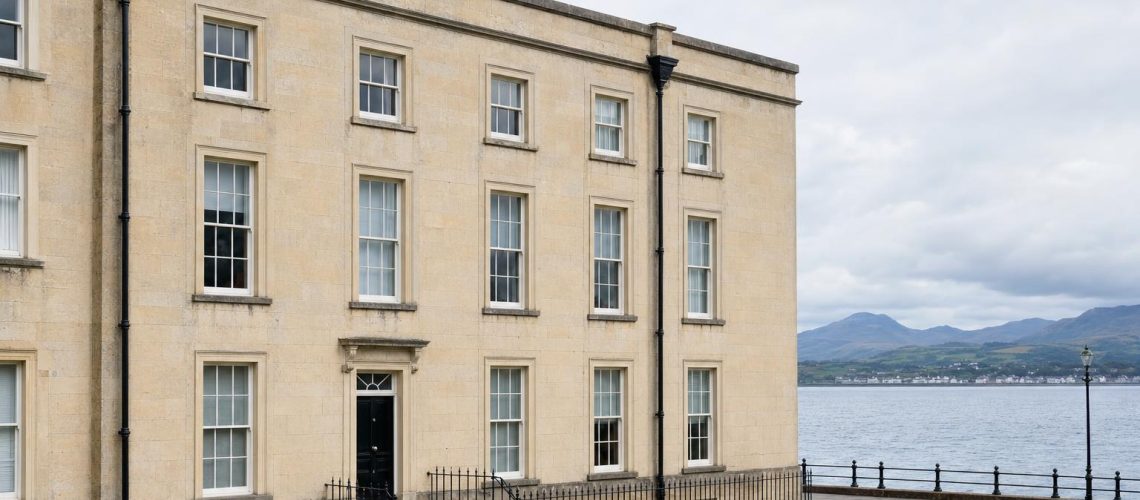
Beaumaris’s Grade I terraces and gaol, the Wyatt mansion at Plas Newydd, the copper port of Amlwch and hundreds of chapels, farmsteads and harbour buildings make Anglesey one of Wales’s most rewarding — and most weather-exposed — places to conserve. We explain how to specify cast iron gutters, downpipes and hopper heads that suit the island’s buildings and stand up to its maritime climate.
Technical Summary
Cast iron is the right rainwater material for listed and conservation-area buildings on Anglesey (Ynys Môn). The island’s historic stock — Georgian and Regency Beaumaris, Victorian Holyhead and Menai Bridge, the copper port of Amlwch, country houses, chapels and farmsteads — is largely fitted with historic cast iron gutters, downpipes and hopper heads, most of them nineteenth-century. Cadw guidance and the Isle of Anglesey County Council expect historic rainwater goods to be repaired where possible and replaced like for like in cast iron. Because almost every building on the island is exposed to salt-laden wind, surface preparation and a well-maintained paint system matter as much as the castings. We supply standard profiles from stock for prompt despatch and copy cast or radius gutters in around 12–14 weeks. Changing material or profile on a listed building normally needs Listed Building Consent, so confirm the position with the council first.
Contents
- Anglesey’s Heritage Landscape
- Typical Heritage Buildings and Materials on Anglesey
- How Cast Iron Came to Anglesey’s Buildings
- Cast Iron on Listed and Conservation Properties on Anglesey
- Planning, Consent and Conservation Guidance on Anglesey
- Cast Iron Profiles and Products Commonly Used on Anglesey
- Protecting Cast Iron in Anglesey’s Maritime Climate
- Common Specification Mistakes on Anglesey Buildings
- Landmark Buildings on Anglesey
- Working With Us on Anglesey Projects
- Frequently Asked Questions
- Conclusion
Anglesey’s Heritage Landscape
For listed and historic buildings on Anglesey, the right rainwater system is traditional cast iron, matched to the existing profile and fixed in the original way, with a paint system chosen and maintained for a maritime climate.
Anglesey is the largest island in Wales and has a built heritage out of proportion to its size. Beaumaris Castle forms part of the Castles and Town Walls of King Edward in Gwynedd World Heritage Site. Thomas Telford’s Menai Suspension Bridge, listed at Grade I, links the island to the mainland. Most of the coastline lies within the Anglesey National Landscape, and the island has 12 conservation areas, including Beaumaris, where an Article 4(2) Direction adds extra controls over alterations to unlisted buildings.
The listed stock ranges widely. The Isle of Anglesey County Council describes it as including bridges, walls, wells, vernacular cottages, large estate houses and farm buildings. Add to that the Regency resort of Beaumaris, the ferry port of Holyhead, the Victorian town of Menai Bridge, the copper-mining town of Amlwch, the market town of Llangefni, dozens of nonconformist chapels and a scattering of windmills, lighthouses and harbour buildings.
This guide is written for conservation architects, surveyors, contractors and owners of listed and period property on the island. It covers the island’s building types and materials, what Cadw and the council expect, which profiles suit which buildings, how to protect cast iron from salt air, and the mistakes that most often cause problems.
We supply traditional cast iron gutters, downpipes and hoppers for projects across Anglesey, from Grade I terraces to chapels and farmhouses. We work with architects, surveyors, contractors and owners to specify authentic cast iron rainwater systems that satisfy conservation requirements and cope with the island’s weather.
Typical Heritage Buildings and Materials on Anglesey
Anglesey’s historic buildings are low, solid and built to resist the wind: rubble stone and local limestone, often rendered or limewashed, under Welsh slate roofs. Beaumaris and the Menai Strait towns add Georgian and Regency ashlar and stucco, while Holyhead and Amlwch carry the marks of the port and copper trades.
Beaumaris and the Menai Strait
Beaumaris was remodelled in the 1820s and 1830s as a fashionable resort, with Joseph Hansom and Edward Welch designing the gaol, the Bulkeley Hotel and Victoria Terrace. The result is a town of Georgian and Regency façades, many with parapets and concealed gutters, set along the Green and Castle Street. Menai Bridge and Llanfairpwll grew after Telford’s bridge opened in 1826, with Victorian villas and terraces of stone and render facing the strait.
Holyhead and the port
Holyhead developed as the packet port for Ireland, and its town centre is largely Victorian: stone and rendered terraces, chapels, hotels and harbour buildings. The ancient church of St Cybi sits within the walls of the Roman fort of Caer Gybi, a reminder of how deep the town’s history runs beneath the later fabric.
Amlwch and the copper landscape
In the late eighteenth century, Parys Mountain was one of the largest copper mines in the world, and Amlwch grew as its port. The town’s terraces, chapels and port buildings are plain and robust, typically fitted with half-round gutters and round downpipes.
Rural Anglesey
Across the island’s interior, farmsteads, cottages and chapels are built of rubble stone, often roughcast or limewashed, with low eaves and simple half-round or beaded half-round gutters on plain brackets. Estate houses such as Plas Newydd and Presaddfed Hall bring larger ashlar elevations and more elaborate rainwater detailing.
Cast iron suits all of these buildings because its weight and profile match their scale. On a limewashed cottage, a modest half-round reads correctly; on a Beaumaris terrace, an ogee or moulded section behind or below a cornice completes the classical composition.
How Cast Iron Came to Anglesey’s Buildings
Most historic rainwater goods on Anglesey date from the nineteenth century, when new roads, bridges and the railway connected the island to the foundries of industrial Britain. Knowing that history helps identify what is original on any building.
Before the nineteenth century, most of the island’s cottages and farmhouses had no gutters at all: low slate or thatched roofs simply shed water over the eaves. Lead gutters, spouts and rainwater heads were confined to the grander houses and churches. That changed quickly once the island was opened up. Telford’s improved Holyhead road and the Menai Suspension Bridge of 1826, the Chester and Holyhead Railway and the Britannia Bridge of 1850, and the great Holyhead breakwater all brought materials, money and new building to Anglesey.
Cast iron gutters, downpipes and hopper heads arrived with that wave of construction. The Regency rebuilding of Beaumaris, the growth of Menai Bridge and Holyhead, the chapel-building boom of the Victorian period and the improvement of estate farms all used standard foundry goods, and many older buildings were fitted with gutters for the first time. That is why the cast iron on a seventeenth-century farmhouse may itself be Victorian, historic in its own right and part of the listing.
The practical lesson for specifiers is that “original” means whatever historic system survives. Dated hopper heads, foundry marks and the pattern of brackets all help date it; our guide to dating historic hopper heads explains what to look for.
Cast Iron on Listed and Conservation Properties on Anglesey
Cast iron is routinely specified on Anglesey’s listed buildings because historic rainwater goods are part of the listed fabric, and the accepted conservation approach is to repair what survives and replace like for like where it cannot be saved.
In Wales a listing protects the whole building, including attached fixtures such as gutters, downpipes and hopper heads. Cadw’s guidance on managing change to listed buildings places weight on retaining historic fabric and matching material and detail where replacement is unavoidable. For rainwater goods, that means cast iron.
Matching the existing profile is essential. Half-round, beaded half-round, ogee, moulded ogee and box gutters each sit differently on the eaves. In Beaumaris, where whole terraces were built as single compositions, a change of profile or colour on one house disrupts the entire frontage. Before ordering, record the overall width, depth, shape and joint type of the existing gutter; our measuring checklist for cast iron rainwater goods sets out what to note.
Conservation officers on the island generally expect:
- Retention and repair of sound historic sections and hopper heads
- Like-for-like replacement in cast iron, matching profile, size and joint detail
- Traditional fixings appropriate to the building’s date, in materials that resist corrosion
- Downpipes kept on their original routes
- A suitable painted finish, maintained on a regular cycle
Where historic sections are damaged or missing, we can copy cast a matching profile from a surviving piece, so that repairs on a Grade I or II* building match the original exactly.
Planning, Consent and Conservation Guidance on Anglesey
Listed Building Consent on Anglesey is decided by the Isle of Anglesey County Council. Like-for-like repair usually does not need consent; changes to material, profile or appearance usually do, and in Beaumaris an Article 4(2) Direction extends controls to many unlisted buildings.
Do I need Listed Building Consent to replace gutters on Anglesey?
Replacing cast iron gutters and downpipes with identical cast iron sections, in the same profile, size and position, is normally treated as repair and does not usually need consent. Changing the material, profile, size or colour, or moving a downpipe, is an alteration and normally does. The council makes the decision, so confirm the position for your own building before work starts.
What does the Beaumaris Article 4(2) Direction mean for rainwater goods?
The Article 4(2) Direction removes certain permitted development rights in the Beaumaris conservation area, so alterations to the front elevations of unlisted houses that would normally need no permission can require planning permission. Changes to rainwater goods on street-facing elevations may be caught. Check with the council before replacing anything in Beaumaris, listed or not.
What do conservation officers on Anglesey expect?
The council expects historic rainwater goods to be retained and repaired, and replaced in matching cast iron where necessary. Early pre-application discussion, supported by photographs and a clear specification, is the best way to avoid delay, particularly on Grade I and II* buildings or within the World Heritage Site setting at Beaumaris.
Can I change the gutter profile on a listed building on Anglesey?
Changing the profile normally needs Listed Building Consent and is only likely to be supported where evidence shows the current profile is a later, inappropriate replacement. Historic photographs, surviving fragments and matching buildings nearby can justify reinstating the original.
Listed building law in Wales is now set out in the Historic Environment (Wales) Act 2023, supported by Planning Policy Wales, Technical Advice Note 24 and Cadw’s best-practice guidance. Planning policy on the island sits within the Joint Local Development Plan shared with Gwynedd. Our guide to shared gutters on listed terraces covers the extra questions that arise on terraces such as those in Beaumaris and Holyhead.
Cast Iron Profiles and Products Commonly Used on Anglesey
The profile should follow the building. Half-round and beaded half-round dominate the island’s cottages, chapels and farmsteads; ogee and moulded ogee belong on the Georgian and Regency frontages of Beaumaris and the Menai Strait; box gutters sit behind parapets.
| Building type on Anglesey | Typical profile | Typical downpipe |
|---|---|---|
| Regency terraces and town houses, Beaumaris | Box gutters behind parapets; ogee or moulded ogee at eaves | Round or rectangular with hopper heads |
| Victorian terraces, Holyhead and Menai Bridge | Half-round or ogee | Round, 65–75 mm |
| Chapels and churches | Deep half-round or ogee | Round, 75–100 mm with hopper heads |
| Cottages and farmsteads | Beaded or plain half-round | Round, 65 mm |
| Estate houses | Ogee, moulded and box gutters | Round or rectangular with decorative heads |
We hold cast iron half-round gutters, beaded half-round gutters, ogee gutters, moulded ogee gutters and cast iron hopper heads, together with round cast iron downpipes and fittings.
For bay windows, bow fronts and curved walls, we supply bespoke and radius cast iron gutters made to the measured curve. Standard stock is available for prompt despatch; copy casting, bespoke profiles and radius gutters typically take around 12–14 weeks, so raise them early in the programme.
Protecting Cast Iron in Anglesey’s Maritime Climate
On Anglesey, salt-laden wind is the single biggest threat to cast iron rainwater goods. The iron itself is durable, but paint breaks down faster than inland, so preparation, coating choice and inspection frequency decide how long a system lasts.
Nowhere on the island is far from the sea, and buildings on the west coast, Holy Island and the north coast take the full force of Atlantic weather. Salt deposits draw moisture onto the surface, attack any break in the paint film and accelerate rusting at joints, bracket seats and the backs of downpipes against the wall, where they cannot be seen.
| Task | Exposed coastal sites | Sheltered and inland sites |
|---|---|---|
| Clear gutters, outlets and hoppers | Twice a year | Annually |
| Rinse salt deposits and inspect paint | Annually | Every 2 years |
| Inspect joints, brackets and pipe ears | Annually | Annually |
| Touch in damaged paint | Every 2 years | Every 3 years |
| Full redecoration | Every 4–5 years | Every 6–8 years |
Good results start with preparation back to a sound, clean surface, followed by a compatible primer and topcoats. A linseed oil paint system suits exposed sites well because it remains flexible and can be cleaned down and recoated without stripping. Our guide to linseed oil paint in salt-air environments covers the extra steps for coastal buildings in detail.
Fixings deserve attention too. Brackets and pipe ears should be painted on all faces before fixing, and downpipes held slightly off the wall so the back can be painted and inspected. Our cast iron gutter bracket spacing guide gives typical centres; on exposed elevations, keeping to the closer end of the range is sensible.
Common Specification Mistakes on Anglesey Buildings
The most common mistakes are under-preparing surfaces before painting, breaking uniform terraces with a different profile, and discarding historic hopper heads instead of repairing them.
- Painting over salt and rust — new paint applied over contaminated surfaces fails within a couple of seasons
- Breaking the composition — changing profile or colour on one house in a Beaumaris or Holyhead terrace
- Copying a later section — matching a twentieth-century replacement rather than the historic evidence
- Fixing tight to the wall — leaving the backs of downpipes unpainted and invisible to inspection
- Discarding hoppers — scrapping decorated or dated heads that could be repaired
- Late ordering — leaving copy cast or radius items until scaffolding is up, which on an island adds cost and delay
Our guide to the ten signs that cast iron guttering is failing helps owners spot problems before they become expensive.
Landmark Buildings on Anglesey
Anglesey’s landmark buildings show how rainwater detailing, exposure and significance interact. They are described for their conservation lessons and are not presented as our projects.
Beaumaris Gaol (Grade I)
Built in 1829 by Joseph Hansom and Edward Welch, Beaumaris Gaol is listed at Grade I as an exceptionally well-preserved early nineteenth-century prison, and retains the only surviving prison treadwheel in England or Wales. Its austere stone elevations and enclosed yards rely on plain, robust rainwater goods. Retaining original pipe positions and matching sections and fixings preserves the stark character that gives the building its significance.
Victoria Terrace, Beaumaris (Grade I)
Completed in 1833 for the Beaumaris corporation, Victoria Terrace is a grand limestone terrace with a slate roof behind a parapet, conceived as the centrepiece of the town’s new resort. Parapet and concealed gutters on a seafront terrace face constant salt exposure, and failures soak masonry unseen. Regular outlet inspection, matching hopper heads and downpipes, and a consistent finish across every house protect both fabric and composition.
Plas Newydd, Llanddaniel Fab (Grade I)
The National Trust’s mansion on the Menai Strait owes its Gothick character to remodelling by James Wyatt and Joseph Potter in the 1780s and 1790s. Large country houses combine extensive roof areas, parapets and long downpipe runs on exposed waterfront elevations. Careful sizing of outlets and hoppers, and coatings maintained to a strict cycle, are what keep a house of this scale dry.
Church of St Eleth, Amlwch (Grade II*)
Amlwch’s parish church stands at the heart of the town that grew from the Parys Mountain copper trade. Churches on Anglesey’s north coast endure some of the island’s harshest weather. Gutters and downpipes sized for heavy rainfall, robust fixings and attentive maintenance, guided by sound church care practice, prevent the saturated walls and failed plaster that so often affect exposed churches.
St Cybi’s Church, Holyhead
St Cybi’s stands within the walls of the Roman fort of Caer Gybi above Holyhead harbour, one of the most remarkable settings of any church in Wales. Buildings in historic enclosures like this often have limited space for downpipe routes and discharge, so the existing arrangement should be recorded and respected. Our churches and ecclesiastical buildings page explains how we support projects of this kind.
We regularly supply half-round, ogee and beaded gutters, downpipes and hopper heads for listed cottages, chapels, farmhouses and terraces across Anglesey.
Working With Us on Anglesey Projects
We supply cast iron rainwater systems throughout Anglesey, including Beaumaris, Holyhead, Llangefni, Menai Bridge, Amlwch and Llanfairpwll, with delivery direct to site across the Menai Strait.
Most projects follow a simple sequence:
- Enquiry — send us photographs, drawings or a schedule of what is needed
- Identification — we help identify the existing profile, size and joint type
- Specification — we advise on sections, fixings, outlets and coatings for exposed sites
- Quotation — itemised, with lead times stated clearly
- Manufacture and delivery — stock items despatched promptly; copy cast, bespoke and radius items typically around 12–14 weeks
For complex restorations, difficult access, or buildings with damaged or missing components, our on-site survey service is a chargeable professional service that protects the project from costly mismatches. On an island, getting the specification right first time matters even more, because return trips and re-delivery add time and cost. For copy casting, a physical sample is the most useful reference, supported by photographs and measured drawings. Our products for heritage buildings cover the full range of traditional components.
Contact us to discuss cast iron rainwater systems for your Anglesey project on 0333 987 4452, or through our contact page.
Frequently Asked Questions
Do I need Listed Building Consent to replace cast iron gutters on a listed building on Anglesey?
Not usually, if the replacement is identical cast iron in the same profile, size and position, because that is generally treated as repair. Changing material, profile, colour or downpipe routes normally needs consent from the Isle of Anglesey County Council. Always confirm before work starts.
Does the Beaumaris Article 4 Direction affect gutters and downpipes?
It can. The Article 4(2) Direction in the Beaumaris conservation area removes some permitted development rights on unlisted houses, so changes to street-facing rainwater goods may need planning permission. Check with the Isle of Anglesey County Council first.
How many conservation areas are there on Anglesey?
There are 12 conservation areas on Anglesey, designated by the Isle of Anglesey County Council for their special architectural or historic interest. Beaumaris also has an Article 4(2) Direction.
What type of cast iron guttering suits Beaumaris’s Georgian and Regency terraces?
Most Beaumaris terraces use box gutters behind parapets, with ogee or moulded ogee gutters at eaves level and matching hopper heads. Keep the profile and colour consistent along the whole terrace.
How often should cast iron gutters be painted on Anglesey?
On exposed coastal sites, plan full redecoration every four to five years, with annual inspection and touching in. Sheltered inland buildings can usually go six to eight years.
Is cast iron suitable for coastal buildings on Anglesey?
Yes. Cast iron is durable in marine environments provided it is properly prepared, painted and maintained. Most problems on the coast come from paint breakdown and neglected joints, not from the iron itself.
Do you supply cast iron rainwater systems to Holyhead, Beaumaris and the rest of Anglesey?
Yes. We supply and deliver cast iron gutters, downpipes and hopper heads throughout Anglesey, including Beaumaris, Holyhead, Llangefni, Menai Bridge, Amlwch and Llanfairpwll.
Can you copy cast a hopper head from a listed building on Anglesey?
Yes. We can copy cast hopper heads, gutters and fittings from a surviving sample, supported by photographs and measurements. Copy casting typically takes around 12–14 weeks.
How long does delivery take to Anglesey?
Standard stock items are available for prompt despatch and delivered direct to site. Bespoke, copy cast and radius gutters typically take around 12–14 weeks; we confirm timings at quotation.
Can cast iron gutters be used in conservation areas on Anglesey?
Yes. Cast iron is the traditional material in all of Anglesey’s conservation areas, and reinstating it where it has been lost is one of the simplest ways to enhance their character.
How long do cast iron gutters last on historic buildings?
Properly maintained cast iron gutters and downpipes routinely last more than 100 years, even on exposed sites. Regular clearing, prompt joint repairs and a sound paint system are the keys to longevity.
Is cast iron a sustainable choice for heritage buildings?
Yes. Cast iron is long-lasting, repairable and fully recyclable, and on listed buildings it avoids the repeated replacement cycles of short-life materials.
Conclusion
Specifying rainwater goods for Anglesey’s historic buildings rests on a few clear principles: identify and match the original profile, keep terraces such as those in Beaumaris consistent, retain and repair hopper heads, replace like for like in cast iron, and agree any change with the Isle of Anglesey County Council before work starts. Above all, treat the coating as part of the specification: thorough preparation, a suitable paint system and a maintenance cycle matched to the building’s exposure.
At Tuscan Foundry Products, we have supplied traditional cast iron rainwater goods for heritage buildings since 1893. From our base in Mid Wales, we support architects, surveyors, contractors and owners across Anglesey and North Wales with stock profiles, copy casting, radius gutters and on-site surveys. To discuss your project, call us on 0333 987 4452 or visit tuscanfoundry.com.