
Writing a Conservation Specification That Gets Comparable Tenders
A guide for architects, surveyors and owners — how to describe conservation work precisely enough that three contractors price the same thing, and disputes do not start on site.
In summary
Most disputes on conservation projects begin in the specification, not on site. Where a document says “repair as necessary,” “make good,” or “match existing,” each tenderer forms a different assumption, prices a different scope, and the lowest price is usually the one that assumed least. The result is a contract awarded on a misunderstanding and a variation account that begins in week one. A conservation specification should define materials by composition rather than by outcome, state methods rather than results, require samples and trial areas before general work, prohibit the substitutions that are known to occur, and carry an openly stated contingency for concealed conditions — which on historic buildings are not a risk but a certainty.
On this page
- Why conservation specifications fail
- Before writing: what you need to know
- Structure of a conservation specification
- Defining materials properly
- Defining methods, not just outcomes
- Samples, trial areas and approval
- Prohibitions: writing out the known substitutions
- Concealed conditions and contingency
- Recording requirements
- Protection and site controls
- Programme, season and curing
- Levels of intervention as priced options
- Tendering: getting comparable prices
- Assessing tenders
- Administration on site
- Common mistakes
- Find a specialist
- Frequently asked questions
Why conservation specifications fail
Four failure modes account for most of it.
Outcome language instead of method language. “Repoint to match existing” describes a result. It does not say what mortar, what joint profile, what raking method, or how much of the wall. Three contractors will read it three ways.
Undefined extent. “Repointing to the north elevation” could mean every joint or a quarter of them. Without a marked-up drawing, it is a guess, and the tenderer who guesses lowest wins.
Silence on substitution. Cement gets used where lime was intended. Disc cutters get used where hand raking was intended. Not because contractors are dishonest, but because the document did not say, and the alternative is faster.
No allowance for what is concealed. On a historic building, opening up changes the scope. A specification that pretends otherwise produces a contract that cannot survive contact with the building.
The remedy in every case is specificity, and specificity requires that the survey came first.
Before writing: what you need to know
You cannot specify what you have not established. Before drafting:
- The construction and materials, identified rather than assumed
- The condition, element by element, from a proper survey
- The cause of each defect, so the specification addresses causes rather than symptoms
- The analysis — mortar, plaster, paint — where matching matters
- The extent, mapped onto drawings
- The significance, so the level of intervention is proportionate
- The consent position, and what has been applied for or granted
- The access constraints, which frequently dominate cost
- The client’s budget and appetite, honestly
Specifying from a site walk-round is the root cause of most of the problems in this guide. If the survey has not been done, the specification is a wish list.
Structure of a conservation specification
A workable structure:
Preliminaries. The building, its designation, the consents obtained and their conditions, site constraints, access, working hours, protection requirements, insurance, and the conservation principles governing the work.
General conservation requirements. Retention of historic fabric, the stop-and-notify obligation, prohibition on disposal without instruction, recording requirements, and the approvals process for samples and trials.
Materials schedule. Every material defined by composition, source and specification.
Workmanship clauses, trade by trade, defining method.
Schedule of works, item by item, keyed to drawings, with quantities where they can be established.
Drawings, marked up with extent.
Contingency and provisional sums, with the basis stated.
Programme and seasonal constraints.
Handover requirements — record drawings, photographic record, materials used, maintenance regime.
The schedule of works is the document contractors will price from. It should be capable of being priced line by line.
Defining materials properly
Define by composition and source, not by appearance.
Weak: Lime mortar to match existing.
Better: Mortar to be [binder type and class], gauged 1:2½ by volume with washed sharp sand from [source], grading and colour to match the approved sample panel. Hair to base coats at [rate]. No cement, no pigment, no plasticiser or admixture of any kind.
The same applies across the board:
- Timber — species, grade, seasoning, moisture content, grain orientation
- Brick — source, size, colour range, hardness, frost resistance
- Slate and tile — source, size, thickness, and the requirement to sort and retain
- Lead — code, bay dimensions, fixing arrangement
- Paint — product, system, number of coats, dry film thickness
- Fixings — material, because ferrous fixings in the wrong place cause staining and rust jacking
- Ironmongery — retain and reinstate, or specified new
Where analysis exists, reference it. Where it does not and matching matters, include it as a specified item before the works.
Defining methods, not just outcomes
Conservation outcomes depend on how the work is done. Specify the how.
Examples of the distinction:
| Outcome language | Method language |
|---|---|
| Rake out and repoint | Rake out by hand using a quirk to a depth of not less than twice the joint width. Disc cutters and angle grinders are not permitted. |
| Remove paint from ironwork | Remove by [named method] at [pressure] using [medium], to the standard of the approved trial area. Dry abrasive blasting is not permitted. |
| Repair decayed timber | Cut back to sound timber and splice in new [species] using a [named] scarf joint, pegged in riven oak. Resin repairs and steel plates are not permitted. |
| Make good plaster | Reattach detached plaster by grouting where sound. Replace only where reattachment is not achievable, in [mix], in [number] coats, finished to match the approved sample. |
| Repair lead | Repair by lead burning. Solder, mastic and applied coatings are not permitted. |
The pattern is consistent: state the technique, state the standard, and name what is not allowed.
Samples, trial areas and approval
A sample or trial area requirement is the most valuable clause in a conservation specification, and it costs almost nothing.
Require, as applicable:
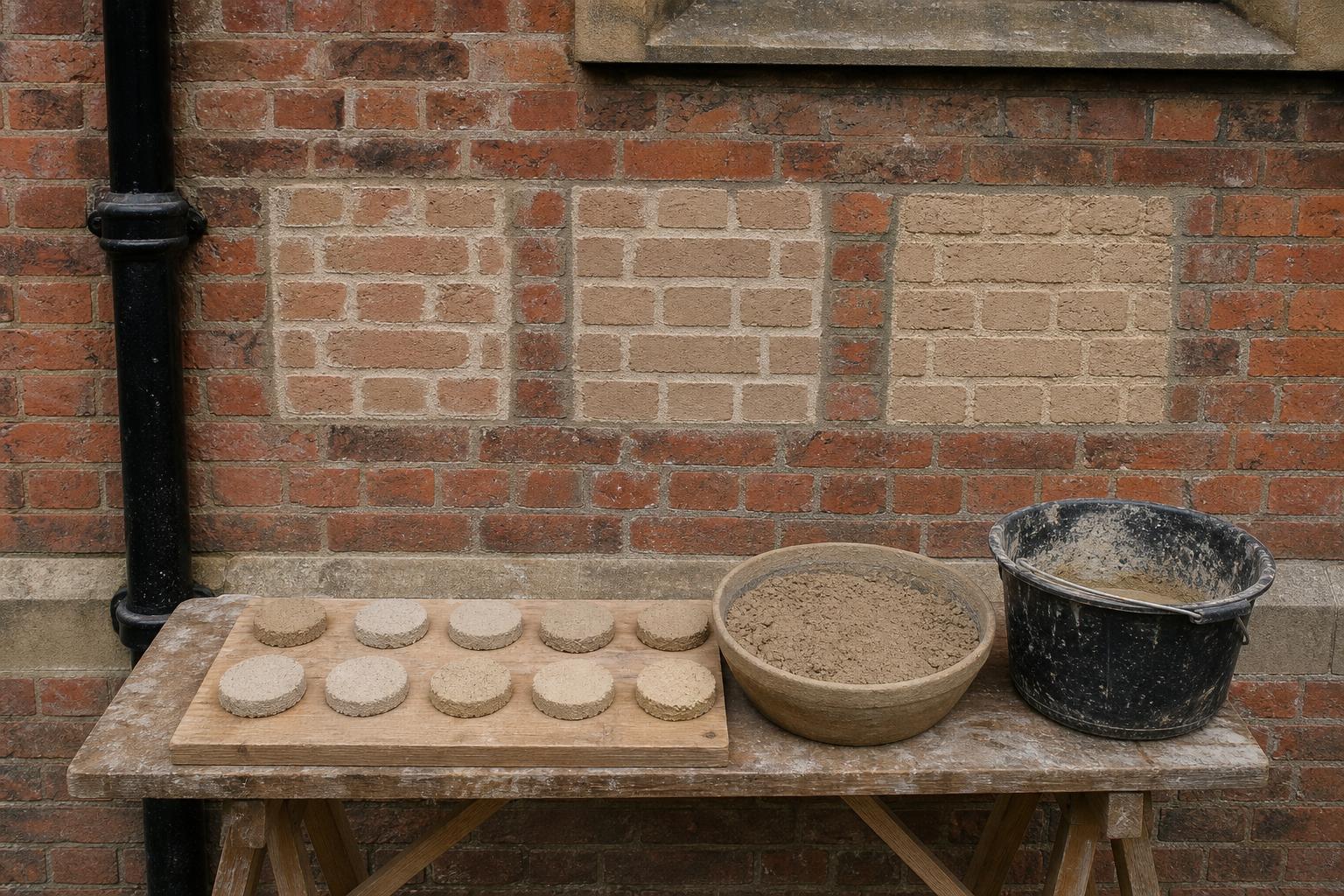
- Mortar sample panels, prepared on site in the specified mix, allowed to weather, and approved before general repointing
- Plaster sample panels, including finish and texture
- A trial area for paint removal, on both a representative and a delicate component
- A cleaning trial, with the method, pressure and duration recorded
- A sample window or sample bay, completed in full, before general work
- Colour samples, applied on the actual substrate rather than viewed on a card
State in the specification:
- Who approves, and within what period
- That general work may not proceed until approval is given
- That the approved sample is retained on site as the standard for the duration
- What happens if the sample is not approved
The sample resolves the word “matching.” Without it, matching is an opinion held differently by each party.
Prohibitions: writing out the known substitutions
Certain substitutions occur repeatedly. They should be prohibited in terms.
- No cement in any mortar, render, plaster, bedding or pointing, unless specifically detailed
- No gypsum where lime is specified
- No disc cutters or angle grinders for raking out
- No dry abrasive blasting of historic masonry, timber or castings
- No high-pressure water cleaning
- No steel plates, flitch repairs or bolted repairs to historic timber except where specifically detailed
- No resin and rod repairs to structural timber
- No ferrous fixings in external masonry or in contact with lead
- No mastic applied as a repair to lead, or smeared over failing joints
- No proprietary chemical treatments without specific instruction
- No disposal of removed components without written instruction
- No fixing into historic timbers other than as detailed
- No film-forming coatings on external historic timber
- No impermeable paint on lime plaster or render
Add the prohibition relevant to the trades on the job. A prohibition costs a line; its absence costs the fabric.
Concealed conditions and contingency
On a historic building, what is found on opening up will change the scope. This is not a risk to be transferred; it is a certainty to be managed.
Handle it by:
Stating a contingency sum openly, so every tenderer prices the same risk. Contingencies hidden in individual rates make tenders non-comparable and reward the optimist.
Including a stop-and-notify clause. Where the contractor encounters anything unexpected — concealed decay, a previously unknown feature, evidence of earlier construction, painted decoration under later finishes — work in that area stops and the contract administrator is notified before proceeding.
Providing provisional sums for work that is anticipated but cannot be quantified — additional timber repair, additional pointing, drain repairs.
Defining the variation mechanism clearly, with agreed rates for likely additional work, so that pricing additional items does not become a negotiation mid-project.
Being realistic about the contingency size. On a frame repair or a project involving concealed timber, a contingency that would be generous on new build is inadequate here.
Recording requirements
Specify what is to be recorded, by whom, and when:
- Photographic record before work commences, of everything to be affected
- Record during opening up, particularly of anything concealed
- Record of what was removed, and where it is stored
- Record of what was found — carpenters’ marks, phasing evidence, historic finishes
- As-built record of repairs, so future work knows what is original
- Materials record — what was used, where, in what mix or colour
- Handover of the record to the client, in a usable form
On a listed building this is frequently a condition of consent. Even where it is not, it is the difference between a building whose repair history is understood and one where every future project starts from scratch.
Protection and site controls
Specify:
- Protection of retained fabric — floors, joinery, plasterwork, fixtures
- Protection of what is not being worked on but is adjacent
- Temporary weather protection, and its adequacy
- Storage of removed components — labelled, indexed, secured, dry
- A prohibition on disposal without written instruction
- Restrictions on fixings into historic fabric, including for scaffold ties
- Vibration limits where fragile plaster or glass is present
- Site access routes, to protect thresholds, floors and landscape
- Fire precautions, particularly for hot works — a defined permit regime, cessation before end of shift, and a fire watch period. Hot works on historic buildings have caused catastrophic losses, and this clause is not a formality
- Lead paint and asbestos controls
- Ecology constraints — bats, nesting birds — and the timing implications
Programme, season and curing
Conservation materials do not obey construction programmes.
- Lime has a working season. It cannot be placed in frost, and it must not dry too fast. Repointing and external lime render have a practical season, and a programme that ignores it will produce defects.
- Curing and carbonation take time, and each coat must set before the next.
- Protection during curing — hessian, sheeting, controlled ventilation — is a specified item, not an optional courtesy.
- Drying time after remediation of damp, before replastering and decoration, is a programme item and is routinely months.
- Casting and pattern-making lead times — typically eight to ten weeks from pattern approval for bespoke castings, and longer for radius work — must be in the programme from the start, not discovered at the point of order.
- Bespoke joinery, matching brick and stone slate all carry lead times that can exceed the construction period if ordered late.
State the seasonal constraints in the preliminaries so tenderers programme realistically, rather than pricing an impossible sequence and then claiming for it.
Levels of intervention as priced options
Where the budget is uncertain — which is most of the time — do not leave the scope vague. Define alternatives and price them.
For example, on a set of railings:
- Option A: Localised repair, hand preparation, and overcoating of sound existing paint
- Option B: Full paint removal, full system rebuild, mechanical repair of fractures
- Option C: Option B plus replication of the missing components identified in the schedule
Three defined options priced by three contractors gives nine comparable numbers and a real decision. A single vague scope gives three incomparable numbers and an argument.
This also protects the fabric: it forces the conversation about what is necessary versus what is desirable to happen before work starts, rather than as a value-engineering exercise mid-contract that falls on the conservation items.
Tendering: getting comparable prices
- Tender to a shortlist of genuinely suitable contractors. Conservation work needs conservation contractors. Sending a lime specification to three general builders produces three prices and no useful competition.
- Allow adequate tender periods. Conservation work cannot be priced quickly, and a rushed tender is priced defensively or carelessly.
- Hold a tender site visit, ideally with all tenderers, so everyone sees the same building and hears the same answers.
- Answer questions in writing to all tenderers. Questions asked at tender are free; the same ambiguity resolved on site is not.
- Require a priced schedule, not a lump sum. Line-by-line pricing shows you where a low tender is low, and reveals where a tenderer has misunderstood the scope.
- Require method statements for the significant conservation items. What a contractor writes about how they will repoint tells you a great deal.
- Ask for relevant references and comparable work.
A contractor who asks good questions at tender is a considerably better prospect than one who prices without comment. Treat questions as a positive signal, not as a nuisance.
Assessing tenders
- Compare line by line, not on the bottom figure.
- Investigate outliers in both directions. A very low line usually means a misunderstanding, and it will surface as a variation.
- Read the method statements.
- Check that the contingency and provisional sums are carried identically, or the totals are not comparable.
- Check qualifications and exclusions attached to the tender, which frequently remove scope quietly.
- Weight conservation competence, not only price. On a significant building the cost of a poor repair exceeds the tender difference many times over.
- Interview, for anything substantial. Ask how they would handle finding something unexpected.
Administration on site
Even a good specification fails without administration.
- Hold the samples and trials process properly. Approve or reject promptly; delay pushes contractors into proceeding.
- Inspect at the right moments — before covering up, not afterwards.
- Enforce the stop-and-notify clause, and respond quickly when it is invoked, or it will stop being invoked.
- Keep the variation account current, rather than settling at the end.
- Record as you go.
- Do not allow substitution by acquiescence. The first time cement appears where lime was specified is the moment the specification is either enforced or abandoned.
- Walk the job with the contractor regularly. Most problems surface in conversation before they surface in writing.
Common mistakes
| Mistake | Consequence |
|---|---|
| “Repair as necessary” | Non-comparable tenders; disputes; lowest price assumed least |
| “Match existing” without a sample | Matching becomes an opinion, differently held by each party |
| Specifying without a survey | A wish list rather than a document that can be priced |
| Extent not marked on drawings | Guesswork; over- or under-pricing |
| No prohibition on cement, disc cutters or blasting | The faster method gets used |
| Contingency hidden in rates | Tenders not comparable; optimists win |
| No stop-and-notify clause | Concealed features destroyed before anyone is told |
| Lead times discovered late | Programme delay of months on castings and bespoke joinery |
| Seasonal constraints ignored | Lime work fails; remedial work at someone’s cost |
| Tendering to general builders | No meaningful competition on conservation competence |
| Lump sum tenders | No visibility of where a low price is low |
| Awarding on price alone | Poor repair costing many times the tender difference |
| Samples process not enforced | Standard never established; work proceeds regardless |
| No hot works permit regime | Catastrophic fire risk on an irreplaceable building |
Find a specialist
The Building Restoration Index lists vetted professionals for specification and contract administration:
- Architects — conservation-accredited practices
- Surveyors — building surveyors experienced in historic repair specification
- Heritage Consultants — significance, consent and conservation strategy
- Project Managers — programme, procurement and contract administration
- Structural Engineers — where structural intervention is specified
- Materials Analysts — mortar, plaster and brick analysis to inform matching
- Paint Research — historic decorative scheme analysis
- Builders — main contractors with conservation experience
- Conservation Supplies — specialist materials
- Courses, Training and Events — for teams developing conservation competence
Related guides in the library: Commissioning a condition survey, Listed Building Consent, Historic brickwork. The full set is on the Technical Library page of the Building Restoration Index.
Frequently asked questions
Why do my tenders come back so far apart?
Almost always because the specification allowed different assumptions. Mark the extent on drawings and price defined options.
What is wrong with “repair as necessary”?
It transfers the scope decision to the tenderer. The lowest price becomes the one that assumed the least work.
How do I specify “matching” mortar?
By composition and source — binder, aggregate, grading, proportions — and by requiring a weathered sample panel approved before general work.
Should I name products or performance?
Name products for conservation materials. Performance specification invites substitution, and substitution is what causes harm.
How big should the contingency be?
Larger than on new build, stated openly, and larger again where concealed timber or opening up is involved.
What is a stop-and-notify clause?
A requirement that the contractor stops and notifies before proceeding when anything unexpected is found. It is what prevents concealed features being destroyed.
Why require a sample window or bay?
It establishes the standard for the whole job, in the actual materials on the actual building, before the standard can go wrong at scale.
Should I tender to general builders?
Not for conservation work. Send it to contractors with relevant experience, or the competition is meaningless.
How long should tenderers get?
Longer than for conventional work. Conservation scope cannot be priced quickly, and rushed pricing is defensive or careless.
Is a contractor asking lots of questions a bad sign?
The opposite. Questions at tender are free; the same ambiguity on site is expensive.
Should I accept the lowest tender?
Only after comparing line by line, investigating outliers, and weighing conservation competence. A poor repair costs many times the tender difference.
How do I stop cement being used where lime is specified?
Prohibit it explicitly, require samples, inspect, and act the first time it appears.
Do I need to allow for lead times?
Yes. Bespoke castings typically run eight to ten weeks from pattern approval, and matching brick, stone slate and joinery can be longer.
Can lime work be done in winter?
No. It cannot be placed in frost and must not dry too fast. State the seasonal constraint in the preliminaries.
What should I ask for at handover?
Photographic record, as-built record of repairs, materials used and where, and a maintenance regime.
What if the budget will not cover everything?
Define levels of intervention as priced options. It gives a real decision and protects the conservation items from mid-contract value engineering.