
Conservation Rooflights for Slate, Tile, Pantile and Stone Roofs
A conservation rooflight only looks right if it sits properly in the roof covering around it. This chapter takes each common historic roof covering in turn: natural slate, plain clay tile, pantile, stone slate and metal, and sets out what changes for each.
In summary
The roof covering decides how flush a conservation rooflight can sit, how it is flashed and whether it suits the roof at all. Thin natural slate gives the neatest result. Plain tiles need a deeper frame profile. Pantiles are the hardest, because their deep profile makes any rooflight more visible and complicates the flashings. Stone slates need careful setting out to the courses. Most makers offer separate slate and tile versions, and most standard units suit pitches from roughly 17 degrees upwards, so check both before ordering.
On this page
Why the roof covering matters
A conservation rooflight is designed to sit within the roof covering rather than on top of it. How well it achieves that depends on the thickness and profile of the covering. A unit made for 5mm slate will stand visibly proud in a plain tile roof; one made for tiles will sit too low in slate and can trap water at the head.
The covering also dictates the flashings. Slate and plain tile take soakers and a straightforward lead apron; pantiles need lead dressed to a deep profile; stone slates need the courses set out around the opening. Each detail affects both weathering and appearance, which is why conservation officers look closely at the section drawing.
Roof coverings compared
| Covering | How well a rooflight sits | Main issue | What to ask the maker for |
|---|---|---|---|
| Natural slate | Best | Keeping the frame truly flush | A slate-profile unit |
| Plain clay tile | Good | Thicker covering and camber | A tile-profile unit |
| Pantile | Difficult | Deep profile, more visible, complex lead | Tile profile and a pantile flashing detail |
| Stone slate | Fair | Thick, irregular courses | A section showing the upstand height |
| Lead, zinc, copper | Specialist | Integration with seams and rolls | A metal-roof upstand and kerb detail |
Natural slate
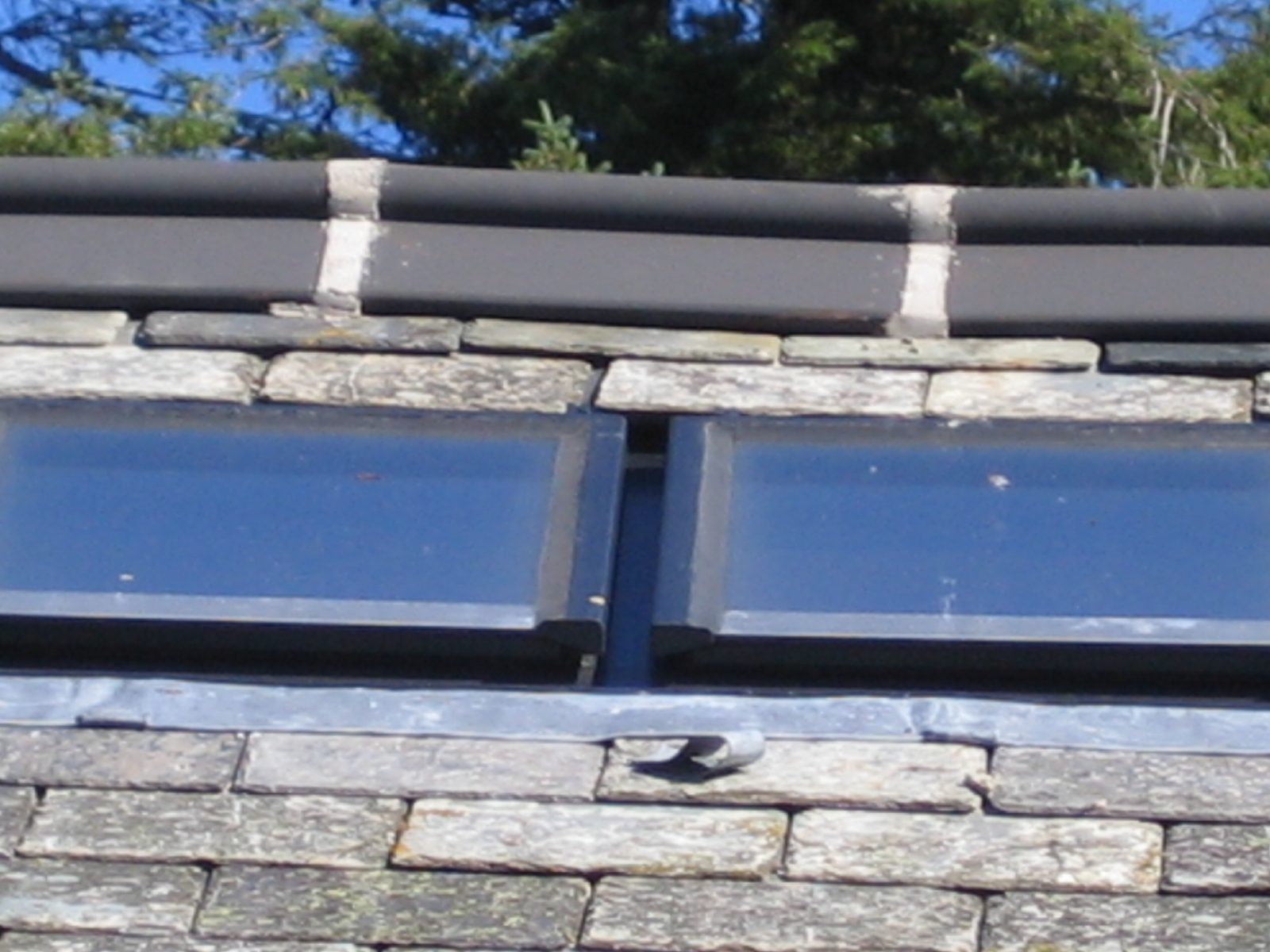
Slate is the covering conservation rooflights were made for, and Welsh, Cumbrian and Cornish slate roofs give the neatest result. Because slate is thin, the frame can sit low so the glass lies close to the plane of the roof.
Ask for the maker’s slate version, which has a shallower frame profile. Slates are cut and holed around the opening, with lead soakers at the sides and a lead apron at the bottom. At the head, a back gutter or a lead tray carries water around the frame. Keep the rooflight within one rafter bay where possible to avoid trimming historic rafters.
Plain clay tiles
Plain tiles are thicker than slate and laid with a camber, so the covering stands higher off the battens. A tile-profile rooflight has a deeper upstand so the frame still finishes flush with the tile surface. Without it, the rooflight looks sunk into the roof and the head flashing is harder to weather.
Tiles around the opening are usually cut and holed or replaced with tile-and-a-half units at the sides, and soakers are slotted between courses. Handmade tiles vary in size and camber, so leave the final setting out to the roofer on site.
Pantiles
Pantiles are the hardest covering for a conservation rooflight. Their deep S-profile makes any flat frame more noticeable, and the lead at the sides and foot has to be dressed to the profile. Some council guidance notes that a standard rooflight has a greater visual impact on a pantile roof than on slate, for exactly this reason (North Yorkshire Council guidance).
On pantile roofs, keep rooflights small, few and on the least visible slope. Expect the officer to ask for a section through the flashings. Check the maker’s pitch limits too: some standard units are recommended only above a higher minimum pitch in pantile roofs, because water can pool at the foot of the frame.
Stone slates
Stone slate roofs, such as Cotswold limestone, Collyweston, Horsham and Pennine sandstone, are laid in diminishing courses and are much thicker than Welsh slate. The upstand needs to be high enough to clear the covering. The opening also has to fit the course gauge, so the rooflight does not land awkwardly mid-course.
Because stone slates are heavy and expensive, the roof is often stripped and relaid in sections. Plan the rooflight position before any re-roofing so the courses can be set out around it, and order a bespoke size if the standard sizes do not fit the gauge.
Lead, zinc and copper roofs
On metal roofs, the rooflight usually sits on a timber kerb or upstand. The sheet metal is turned up and welted, or dressed, around it. The detail has to respect the roll or seam spacing of the roof, so it belongs with a specialist leadworker or metal roofer. Some makers offer a zinc-roof version of their conservation rooflight; for anything else, ask for a bespoke upstand detail.
Roof pitch
Most standard conservation rooflights are designed for pitched roofs of roughly 17 to 65 or 70 degrees, depending on the maker and the model. One maker’s published range, for example, covers pitches between 17.5 and 65 degrees (NBS Source). Below the minimum, water drains too slowly from the frame and can pool at the foot. Shallow catslides and lean-tos are where this most often goes wrong.
For low-pitched and flat roofs, look at a purpose-made flat conservation rooflight rather than forcing a pitched unit. The installation chapter covers the flashing details in more depth.
Common mistakes
- Ordering a slate-profile unit for a tile roof, or the reverse.
- Fitting a pitched unit below the maker’s minimum pitch.
- Placing rooflights on the front slope of a pantile roof, where they are most visible.
- Cutting principal rafters to fit a standard size, instead of choosing a size that fits the existing bay.
- Leaving the head detail to chance: most leaks start at the top of the frame.
- Forgetting the gutter below. A rooflight changes how water arrives at the eaves, and the roof works chapter explains why it is the moment to check the rainwater goods.
Where to go next
For sizing and lead times, see ordering a conservation rooflight. For what officers look for in the design, see the specification guide. To find a roofer, browse the roofing contractors and leadwork categories of the Building Restoration Index, or return to the Conservation Rooflight Guide.
Speak to the manufacturers directly
The Rooflight Co. — Bourton-on-the-Water, Gloucestershire. Makers of The Original Conservation Rooflight, the Conservation Egress side-hung escape unit and the Conservation Plateau for flat roofs. Tel 01993 833155 · hello@therooflightco.com · therooflightco.com · Index listing
Clement Windows Group — Haslemere, Surrey. Makers of the Clement Conservation Rooflight in separate slate and tile profiles, with a published size and price list and a showroom in Haslemere. Tel 01428 643 393 · info@clementwg.co.uk · clementwindows.co.uk · Index listing
Enquiries go straight to the manufacturer. Tuscan Foundry is not a rooflight supplier and receives no commission; we feature these two because their conservation ranges are made for exactly the buildings this guide covers.
Tuscan Foundry supplies cast iron gutters, downpipes and hopper heads to BS 460 for listed and traditional buildings, with an in-house linseed oil paint finish. Damp that is blamed on a rooflight is often a blocked or overflowing gutter soaking the wall below, so the same inspection should take in the rainwater goods. If the roof is scaffolded, it is the cheapest moment to repair or replace them; stock items dispatch promptly and bespoke castings take around 12–14 weeks.
Frequently asked questions
Can you put a conservation rooflight in a tiled roof?
Yes. Choose the maker’s tile-profile version, which has a deeper upstand so the frame finishes flush with the thicker tile covering. Plain tile roofs take soakers and a lead apron in much the same way as slate.
Are conservation rooflights suitable for pantile roofs?
They can be fitted, but pantiles are the most difficult covering. The deep profile makes the rooflight more visible and the lead has to be dressed to the profile. Keep rooflights small, few and on the least visible slope, and check the maker’s minimum pitch for pantiles.
What is the difference between a slate and a tile conservation rooflight?
The depth of the frame. A slate version sits lower to suit a thin covering; a tile version has a deeper upstand for thicker tiles. Fitting the wrong one leaves the rooflight sunk below or standing above the roof.
What is the minimum roof pitch for a conservation rooflight?
It varies by maker and model, but most standard units are designed for pitches from about 17 degrees upwards. Below that, use a purpose-made flat or low-pitch rooflight.
Can a conservation rooflight go in a stone slate roof?
Yes, with care. The upstand must clear the thicker stone, and the opening should be set out to the course gauge. Bespoke sizes are often the best solution on stone roofs.
Who should fit a conservation rooflight?
A roofer experienced with the specific covering, working to the maker’s installation details. On metal roofs, a specialist leadworker or metal roofer should form the upstand.