
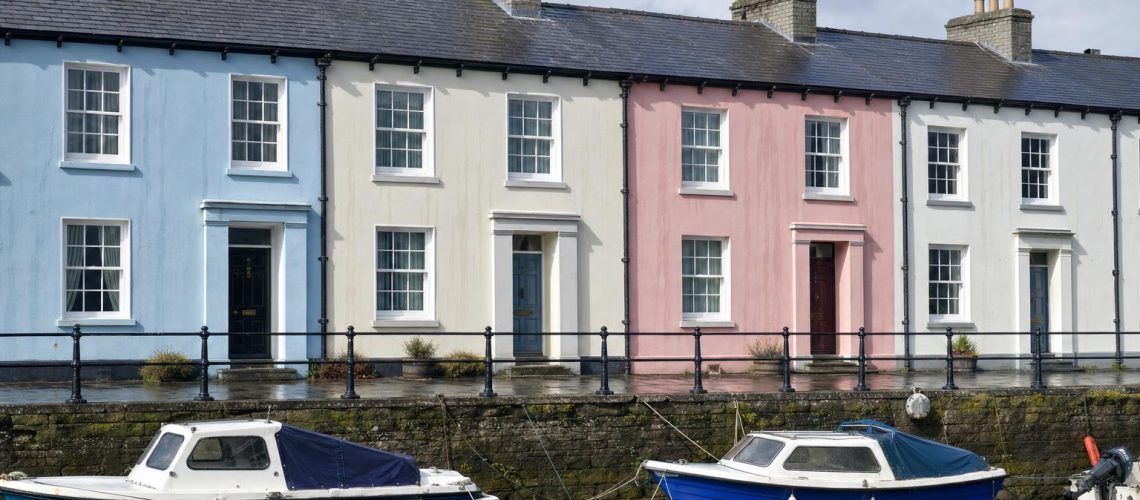
From the Regency harbour terraces of Aberaeron to the seafront of Aberystwyth, the Ruskinian Gothic Guildhall at Cardigan and the Georgian mansion of Nanteos, Ceredigion’s historic buildings face some of the most exposed weather in Wales. We set out how to specify cast iron gutters, downpipes and hoppers that respect that heritage and stand up to salt air and Atlantic rain.
Technical summary: Historic buildings in Ceredigion should be fitted with cast iron rainwater goods that match the original profile, size and fixing: typically ogee or moulded ogee on Georgian and Regency terraces in Aberaeron, Cardigan and Aberystwyth, and half-round on Victorian terraces, chapels and farm buildings, with larger sections where big slate roofs and heavy rainfall demand more capacity. On the Cardigan Bay coast, every face must be prepared and painted to resist salt air, and the finish maintained. Listed building consent is decided by Ceredigion County Council under the Historic Environment (Wales) Act 2023, and every application needs a heritage impact statement. We supply standard stock for prompt despatch, bespoke and copy casting in typically 8 to 10 weeks, radius gutters in 12 to 14 weeks, linseed oil paint finishes, and a chargeable site survey service for complex projects.
Ceredigion runs for around 80 kilometres along Cardigan Bay, from the Dyfi estuary in the north to the Teifi at Cardigan, and climbs east into the Cambrian Mountains. Cast iron gutters in Ceredigion should match the surviving profile, size and fixing of each building, be sized for heavy Atlantic rainfall, be protected by a maintained paint system against salt-laden westerly winds, and be agreed with Ceredigion County Council before any change is made to a listed building. That holds as firmly for a Regency house on Aberaeron harbour as for a chapel in the Teifi valley.
The county contains around 1,880 listed buildings and structures, ten of them Grade I and just over a hundred Grade II*, together with 13 conservation areas: Aberaeron, Aberystwyth, Adpar, Cardigan, Cenarth, Lampeter, Llanbadarn Fawr, Llanddewi Brefi, Llandysul, Llanrhystud, Llansantffraed (Llan-non), New Quay and Tregaron. No National Park falls within Ceredigion, so the County Council is the local planning authority for the whole county, with Cadw as the Welsh Government’s historic environment service.
The building stock is distinctive. Aberystwyth is a rendered Georgian and Victorian seaside town; Aberaeron is a planned Regency harbour town; Cardigan and Lampeter are market and college towns; and inland lie farmsteads, chapels, woollen mills along the Teifi and the remains of upland lead mining. We are based in Mid Wales and supply traditional cast iron gutters, downpipes and hopper heads for listed, conservation-area and period buildings across the county, working with architects, surveyors, conservation officers, contractors and owners.
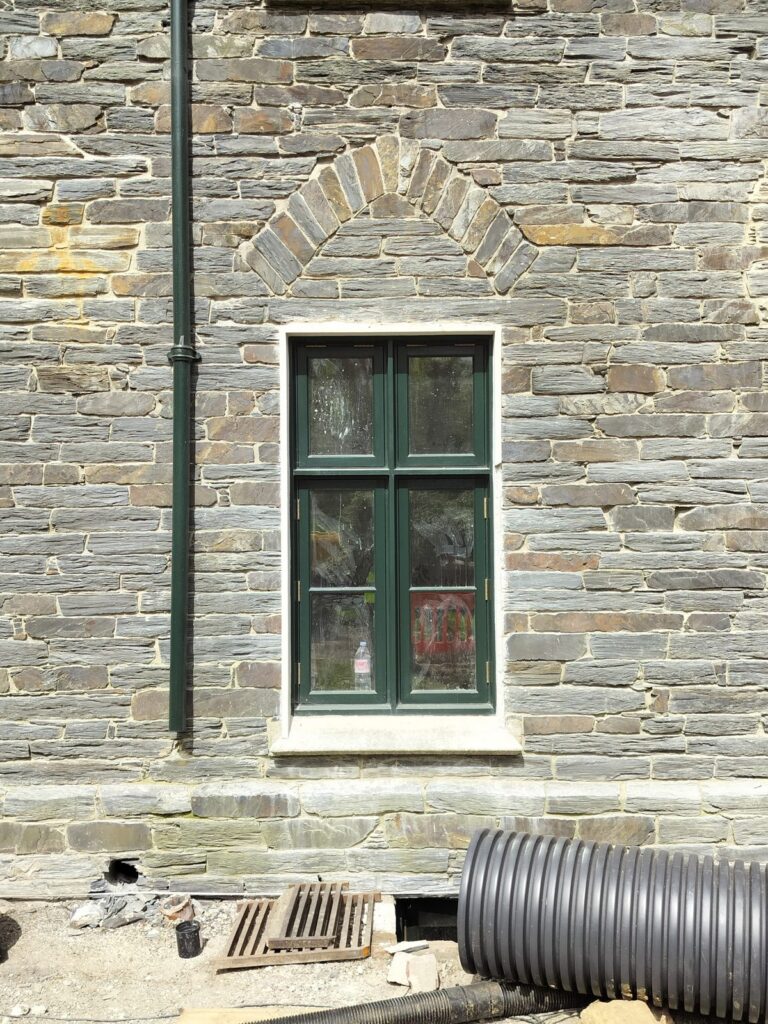
Ceredigion’s historic buildings are mostly of local rubble stone, very often rendered, roughcast or limewashed, under Welsh slate roofs, with deep bracketed eaves on its Georgian and Victorian town houses. Brick and imported freestone arrive mainly after the railway reached Aberystwyth in 1864.
Cadw’s study of Aberystwyth describes the local stone as alternating beds of hard greywacke and poorer shale, quarried from Constitution Hill and Penglais. Rubble of this kind was rarely meant to be seen. Early vernacular buildings were limewashed, and by 1864 rendering over exposed stonework was described as becoming universal. Rusticated ground floors, scribed blocking, pilasters and quoins in render became the language of the town, and the same approach runs through Aberaeron, New Quay and Cardigan.
Slate is by far the dominant roof covering across the county, with clay tile rare. Cadw notes that deep eaves, often carried on ornamental brackets, are a strong feature of most Aberystwyth facades. That matters for rainwater goods: on a bracketed eaves the gutter sits on or under a projecting timber soffit, and its profile, fixing and outlet positions are part of the elevation.
Aberaeron was laid out after an Act of 1807 obtained by the Reverend Alban Thomas Jones Gwynne, with expansion plans drawn up by Edward Haycock from around 1830. Its two-storey Regency terraces, grouped around the harbour and Alban Square, are now painted in the varied colours that make the town familiar; the colours are a twentieth-century addition to plainer original finishes. Aberystwyth’s Marine Terrace began with five houses by 1806 and was largely built or rebuilt in the 1860s and 1870s as four-storey stuccoed and rendered frontages. At Lampeter, St David’s College of 1822 to 1827, designed by C. R. Cockerell, is a rendered Tudor Gothic quadrangle, while the National Library of Wales and the Old College give Aberystwyth civic scale.
On a rendered or limewashed wall, the gutter and downpipe are among the few dark lines on the elevation, so their proportion matters. A moulded ogee on bracketed Georgian eaves reads as a continuation of the cornice; a half-round on a Victorian terrace or chapel gives a lighter line. For the Regency character of Aberaeron, our Regency cast iron rainwater goods conservation guide explains how period profiles and rainwater heads were detailed.
Cast iron remains the expected material for rainwater goods on listed and conservation-area buildings in Ceredigion because, for most of the county’s nineteenth-century stock, it is the material the building was given. Like-for-like replacement is the starting point of Welsh conservation practice, and where original sections survive they form part of the building’s significance.
A gutter profile sets the eaves line. Replacing a moulded ogee with a half-round, or losing a beaded edge along a terrace, changes a detail the listing protects, and on a uniform terrace such as Alban Square or Marine Terrace one mismatched house breaks the group. Our guide to cast iron gutter profiles explains how to identify what is on the building before anything is ordered.
Conservation officers will expect a proposal to show what exists, what is to be replaced and why. Photographs of the gutter, downpipes, hoppers and brackets, the profile and size, the fixing method and the proposed finish are the minimum a useful pre-application conversation needs. Early contact avoids abortive orders, particularly where castings must be made to pattern.
Ceredigion’s rainwater systems face two pressures together: salt-laden westerly winds off Cardigan Bay along the coast, and heavy rainfall that increases towards the Cambrian Mountains. Paint condition and outlet capacity decide how long cast iron lasts here.
The Met Office station at Gogerddan, just outside Aberystwyth, records an annual average of around 1,100 mm of rain falling on around 160 days a year (1991 to 2020), and the uplands to the east are considerably wetter. On the seafront at Aberystwyth, New Quay or Aberaeron, wind-driven spray deposits salt on every exposed surface. Salt is hygroscopic, holds moisture against the iron and attacks any break in the paint film, especially on the back of downpipes and the inside of gutter joints.
Our article on linseed oil paint for cast iron in salt-air environments sets out how preparation, film build and a shorter inspection cycle keep coastal ironwork sound.
On most Ceredigion buildings we suggest clearing gutters and hoppers at least twice a year, after leaf fall and again in spring, with a check after winter storms. On coastal elevations, inspect the paint annually and touch in any break straight away, because salt-driven corrosion spreads quickly beneath a damaged film. Rinsing salt deposits from sheltered sections that rain does not reach is a simple, worthwhile addition to the routine.
In Ceredigion, listed building consent is decided by Ceredigion County Council as local planning authority for the whole county, under the Historic Environment (Wales) Act 2023, which came into force on 4 November 2024. Cadw maintains the list and publishes national guidance.
The 2023 Act consolidated the earlier listed building and ancient monuments legislation into a single bilingual statute; the substance of the listed building regime is largely unchanged.
Genuinely like-for-like repair, using the same material, profile, size and fixing, is not normally treated as needing consent, but the Council will apply that test carefully. Any change of material, profile, size, colour or downpipe position on a listed building is likely to need listed building consent. Cadw notes that consent may be needed even for painting or repainting a listed building, and that unauthorised work can be a criminal offence. Our article on planning requirements for gutter repair on listed buildings explains the distinction.
Every listed building consent application in Wales must include a heritage impact statement. For rainwater goods, that means describing the significance of the existing system, what is proposed and why, and how the replacement matches the original. Clear photographs, the profile and size, fixing details and the proposed paint colour will usually support a proportionate assessment.
Changing the profile changes the building’s appearance and will normally require consent, which is unlikely without good evidence. The exception is reinstatement: where research shows a correct earlier profile was replaced with an inappropriate one, restoring it can be supported. This is practical guidance, not legal advice; confirm the position for your own building with the Council before work starts.
| Body or guidance | Role in Ceredigion | Useful for rainwater work |
|---|---|---|
| Ceredigion County Council (planning and conservation) | Local planning authority for the whole county; determines listed building consent and manages 13 conservation areas | Pre-application discussion; conservation area boundaries and appraisals, such as the Llandysul appraisal |
| Ceredigion Built Environment and Design SPG (adopted January 2015) | Supplementary planning guidance on design and the historic environment | Emphasises quality materials that reflect local character |
| Cadw | Welsh Government historic environment service; maintains the list | Managing Change to Listed Buildings in Wales; listed building consent and heritage impact statement guidance |
| Cadw, Aberystwyth: Understanding Urban Character | Characterisation study of the town | Records local stone, render traditions, slate roofs and bracketed eaves |
Half-round and ogee are the profiles found most often on Ceredigion buildings: ogee and moulded ogee on Georgian and Regency frontages, half-round on Victorian terraces, chapels and farm buildings. The evidence on the building comes first, then the hydraulic demand of the roof.
Cast iron half-round gutters are the usual pattern on Victorian terraces, chapels and vernacular stock across the county. Cast iron ogee gutters belong on the formal Georgian and Regency fronts of Aberaeron, Aberystwyth and Cardigan, where the gutter completes the eaves. Where a large slate roof discharges to few outlets, or rainfall on an upland site demands more capacity, a deeper or larger section can be specified without changing the character of the eaves.
| Building type | Where in Ceredigion | Typical profile and components | Notes |
|---|---|---|---|
| Regency and Georgian terraces | Aberaeron, Cardigan, Aberystwyth | Ogee or moulded ogee on bracketed eaves; round downpipes | Keep one profile and colour across a terrace; the group is the significance |
| Victorian seaside terraces and hotels | Aberystwyth seafront, New Quay, Borth | Ogee or half-round; larger downpipes on four-storey fronts; rainwater heads | Salt exposure: prepare and paint all faces, including pipe backs |
| Chapels and churches | Across the county | Half-round or ogee at eaves; hoppers and downpipes serving valleys and parapets | Outlet capacity and safe access for clearing are critical |
| Country houses and estates | Nanteos, Llanerchaeron and smaller estates | Rainwater heads, often dated or crested; parapet outlets; copy cast components | Historic lead heads are retained; match any cast iron to its phase |
| Colleges and civic buildings | Aberystwyth, Lampeter, Cardigan | Moulded sections, decorative heads, larger-diameter pipes | Complex roofs need a measured survey |
| Mills, farm buildings and vernacular stock | Teifi valley, Llandysul, upland farmsteads | Half-round or beaded half-round on drive-in brackets | Keep discharge clear of rubble footings and limewashed walls |
Cast iron hopper heads matter on Ceredigion’s parapeted and valley roofs because they collect storm flows and are the first components to block. Where a building carries a pattern no longer made, whether a crested rainwater head or an unusual gutter moulding, we can reproduce it by copy casting from a surviving section, fragment or detailed survey.
Standard stock is available for prompt despatch; please confirm current availability on enquiry. Bespoke and copy cast items typically require 8 to 10 weeks from pattern confirmation to delivery. Radius gutters, for curved bays and apses, require site measurement and typically take 12 to 14 weeks.
Five listed buildings show the range of rainwater considerations Ceredigion presents, from a seafront college to a Georgian mansion with dated lead rainwater heads. None is presented as a Tuscan Foundry project; each is described from its listing and published sources.
Old College, Aberystwyth (Grade I)
Begun as Castle House by John Nash in 1794, the building was remodelled by J. P. Seddon from 1864 as the Castle Hotel, then bought in 1867 for the new University College of Wales. Seddon and John Coates Carter repaired it after the 1885 fire, and C. A. Ferguson’s central block followed in 1896. Its steep slate roofs with swept eaves face Cardigan Bay directly. A major transformation into a cultural and creative centre, including reslating of the south Seddon turrets, is due for completion in 2026.
The Guildhall and Markets, Cardigan (Grade II*)
Built in 1858 to 1860 to designs by R. J. Withers, the Guildhall is recorded in its listing as among the first municipal buildings in Britain to follow Ruskin’s Gothic principles. It is built of coursed blue lias stone with red brick banding and ashlar dressings, under banded slate roofs with ornamental iron cresting; a lead-clad clock turret was added in 1892. The markets are lit by glazed ridges. Multiple hipped roofs and rooflights make outlet positions and gutter capacity central to its care.
Nanteos, Llanfarian (Grade I)
Built in 1739 to 1757 for Thomas Powell, Nanteos is described in its listing as the major surviving Georgian house of the region. It is of coursed squared local stone with sandstone dressings, with flat or very low roofs behind parapets carrying urns. The listing records two lead downpipes on lead brackets with finely moulded lead rainwater heads bearing the Powell crest, the initials W P and the date 1757. Parapet drainage depends on those outlets, and the heads themselves are significant fabric.
Church of St Padarn, Llanbadarn Fawr (Grade I)
St Padarn’s stands on the site of a sixth-century monastic foundation; the present church is largely thirteenth-century, with a fifteenth-century chancel. J. P. Seddon restored it in phases between 1868 and 1884. The listing records rubble stone walls with ashlar quoins, coped gables and slate roofs with patterned bands of fishscale slates. On a large cruciform church, eaves gutters, downpipe positions and ground drainage together decide whether water is kept away from rubble walls and medieval stonework.
9–20 Alban Square, Aberaeron (Grade II*)
This terrace of around 1830 belongs to the planned harbour town begun under an Act of 1807, and is listed Grade II* as a well-preserved group in a key location. The houses are two-storey, in a simple Regency manner, with Welsh slate roofs; the varied colour-washed fronts are a twentieth-century addition. On a uniform terrace the gutter line runs from house to house, so a consistent profile, bracket spacing and paint finish are what preserve the group.
Beyond these landmarks, the everyday heritage of Ceredigion is its chapels, farmhouses, harbour terraces and market town frontages. We supply half-round and ogee gutters, downpipes and hopper heads for Grade II listed and conservation-area properties of all these types. For chapels and churches, our page on church and chapel rainwater systems sets out the particular demands of valley and parapet gutters.
On a listed building in Ceredigion, a wrong rainwater specification costs twice: in wasted castings, scaffold and labour, and in damage to historic fabric if an inadequate system is left in place. The specifier carries that exposure, and a site survey is the most reliable way to remove it.
When a profile is misread from a photograph or a size is guessed, the castings arrive, the scaffold is up on a seafront terrace, and the new gutter does not match the surviving lengths. The conservation officer questions the work and the architect is answerable to the client. On copy cast items, a second order means another 8 to 10 weeks, often into the autumn gales, with scaffold hire running on an exposed site.
Undersizing and poor preparation carry a slower cost. Repeated overflow soaks render and rubble, salt-driven corrosion shortens the life of unprotected ironwork, and by the time damp shows inside, the repair is to the building rather than the gutter.
That is why, on complex projects, we recommend our chargeable site survey and site visit service before specification is finalised. A survey records profiles, sizes, fixings, outlet positions and hopper patterns, identifies what can be retained, and gives an accurate basis for the heritage impact statement. It is professional due diligence that protects the project outcome, particularly where components are damaged or missing, access is difficult, or copy casting is required.
We recommend linseed oil paint for cast iron guttering and pipes as the heritage-appropriate finish for Ceredigion buildings. It penetrates and bonds well to properly prepared iron, remains flexible, weathers by gentle chalking rather than flaking, and can be recoated without full stripping. Its limitations should be planned for: it dries more slowly than modern coatings, particularly in cool, damp coastal weather, so application needs a suitable window, and on salt-exposed elevations it needs a disciplined cycle of inspection and recoating to keep performing.
We work with architects, surveyors, contractors and owners across Ceredigion, from Borth and Aberystwyth in the north through Aberaeron, New Quay, Lampeter and Tregaron to Llandysul and Cardigan in the south.
A typical project runs from enquiry and photographs, through advice on profile, size and fittings, to quotation, manufacture or supply from stock, and delivery.
We deliver throughout the county, including rural and upland sites; please mention access restrictions when you enquire. Standard stock is available for prompt despatch, subject to availability; bespoke and copy cast work typically requires 8 to 10 weeks and radius gutters 12 to 14 weeks, so engage early where work must finish before winter. For projects south of the Teifi, our Pembrokeshire heritage guttering guide covers the neighbouring county.
Contact us to discuss cast iron rainwater systems for your Ceredigion project, or call 0333 987 4452.
You may not need consent for genuinely like-for-like repair using the same material, profile, size and fixing, but any change to material, profile, size, colour or downpipe position is likely to need listed building consent. Applications are made to Ceredigion County Council, which is the local planning authority for the whole county. Always confirm the position with the Council before work begins.
Ceredigion County Council decides listed building consent throughout the county, because no National Park lies within Ceredigion. Cadw maintains the list of historic buildings and publishes national guidance, including Managing Change to Listed Buildings in Wales.
Listed buildings in Wales are governed by the Historic Environment (Wales) Act 2023, which came into force on 4 November 2024. It consolidated the earlier legislation into a single bilingual Act without substantially changing the listed building regime. Every listed building consent application must include a heritage impact statement.
The right gutter is the one that matches the evidence on the building. In Ceredigion that usually means ogee or moulded ogee on Georgian and Regency terraces in Aberaeron, Cardigan and Aberystwyth, and half-round on Victorian terraces, chapels and farm buildings. Size should be checked against roof area and rainfall rather than copied from a later replacement.
Salt carried on westerly winds from Cardigan Bay holds moisture against the iron and attacks any break in the paint, so corrosion starts at pipe backs, joints and chips. Sound cast iron copes well with coastal exposure if every face is properly prepared and painted before fixing. Annual paint inspection and prompt touching-in are the key to a long life on seafront elevations.
Yes, we can reproduce gutter profiles, rainwater heads and fittings by copy casting from a surviving length, fragment or detailed survey. Bespoke and copy cast items typically require 8 to 10 weeks from pattern confirmation to delivery. On complex buildings, our chargeable site survey ensures the pattern is recorded accurately.
Yes, we supply cast iron gutters, downpipes and hopper heads throughout Ceredigion, including Aberystwyth, Aberaeron, Cardigan, Lampeter, New Quay, Tregaron and Llandysul. Standard stock is available for prompt despatch, subject to availability. Please tell us about any access restrictions when you enquire.
Well-maintained cast iron gutters and downpipes commonly last a century or more, and many original nineteenth-century systems are still in service. Their life depends on the paint film being kept intact and outlets being kept clear. Neglect, rather than the material, is what usually ends a cast iron system’s life.
Linseed oil paint bonds well to properly prepared cast iron, stays flexible and weathers by gentle chalking rather than flaking, so it can be recoated without full stripping. It dries more slowly than modern coatings and needs a regular cycle of inspection and recoating. For historic buildings, it is the finish most consistent with traditional practice.
Book a site survey before specification is finalised on any complex Ceredigion project, especially where components are damaged or missing, access is difficult or copy casting is needed. Our site survey is a chargeable service that records profiles, sizes, fixings and outlets accurately. It protects the project from costly mismatches once scaffold is up.
Standard stock is available for prompt despatch, subject to confirmation of availability. Bespoke and copy cast items typically require 8 to 10 weeks from pattern confirmation, and radius gutters for curved bays or apses typically take 12 to 14 weeks. We recommend engaging early where work must be finished before winter.
A heritage impact statement for rainwater work should describe the existing system and its significance, what is proposed and why, and how the replacement matches the original. Include photographs, the profile and size, fixing details and the proposed paint finish. Ceredigion County Council will expect the level of detail to be proportionate to the building and the work.
Specifying cast iron gutters in Ceredigion comes down to a few principles: identify and match the surviving profile, size and fixing; size the system for heavy Atlantic rainfall and large slate roofs; prepare and paint every face to resist salt air on the coast, then keep that finish maintained; and agree any change with Ceredigion County Council, supported by a heritage impact statement, before work starts. Rendered terraces, rubble chapels, Regency harbour fronts and Georgian estates all reward that care.
Tuscan Foundry Products has supplied cast iron rainwater goods since 1893, and we are based in Mid Wales, a short distance from the Ceredigion border. We supply projects across the county, from Aberystwyth and Aberaeron to Lampeter and Cardigan, offering standard stock ranges, bespoke and copy casting, radius guttering, linseed oil paint finishes and a chargeable site survey service for complex work. To discuss your Ceredigion project, call us on 0333 987 4452 or visit tuscanfoundry.com.