
From Wealden hall houses and oast houses to ragstone churches, Georgian market towns and Regency seafronts, Kent’s historic buildings depend on rainwater goods that are correctly matched and properly maintained. This guide sets out how we approach cast iron gutters, downpipes and hopper heads for listed and conservation-area buildings across the county.
Technical summary: Historic buildings in Kent generally require cast iron rainwater goods that match the existing profile, size, joint and fixing detail: beaded or plain half-round on timber-framed, vernacular and Victorian buildings, ogee on Georgian and Regency frontages, and larger box, valley or bespoke sections on churches, country houses and industrial buildings. Listed Building Consent is decided by the relevant district or borough council or Medway Council, and any change of material or profile will usually need it. Coastal buildings need a maintained linseed oil paint system with shorter inspection intervals. We supply standard half-round and ogee systems for prompt despatch, copy cast lost profiles and hopper heads in typically 8 to 10 weeks, make radius gutters in typically 12 to 14 weeks, and offer chargeable site surveys for complex projects.
Kent holds one of the densest concentrations of historic buildings in England, from Wealden hall houses and weatherboarded high streets to naval dockyards, Georgian seaside terraces and a World Heritage cathedral. Cast iron gutters in Kent should match the profile, size and fixing of the originals on each building, typically half-round or ogee, finished in linseed oil paint and approved by the local planning authority where the building is listed. We supply cast iron guttering, downpipes, hopper heads and bespoke castings for listed and conservation-area projects across the county.
Kent County Council’s Heritage Conservation Strategy (2022) records more than 17,000 listed buildings and around 500 conservation areas in the county, alongside some 400 historic parks and gardens. Canterbury Cathedral, St Augustine’s Abbey and St Martin’s Church together form a World Heritage Site, inscribed by UNESCO in 1988. The Kent Downs and High Weald National Landscapes, taken together, cover around a third of Kent’s land area, and much of the county’s most sensitive vernacular building stock sits within them.
The building types are unusually varied for a single county: timber-framed farmhouses and oast houses in the Weald, ragstone churches along the Medway valley, red brick market towns such as Faversham and Sandwich, Regency and Victorian terraces in Margate, Ramsgate, Folkestone and Royal Tunbridge Wells, and the industrial buildings of Chatham Historic Dockyard. Each carries its own rainwater detail, and each deserves to be specified on its own terms.
We work with architects, surveyors, conservation officers, contractors and owners to specify authentic cast iron rainwater systems that satisfy conservation requirements on listed buildings, and to manufacture what cannot be bought from stock.
Kent’s historic building stock is defined by timber framing, Kentish ragstone, flint, red and yellow stock brick, clay peg tiles, tile hanging and white-painted weatherboarding, used in combinations that change noticeably between the Weald, the Downs, the Medway towns and the coast. Rainwater goods on these buildings are usually modest in scale, but they are highly visible against pale weatherboarding and warm brick.
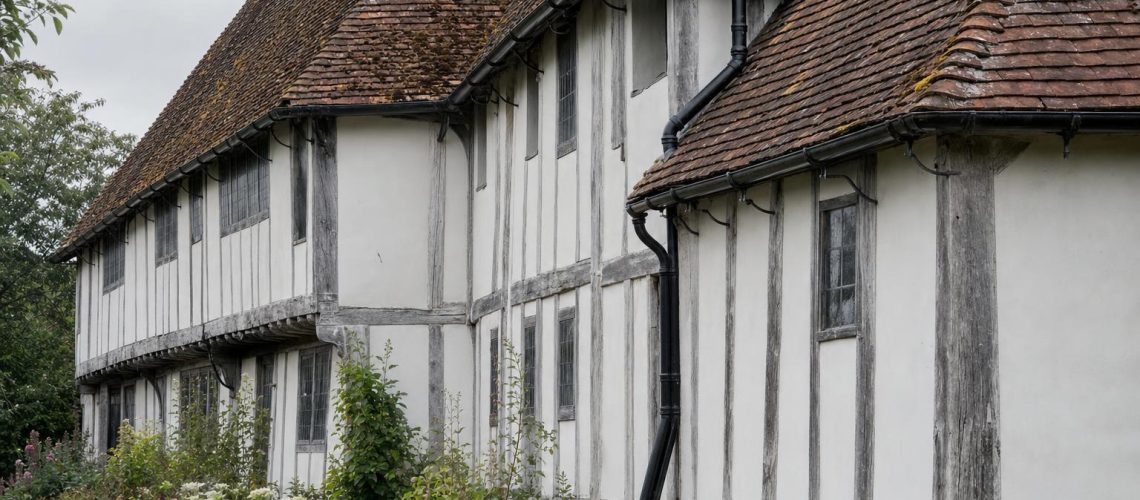
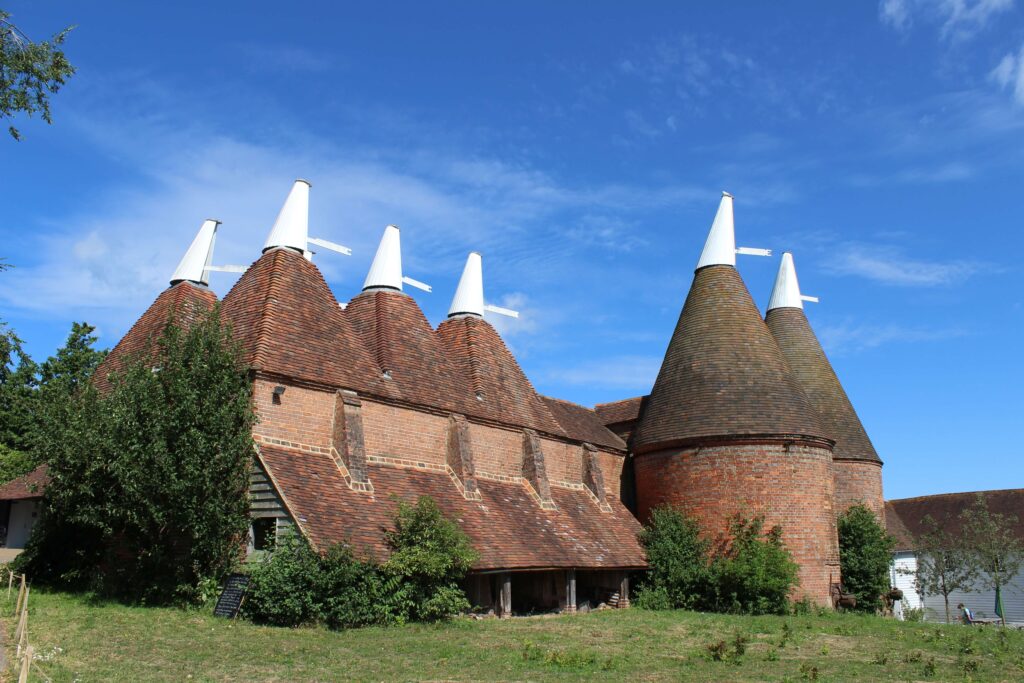
The Weald has one of the highest surviving concentrations of medieval timber-framed houses in England, including the Wealden hall house with its recessed central hall and jettied end bays. Towns such as Tenterden, Cranbrook, Biddenden and Smarden combine these frames with later tile-hung upper storeys and weatherboarded fronts. Steep peg-tile roofs with deep eaves and catslides are typical, and the oast houses and barns of the hop-growing country add roundels, kilns and long agricultural roof slopes.
On these buildings, small-section half-round or beaded half-round gutters on individual brackets are usually the correct reading. The jetty complicates things: a downpipe that runs straight down a jettied front has to be offset or taken to the flank, and the placement needs to respect the bressummer and the frame rather than simply the shortest drop.
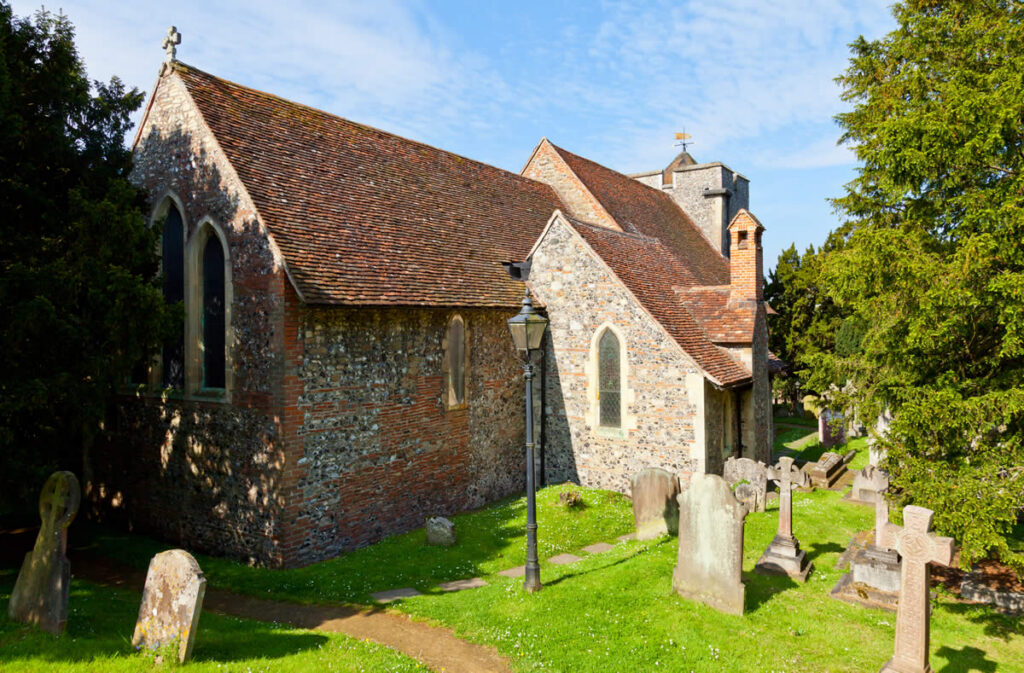
Kentish ragstone, a hard, grey sandy limestone quarried around Maidstone for centuries, gives Knole and many village churches in the Medway valley their character. The Kent Downs National Landscape itself describes its settlements as ragstone villages, and on the chalk further east flint appears in church walls, boundary walls and farm buildings, often dressed with brick. Ragstone rubble and flint are both porous at the joints, so a leaking gutter joint or a blocked shoe does direct damage to the lime mortar beneath.
Faversham, Sandwich, Rochester and Canterbury carry long runs of Georgian and earlier brick frontages, many refronting timber-framed cores. Along the coast, Deal, Whitstable, Broadstairs and Margate mix weatherboarded fishermen’s cottages with stuccoed Regency terraces, while Royal Tunbridge Wells and Folkestone’s Leas show the confident Victorian villa and hotel. Ogee gutters on stuccoed and brick Georgian fronts, and heavier moulded or deep sections on Victorian commercial buildings, are the norm.
Many of these materials and building types are shared with the Weald of Surrey and Sussex; our guide to cast iron rainwater systems in Surrey covers the western end of the same Wealden tradition.
Cast iron is specified on listed and conservation-area buildings in Kent because it is, in most cases, the material that was there, and like-for-like replacement is the starting position for any conservation officer. Correctly detailed and maintained, it will outlast several generations of paint and can be repaired or recast rather than discarded.
Matching means more than choosing cast iron. The profile, the nominal size, the joint type, the bracket pattern and the spacing of downpipes all contribute to the character of a frontage. A 100mm ogee replaced with a 125mm half-round changes the eaves line of a Georgian house in a way that is obvious from the street, and on a terrace the mismatch is repeated door after door. The profile on site, not the catalogue, sets the specification.
Most rainwater damage on Kent’s historic buildings is slow and preventable. The pattern we see repeatedly is a combination of blocked outlets, failed joints and paint breakdown at the back of the gutter, where it cannot be seen from the ground.
The coast from Whitstable round through Margate, Ramsgate and Deal to Folkestone is exposed to salt-laden wind, which shortens paint life and attacks any breach in the coating. Here the finish matters as much as the casting. We cover preparation and maintenance cycles in our guide to linseed oil paint for cast iron in salt air.
Across the county, the same defects recur. Georgian parapet fronts in Canterbury, Faversham and Sandwich often hide lead-lined box gutters behind the parapet, and a single blocked outlet can put water into the top of the wall or the roof timbers before anyone notices. Oast houses and barns have long, steep roof slopes that deliver more water to the eaves than a small gutter can take in a summer storm. On older replacements, undersized sections, too few downpipes and steel fixings bolted into cast iron are common, and each shortens the life of the system.
Timber-framed buildings are the most vulnerable to rainwater failure because the damage is hidden. A leaking joint above a jetty or a blocked downpipe against a sole plate can rot a frame for years behind tile hanging or weatherboarding before anything shows inside. On Wealden houses, gutter capacity and outlet positions deserve as much attention as appearance.
Conservation officers in Kent generally expect evidence: photographs of the existing goods, a note of the profile and size, and a clear statement of what is being replaced and why. Engaging them early, before goods are ordered, avoids abortive work.
Listed Building Consent in Kent is determined by the district, borough or unitary council for the area, not by Historic England, and whether it is required depends on what is proposed and the building concerned. Like-for-like repair may not need consent, but any change of material, profile or appearance on a listed building usually will.
Kent has a two-tier structure: Kent County Council, which maintains the Kent Historic Environment Record, and twelve district and borough councils that act as local planning authorities. Medway Council is a separate unitary authority covering Rochester, Chatham, Gillingham and Strood. Historic England’s South East team advises on the most significant cases, including works to Grade I and II* buildings.
Local government in the county is being reorganised. In July 2026 the government confirmed that Kent and Medway will be replaced by four unitary councils, with shadow elections in May 2027 and the new councils taking over on 1 April 2028. Until then, the existing councils remain responsible for planning and listed building decisions.
| Local planning authority | Historic centres (examples) | Proposed unitary area from April 2028 |
|---|---|---|
| Ashford Borough Council | Ashford, Tenterden, Wye | Mid Kent |
| Canterbury City Council | Canterbury, Whitstable, Herne Bay | East Kent |
| Dartford Borough Council | Dartford | North Kent |
| Dover District Council | Dover, Deal, Sandwich | East Kent |
| Folkestone and Hythe District Council | Folkestone, Hythe, New Romney | Mid Kent |
| Gravesham Borough Council | Gravesend | North Kent |
| Maidstone Borough Council | Maidstone, Hollingbourne | West Kent |
| Medway Council (unitary) | Rochester, Chatham, Strood | North Kent |
| Sevenoaks District Council | Sevenoaks, Westerham | West Kent |
| Swale Borough Council | Faversham, Sittingbourne, Sheerness | Mid Kent |
| Thanet District Council | Margate, Ramsgate, Broadstairs | East Kent |
| Tonbridge and Malling Borough Council | Tonbridge, West Malling | West Kent |
| Tunbridge Wells Borough Council | Royal Tunbridge Wells, Cranbrook | West Kent |
You need Listed Building Consent in Kent for any works that affect the character of a listed building, and a change of gutter material or profile almost always does. Straight like-for-like repair in cast iron, matching the existing profile and fixing, is often treated as repair not requiring consent, but the decision rests with the council. Confirm the position in writing before work starts; we set out the principles in our guide to planning requirements for gutter repair on listed buildings.
Conservation officers in Kent expect cast iron to be retained and repaired wherever possible, and replaced like-for-like where it cannot. They will look for the correct profile, size, joint and bracket detail, and a heritage-appropriate paint finish. Photographs, a short method statement and a product specification make the application quicker to assess.
Changing the profile on a listed building in Kent requires Listed Building Consent and a clear justification, and is rarely supported unless it reinstates an original profile lost to earlier alterations. Historic photographs, surviving fragments or matching neighbouring buildings are the usual evidence. In conservation areas, article 4 directions may also bring rainwater goods on unlisted houses under control, so check with the council.
Half-round and ogee gutters account for most of Kent’s historic rainwater goods: half-round and beaded half-round on vernacular, timber-framed and Victorian buildings, and ogee on Georgian and Regency frontages. Larger and bespoke sections are needed on churches, country houses and industrial roofs.
| Building type in Kent | Typical profile | Specification notes |
|---|---|---|
| Wealden hall houses and timber-framed cottages | Beaded or plain half-round, 100–115mm | Individual rise-and-fall brackets; offset downpipes around jetties |
| Oast houses and barns | Half-round or deep half-round | Long roof slopes and high catchments; check outlet capacity |
| Georgian town houses (Faversham, Sandwich, Canterbury) | Ogee, often 100–125mm | Fascia-fixed; profile continuity along terraces |
| Regency and Victorian seaside terraces | Ogee or moulded ogee | Coastal exposure; paint maintenance is critical |
| Ragstone and flint churches | Half-round, box or parapet gutters with rainwater heads | Outlets and hoppers often the weak point |
| Dockyard and industrial buildings | Large sand-cast sections and valley gutters | Bespoke sizes common; site measurement advised |
Our standard ranges include cast iron ogee gutters and cast iron half-round gutters in the sizes most often found in the county, with round and rectangular downpipes, offsets, shoes and cast iron hopper heads. Standard stock is available for prompt despatch; please confirm current availability on enquiry.
Downpipes and rainwater heads deserve the same attention as the gutter. Round downpipes with eared sockets are standard on most Kent houses, while rectangular pipes and ornamental heads appear on grander Georgian and Victorian fronts and on civic buildings. Hopper heads on older buildings sometimes carry a date or initials; where they survive they should be repaired or copied rather than replaced with a plain pattern, because they are part of the listed fabric.
Where a surviving profile is no longer made, where hopper heads carry dates or initials, or where a run is curved, we make it. Our bespoke castings service reproduces profiles from photographs, drawings or physical samples; bespoke and copy cast items typically require 8 to 10 weeks from pattern confirmation. Oast house roundels, bay windows and bowed shopfronts may call for radius cast iron guttering, which requires site measurement and a template and typically takes 12 to 14 weeks.
Kent’s landmark buildings show the full range of rainwater problems the county presents, from lead-roofed cathedrals to long slate valley roofs and jettied medieval streets. The examples below are described from published sources; none is presented as a Tuscan Foundry project.
Rochester Guildhall, Rochester (Grade I)
Built in 1687 according to Medway Council, with plaques recording its completion in 1697, the Guildhall on Rochester High Street is a Grade I listed civic building with an open, columned ground floor once used as a market, a bell-turret, and a weathervane in the form of a warship added in 1780. Wings followed in 1838 and 1893. On a frontage of this rank the rainwater goods sit in direct view of the street, and profile, joint spacing and downpipe positions govern how the three building phases read together.
Knole, Sevenoaks (Grade I)
Built largely between the late fifteenth century and the Jacobean remodelling of the early 1600s, Knole is one of England’s largest houses, constructed in Kentish ragstone and owned by the National Trust since 1947. The Trust’s conservation programme, completed in 2019 at a cost of £19.8 million, was prompted in part by damp harming interiors and collections. A roofscape of this scale, with its many gables, courtyards and internal valleys, shows why controlled rainwater discharge is a core conservation concern on country houses.
Canterbury Cathedral, Canterbury (Grade I, World Heritage Site)
Listed Grade I in 1949 and part of the World Heritage Site inscribed in 1988, the cathedral combines Romanesque and Gothic work in Caen limestone beneath extensive lead roofs. The Canterbury Journey programme, completed in 2022 at a cost of £34.5 million, included replacement and restoration of roof and fabric, with the nave roof replaced in 2018, and trained apprentices including a leadworker. On buildings of this order, parapet gutters, outlets and rainwater heads must be treated as part of the stone fabric they protect.
The Ropery, Chatham Historic Dockyard (Grade I)
Built between 1785 and 1791 and more than 1,100 feet long, the double ropehouse at Chatham is listed Grade I and still makes rope commercially. Its list entry describes red brick with grey headers, stone dressings and a slate valley roof. A valley roof of that length concentrates water into long internal gutters, so outlet capacity, falls and the soundness of every joint decide whether the building stays dry. The dockyard contains 47 scheduled monuments across 80 acres.
Abbey Street, Faversham (conservation area; individually listed houses)
Laid out in the twelfth century as the approach to Faversham Abbey, Abbey Street is lined with timber-framed houses, many refronted in the Georgian period. No. 7, for example, is a Grade II listed fifteenth-century house refaced in the eighteenth century, still showing its jetty on a bressummer. Threatened with clearance after the war, the street was saved by Faversham Borough Council’s pioneering town scheme of the late 1950s, encouraged by SPAB. Here gutter lines and downpipes must respect jetties and refronting, not simply take the shortest route.
Beyond landmarks of this kind, we regularly supply half-round and ogee gutters, downpipes and hopper heads for Grade II listed farmhouses, oast conversions, town houses and coastal terraces, and larger sections for the county’s churches. Our churches and ecclesiastical buildings page sets out how we approach parish churches, where rainwater heads and parapet outlets are so often the source of damp. Civic buildings follow the same logic: Faversham’s Grade II* Guildhall, first built in 1574 and rebuilt in 1814, has a programme of roof, elevation and arcade repairs planned by Faversham Town Council from 2026.
Most Kent projects start with photographs and a short description of the building, and move to specification advice, quotation, manufacture and delivery. For complex restorations, damaged or missing components, or difficult access, we recommend a site survey before the specification is finalised.
For copy casting, the most useful reference is a physical length of the original gutter or a surviving hopper head, but clear photographs with a tape measure in shot, a profile drawing and a note of the joint and bracket detail are often enough to begin. Where the original has gone entirely, neighbouring buildings of the same date and historic photographs are the usual evidence.
The specifier’s exposure on a listed building is real. An incorrect profile can mean a refused or conditioned consent, goods returned or recast, scaffolding hired for weeks longer than planned, and in the worst case an enforcement requirement to reinstate. On a Wealden frame or a ragstone church, an undersized gutter or badly placed outlet can go on causing damage long after the job is signed off.
Our chargeable site survey and site visit service exists to remove that risk. We measure profiles and runs on site, record surviving components for copy casting, and check capacity against the roof, so the specification put to the conservation officer is right first time. On complex projects it is professional due diligence that protects the outcome and the programme.
We recommend linseed oil paint for cast iron guttering and pipes as the heritage finish for Kent’s listed buildings: it is flexible, easy to overcoat and sympathetic to historic fabric. It dries more slowly than modern coatings, so programme time is needed between coats, and it relies on a maintenance cycle of inspection and recoating, particularly on the coast.
Contact us to discuss cast iron rainwater systems for your Kent project by calling 0333 987 4452 or through our contact page.
You usually need Listed Building Consent in Kent if the replacement changes the material, profile or appearance of the gutters. Like-for-like repair in cast iron matching the existing profile may not need consent, but the district, borough or Medway Council decides. Always confirm in writing before work starts.
The best cast iron guttering for a listed building in Kent is the profile and size already on the building, or the original where it has been lost. Half-round and beaded half-round are typical on timber-framed and Victorian buildings, and ogee on Georgian and Regency frontages.
Yes, cast iron gutters are the expected material on most historic buildings in Kent’s conservation areas. The county has around 500 conservation areas, and some are covered by article 4 directions that bring rainwater goods on unlisted houses under planning control, so check with the council.
Kent’s ragstone and flint parish churches usually carry half-round gutters on the aisles, with box or parapet gutters and cast iron or lead rainwater heads on larger roofs. Profiles vary with each phase of repair, so the surviving goods should be recorded before anything is ordered.
Well-maintained cast iron gutters and downpipes commonly last a century or more. Their life depends on regular clearing and a maintained paint system, and on the Kent coast shorter repainting intervals are needed because salt air accelerates coating breakdown.
Yes, we supply cast iron gutters, downpipes and hopper heads throughout Kent, including Canterbury, Maidstone, Rochester, Sevenoaks, Royal Tunbridge Wells, Faversham, Folkestone and Margate. Standard items are available for prompt despatch, subject to current stock.
Yes, we copy cast gutters, hopper heads and fittings from photographs, measured drawings or physical samples. Bespoke and copy cast items typically require 8 to 10 weeks from pattern confirmation to delivery, so allow for this in the programme.
Standard stock cast iron guttering is available for prompt despatch; please confirm current availability when you enquire. Bespoke and copy cast items typically take 8 to 10 weeks, and radius gutters 12 to 14 weeks.
Yes, we offer site surveys and site visits as a chargeable professional service. They are recommended for complex restorations, damaged or missing components, copy casting and sites with difficult access, because they establish the correct specification before money is committed.
Speak to the conservation or heritage officer at the local planning authority for the building, which in Kent is one of the twelve district and borough councils or Medway Council. Historic England’s South East team is involved in the most significant cases.
We recommend linseed oil paint as the heritage finish for cast iron on listed buildings. It is flexible and straightforward to maintain, but it dries more slowly than modern coatings and needs a regular cycle of inspection and recoating.
Not yet: the existing district, borough and Medway councils remain the planning authorities until the new unitary councils take over on 1 April 2028. After that date, applications will go to one of four new unitary councils covering North, East, Mid and West Kent.
Specifying cast iron gutters in Kent comes down to a few principles: match the profile, size and fixing already on the building; respect the particular vulnerabilities of timber frames, ragstone and flint; agree the approach with the local planning authority before ordering; and finish in linseed oil paint on a maintained cycle, with shorter intervals on the coast. Where profiles are lost or runs are curved, copy casting and radius work solve the problem, with lead times planned from the start.
Tuscan Foundry Products has supplied traditional cast iron rainwater goods since 1893. We supply projects across Kent, from Wealden farmhouses to coastal terraces and churches, and we bring the same care to a single hopper head as to a full estate specification. To discuss your Kent project, call us on 0333 987 4452 or visit tuscanfoundry.com.