
Shropshire holds one of the finest collections of historic vernacular architecture in England — medieval timber-framed buildings of extraordinary quality in Shrewsbury and Ludlow, the industrial revolution heritage of Ironbridge, and a broad rural stock of black-and-white farmhouses, Georgian market towns and Victorian estate buildings. Cast iron rainwater systems are the standard specification for listed and conservation-area properties across the county, and we supply them to projects throughout Shropshire and the Marches.
Shropshire’s listed building stock is dominated by timber-framed vernacular buildings — the black-and-white oak-framed properties of the Marches — together with the medieval town centres of Shrewsbury and Ludlow, the Georgian market towns of Bridgnorth and Market Drayton, and the Ironbridge Gorge World Heritage Site. Cast iron rainwater systems in half-round, ogee and beaded half-round profiles serve the overwhelming majority of requirements. The relevant heritage body is Historic England; the relevant planning authorities include Shropshire Council, the unitary authority that covers most of the county, and the Ironbridge Gorge World Heritage Site buffer zone where additional planning requirements apply. We supply and deliver cast iron rainwater systems throughout Shropshire.
Shropshire is most famous for its timber-framed vernacular buildings — the black-and-white architecture of the Welsh Marches, which stretches from north Shropshire through Shrewsbury, Ludlow and south into Herefordshire. These timber-framed buildings, many of them medieval, carry a distinctive rainwater challenge: the infill panels of lime plaster or brick nogging are exposed to weather at every edge and joint, and if water is allowed to collect or track along the timber sills it will cause the rapid deterioration that has destroyed so many of these buildings. Correct rainwater specification, and correct fixing, is essential for the fabric to survive.
The broader Shropshire listed building stock includes: the medieval town fabric of Shrewsbury (one of the finest medieval towns in England, with a largely intact street pattern and very high density of listed buildings); Ludlow, where the medieval grid plan and Georgian townscape create one of the most complete historic towns in England; the industrial heritage of the Ironbridge Gorge — a UNESCO World Heritage Site, the birthplace of the industrial revolution; the Victorian and Edwardian estate buildings of the great Shropshire landed estates; and the Georgian market towns of Bridgnorth, Oswestry, Whitchurch and Market Drayton.
Timber-framed vernacular buildings
On the black-and-white timber-framed buildings of Shropshire, the correct profile is almost invariably half-round or beaded half-round. The half-round gutter hangs on the rafter feet at the eaves and throws water clear of the infill panels; the beaded lower edge of the beaded half-round is a decorative variant that suits buildings with carved bargeboards and decorative framing. The critical issue on timber-framed buildings is the fixing: the gutter bracket must be fixed to the rafter feet or to a fascia board, never into the infill panel, never into the lime plaster, and never across the timber-to-infill junction where movement occurs.
Medieval town centres: Shrewsbury and Ludlow
In Shrewsbury and Ludlow, the close-packed medieval frontages carry a mixture of half-round and ogee gutters. Ogee is found on the Georgian frontages around the Shrewsbury town centre and on the Regency and early Victorian commercial buildings of Pride Hill and Castle Street. Half-round serves the earlier timber-framed buildings and the smaller terrace properties throughout both towns. The conservation area designations in both towns are extensive, and works to rainwater goods on listed buildings require confirmation that the replacement is like-for-like and in original materials.
Ironbridge Gorge World Heritage Site
The Ironbridge Gorge World Heritage Site includes the Ironbridge itself, the Coalbrookdale Furnace, and the surrounding settlement of Ironbridge, Coalbrookdale, Jackfield and Broseley. The building stock is predominantly Victorian industrial and terraced housing of brick under Welsh slate, carrying half-round cast iron gutters and round downpipes. Within the World Heritage Site buffer zone, the relevant planning policy and conservation guidance is more demanding than elsewhere in Shropshire. Any significant changes to the external appearance of listed buildings or to rainwater goods require careful planning assessment. The Ironbridge Institute at the University of Birmingham is the relevant academic and conservation resource for Ironbridge heritage.
Georgian market towns and Victorian estate buildings
Bridgnorth, a double town of high and low town on the River Severn, carries the full range of Georgian and Victorian brick and stone townscape with ogee and half-round gutters. Oswestry, on the Welsh border, and the Marches towns of Whitchurch, Wem and Market Drayton have similar stock. Shropshire’s Victorian estate buildings — the model farms, lodges, estate cottages and country houses of the great landed estates — are a significant part of the listed building stock, and many carry estate-specific rainwater good patterns. Copy casting from a surviving example is often the right route for estate rainwater goods where the original pattern is unusual.
Shropshire became a unitary authority in 2009, with Shropshire Council replacing the former Shropshire County Council and the district councils. Shropshire Council is the relevant local planning authority for listed building and conservation area consents throughout most of the county. Telford and Wrekin is a separate unitary authority, covering the New Town and the Ironbridge area. For the Ironbridge Gorge World Heritage Site, Telford and Wrekin Council is the planning authority, and the World Heritage Site management plan applies additional requirements.
Like-for-like replacement of cast iron gutters and downpipes on a listed Shropshire building with the same profile and material generally does not require Listed Building Consent. Any change of profile, material, size, colour or routing does require consent. Conservation officers in Shropshire expect cast iron replacement in original profiles, appropriate fixings for the wall material, and a painted finish consistent with the building’s character. For the highest-grade buildings — Grade I and Grade II* — Historic England is a statutory consultee.
|
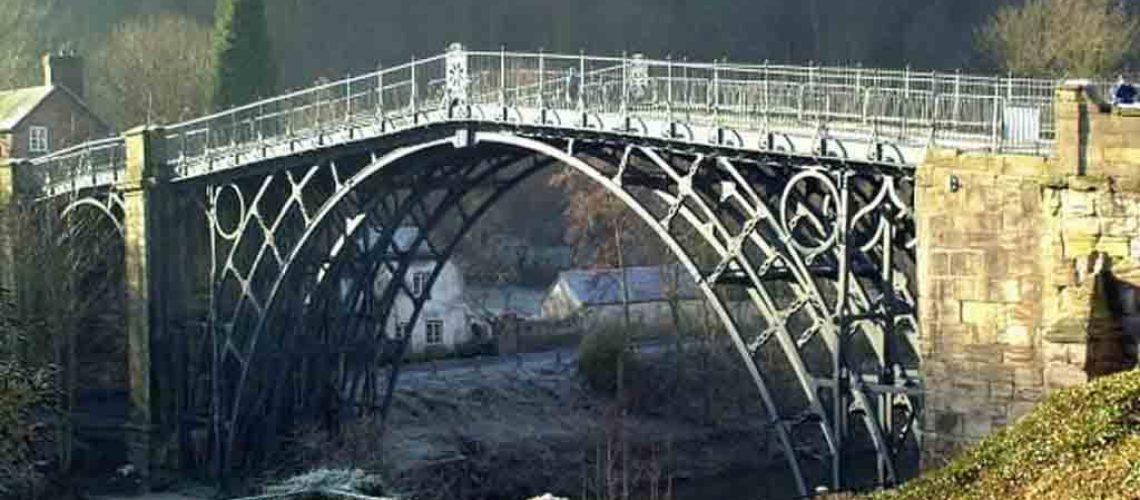
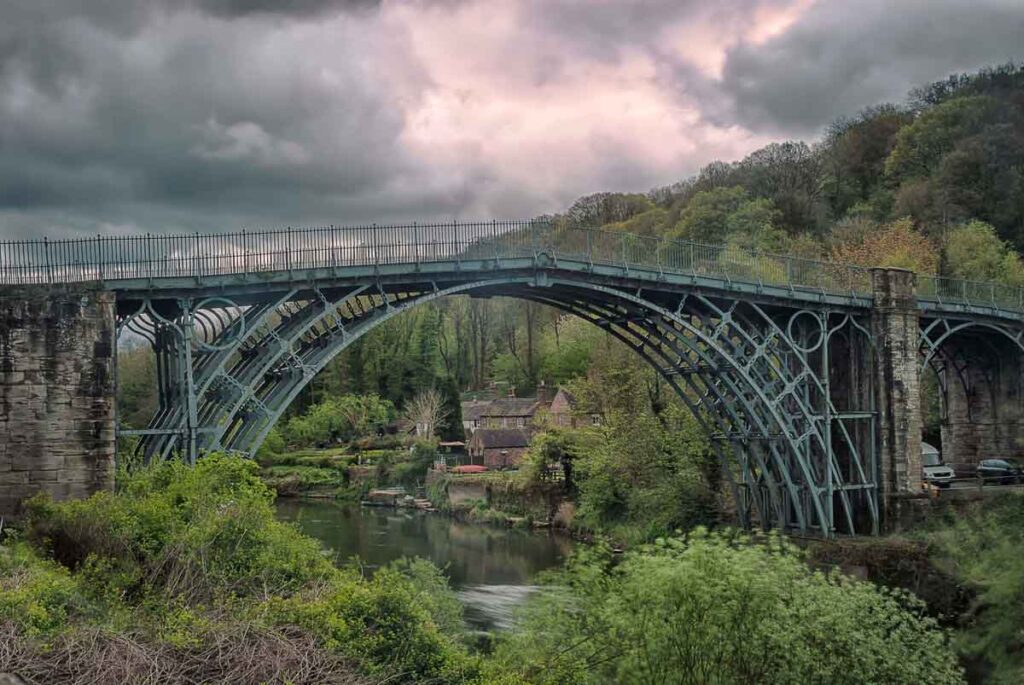
The Iron Bridge, Ironbridge (Grade I, World Heritage Site) The Iron Bridge over the River Severn, cast by the Coalbrookdale Company under Abraham Darby III in 1779, is the world’s first cast iron arch bridge and the centrepiece of the Ironbridge Gorge World Heritage Site. Its rainwater management is an engineering study in the drainage of a large cast iron structure exposed to the full force of the Severn valley weather. The conservation lesson from Ironbridge for other cast iron buildings in the Gorge is the same: paint systems matter as much as the casting, and a failure of the paint film causes rapid surface corrosion that, if unchecked, leads to permanent loss of material. |
|
Shrewsbury Castle, Shrewsbury (Grade I) Shrewsbury Castle, a Norman motte-and-bailey fortress substantially rebuilt by Thomas Telford in the 1780s, overlooks the centre of Shrewsbury where the River Severn makes its tight loop. The castle now houses the Shropshire Regimental Museum. Its red sandstone walls drain through parapet gutters and large-section downpipes; the softer beds of the local red sandstone are vulnerable to concentrated water run-off. Correct downpipe sizing and outlet positioning are more important here than gutter profile. |
|
A Medieval Timber-Framed Farmhouse, North Shropshire (Grade II) The timber-framed farmhouses of north Shropshire — close-studded oak framing with lime render or herringbone brick nogging infill panels — are the characteristic building type of the Marches. On a working farm in the Shropshire Plain, half-round cast iron gutters at 100mm, on rafter-arm brackets fixed to the rafter feet only, with 75mm round downpipes and simple hopper heads at the corners, is the standard specification. Nothing penetrates the infill panels. The gutters are painted black to match the original ironwork; the brackets are positioned so the gutter throws water clear of the timber sills. |
|
Ludlow Castle, Ludlow (Grade I, Scheduled Monument) Ludlow Castle, one of the finest medieval castle ruins in England, is owned by the Earl of Powis and managed as a visitor attraction. The castle’s inner and outer wards, towers and chapel are all Scheduled Monuments as well as Grade I listed buildings. Works require both Scheduled Monument Consent and Listed Building Consent. The castle’s rainwater management is designed around clearing water from the complex roofscape of the surviving great hall, solar and gatehouse, without concentrating run-off onto the fragile medieval stone. Any proposal for new or replacement rainwater goods on the castle requires Cadw-level expert involvement even though the castle is in England, given its cross-border cultural significance. |
|
The Ironbridge Town Terrace Housing (Grade II, World Heritage Site) The terraced housing of Ironbridge itself — the Victorian brick rows that climb the steep valley sides from the gorge floor — forms a consistent and largely intact industrial settlement. Cast iron half-round gutters and round downpipes are universal here; like-for-like replacement is straightforward and requires confirmation with Telford and Wrekin Council’s conservation officer. The World Heritage Site management plan requires that materials and profiles are consistent across the terrace, not just on the individual property being repaired. This means a replacement gutter must match its neighbours, and a Conservation Area Application is needed for any change. |
Most Shropshire projects start with photographs and a profile enquiry. We confirm the profile, advise on any conservation or planning issues, and produce a quotation. We deliver by pallet throughout Shropshire: to Shrewsbury, Ludlow, Bridgnorth, Oswestry, Market Drayton, Whitchurch, Wem, Telford and to rural sites across the Shropshire Plain, Clun, Corvedale, and the South Shropshire Hills.
For complex buildings, unusual profiles, or copy casting from damaged hopper heads or decorative sections, a site survey before specification is the right approach. We are based in Mid Wales and are familiar with the Shropshire and Welsh Marches heritage context and planning regime.
Contact us to discuss a Shropshire project: 0333 987 4452 or tuscanfoundry.com.
| Question | Answer |
| What gutter profiles are typical on Shropshire listed buildings? | Half-round is the most common profile on Shropshire vernacular buildings, including the timber-framed farmhouses and cottages of the Welsh Marches and the terrace housing of the Ironbridge Gorge. Beaded half-round suits the decorative timber-framed buildings of Shrewsbury and Ludlow. Ogee and moulded ogee are found on the Georgian and Regency frontages of the market towns. Deep half-round at 125mm and 150mm serves larger churches and Victorian public buildings. |
| Do I need Listed Building Consent to replace cast iron gutters in Shropshire? | Like-for-like replacement of cast iron gutters with the same profile and material generally does not require Listed Building Consent. Any change of profile, material, size or routing does require consent from Shropshire Council or Telford and Wrekin Council as appropriate. For buildings within the Ironbridge Gorge World Heritage Site buffer zone, additional guidance from Telford and Wrekin’s conservation team applies. |
| Who deals with listed building consent in Shropshire? | Shropshire Council is the local planning authority for most of the county. Telford and Wrekin is a separate unitary authority covering the Telford New Town area and the Ironbridge Gorge. Historic England is a statutory consultee for Grade I and Grade II* buildings throughout Shropshire. |
| Are there special requirements for works within the Ironbridge Gorge World Heritage Site? | Yes. The Ironbridge Gorge World Heritage Site has a management plan and a buffer zone within which planning policies are more demanding than in the wider county. Within the buffer zone, the appearance of historic buildings must be maintained, and any change to rainwater goods that would affect the character of the townscape requires careful consultation with Telford and Wrekin Council’s conservation team. Like-for-like cast iron replacement is generally supported. |
| Can Tuscan Foundry supply to Shrewsbury and Ludlow? | Yes. We deliver by pallet to Shrewsbury, Ludlow, Bridgnorth, Oswestry, Telford, Whitchurch, Market Drayton and throughout rural Shropshire. Standard stock items are typically despatched within 5–10 working days. We are based in Mid Wales and are familiar with the Shropshire heritage context. |
| How should gutters be fixed on a timber-framed Shropshire farmhouse? | On black-and-white timber-framed buildings, gutters must be fixed to the rafter feet or to a fascia board only. Nothing should penetrate the infill panels, lime plaster, or the timber-to-infill junction. Rafter-arm brackets are the correct fixing system; drive-in gutter spikes are not appropriate. The gutter should be positioned to throw water clear of the timber sills and the infill panels below. |
| What is the correct profile for a Georgian building in Ludlow or Shrewsbury? | Georgian and Regency frontages in Shrewsbury and Ludlow typically carry ogee cast iron gutters. The size is usually 100mm or 115mm on a townhouse or commercial frontage, with 75mm round downpipes. Where the original cast iron has survived, matching the existing profile exactly is the conservation standard. Where the original has been lost, a survey of the immediate context should inform the profile choice. |
| Is copy casting available for unusual Shropshire estate rainwater patterns? | Yes. Many of the great Shropshire estates — Attingham Park, Stokesay Court, Powis (just across the border in Wales), and others — carry estate-specific rainwater good patterns on their lodges, model farms and cottages. We copy cast from photographs with a scale reference, measured drawings, or physical fragments. The pattern is retained after first manufacture for future reorders. Photographs with a clear scale reference are the starting point. |
Shropshire’s exceptional stock of timber-framed vernacular buildings, medieval town fabric and industrial heritage at Ironbridge makes it one of the most important and demanding counties in England for cast iron rainwater specification. The key principles: half-round for vernacular and Marches buildings, ogee for Georgian townscape, appropriate fixings for timber-framed buildings, and extra care within the Ironbridge Gorge World Heritage Site. We supply cast iron gutters, downpipes and hopper heads throughout Shropshire and the Welsh Marches. Call 0333 987 4452 or enquire at tuscanfoundry.com.