
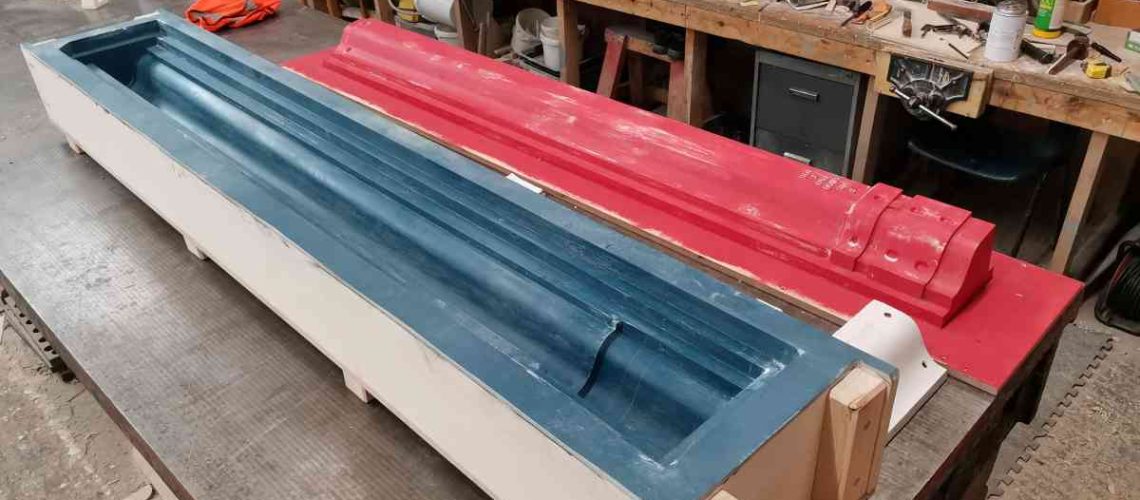
When a length of Victorian ogee gutter fractures, or when a hopper head bearing a family crest is damaged beyond repair, the project specification cannot simply call for ‘like-for-like replacement’ without first understanding what that replacement must look like. Across the listed building stock of England, Wales, and Scotland, the cast iron rainwater goods fitted to stately homes, churches, civic buildings, and country houses represent a material record of Victorian and Edwardian foundry craft. Many of those profiles are no longer in standard production, and many of those hopper heads exist nowhere but on the building itself.
Bespoke cast iron guttering supply is the mechanism by which authentic restoration becomes possible. It encompasses three distinct capabilities: profile matching from existing pattern libraries; copy casting from surviving original components; and full custom creation where no precedent exists.
The regulatory framework governing cast iron rainwater goods on listed buildings operates from a clear principle: minimum intervention and like-for-like repair. Listed Building Consent is required for any works that would alter the character or appearance of a listed structure. In practice, this means that replacing cast iron with a different profile, a different material, or a modern approximation will, in most cases, require formal consent — and may be refused entirely.
Historic England’s guidance on resilient rainwater systems emphasises that where original cast iron systems are intact, they should be maintained and repaired rather than replaced wholesale. Where replacement is necessary, the expectation is that the new component matches the original as closely as possible in material, profile, and finish.
Cadw’s position in Wales is similarly explicit. Straightforward maintenance does not normally require formal approval. However, altering or upgrading a system — including replacing a component with a different profile or a larger pipe diameter — will almost certainly require Listed Building Consent. Conservation officers across England and Wales will expect specifiers to demonstrate that replacement components are materially authentic and visually identical to the originals.
The practical implication is clear: bespoke supply is not an optional refinement on heritage projects. When the original profile is not available as standard stock, it is a regulatory requirement.
The first stage of any bespoke enquiry is to establish whether the required profile already exists within a manufacturer’s pattern library. Specialist cast iron foundries maintain extensive collections of historical patterns — some numbering in the hundreds — acquired over generations of manufacture, and in many cases from defunct nineteenth-century foundries whose moulds and patterns were purchased when they closed.
Our own pattern library encompasses gutter profiles spanning the full range of Victorian and Edwardian architectural traditions. The ogee family alone includes multiple variants, from the standard 100mm OG through to deep 150mm profiles designed for large roof areas on substantial country houses. For cast iron hopper heads, we hold patterns for tapered flat-back designs typical of Regency architecture, ornamental hoppers with large-capacity silhouettes for formal façades, and a wide range of plain and semi-ornamental rectangular box hoppers.
When a specifier approaches us with a restoration project, we ask first for dimensions and photographs of the surviving original components. In the majority of cases, a match exists within our catalogue and the replacement can be supplied from standard or near-standard stock. When no match exists, the project moves to copy casting from a surviving original, or full pattern recreation from archive evidence.
When the required profile cannot be matched from existing stock, but an original component survives on the building — even if damaged — copy casting is the appropriate method. The process involves taking a cast from the original component to create a new foundry pattern, from which replacement castings can be made in cast iron to an exact match in profile, surface texture, and detail.
Copy casting requires the original component to be temporarily removed and transported to the foundry. The original is returned undamaged after the new pattern has been made; the casting process does not consume or alter it.
Where no original component survives at all, pattern recreation from scratch becomes the only route. Our pattern makers work from architectural drawings, photographs of the original components, comparative evidence from similar properties, and physical measurement of adjacent surviving components. Three-dimensional scanning of surviving elements can produce digital models from which patterns are cut or printed with high precision — particularly valuable for complex hopper head profiles where fine surface detail must be replicated exactly.
Once a new pattern has been made, it is retained in our library, meaning that any future replacement requirements for the same building can be fulfilled without further pattern cost. For an overview of our wider bespoke castings service for heritage buildings, visit our dedicated pages.
One of the most technically demanding bespoke requirements on heritage buildings is the radius cast iron gutter — curved sections that must be cast to the precise arc of the building. Standard cast iron sections are straight, but the built form of the Victorian and Edwardian eras frequently demanded curves: the sweep of a bay window, the face of a turret, the arc of a curved parapet. Cast iron’s inherent brittleness means that standard sections cannot be bent to meet these geometries.
We require either a physical template — a flexible strip bent to the exact curve and confirmed on site — or detailed CAD drawings showing the arc radius to millimetre precision. Radius gutter production typically requires 12 to 14 weeks from the point of template confirmation to delivery. For total replacements, a site survey is strongly recommended before the specification is finalised.
Cast iron hopper heads occupy a unique position in heritage rainwater systems: they are simultaneously functional and symbolic. On Victorian and Edwardian estates, hoppers frequently displayed dates of construction, family crests, initials, and decorative motifs — floral scrollwork, heraldic embossing, lion’s masks — transforming a drainage fitting into a statement of architectural identity.
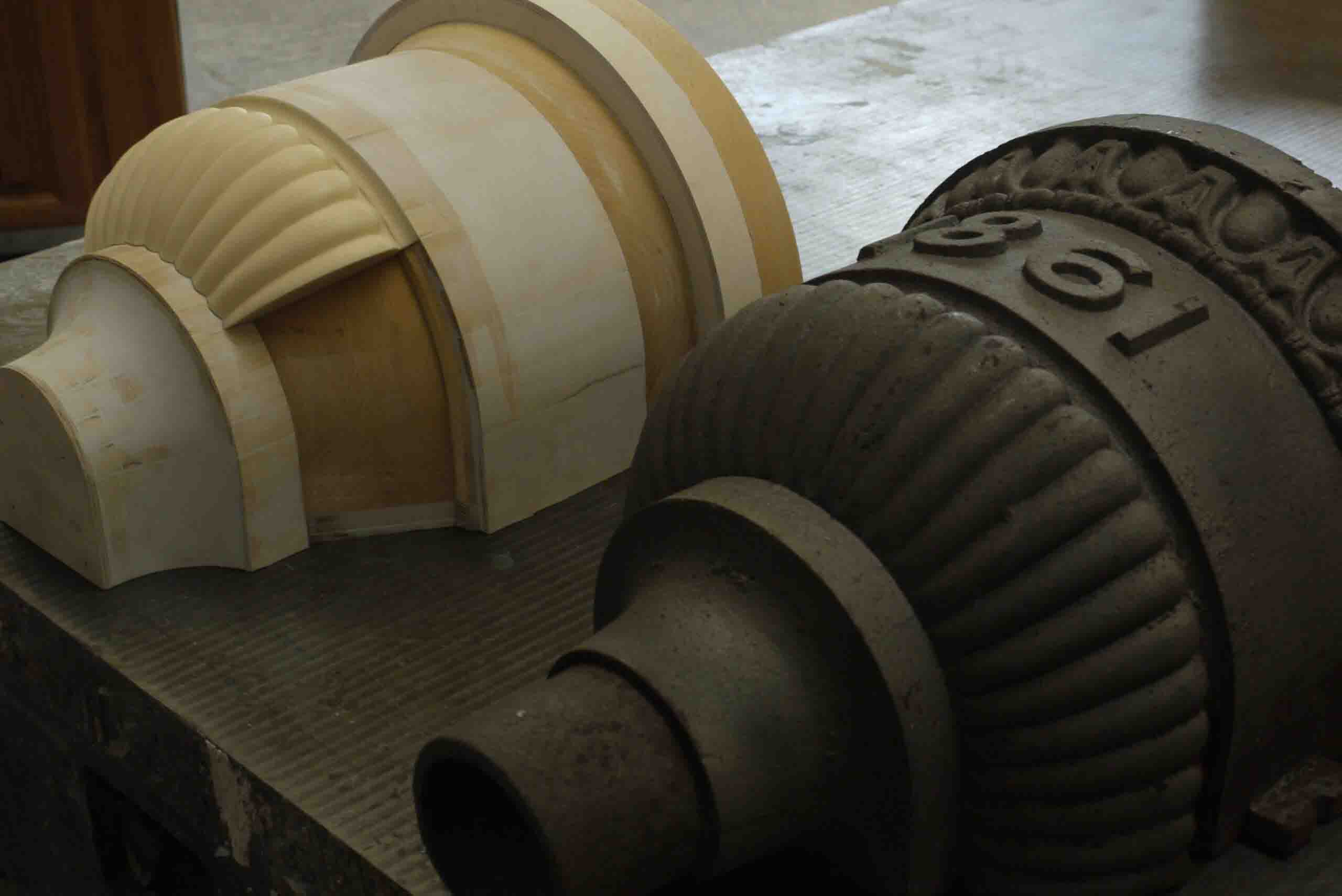
We can incorporate bespoke elements into new hopper patterns, including dates, initials, and stylised decorative motifs. For an overview of our bespoke hopper heads service and the range of customisation available, visit our dedicated page. Once a pattern is made, it is retained in our library and repeat castings can be produced at standard unit cost.
Decorative elements extend to downpipes. Barley twist cast iron pipes — historically used in gardens, conservatories, and ornamental settings — are available from our pattern library. Custom decorative earbands and ornamental pipe sections can also be produced for distinctive applications.
Standard stock is available for prompt despatch — please confirm current availability on enquiry. Bespoke and copy cast items — including custom hopper heads, non-standard gutter profiles, and any components requiring new pattern development — typically require 8 to 10 weeks from pattern confirmation. Radius gutters require 12 to 14 weeks from template confirmation.
On projects where the specification is uncertain, we actively recommend commissioning a site survey before the specification is finalised. Our on-site survey service is a chargeable professional service, and its value lies in eliminating the uncertainty that leads to costly errors: specifying the wrong profile or the wrong arc radius for a curved section, and discovering this on delivery, creates programme delays and remediation costs that far exceed the cost of an accurate survey.
Bespoke components should always be assessed against whole-life cost. A correctly specified cast iron system with a service life exceeding 100 years represents a fundamentally different economic proposition from a replacement requiring periodic attention on a ten-to-fifteen-year cycle.
We approach every bespoke enquiry as a technical problem to be solved. Where we have a pattern library match, we say so — there is no benefit to overstating the complexity of a project. Where we cannot match from stock, we explain clearly what the copy casting or pattern recreation process involves, what we need from the site, and what the realistic lead time is.
For complex restoration commissions — particularly those involving Grade I or Grade II* listed buildings — we are happy to liaise directly with the project architect or surveyor at specification stage. Getting the specification right from the outset is the single most effective way to protect the project outcome, the timeline, and the conservation record of the building.
For enquiries about bespoke cast iron guttering, copy casting, or radius gutter supply, contact our team on 0333 987 4452 or visit tuscanfoundry.com.
Tuscan Foundry Products has been supplying cast iron rainwater systems to the UK heritage sector for over 130 years. We hold one of the most extensive pattern libraries in the industry and offer a complete bespoke service: profile matching, copy casting, radius gutter production, and custom hopper head design. Our team understands the regulatory and technical demands that heritage projects place on specifiers, and we welcome early-stage enquiries on complex or unusual commissions. For bespoke cast iron guttering, copy casting, or radius gutter supply, call us on 0333 987 4452 or visit tuscanfoundry.com.
In most cases, yes. Listed Building Consent is required for any works that would alter the character or appearance of a listed structure, and replacing cast iron with a different profile, material, or modern approximation may be refused entirely. Where replacement is necessary, the expectation is that the new component matches the original as closely as possible in material, profile and finish.
We first ask for dimensions and photographs of the surviving original components and check them against our pattern library. In the majority of cases a match already exists within our catalogue and the replacement can be supplied from standard or near-standard stock.
Copy casting is used when the required profile can’t be matched from existing stock but an original component survives on the building, even if damaged. A cast is taken from the original to create a new foundry pattern, from which replacement castings are made to an exact match in profile, surface texture and detail. The original component is returned undamaged once the new pattern has been made.
Full pattern recreation from scratch becomes the only route. Our pattern makers work from architectural drawings, photographs, comparative evidence from similar properties, and physical measurement of adjacent surviving components — including three-dimensional scanning for complex hopper head profiles where fine surface detail must be replicated exactly.
Yes, in substance. Cadw’s position is similarly explicit: straightforward maintenance doesn’t normally require formal approval, but altering or upgrading a system — including changing profile or pipe diameter — will almost certainly require Listed Building Consent.
Yes. Once a new pattern has been made it’s retained in our library, so any future replacement requirements for the same building can be fulfilled without further pattern cost.
