
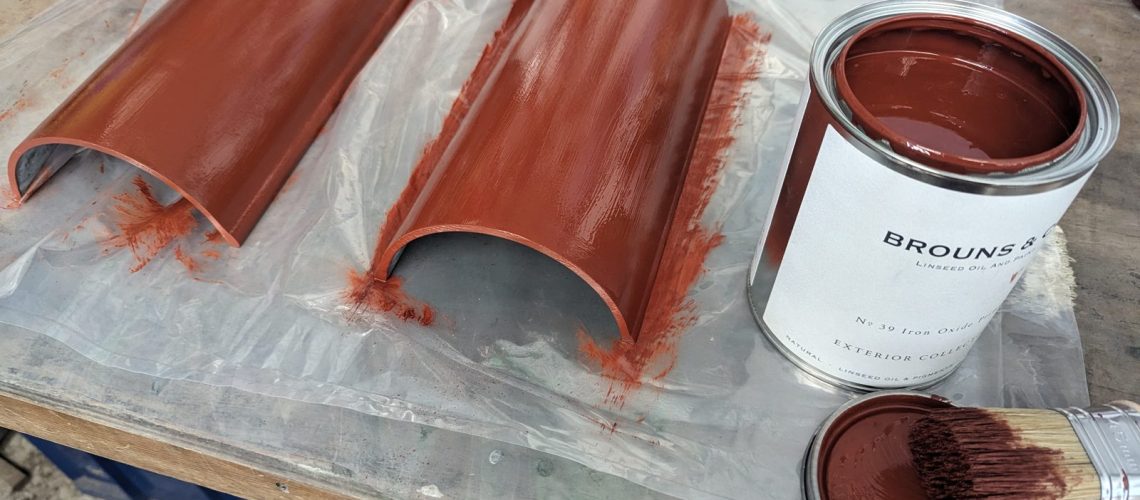
Linseed oil paint fails differently from modern coatings, and it is maintained differently too. This guide sets out realistic planning horizons for painted cast iron rainwater goods, what to inspect at each stage, and why the numbers on the page are planning tools rather than promises.
In short: Linseed oil paint on cast iron rainwater goods weathers by gradual surface erosion rather than by blistering and sheet delamination, which means it can usually be maintained by cleaning and recoating rather than by stripping back to bare metal. That characteristic is what makes long-term maintenance planning possible. The ten, twenty and thirty-year horizons used in this guide are planning stages for budgeting and access, not guaranteed service lives — actual performance depends on exposure, preparation, application, detailing, moisture, pollution, coastal conditions, mechanical damage and maintenance history. The single most important variable is not the paint. It is whether anyone looks at it. #LABEL# Contents #TOC# 1. What linseed oil paint is 2. Why it has been used on traditional buildings and architectural metalwork 3. How it differs from modern coating systems 4. Why the maintenance plan matters more than the product 5. Surface preparation: the stage that decides everything 6. Applying compatible coats correctly 7. Drying and curing 8. How colour, gloss and surface appearance change over time 9. Early signs that maintenance may be needed 10. Localised repair versus complete redecoration 11. The long-term planning framework 12. Inspection priorities and possible actions, stage by stage 13. What happens when gutters are neglected 14. Planning maintenance around access, scaffolding and other works 15. Record keeping 16. A practical inspection checklist 17. Buildings where painted cast iron has been maintained for generations 18. Frequently asked questions
Every conversation about coating life eventually arrives at the same question: how long will it last? It is a fair question and an unanswerable one, because the paint is only one of a dozen variables and rarely the decisive one. A linseed oil system on a sheltered south-facing gutter that is cleared every autumn and touched in when it needs it will outlast the same system on an exposed coastal elevation that nobody has looked at since the scaffold came down — by a margin that dwarfs any difference between products.
This article is written for owners of historic properties, conservation architects, building surveyors, estates and facilities managers, local authorities and contractors responsible for painted cast iron gutters, downpipes, hopper heads and related architectural metalwork. It sets out what linseed oil paint does over time, what to inspect and when, and how to build a maintenance plan around realistic planning horizons rather than around a warranty figure.
We supply linseed oil paint alongside our cast iron rainwater goods because it is the heritage-appropriate finish, and because it behaves in a way that suits a building maintained over centuries rather than replaced over decades. What follows is honest about its limits as well as its qualities.
1. What linseed oil paint is
Linseed oil paint is a traditional coating in which pigment is bound in linseed oil pressed from flax seed, and which cures by oxidation — reacting with oxygen in the air — rather than by the evaporation of a solvent. That single difference in chemistry accounts for most of its behaviour in service.
Because the binder is an oil rather than a resin dispersed in solvent, the paint penetrates into the surface of the metal and into any sound existing paint rather than sitting entirely on top of it as a discrete film. The cured coating remains comparatively flexible, and it is vapour-permeable — moisture can pass through it rather than being sealed beneath it. Pigmentation is typically with iron oxides, zinc oxide, earth pigments and other traditional colourants; the historic lead-based pigments that gave nineteenth-century linseed paints much of their performance are no longer generally available for this use.
Application characteristics differ too. Linseed oil paint is applied thinly and worked well in, and it covers a considerably greater area per litre than a modern film-forming paint. Applying it as though it were a modern gloss — thickly, to build a film — produces a coating that wrinkles as it cures and takes a very long time to harden.
2. Why it has been used on traditional buildings and architectural metalwork
Linseed oil paint was, for most of the period during which Britain’s historic cast iron rainwater goods were installed, simply what ironwork was painted with. Its continued use on historic buildings rests on authenticity, on compatibility with the substrate, and on maintainability.
The authenticity argument is straightforward: it is what was there. On a listed building, using a coating consistent with historic practice is generally the conservation-appropriate position, and conservation officers frequently expect it.
The technical arguments are more interesting. Cast iron rainwater goods sit in a permanently damp environment, wet inside and frequently wet behind. A vapour-permeable coating allows moisture that reaches the metal to escape rather than being trapped beneath an impermeable film, where it would drive corrosion and lift the coating from behind. A flexible coating accommodates the small dimensional movements of a component that heats in sun and chills at night.
And there is the maintenance argument, which is the subject of this article. A linseed system that has weathered can usually be cleaned down and recoated, with the new coat keying into and reviving what remains. That is a very different — and much cheaper — proposition from a modern system that has failed by delamination and must be stripped back to bare metal before anything can be done.
3. How it differs from modern coating systems
Linseed oil paint and modern coating systems fail in different ways, and it is the failure mode rather than any headline durability figure that determines maintenance cost over a building’s life. Neither is universally superior; they suit different situations.
| Characteristic | Linseed oil systems | Modern film-forming systems |
|---|---|---|
| Curing | By oxidation; continues to harden over an extended period | By solvent or water evaporation, and in two-pack systems by chemical reaction |
| Relationship to substrate | Penetrates the surface and sound existing coatings | Forms a discrete film adhering to the surface |
| Permeability | Vapour-permeable; moisture can escape | Generally low permeability; moisture may be trapped beneath |
| Typical failure mode | Gradual surface erosion, chalking and thinning, usually beginning on the most exposed faces | Blistering, cracking and sheet delamination, often with sound-looking paint over active corrosion |
| Typical remedial action | Clean down and recoat; localised repair is straightforward | Frequently requires stripping back to bare metal over the affected area |
| Film build | Thin coats, worked well in; high coverage per litre | Heavier films; specified dry film thickness |
| Appearance over time | Gloss falls gradually; colour softens; surface remains continuous | Holds gloss longer, then fails more abruptly |
Two points of accuracy are worth making. First, modern systems can and do perform extremely well, particularly in aggressive industrial and marine environments; the case for linseed oil on historic buildings is about compatibility, authenticity and maintainability, not about a blanket claim to superiority. Second, the protective coatings standard most often cited — BS EN ISO 12944 — is written for carbon and low-alloy steel structures of not less than 3 mm thickness, so cast iron is outside its stated scope. Its corrosivity categories, running from C1 in dry interiors to C5 in aggressive coastal and industrial atmospheres, remain a useful shared language for describing exposure, and this article uses them in that spirit rather than as a compliance claim.
4. Why the maintenance plan matters more than the product
The determining factor in how long a painted cast iron system lasts is whether it is inspected and maintained, not which paint was chosen. This is the least commercially convenient thing we could say, and it is the most useful.
Historic England’s guidance makes the point directly: lead and cast iron rainwater goods can, with appropriate maintenance and redecoration, last far longer than modern replacement materials. The conditional in that sentence is doing all the work. Historic Environment Scotland’s INFORM guide on maintaining cast iron rainwater goods recommends annual inspection, with additional checks during heavy rainfall when leaks become visible. SPAB’s advice is to clear fittings particularly after autumn leaf fall, and notes that periodic redecoration of ironwork is required to inhibit corrosion.
None of these is a demanding regime. An annual look, a clear-out after leaf fall, and a proper look during a downpour will identify almost everything before it becomes expensive. What actually happens on most buildings is that nothing is done until water appears on an internal wall, by which time the gutter has been failing for years and the masonry has been saturated for months.
5. Surface preparation: the stage that decides everything
Preparation determines the performance of the coating far more than the coating determines its own performance. This is true of every paint system and it is emphatically true of linseed oil, which relies on penetrating a sound, clean, dry surface.
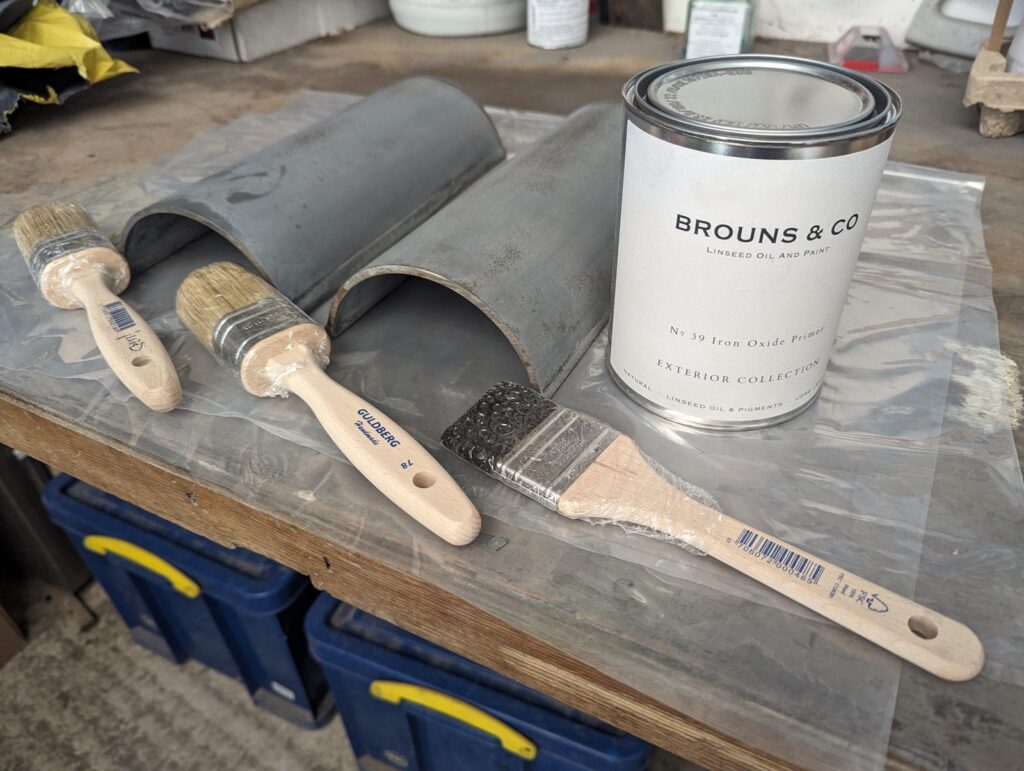
Removing loose or failed coatings
The objective is to remove everything unsound and retain everything sound — not to strip for the sake of stripping. SPAB’s guidance is to remove unsound old paint and rust; it does not say remove all paint. Sound, well-adhered historic coatings can often be retained and overcoated provided they are compatible with what is going on top, and retaining them preserves both fabric and evidence.
Where removal is necessary, the method should suit the component and its significance. Hand and mechanical preparation, careful abrasive methods, and chemical stripping all have their place; aggressive blasting can damage the crisp arrises and surface detail that give a heritage casting its character. Where components are removed for workshop treatment, controlled shot blasting to an appropriate standard is normally the most effective route. Preparation grades such as Sa 2½ for blast cleaning and St 3 for hand and power tool cleaning are defined in BS EN ISO 8501-1 — a standard written for steel substrates, but whose descriptions and reference photographs are the common professional vocabulary for describing prepared cast iron as well. Our guide to cleaning, stripping and preparing cast iron rainwater goods sets out the conservation-led approach.
Rust, moisture, contamination and defective joints
Four conditions will defeat any coating applied over them.
- Active rust must be removed, not painted over. Rust left beneath a coating continues to develop, expands, and lifts the paint from behind. Pitted areas need particular attention because corrosion product sits in the pits where a brush will not reach.
- Moisture. Linseed oil paint applied to damp metal will not cure properly. Cast iron rainwater goods hold moisture in joints, behind ears, inside sockets and on rear faces, and a component that looks dry on the visible face may not be.
- Contamination. Salts, algae, moss, bird droppings, old sealant residue and oily deposits all prevent adhesion and penetration. Washing down and allowing to dry thoroughly is not an optional preliminary.
- Defective joints. Painting over a joint that is open, displaced or full of failed mastic buys perhaps a season. Joints should be remade before decoration, not disguised by it.
Rear faces deserve their own mention. The back of a downpipe against a wall, the rear of a hopper and the outer face of a gutter behind a bracket are the surfaces that corrode first, dry slowest and are never seen. Wherever components are removed or newly installed, those faces should be fully prepared and coated before fixing. It is the single cheapest intervention available and the one most often skipped.
6. Applying compatible coats correctly
Compatibility between coats is not a refinement; it is the difference between a system that can be maintained and one that will have to be stripped. Establish what is already on the metal before deciding what goes on next.
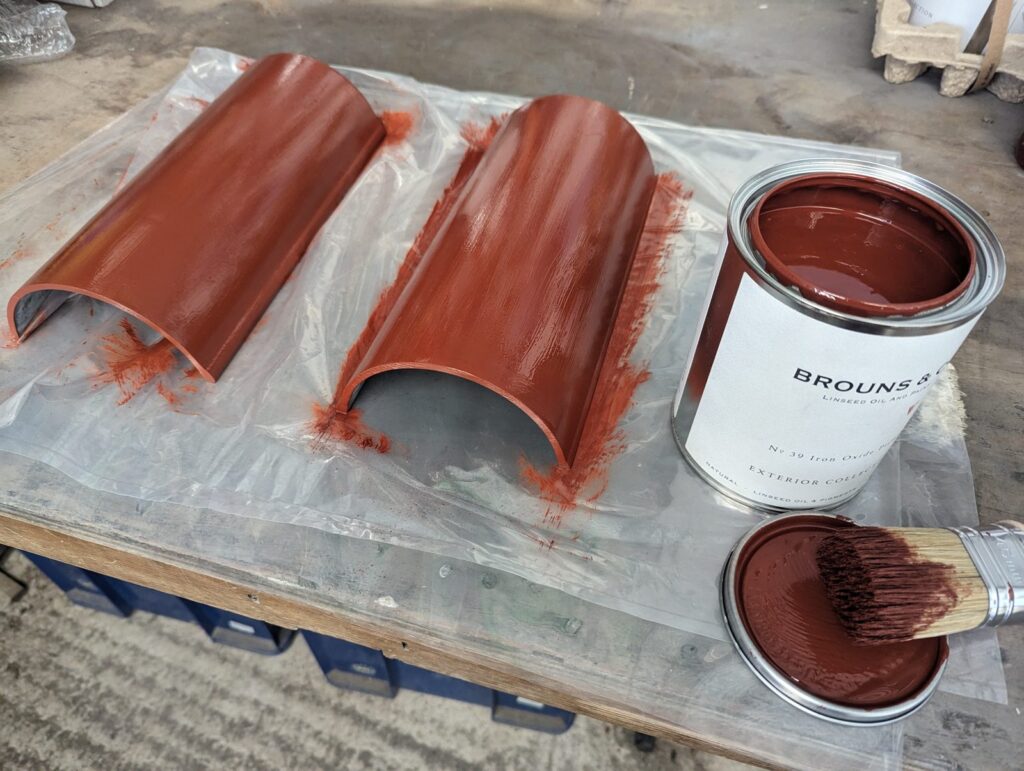
A linseed oil system applied over a residual modern epoxy or two-pack coating, or a modern system applied over a linseed one, is a common cause of early failure — adhesion is poor, the permeability mismatch traps moisture, and the two behave differently under thermal movement. Where existing components are being redecorated, the existing coating should be investigated and identified. Where it cannot be identified with confidence, a trial area is a sensible precaution.
Application itself follows the material’s requirements: thin coats, worked well in, applied to a sound dry surface, with each coat allowed to cure properly before the next. Coverage is high and the temptation to build film thickness should be resisted — a heavy coat of linseed oil paint wrinkles as it cures and remains soft for a very long time. Our specification for painting cast iron gutters and pipes using linseed oil paint sets out the build-up, and our heritage finish guide covers the practicalities.
Where components are being newly supplied, applying the finishing coats in the works gives better control of conditions and better access to rear faces than site application ever will. Site decoration then handles touching in after installation.
7. Drying and curing
Linseed oil paint dries slowly and cures over a much longer period still, and the distinction between the two matters when planning a programme. Touch-dry is not the same as ready for the next coat, and ready for the next coat is not the same as fully hardened.
Curing is an oxidation reaction, so it depends on air, temperature and humidity rather than on ventilation carrying solvent away. Cold, damp and still conditions slow it considerably; late autumn and winter application on an exposed elevation is asking for trouble. Direct strong sun on a dark colour can skin the surface before the coat beneath has cured, which causes wrinkling.
Practically, this means the painting programme should be planned into a suitable season, adequate intervals allowed between coats, and the finished work protected from rain, dust and contact until it has hardened. It also means that a newly painted system will remain vulnerable to mechanical damage — from scaffold boards, ladders and adjacent trades — for longer than a modern gloss would, and should be programmed accordingly.
8. How colour, gloss and surface appearance change over time
A linseed oil coating changes appearance gradually and predictably, and understanding the sequence prevents normal weathering being mistaken for failure.
The first change is usually a loss of gloss, beginning on the most exposed faces — south and west elevations, upper surfaces, and anything in full sun. The surface becomes progressively more matt while remaining continuous and protective. Colour softens: dark colours lighten slightly and lose depth, and some pigments shift more than others. Over a longer period the surface may begin to chalk, developing a fine powdery layer that transfers to the hand.
None of this is failure. A chalked, matt, softened coating is still doing its job, and it is precisely the condition in which a linseed system is easiest to clean down and recoat. The point at which intervention becomes necessary is when the coating begins to thin to the extent that the metal shows through on arrises and high points, or when localised breakdown exposes bare metal.
There is a practical consequence for appearance-sensitive buildings. Different elevations weather at different rates, so a building redecorated all at once will develop visible differences between elevations within a few years. On a building where uniformity matters, either accept that difference as normal or plan to redecorate the whole envelope together rather than elevation by elevation.
9. Early signs that maintenance may be needed
Most coating problems announce themselves well before they become expensive. The signs below, in roughly ascending order of urgency, are what an annual inspection is looking for.
- Loss of gloss and colour softening on exposed faces. Normal. Note it and monitor.
- Chalking. Normal at the appropriate stage. A signal that recoating will be needed within the planning horizon, not immediately.
- Thinning on arrises, mouldings and high points. The coating is wearing through where it is thinnest. This is the point at which localised recoating is cheap and effective.
- Isolated breakdown to bare metal. Usually at cut edges, drilled holes, fixing points, joints and mechanical damage. Treat promptly and locally.
- Rust staining running from a joint, ear or fixing. Indicates active corrosion behind or beneath the coating, and needs investigation rather than overpainting.
- Blistering or lifting. On a linseed system this generally indicates moisture beneath — often from a leaking joint, a blocked gutter, or an incompatible coating below.
- Water staining on the wall beneath a joint or hopper. The system is leaking. The paint is not the primary problem.
- Vegetation growing in a gutter. The gutter is holding soil and water and has been doing so for some time.
Our guide to cast iron corrosion protection covers the mechanisms behind several of these.
10. Localised repair versus complete redecoration
The great practical advantage of a linseed oil system is that localised repair is genuinely viable, which changes the economics of maintenance. Deciding between local and full redecoration is a judgement about extent, access and appearance.
Localised repair is appropriate where breakdown is confined to identifiable areas — cut edges, fixings, joints, a mechanically damaged section, one exposed elevation — while the remainder of the coating is sound and continuous. Prepare the affected area back to a sound edge, treat any corrosion, and build back up with compatible coats, feathering into the surrounding paintwork. On a linseed system the repair blends in as it weathers rather than remaining as a visible patch.
Full redecoration is appropriate where the coating has thinned generally across an elevation or the building, where colour or gloss variation has become visually unacceptable, where the system is being changed, or — often the deciding factor — where access has been provided for other works and the marginal cost of doing everything is small.
That last point deserves emphasis. On any building where access requires scaffold or a platform, access is usually the dominant cost, and it makes little sense to mobilise it for a patch repair. The strategic approach is to programme redecoration alongside roof works, masonry repairs, window overhaul or quinquennial inspection, and to accept a slightly earlier or later intervention in exchange for sharing the access.
11. The long-term planning framework
The stages below are planning horizons for budgeting, programming and access. They are not guaranteed service lives, and they are not a specification. A system on a sheltered inland elevation may run well beyond these intervals; one on an exposed coastal or heavily polluted site may need attention considerably sooner.
Before installation, or initial preparation
Everything that follows is set here. Components should be fully prepared, including rear faces and internal surfaces, and coated before fixing wherever possible. Joints should be made properly, cut edges dressed and primed, and the system tested and cleared of debris before handover. The colour reference, paint system and application record should be documented. Time and money spent at this stage is recovered several times over across the following decades; time saved here is borrowed at a high rate of interest.
Years 1 to 5
The settling-in period. The coating continues to cure and harden through the early part of it. Inspection is looking for defects arising from installation rather than from weathering: joints that have moved or begun to weep, fixings that have worked, mechanical damage from scaffold striking or subsequent trades, and any area missed during application. Gutters should be cleared annually, and after the first autumn in particular. Interventions in this period should be small, local and cheap — and finding them early is exactly the point.
Years 5 to 10
Weathering becomes visible. Gloss falls on exposed faces, colour begins to soften, and thinning may start to show on arrises and mouldings. Localised touching-in at cut edges, fixings and joints is typical. This is the period in which the maintenance regime either establishes itself or does not — a building inspected annually through years 5 to 10 will generally proceed smoothly for decades; a building left alone will start accumulating problems now that surface only much later.
Years 10 to 20
The first substantial redecoration commonly falls somewhere in this band, though the timing varies enormously with exposure. On a sound, maintained system this typically means washing down, spot preparation of localised breakdown, and one or more fresh coats over the retained sound coating rather than any stripping. It is the natural point to coordinate with other envelope works, and the first stage at which access costs are likely to dominate the decision. It is also the point at which any preparation shortcut taken at installation will make itself known.
Years 20 to 30
The system’s history determines what happens here. A well-maintained system may need no more than a second cycle of the same washing-down-and-recoating exercise. A neglected one will by now show general breakdown, active corrosion at joints and fixings, and possibly component failure — and the work becomes repair as much as decoration. This is also the stage at which accumulated coating build-up may need attention on components with fine detail, where successive layers begin to obscure mouldings and arrises.
Beyond 30 years
Cast iron rainwater goods are routinely still in service after a century and more, and there is no reason a maintained system should not continue indefinitely. Beyond thirty years the question is generally about the components rather than the coating: whether individual sections have corroded or cracked, whether joints and fixings remain sound, whether earlier repairs need undoing, and whether the accumulated paint layers should be removed and the system taken back to a fresh start. Where components do need replacing, matching the existing profile is normally the conservation expectation, and copy casting is the route where the profile is no longer available as stock. Bespoke and copy cast items typically require 12 to 14 weeks from pattern confirmation.
12. Inspection priorities and possible actions, stage by stage
The table below is indicative. It sets out what an inspection should concentrate on at each planning stage and the actions that commonly follow — not what will happen, and not a warranty of any kind.
| Stage | Inspection priorities | Possible actions |
|---|---|---|
| Before installation | Preparation of all faces including rear and internal; joint condition; cut edges primed; colour and system recorded | Works application of finishing coats; test and clear system; record the specification |
| Years 1–5 | Installation defects; weeping joints; worked fixings; mechanical damage; missed areas; debris | Annual clearing; localised touching-in; remake defective joints; correct damage from other trades |
| Years 5–10 | Gloss loss and colour softening on exposed faces; thinning on arrises; breakdown at cut edges and fixings | Continue annual clearing; localised preparation and recoating of affected areas; establish the record |
| Years 10–20 | General coating condition by elevation; extent of thinning; corrosion at joints, ears and fixings; bracket condition | Wash down, spot-prepare, recoat over retained sound coating; coordinate with other envelope works |
| Years 20–30 | Extent of general breakdown; active corrosion; component integrity; accumulated paint build-up on detail | Second recoating cycle, or repair-led work where maintenance has lapsed; consider removing built-up layers on fine detail |
| Beyond 30 years | Component condition rather than coating; cracks, perforation, failed joints, earlier repairs; profile availability | Repair or selective replacement; copy casting where the profile is obsolete; potential full strip and recoat |
13. What happens when gutters are neglected
A neglected rainwater system does not fail politely. It transfers its problem to the building fabric, where the cost is an order of magnitude higher than the maintenance that would have prevented it.
The sequence is consistent. Debris accumulates and the gutter holds water. Standing water corrodes the gutter from the inside, where nothing is visible from the ground. Joints open under ice and load. The run deflects, losing its fall, which increases the standing water. Water then discharges continuously onto the wall below — not in a storm, but every time it rains. Masonry saturates, and stays saturated through the winter. Where the wall is a soft or vulnerable stone, decay accelerates markedly; where there is timber at the eaves or embedded in the wall, decay begins. Internally, damp appears on the wall, usually long after the external cause has been established.
BS 7913 lists blocked rainwater goods and drainage systems among the common defects of historic buildings, and advises that a broken or decayed gutter should be repaired before repairs to internal finishes are carried out — advice which is regularly reversed on site, with predictable results. We set out the mechanism in more detail in our guide to how blocked rainwater systems damage historic buildings.
The economic point is simple. Clearing gutters annually and touching in paintwork occasionally is inexpensive. Repairing saturated masonry, replacing decayed timber and drying out an interior is not.
14. Planning maintenance around access, scaffolding and other works
On most buildings, access costs more than the work. A maintenance plan that ignores this will be uneconomic no matter how technically sound it is.
The practical consequences:
- Bundle the work. Programme rainwater goods redecoration alongside roof repairs, masonry work, window overhaul, or any other envelope project that requires access. Bringing forward or deferring a redecoration by two or three years to share a scaffold is almost always the right economic decision.
- Do everything while access exists. If the scaffold is up, deal with the rear faces, the awkward corners, the hopper interiors and the high-level joints — the surfaces that will otherwise be untouched until the next scaffold.
- Inspect from access when you have it. Any scaffold or platform on a building is an opportunity to record the condition of the whole rainwater system properly, not just the part being worked on.
- Design for maintenance where you can. Reachable pipe heads, hoppers where a blockage will announce itself, access fittings at the base of long drops, and safe ladder positions all reduce the number of occasions on which full access is needed. We discuss this in our guide to maintaining cast iron drainage on historic buildings.
- Programme for the season. Linseed oil paint needs suitable conditions to cure, and an autumn or winter application on an exposed elevation will not perform. Fixing scaffold dates without considering this is a common false economy.
For churches and other buildings subject to periodic inspection regimes, the quinquennial cycle provides a natural framework, and rainwater goods should be a standing item within it rather than an incidental observation.
15. Record keeping
A maintenance record is what turns a series of individual jobs into a maintenance strategy, and its absence is why so many buildings are redecorated in the wrong colour with an incompatible system. It costs nothing to keep.
What to record, each time work is carried out:
- Date of the work, and the weather conditions during application
- Extent — which elevations, which runs, which components; full redecoration or localised repair
- Preparation method used, and the condition found beneath
- Products — the paint system, primer, number of coats, and the manufacturer
- Colour — the reference number and the system it belongs to, since “black” recorded alone is no record at all
- Contractor and, where relevant, the specifier
- Defects found and what was done about them, including anything deferred
- Photographs, particularly of anything unusual and of components that were removed
- Components replaced, with the profile, size and source, and whether patterns were made
Where copy casting has been carried out, note it prominently. Knowing that a pattern already exists for a particular profile can save a great deal of time and cost when the next section fails, and that knowledge is otherwise lost with the individuals involved.
16. A practical inspection checklist
Use this as an annual walk-round, with a supplementary look during heavy rain. Most of it can be done from the ground with binoculars; anything that cannot be seen properly should be noted for inspection when access is next available.
Paint breakdown
Loss of gloss and colour by elevation; chalking; thinning on arrises, mouldings and high points; localised breakdown to bare metal; blistering or lifting; any patch repairs from previous cycles and how they are performing.
Rust
Surface rust and its extent; rust staining running from joints, ears and fixings; pitting; perforation, particularly on rear faces and the underside of gutters; any area where rust is developing beneath apparently sound paint.
Joints
Open, displaced or weeping joints; failed or repeatedly renewed mastic; joints that fall between distant brackets; staining on the wall directly beneath a joint.
Brackets and fixings
Loose, corroded, missing or replaced brackets; fixings that have worked out or split the substrate; decay in the fascia, soffit or rafter feet a bracket fixes into; any evidence of dissimilar metals in contact.
Gutters and outlets
Debris, silt, moss and vegetation; standing water and where it stands; level or reverse falls; deflection between brackets; obstructed outlets; evidence of overflowing at any point along the run.
Hopper heads
Debris and blockage; corrosion at the base and in the corners; condition of decorative detail and any date or armorial panel; staining beneath, indicating overflow; whether the head of the downpipe can be reached to clear it.
Downpipe shoes
Discharge falling clear of the wall base; gap between shoe and gully or channel; blockage at low level; splashing back onto the plinth; condition of the shoe itself, which is vulnerable to impact.
Water staining
Staining, algae or moss on the wall face; saturated masonry, particularly below joints, hoppers and outlets; efflorescence; decay in stone or brick beneath a persistent discharge; internal damp on walls that correspond to external rainwater goods.
Plant growth and blockages
Vegetation in gutters, hoppers or at the head of downpipes; moss on roof coverings washing into the gutter; overhanging trees and the volume of leaf loading they produce; nesting material.
Damage from ladders, scaffolding or adjacent works
Impact damage, dents and cracks; paint damage at ladder contact points; components displaced or pulled by scaffold ties; mortar splash and staining from adjacent masonry work; anything altered since the last inspection.
17. Buildings where painted cast iron has been maintained for generations
The buildings below illustrate the range of exposure conditions that painted cast iron has to survive, and the maintenance regimes that follow from them. They are given as representative examples rather than as project references.
The Iron Bridge, Shropshire
Grade I listed, a Scheduled Monument and part of the Ironbridge Gorge World Heritage Site, Abraham Darby III’s bridge of 1779 is the most closely watched piece of architectural cast iron in Britain. It demonstrates the central principle of this article at the largest scale: the material’s longevity is a function of sustained inspection and recoating rather than of any single treatment. Its protection has been repeatedly renewed across two and a half centuries, and the colour it carries has itself been the subject of research into the original finish.
Pontcysyllte Aqueduct, Wrexham
Grade I listed and a World Heritage Site, Thomas Telford and William Jessop’s aqueduct of 1805 carries a cast iron trough 38 metres above the Dee valley. Exposure here is severe and permanent — wind, driven rain and continuous contact with water — and the maintenance regime reflects it. It illustrates the point that exposure, not product, sets the cycle: the same coating on a sheltered inland elevation would be inspected on a very different rhythm. In Wales, works of this kind sit within the Cadw and Welsh planning framework.
Royal Albert Dock, Liverpool
Grade I listed and within the historic city’s dockland, Jesse Hartley’s warehouses of 1846 present the estuarine exposure problem: salt-laden air, driving weather off the Mersey, and vast quantities of cast iron in the colonnade and in the buildings’ rainwater goods. Coastal and estuarine sites belong at the aggressive end of any corrosivity scale, and maintenance intervals on such buildings are properly shorter than the planning stages set out above, particularly on the weather elevations.
Kibble Palace, Glasgow Botanic Gardens
Category A listed, the glasshouse of 1873 relocated from Coulport is a structure in which painted ironwork is the building. Its major restoration in the present century involved dismantling, blast cleaning and recoating on a scale that few buildings ever require, and it illustrates the far end of the maintenance spectrum: what happens when a system reaches the point at which localised repair is no longer viable, and the accumulated legacy of a century has to be dealt with in one operation.
The Circus, Bath
Grade I listed and within the City of Bath World Heritage Site, John Wood the Elder’s circus of 1754 to 1768 is a building where rainwater goods are subordinate to a townscape composition of extraordinary uniformity. Maintenance here is as much about consistency as about protection: thirty-three houses in separate ownership, redecorated at different times by different contractors, will drift apart in colour and gloss unless the colour reference and paint system are recorded and adhered to. It is the strongest possible argument for record keeping.
18. Frequently asked questions
How long does linseed oil paint last on cast iron guttering?
There is no fixed figure, and we would not offer one. Performance depends on exposure, the quality of surface preparation, how it was applied, the detailing, how much moisture the component sits in, pollution and coastal conditions, mechanical damage, and above all the maintenance history. The ten, twenty and thirty-year stages used in maintenance planning are horizons for budgeting and access, not guaranteed service lives.
How often should painted cast iron rainwater goods be inspected?
Annually is the widely recommended interval — Historic Environment Scotland’s guidance recommends an annual inspection, with additional checks during heavy rainfall when leaks become visible. SPAB advises clearing fittings particularly after autumn leaf fall. On buildings subject to a quinquennial inspection regime, rainwater goods should be a standing item rather than an incidental observation.
Is linseed oil paint better than modern paint for cast iron?
It is better suited to historic buildings, which is not the same thing. Its advantages there are authenticity, vapour permeability, flexibility, and — critically — that it fails by gradual surface erosion rather than by sheet delamination, so it can usually be maintained by cleaning down and recoating rather than by stripping to bare metal. Modern systems can perform extremely well, particularly in aggressive industrial and marine environments.
Can linseed oil paint be applied over existing modern paint?
Not reliably, and it is a common cause of early failure. A linseed system over a residual modern epoxy or two-pack coating adheres poorly, cannot penetrate, and creates a permeability mismatch that traps moisture. Establish what is already on the metal before specifying what goes on next, and where the existing coating cannot be identified with confidence, carry out a trial area first.
What does chalking on linseed oil paint mean?
Chalking is the development of a fine powdery layer on the surface, and on a linseed system at the appropriate stage it is normal weathering rather than failure. A chalked, matt coating is still continuous and still protective. It signals that recoating will be needed within the planning horizon, and it is in fact the condition in which cleaning down and recoating is most straightforward.
Do I need to strip cast iron guttering back to bare metal before repainting?
Usually not, if the existing coating is a sound linseed system. The objective is to remove everything unsound and retain everything sound — SPAB’s guidance is to remove unsound old paint and rust, not all paint. Full stripping becomes necessary where the coating has failed generally, where incompatible layers are present, or where accumulated build-up is obscuring moulded detail.
When is a localised repair enough, and when is full redecoration needed?
Localised repair suits breakdown confined to identifiable areas — cut edges, fixings, joints, one exposed elevation — with the rest of the coating sound. Full redecoration suits general thinning, unacceptable colour or gloss variation, a change of system, or the situation where access has been provided for other works and the marginal cost of doing everything is small. On most buildings, access cost decides it.
Why does the back of my downpipe rust when the front looks fine?
Because the rear face sits closest to the wall, dries slowest, is never seen and is rarely painted. It is the most consistent failure point on cast iron rainwater goods. Wherever components are removed or newly installed, prepare and coat the rear faces fully before fixing, and consider fixing pipes on distance holderbats so the back can be reached at future redecorations.
What time of year should cast iron rainwater goods be painted?
In conditions that allow the coating to cure. Linseed oil paint cures by oxidation, and cold, damp, still weather slows it considerably — late autumn and winter application on an exposed elevation should be avoided. Very strong direct sun on a dark colour can also cause problems by skinning the surface before the coat beneath has cured. Programme the scaffold dates accordingly.
Will different elevations weather at different rates?
Yes, noticeably. South and west elevations, upper surfaces and anything in full sun lose gloss and colour faster than sheltered north elevations. On a building where uniformity matters, plan to redecorate the whole envelope together rather than elevation by elevation, and accept that some difference between elevations is normal weathering rather than a defect.
What should I keep a record of after painting?
The date and weather conditions, the extent of the work, the preparation method and what was found beneath, the paint system and number of coats, the colour reference and the system it belongs to, the contractor, defects found and anything deferred, photographs, and details of any components replaced or patterns made. “Black” recorded on its own is not a record; a colour reference with its system is.
What happens if cast iron gutters are simply left alone?
Debris accumulates, water stands, the gutter corrodes from the inside where nothing is visible, joints open under ice and load, the run deflects and loses its fall, and water then discharges onto the wall every time it rains rather than only in storms. Masonry saturates through the winter, timber decays, and internal damp appears long after the external cause was established. The repair cost is an order of magnitude above the maintenance cost.
19. Maintenance as a plan, not an event
The value of thinking in ten, twenty and thirty-year horizons is not that the numbers are accurate — they are not, and no honest supplier will tell you otherwise. The value is that they turn maintenance into something that can be budgeted, programmed and coordinated with other works, rather than something that happens when water appears on a wall.
The practical version is short. Prepare properly, including the faces nobody will see again. Record what was used and in what colour. Look at the system once a year and again in a downpour. Clear it after leaf fall. Deal with small breakdowns locally while they are small. Bundle the bigger work with whatever else needs access. Do that, and painted cast iron rainwater goods will outlast most of what is around them — as a great many of them already have.
We supply cast iron gutters, downpipes, hopper heads and fittings together with linseed oil paints and heritage finishes, including traditional linseed oil colours developed for historic buildings. We can advise on preparation, on compatibility with an existing coating, on colour matching, and on repair or replacement where components have reached the end of their life — including copy casting of obsolete profiles at a typical lead time of 12 to 14 weeks. We do not claim that any finish will last a fixed number of years, because that depends on the building rather than on the tin. To discuss a maintenance programme, call 0333 987 4452 or contact us.