Established 1893 | BS 460:2002 Certified | UK & International Supply | Expert Technical Support | 0333 987 4452
More historic building fabric is lost to water damage from failed or neglected drainage than to any other single cause. A blocked gutter, a split downpipe, or an overflowing hopper head — each is a small failure with potentially catastrophic consequences: saturated masonry, eroded lime mortar, wet rot in structural timbers, and the progressive deterioration of irreplaceable historic fabric that is enormously expensive and sometimes impossible to reverse. Yet of all the maintenance obligations that come with owning or managing a listed building, drainage is frequently the most neglected.
We have supplied cast iron rainwater systems to heritage buildings since 1893. We know from the enquiries we receive that a large proportion of the projects we are asked to assist with could have been avoided entirely by more consistent maintenance of the existing system. Cast iron, when properly maintained, has a service life well in excess of 100 years. This guide sets out the practical framework for maintaining cast iron drainage on historic and listed buildings.
By the mid-Victorian period, cast iron had become the dominant material for gutters, downpipes, hopper heads, and soil stacks across the UK’s building stock. It is important to distinguish between rainwater systems — comprising gutters, hopper heads, and downpipes — and soil drainage, which collects domestic wastewater. Both are found on historic buildings in cast iron, and both require specialist attention. Cast iron is a brittle material with high compressive strength but poor tensile elasticity. Unlike wrought iron, it cannot absorb bending or impact forces — it fractures suddenly.
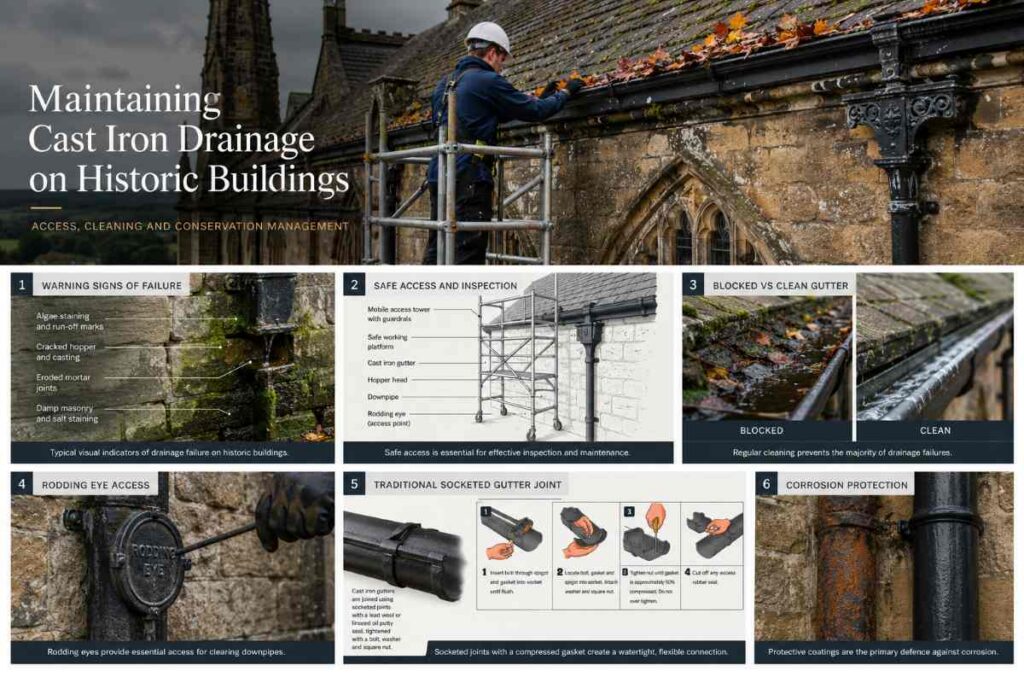
A twice-yearly inspection regime — in late autumn after leaf fall, and in early spring following the freeze-thaw cycle — is the minimum we recommend. The most telling diagnostic signs of drainage failure are visible from ground level: green algae staining or dark tide-marks on masonry below a downpipe indicate a split or leaking joint. Eroded mortar joints and persistently damp masonry suggest overflowing gutters. Blistering paintwork at joints indicates water entrapment and early oxidation. Rot in adjacent timber fascias indicates water is bypassing the gutter entirely.
Internally, persistent dampness or mould on internal wall finishes may indicate a leaking soil stack. A hand mirror is invaluable for inspecting the rear of vertical downpipes and hopper heads, where frost splits are most likely to begin and most easily missed.
The standard for access points requires rodding eyes or inspection hatches at every change of direction exceeding 45 degrees, at every branch junction, and at regular intervals — with a maximum of 22 metres between access points on underground lines. Access points must never be sealed over by hard landscaping, concrete, or plasterwork. Safe physical access to gutters requires appropriate scaffolding or access platforms — cast iron gutters are not designed to bear significant point loads from ladders.
External rainwater blockages arise almost entirely from organic accumulation: fallen leaves and twigs, moss, windborne seeds, and bird nesting material. Wire balloon guards in downpipe tops prevent leaves and nesting material from entering the vertical stack. In soil and waste pipes, nearly 80 per cent of blockages are caused by disposal of non-flushable materials or the buildup of solidified cooking fat.
For routine blockage clearing in historic cast iron drainage, manual rodding is the safest and most appropriate method. Jointed rods fitted with plunger, scraper, or corkscrew attachments exert minimal mechanical force on the pipe walls and joints. Rodding should always be carried out in the direction of hydraulic flow wherever access allows — rodding against the flow risks compacting the obstruction or forcing waste backward through domestic fixtures.
High-pressure hydro jetting is the method most likely to cause serious and irreversible damage to historic cast iron. The internal bore of a cast iron pipe that has been in service for decades is frequently reinforced by a continuous crust of mineral scale and oxidised iron. This scale provides genuine structural support to metal walls that have thinned over time. High-pressure water streams strip this scale away, potentially exposing paper-thin sections or triggering joint separation and structural collapse. A full CCTV inspection must be completed before jetting is considered.
The correct protocol for removing mature ivy, buddleia, or valerian is to cut the stem at its base, apply a systemic herbicide, and leave the treated plant completely undisturbed for several weeks. As the root system dies naturally, it shrinks and loosens its grip, and can then be cleared without damage to the historic fabric.
Rainwater gutter joints in historic cast iron systems were traditionally assembled using linseed oil putty, with sections fastened by bolts, nuts, and rubber washers. This remains the correct conservation method today. We specifically recommend linseed oil putty compatible with the original assembly method rather than modern silicone sealants, which are not sympathetic to historic ironwork and can cause long-term joint bonding problems.
For cast iron soil pipe joints assembled by the traditional lead and oakum caulking method, repair requires the same craft technique: tarred oakum packed tightly into the annular joint space to a depth of one inch below the socket rim, followed by a single clean pour of molten lead, caulked cold to form a permanent watertight compression fit. On-site welding of cast iron should never be attempted — the localised heat of arc welding induces thermal shock in the brittle material, generating internal stresses that create new and worse cracks.
The protective paint system is the primary barrier between the iron and the atmosphere. A proactive redecorating cycle of every 3-4 years is far less expensive than the remediation of advanced corrosion. The iron must be clean, dry, and entirely free of grease, loose paint, and active rust before any primer is applied. Minor surface corrosion can be removed with hand scrapers, sandpaper, or bronze wire brushes — never power tools, which risk fracturing brittle iron.
For listed buildings, we particularly recommend the use of traditional linseed oil paint as a finish system. Unlike synthetic coatings that form a surface film, linseed oil paint penetrates the pores of the iron, cures by oxidative polymerisation, and remains flexible throughout its service life. It expands and contracts with thermal movement, making it significantly less prone to the cracking and delamination that afflicts harder synthetic finishes on the external ironwork of historic buildings. For modern multi-coat systems, a zinc-rich primer provides galvanic protection; a micaceous iron oxide intermediate coat forms a barrier against moisture and UV; and two high-gloss topcoats provide the finished surface.
Under the Planning (Listed Buildings and Conservation Areas) Act 1990, routine maintenance — clearing gutters, resealing joints, painting — does not generally require formal Listed Building Consent. But replacing any section of drainage, even like-for-like in matching cast iron, is classed as an alteration and typically requires LBC. Altering the routing of a downpipe, changing a profile, or installing a new inspection hatch on a soil stack all require consent. Unauthorised works carry criminal liability and may require complete reinstatement at the owner’s expense.
Where replacement is required and approved, conservation guidelines mandate matching the original component in material, dimension, profile, and style. Our copy casting and bespoke casting service allows us to replicate any historic profile from drawings, photographs, or physical samples, with lead times of 8-10 weeks. Cast iron is classified as a non-combustible material under BS EN 877, achieving an A2-s1, d0 fire rating. Where soil pipes pass through fire-separating floors or walls, cast iron maintains compartment integrity without mechanical fire collars.
We have been supplying authentic sand-cast iron rainwater goods to heritage and listed buildings since 1893 — long enough to understand that the buildings we supply are not simply construction projects, but living responsibilities. Maintenance matters as much as the original specification, and we are committed to supporting conservation professionals, building surveyors, and heritage contractors throughout the entire lifecycle of a cast iron drainage system. Whether you need standard cast iron gutter profiles for a like-for-like replacement, a copy casting of a unique historic profile, or advice on paint systems and jointing materials, we can assist. Standard stock items are available for prompt despatch; bespoke and copy-cast components carry a lead time of 8-10 weeks. To discuss your project, please contact us on 0333 987 4452 or visit tuscanfoundry.com/contact.
A twice-yearly inspection is the minimum we recommend — once in late autumn after leaf fall, and again in early spring following the freeze-thaw cycle.
Green algae staining or dark tide-marks on masonry below a downpipe usually indicate a split or leaking joint. Eroded mortar joints and persistently damp masonry point to overflowing gutters, blistering paintwork at joints suggests water entrapment and early oxidation, and rot in adjacent timber fascias means water is bypassing the gutter entirely.
The standard requires rodding eyes or inspection hatches at every change of direction exceeding 45 degrees, at every branch junction, and at regular intervals, with a maximum of 22 metres between access points on underground lines. These must never be sealed over by hard landscaping, concrete or plasterwork.
No. High-pressure hydro jetting is the method most likely to cause serious and irreversible damage to historic cast iron, since it can strip away the internal scale that is often providing genuine structural support to thinned pipe walls. A full CCTV inspection should always be completed before jetting is even considered.
Manual rodding is the safest and most appropriate first-line method. Jointed rods fitted with plunger, scraper or corkscrew attachments exert minimal mechanical force on the pipe walls and joints, and rodding should always be carried out in the direction of hydraulic flow.
Cut the stem at its base, apply a systemic herbicide, and leave the treated plant undisturbed for several weeks. As the root system dies naturally it shrinks and loosens its grip, so it can then be cleared without damage to the historic fabric.
Traditional linseed oil putty, matching the original assembly method, rather than modern silicone sealants — silicone is not sympathetic to historic ironwork and can cause long-term joint bonding problems.
Cast iron, when properly maintained, has a service life well in excess of 100 years.