
How to Measure a Cast Iron Downpipe Offset
An offset carries a downpipe out from the wall, or across it, to clear something in its path. There are two kinds: standard offsets (112.5°) for most situations, and plinth offsets (135°) for shallow plinths where height is limited. Both are ordered by one measurement, the projection. This guide explains how to take it and which sizes we offer in each range.
In summary
Projection is the distance between the centre line of the pipe above the offset and the centre line of the pipe below it. It is not measured face to face, and it is not the overall width of the fitting. It is measured the same way for standard and plinth offsets. Choose a standard offset for most runs, and a plinth offset where a shallow plinth leaves little height to step out.
On this page
What projection means
Every offset has two vertical runs joined by an angled section. The projection is the distance between the centre lines of those two runs. Because it is taken centre to centre, it is the same whatever the pipe size: a 115mm projection offset moves a 65mm pipe and a 100mm pipe by the same amount.
How to measure on site
- Above the obstruction, measure from the wall face to the centre of the pipe. If the pipe is not yet fitted, use the planned position: the wall face plus the bracket or ear stand-off plus half the pipe width.
- Below the obstruction, measure from the same wall face to where the centre of the lower pipe needs to sit. Allow clearance in front of the obstruction, plus room for fixings.
- Subtract the first figure from the second. The difference is the projection you need.
- Check the height available. The angled section takes up height as well as projection. Make sure the offset fits between the obstruction and the joint above, and allow for it when setting out pipe lengths. If height is tight, a plinth offset may be the better choice.
Standard offsets (112.5°)
Standard offsets have a shallow angled section and cover the full range of projections, from 56mm up to 610mm. Use them to step a pipe out over a string course, band or cornice, to bring it in from an overhanging gutter outlet, or to move it across the wall face.
Round and square offsets step the pipe away from the wall. Rectangular pipe has two versions: a front offset, which steps away from the wall, and a side offset, which steps sideways along the wall face. Side offsets are handed, so state left or right hand when ordering.
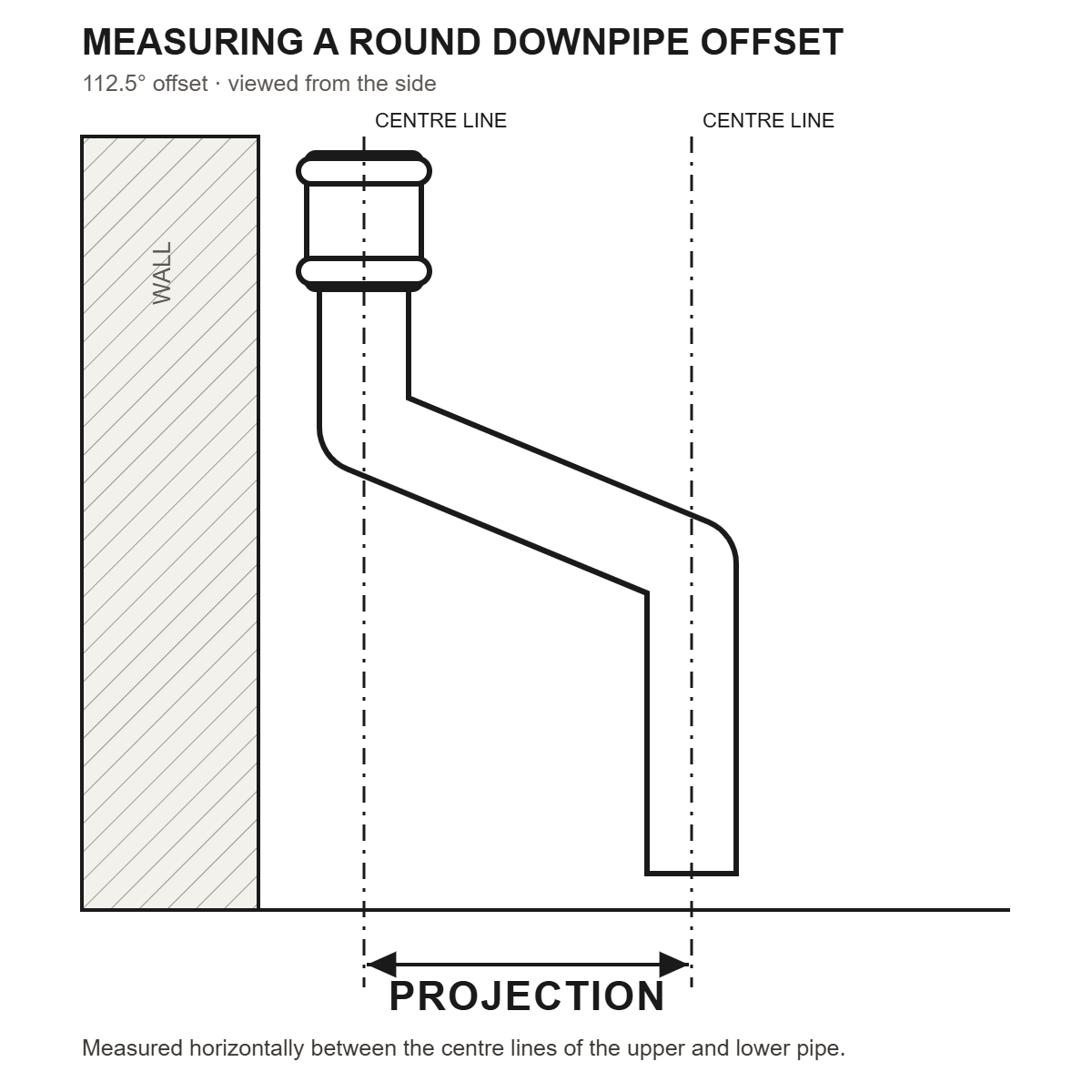
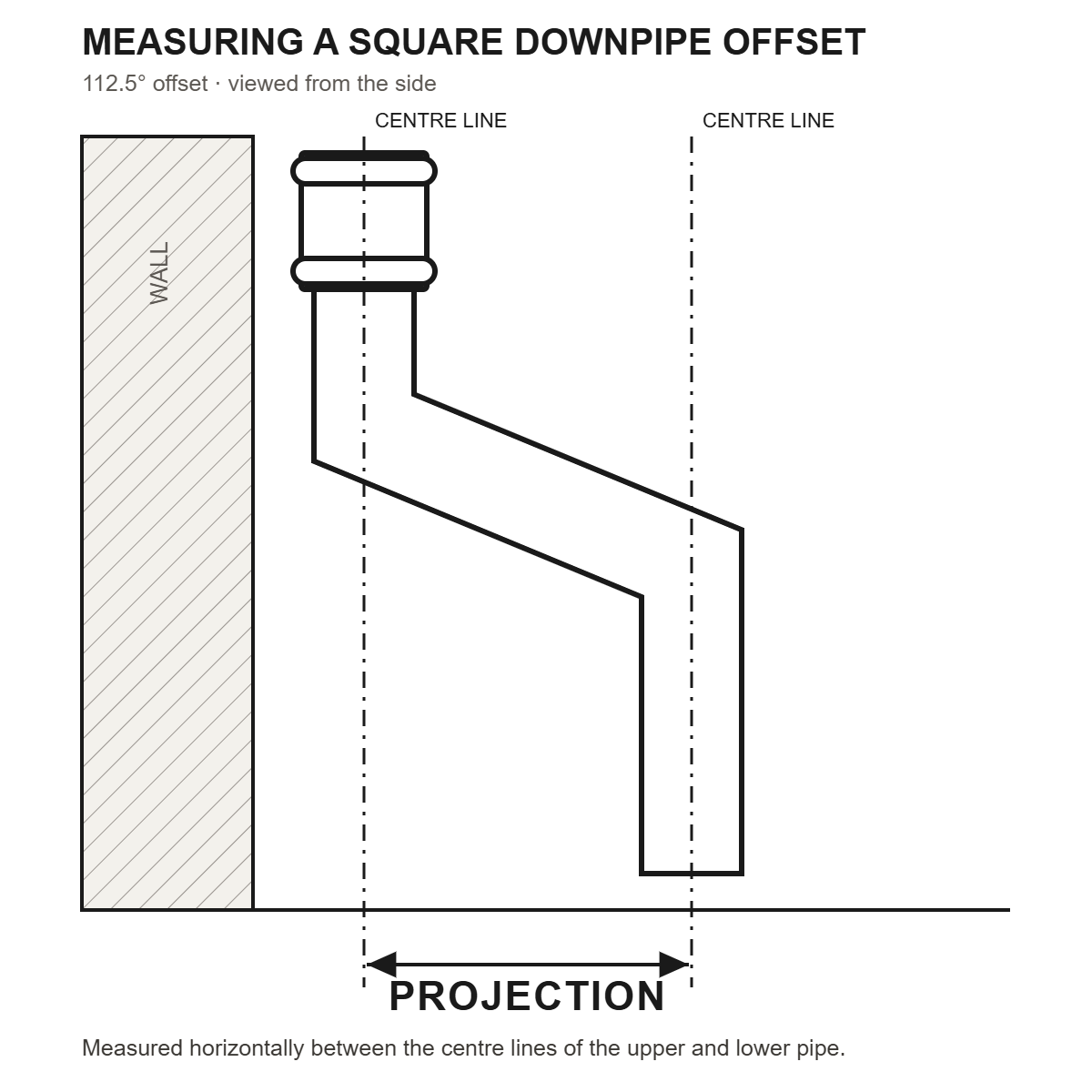
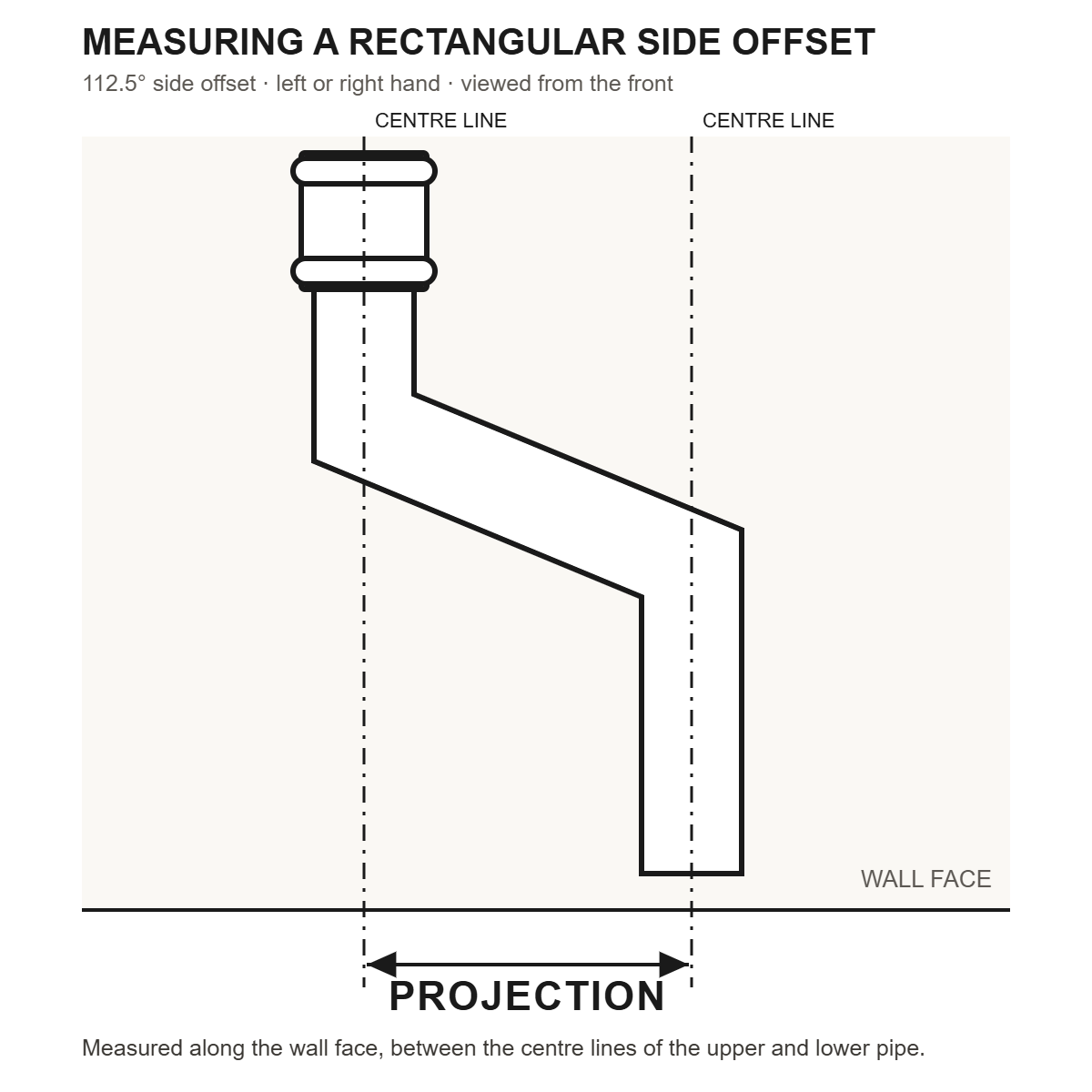
Worked example: standard offset
Above a string course, the pipe centre sits 90mm from the wall face. Below it, the pipe needs to sit with its centre 205mm from the same wall face to clear the course. 205mm minus 90mm gives a projection of 115mm, so a 115mm (4½″) standard offset is the one to order.
Standard offset sizes. All are available in primer or factory black, eared or plain. Imperial equivalents are nominal.
| Range and pipe size | Offset | Standard projections |
|---|---|---|
| Round 65mm, 75mm, 100mm | 112.5° offset | 75mm (3″), 115mm (4½″), 150mm (6″), 230mm (9″), 305mm (12″), 380mm (15″), 457mm (18″), 533mm (21″), 610mm (24″) |
| Square 75 x 75mm, 100 x 100mm | 112.5° offset | 56mm (2¼″), 75mm, 115mm, 150mm, 230mm, 305mm, 380mm, 457mm, 533mm, 610mm |
| Rectangular 100 x 75, 125 x 70, 125 x 100, 150 x 100mm | 112.5° front offset | 56mm, 75mm, 115mm, 150mm, 230mm, 305mm, 380mm, 457mm, 533mm, 610mm |
| Rectangular 100 x 75, 125 x 70, 125 x 100, 150 x 100mm | 112.5° side offset, left or right hand | 56mm, 75mm, 115mm, 150mm, 230mm, 305mm, 380mm, 457mm, 533mm, 610mm |
Plinth offsets (135°)
Plinth offsets have steeper bends, so they step the pipe out in less height than a standard offset of the same projection. They are made for the short step over a plinth at the foot of a wall, where the pipe needs to clear the plinth and reach the shoe or drain with little height to spare. They come in 75, 115 and 150mm projections, for square and rectangular pipe.
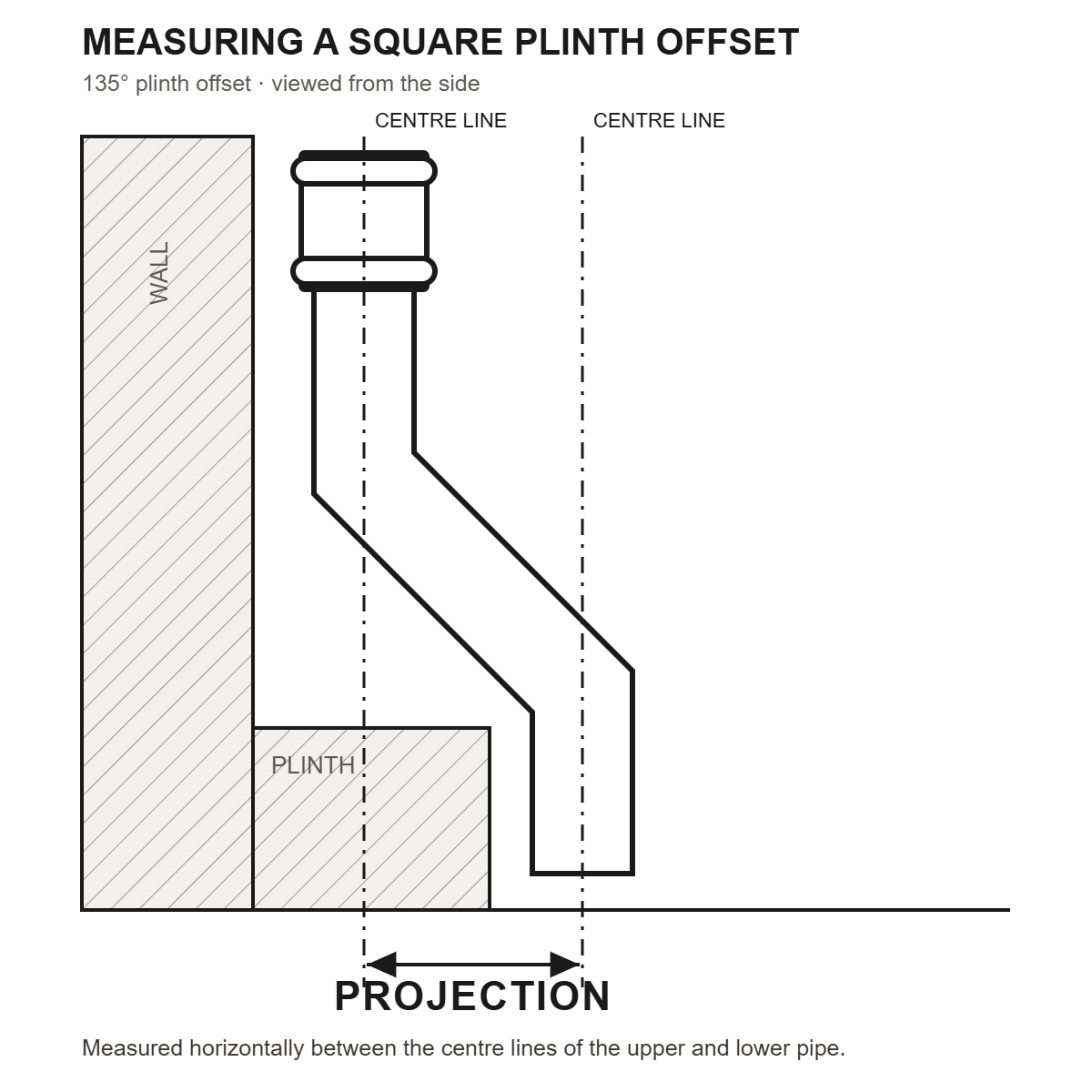
Worked example: plinth offset
Above the plinth, the pipe centre sits 80mm from the wall face. The plinth projects 60mm, and the lower pipe needs its centre 155mm from the wall face to clear it. 155mm minus 80mm gives a projection of 75mm, so a 75mm plinth offset is the one to order.
Plinth offset sizes. All are available in primer or factory black, eared or plain.
| Range and pipe size | Offset | Standard projections |
|---|---|---|
| Square 75 x 75mm, 100 x 100mm | 135° plinth offset | 75mm (3″), 115mm (4½″), 150mm (6″) |
| Rectangular 100 x 75, 125 x 70, 125 x 100, 150 x 100mm | 135° plinth offset | 75mm (3″), 115mm (4½″), 150mm (6″) |
For round pipe, use a standard offset; there is no 135° plinth offset in the round range.
If your measurement falls between sizes
A few millimetres can often be taken up at the fixings, by adjusting the stand-off of the brackets or ears on the upper or lower run. Where the difference is larger, or the obstruction is unusual, a bespoke offset can be cast to suit. Bespoke castings typically take 12 to 14 weeks from pattern approval. Send us your measurements and a photograph and we will advise on the best option.
Frequently asked questions
How is the projection of a downpipe offset measured?
Between the centre line of the pipe above the offset and the centre line of the pipe below it, horizontally for front offsets and along the wall face for side offsets. It is not measured from face to face or across the overall width of the fitting.
Does the pipe size change the projection I need?
No. Because projection is measured centre to centre, the same projection moves any size of pipe out by the same distance. You still need to order the offset in the pipe size you are using.
What is the difference between a standard offset and a plinth offset?
A standard offset has 112.5° bends, a shallow angled section and projections from 56mm to 610mm. A plinth offset has 135° bends, so it steps out in less height, and comes in 75, 115 and 150mm projections for clearing a shallow plinth.
How do I tell a left hand side offset from a right hand one?
Stand facing the wall and note which way the pipe needs to step as it runs down. If you are unsure, send us a photograph and we will confirm the hand before you order.
Are eared and plain offsets measured the same way?
Yes. Ears are fixing lugs and do not change the projection. Choose eared where the offset needs fixing to the wall, and plain where it sits between fixed lengths.
What if the projection I need is not a standard size?
Small differences can usually be taken up at the fixings. For larger differences we can cast a bespoke offset, typically in 12 to 14 weeks from pattern approval.
Can you check my measurements before I order?
Yes. Email your measurements and a photograph of the obstruction to info@tuscanfoundry.com and we will confirm the right offset.