Established 1893 | BS 460:2002 Certified | UK & International Supply | Expert Technical Support | 0333 987 4452
£6.40 – £35.80Price range: £6.40 through £35.80 ex VAT (£7.68 – £42.96 inc VAT)
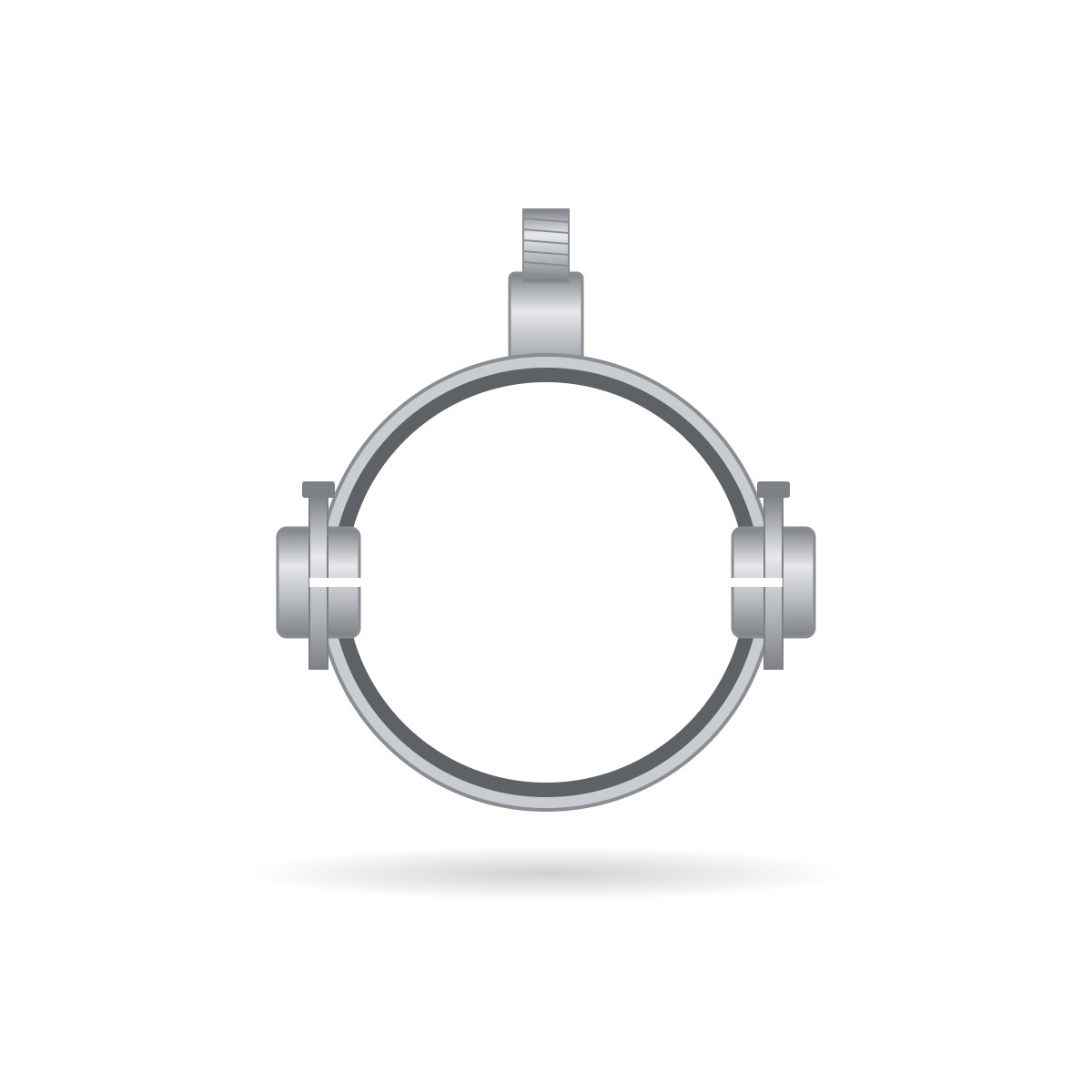
Socketless cast iron soil, waste and rainwater system made to BS EN 877. Bismat Pipe Bracket, available in 50mm, 70mm, 100mm, 150mm, 200mm. Cast iron, supplied factory coated.
Product codes: HS2061 (50mm), HS3061 (70mm), HS4061 (100mm), HS6061 (150mm), HS8061 (200mm).
UK delivery from £30. Fittings are despatched boxed. See delivery rates.
Tuscan EN877 Soil is a socketless cast iron soil, waste and rainwater system made to BS EN 877. Plain-ended pipes and fittings are joined with stainless steel or ductile iron couplings, giving a slim, continuous line on a façade or in a service riser. Cast iron is non-combustible, quiet in use and very long-lived. That is why it remains the specification of choice for heritage buildings, tall stacks, and anywhere acoustic performance or fire safety matters.
A zinc plated bracket with a rubber lining, closed with two screws. The lining reduces noise transfer to the structure.
Available in 5 sizes, from 50mm to 200mm.
Typical use: Fixing stacks and branches to walls or rod, internally and externally.
| Size | Product code |
|---|---|
| 50mm | HS2061 |
| 70mm | HS3061 |
| 100mm | HS4061 |
| 150mm | HS6061 |
| 200mm | HS8061 |
Often used with: Double Spigot Pipe 3m, Zinc Plated Wall Plate, Rubber Lined Heavy Duty Bossed Pipe Bracket.
Comparing systems? Our guide to choosing a cast iron soil pipe system sets out how LCC, Traditional Express, mechanical BS 416 and EN 877 differ.
Prices are per item, excluding VAT and delivery. Stock items are usually dispatched within 5 to 7 working days, and non-stock sizes within 7 to 10 working days. For a full stack or drainage schedule, or advice on the right fittings, call 0333 987 4452 or use the contact form.
It is available in 50mm (HS2061), 70mm (HS3061), 100mm (HS4061), 150mm (HS6061), 200mm (HS8061).
Yes, for guiding and fixing. On tall stacks use stack supports to carry the weight, with bismat brackets in between.
| Size | 50mm, 70mm, 100mm, 150mm, 200mm |
|---|
Prices for rooflight openers are shown on the product pages at tuscanfoundry.com. For volume orders, project pricing, or compatibility queries, please call 0333 987 4452 or use the contact form on our website.
Polished chrome has a bright mirror finish, while satin chrome has a brushed, low-sheen appearance. Both are available in the telescopic hand winder range. The finish choice typically depends on the ironmongery specification for the project.
Please call 0333 987 4452 or use the contact form with the size, quantity and connection details, and we'll provide a quotation.
BTU stand’s for British Thermal Units. This was the old (Imperial) measurement for heat in connection with plumbing. Although BTU’s is a term still commonly used within the heating and plumbing, the industry is now going over to KW’s Kilowatts.
Victorian properties most commonly used Ogee (OG) gutter profiles, including the standard Cast Iron Ogee and the G46 Moulded Ogee. Half Round guttering was also widely used, particularly in the later Victorian period. The correct profile depends on what is already present on the building — we recommend inspecting any surviving sections and matching the profile, size, and socket direction exactly. We supply 19 standard gutter profiles and can copy-cast any non-standard profile from a drawing, photograph, or physical sample.
The Gothic foliate tracery design of the Ornamental Airbrick provides a good free-flow ventilation area relative to its face size. The open area is comparable to other standard cast iron airbrick patterns. The visual density of the pattern at a distance reads as solid ironwork, which suits formal and decorative elevations without compromising subfloor ventilation effectiveness.
Yes. Cast iron is the material required by most conservation officers and listed building consents for the replacement or replication of traditional rainwater goods. Our hopper heads are produced in solid cast iron and we can assist with specification notes or material statements for planning purposes if required.
Our cast iron hopper heads are available with 65mm, 75mm and 100mm round outlets, 75mm, 100mm and 125mm square outlets, and 100x75mm, 125x100mm and 150x125mm rectangular outlets, to match the downpipe already on site or specified for the project.
Half round gutter has a simple semicircular profile and is the most widely used pattern across all building types and periods. Ogee (OG) gutter has an S-shaped decorative profile, historically associated with Victorian and Edwardian properties. Moulded ogee profiles, such as the G46 and Regent No.16, have a more elaborate cross-section with additional mouldings and are typically found on larger or more architecturally significant buildings. The correct choice depends on what is already present on the building and any requirements set by a conservation officer.
The drainage and guttering market has matured considerably over the past 20 years and there are now many more product choices for consumers to consider.
Despite the influx of new materials it appears that the benchmark for rainwater systems is still cast iron. Cast iron rainwater goods were introduced in the late 18th Century as an alternative to lead. As well as being easier to produce, the material enabled eaves gutters to be installed more simply, since lead could only be used in this location as a lining for timber gutters.
Many modern materials focus on replicating the appearance of cast iron but those materials can vary rarely offer any of the benefits. Cast iron gutters and pipes offer great strength and durability, a proven history of long life, low noise operation and fire resistance. Most old buildings have cast iron rainwater systems that should be maintained and preserved however; these inherent benefits make cast iron an ideal choice for both traditional and modern installations.
It is not uncommon to see modern alternative products marketed with terms like low maintenance or easy to install and cost effective. It has even been said that ‘plastic guttering systems provide a way of achieving a traditional look with modern convenience’. These terms tend to refer to possible cost savings rather than any real product benefits. It is also difficult to quantify the benefits of modern convenience over traditional build quality.
It is worth remembering that all rainwater goods will require some element of maintaining to ensure they are unblocked by debris and remain functional. No rainwater system cleans itself. Today most suppliers of cast iron rainwater systems offer products in both primer or pre-painted with a 10 year protective coating. When describing modern materials, the term ‘cost effective’ is used rather than simply saying cheap. There is no doubt that the initial cost of many modern materials is less than cast iron but you might be surprised to know that over its lifespan, cast iron will cost around a third of plastic.
It is easy to forget about your rainwater system but it does need to be maintained and inspected at least twice a year regardless of the product material. It does not matter whether the property is hundreds of years old or brand new, the message is the same; ‘maintaining your rainwater system contributes to the external appearance of the building as well as keeping it free from damp and structural damage.