Our cast iron hopper heads are available with 65mm, 75mm and 100mm round outlets, 75mm, 100mm and 125mm square outlets, and 100x75mm, 125x100mm and 150x125mm rectangular outlets, to match the downpipe already on site or specified for the project.
Established 1893 | BS 460:2002 Certified | UK & International Supply | Expert Technical Support | 0333 987 4452
Call for Price
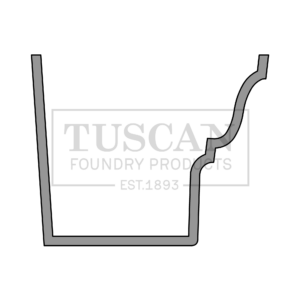
H12 – Large sand cast moulded guttering. Often called a Railway Patter Gutter
Suitable for installation on buildings for larger roof areas, including industrial
heritage and church projects.
Sizes Available:
105 x 75mm
125 x 100mm
150 x 100mm
Railway Pattern Cast Iron Guttering (S & D No’s 12 + 21)
The TFH12 is a large sand cast moulded gutter known historically as the Railway Pattern — a profile developed for and widely used on Victorian railway infrastructure, station buildings, goods sheds, engine houses, and ancillary railway architecture. The Railway Pattern has a distinctive moulded cross-section characterised by its strong horizontal lines and deep section, designed for the heavy rainfall loads and robust construction requirements of industrial and railway heritage buildings.
Beyond its railway heritage context, the TFH12 is appropriate for any large Victorian industrial or civic building where a substantial moulded gutter is required. It is increasingly specified on railway heritage restoration projects and industrial conservation schemes where architectural accuracy is a requirement. Pattern references include S&D numbering.
Available in three sizes: 105×75mm, 125×100mm, and 150×100mm. Sand cast iron, manufactured to BS 460:2002. Supplied in grey primer or black painted finish. As a sand cast profile, lead times are typically 8–10 weeks. Contact Tuscan Foundry Products to discuss your project before ordering.
Suitable for: Railway heritage buildings, industrial heritage, Victorian civic architecture, large heritage conservation projects. Call for price: 0333 987 4452.
Our cast iron hopper heads are available with 65mm, 75mm and 100mm round outlets, 75mm, 100mm and 125mm square outlets, and 100x75mm, 125x100mm and 150x125mm rectangular outlets, to match the downpipe already on site or specified for the project.
The physical properties of cast iron are sustained throughout its working life, so with proper maintenance we'd expect our gutters and pipes to last over 100 years under normal conditions.
Yes. Cast iron is the original material for external soil stacks on most period buildings, and like-for-like replacement in cast iron is usually what conservation officers expect. Check with your local planning authority whether listed building consent is needed for the works.
The Paxton H82 accepts round, square, and rectangular pipe connections. Round: 65mm, 75mm, and 100mm. Square: 75×75mm, 100×100mm, and 125×125mm. Rectangular: 100×75mm, 125×100mm, and 150×100mm. Bespoke adaptations including double pipe connections are also available on request. Please confirm your required connection type when ordering.
Our cast iron airbricks are available in a choice of finishes including primer and painted options. If you require a specific finish for a conservation project or to match existing ironwork, please call us on 0333 987 4452 to discuss.
This opener is particularly well suited to period and heritage properties — Georgian and Victorian terraces, conservation area houses, traditional orangeries, and listed buildings where a brass finish is required to complement existing ironmongery. It is compatible with Lumen Rooflights and most timber-framed skylights.
Yes, provided they are sized for the lower water temperature. Outputs are published at ΔT50; at ΔT30 a section gives about half that, so heat pump systems usually need more sections or a deeper pattern. We can prepare a radiator schedule at your heat pump design temperature.
Yes. Churches and ecclesiastical buildings are one of our most common project types. We regularly supply large sand cast gutters, rectangular and square downpipes, and bespoke hopper heads for church restorations. Many churches have non-standard profiles that require copy casting. We work directly with architects, church fabric advisors, and quinquennial inspection surveyors. Historic England and many Diocesan Advisory Committees specify cast iron as the appropriate material for listed ecclesiastical buildings.
Yes. Cast iron hopper heads are the historically correct choice for listed and period buildings, and a like-for-like cast iron replacement is generally accepted without objection by conservation officers. We manufacture to BS 460 for genuine heritage character and durability.
Hopper heads are supplied in red oxide primer ready for on-site painting, or pre-finished in black. A full range of Heritage Colours in traditional linseed oil paint is also available on request — please contact us for the swatch chart.