Established 1893 | BS 460:2002 Certified | UK & International Supply | Expert Technical Support | 0333 987 4452

Call for Price
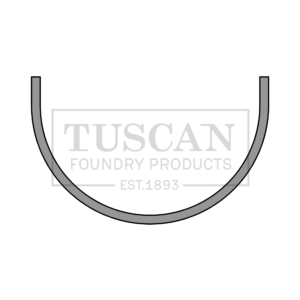
H25S – Large socket and spigot guttering.
This large box gutter cast iron rainwater system is suitable for larger
buildings and industrial and railway heritage projects.
Size Available:
160 x 130 x 115mm
Large sand cast socket and spigot box gutter – H25S6401
The TFH25SI is a large sand cast socket and spigot box gutter in the 160×130×115mm three-dimension size — a deeper-channelled box profile suited to applications where the gutter sits within a structural or architectural rebate and the three-dimensional size must conform to the available space as well as the drainage requirement.
The three-way dimension (160×130×115mm) makes the TFH25SI a specialist casting for specific architectural situations — typically valley gutters, parapet gutters, and gutter-behind-parapet details on large Victorian and Edwardian civic buildings, churches, and institutional architecture. Contact Tuscan Foundry Products to confirm whether this profile is the correct match before ordering.
Sand cast iron, manufactured to BS 460:2002. Supplied in grey primer or black painted finish. Lead times are typically 8–10 weeks.
Suitable for: Valley and parapet gutter applications, large civic buildings, churches, Victorian institutional architecture. Call for price: 0333 987 4452.
Our standard spike or sturt length is 300mm (12″). Other sizes are available upon request.
Hopper heads are supplied in red oxide primer ready for on-site painting, or pre-finished in black. A full range of Heritage Colours in traditional linseed oil paint is also available on request — please contact us for the swatch chart.
The H530 measures 330mm wide x 150mm deep x 350mm high, making it well suited to Georgian and Victorian terraces, where a compact, narrow footprint is needed.
In most cases, replacing like-for-like cast iron guttering on a listed building does not require Listed Building Consent (LBC), provided the replacement matches the existing profile, material, and finish exactly. However, any change of material away from cast iron will almost always require consent. We recommend consulting your local conservation officer before proceeding, and we can provide specification documentation to support your application if required.
For rooflights directly above a worktop or sink, a telescopic screw-jack hand winder is the most practical choice. Available in polished brass, satin chrome, and polished chrome, these openers allow controlled ventilation from a fixed handle position without requiring a pole. The 150mm or 250mm size is typically appropriate for standard-height kitchen rooflights.
Yes. Cast iron hopper heads are the historically correct choice for listed and period buildings, and a like-for-like cast iron replacement is generally accepted without objection by conservation officers. We manufacture to BS 460 for genuine heritage character and durability.
Rooflight opener handles can be ordered directly through tuscanfoundry.com. For volume orders or project-specific queries, please call 0333 987 4452 or use the contact form on our website.
Our brackets are more commonly used on cast iron rainwater systems. Unlike plastic, cast iron is heavy and the weight keeps the gutter in position. As such our brackets do not normally have retaining clips which could lead to plastic or lightweight gutters blowing out of the bracket. The profile of your gutter should match that of our bracket but without the weight to keep it in place you may well encounter problems in bad weather.
Yes. Bespoke copy casting is a core service at Tuscan Foundry Products. We can replicate any cast iron gutter, downpipe, hopper head, or fitting from drawings, detailed photographs, or a physical sample or surviving section. Each commission is assessed individually. Lead time is typically 12 to 14 weeks, and quantities as low as a single piece can be considered depending on pattern-making costs.
Casting of iron is an imperfect processs. It is possible with some cast iron radiators that you will get minor imperfections in the surface finish. When radiators are painted this will reduce and over the years every additional coat of paint applied will provide a smoother more equal finish.