Established 1893 | BS 460:2002 Certified | UK & International Supply | Expert Technical Support | 0333 987 4452


£845.00 – £985.00Price range: £845.00 through £985.00 ex VAT (£1,014.00 – £1,182.00 inc VAT)
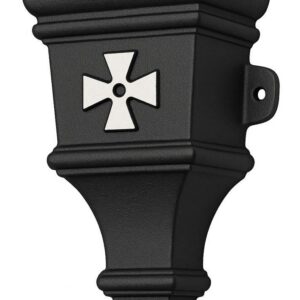
Cast iron rainwater ornamental head No.42 and cast iron hopper head No.42 – H2 Castings for period, listed and traditional buildings.
(Bespoke cast iron hopper heads maufactured to order)
UK delivery from £30. Fittings are despatched boxed. See delivery rates.
The Saxby Cast Iron Hopper Head No.1 is one of the most recognisable forms in the traditional rainwater catalogue — a wide-shouldered, multi-faceted body that narrows dramatically to a slender outlet, with the kind of confident silhouette you see on Victorian terraces, civic buildings, and well-detailed country houses across the UK.
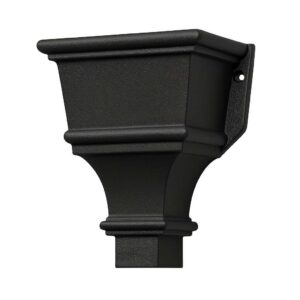
The Saxby No.2 is cast with a flat back for wall mounting, with integral fixing holes, and offered in three pipe sizes: 65mm (2.5″), 75mm (3″), and 100mm (4″). At its largest — for 100mm pipe — the unit measures 355mm wide by 230mm deep and 240mm high, making it a substantial and visually authoritative component on larger drainage runs. The smaller 65mm and 75mm variants share the same 305mm width and 197mm depth, appropriate for secondary stacks, outbuildings, and properties where the downpipe run is lighter.
The multi-faceted tapering body is the defining characteristic of this hopper: it gives the No.2 depth and shadow without relying on applied ornament. On Victorian townhouses, listed commercial properties, and Gothic-influenced ecclesiastical buildings, this form reads as period-accurate and architecturally coherent.
Manufactured to order in solid cast iron in the UK. Available in Standard Black and Heritage Colour finishes, with a linseed oil paint option for conservation and listed building projects.
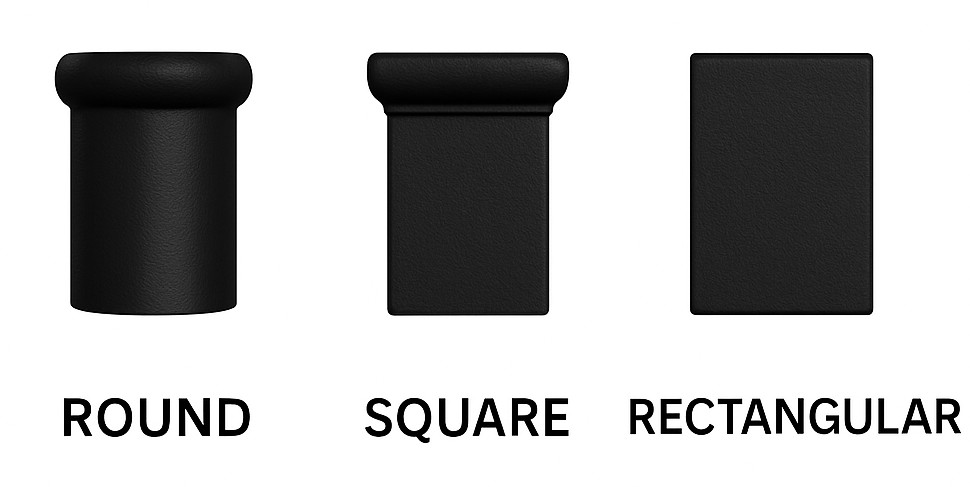
Pipe connections: Round 65mm, 75mm, 100mm, 150mm.
For listed buildings and conservation projects, call 0333 987 4452 or visit tuscanfoundry.com.
| Weight | 3 kg |
|---|---|
| Pipe Size/Finish | Primer 65mm, Primer 75mm, Primer 100mm, Black Painted 65mm, Black Painted 75mm, Black Painted 100mm |
Our standard spike or sturt length is 300mm (12″). Other sizes are available upon request.
The H532 measures 560mm wide x 290mm deep x 305mm high, making it well suited to a broad, low-profile design suited to substantial roofs and box gutters on period commercial and civic buildings.
The Gothic foliate tracery design of the Ornamental Airbrick provides a good free-flow ventilation area relative to its face size. The open area is comparable to other standard cast iron airbrick patterns. The visual density of the pattern at a distance reads as solid ironwork, which suits formal and decorative elevations without compromising subfloor ventilation effectiveness.
The School Board Airbrick (F020801AFC) is available in three standard sizes: 225mm × 75mm, 225mm × 150mm, and 225mm × 225mm. These correspond to one-, two-, and three-brick-course heights and allow ventilation requirements to be met across a range of subfloor and wall opening sizes.
Eared LCC pipe is fixed through ears cast on the socket. Plain LCC pipe is fixed with holdfasts driven into the mortar joint, screw-to-wall holderbats, build-in holderbats or loose ears. Fix every length below the socket so each joint is supported. Traditional Express uses adjustable brackets.
Most old buildings have cast iron rainwater systems that should be maintained and preserved however; these inherent benefits make cast iron an ideal choice for both traditional and modern installations. It is not uncommon to see modern alternative products marketed with terms like low maintenance or easy to install and cost effective. It has even been said that ‘plastic guttering systems provide a way of achieving a traditional look with modern convenience
As well as being easier to produce, the material enabled eaves gutters to be installed more simply, since lead could only be used in this location as a lining for timber gutters. Many modern materials focus on replicating the appearance of cast iron but those materials can vary rarely offer any of the benefits. Cast iron gutters and pipes offer great strength and durability, a proven history of long life, low noise operation and fire resistance.
Most old buildings have cast iron rainwater systems that should be maintained and preserved however; these inherent benefits make cast iron an ideal choice for both traditional and modern installations. It is not uncommon to see modern alternative products marketed with terms like low maintenance or easy to install and cost effective. It has even been said that ‘plastic guttering systems provide a way of achieving a traditional look with modern convenience’.
These terms tend to refer to possible cost savings rather than any real product benefits. It is also difficult to quantify the benefits of modern convenience over traditional build quality. It is worth remembering that all rainwater goods will require some element of maintaining to ensure they are unblocked by debris and remain functional. No rainwater system cleans itself.
Today most suppliers of cast iron rainwater systems offer products in both primer or pre-painted with a 10 year protective coating. When describing modern materials, the term ‘cost effective’ is used rather than simply saying cheap. There is no doubt that the initial cost of many modern materials is less than cast iron but you might be surprised to know that over its lifespan, cast iron will cost around a third of plastic.
Casting of iron is an imperfect processs. It is possible with some cast iron radiators that you will get minor imperfections in the surface finish. When radiators are painted this will reduce and over the years every additional coat of paint applied will provide a smoother more equal finish.
The H544 measures 380mm wide x 220mm deep x 418mm high, making it well suited to Georgian and Victorian townhouses and period commercial buildings.
The H534 measures 430mm wide x 240mm deep x 366mm high, making it well suited to Victorian villas and townhouses.
The School Board Airbrick suits Victorian and Edwardian institutional, civic, and residential buildings where the square-grid airbrick pattern was standard — including school buildings, civic halls, estate housing, terrace houses, and warehouses. It is also appropriate on listed buildings and conservation area properties as a like-for-like replacement for worn square-grid cast iron vents.