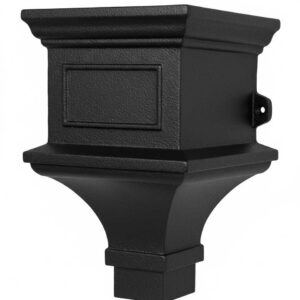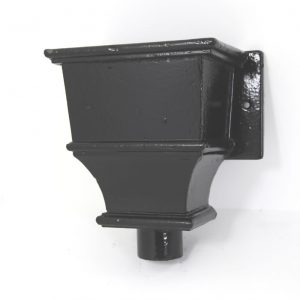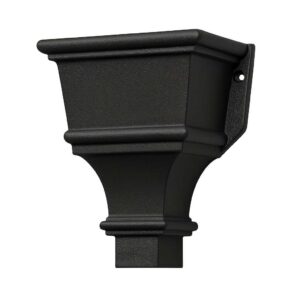
Our cast iron hopper heads are available with 65mm, 75mm and 100mm round outlets, 75mm, 100mm and 125mm square outlets, and 100x75mm, 125x100mm and 150x125mm rectangular outlets, to match the downpipe already on site or specified for the project.
Established 1893 | BS 460:2002 Certified | UK & International Supply | Expert Technical Support | 0333 987 4452
Call for Price
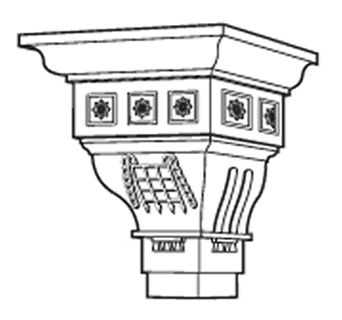
Cast iron rainwater Head H526. Created using bespoke cast iron hopper pattern H526.
Cast iron leader heads for period, listed and traditional buildings.
(Bespoke cast iron rainwater heads and ornamental hoppers manufactured to order)
The Osborne No.526 is an architectural composition rather than a plain vessel: a tiered casting whose face carries rows of square coffered panels, stepping inward as the body descends to the outlet.
The coffering is the defining feature. Each panel is recessed within a raised frame, and the panels are arranged in registers that diminish with each tier, so the head reads as a miniature entablature rather than a box. The effect at high level is of depth and repetition, and it changes markedly as the light moves across the face during the day.
Coffered ornament belongs to the classical tradition and to its nineteenth-century revivals in particular. This pattern suits Italianate villas, stucco terraces, orangeries and garden buildings, civic and institutional architecture of the mid-Victorian period, and high-quality new construction in a classical idiom. It carries real visual weight and needs an elevation with the scale to support it.
Cast in solid iron to BS 460:2002, supplied in primer or black as standard, with heritage colours and traditional linseed oil finishes available on request.
Pipe connections: 65mm, 75mm and 100mm round; 75×75mm, 100×100mm and 125×125mm square; 100×75mm, 125×100mm and 150×125mm rectangular.
Suitable for listed buildings and conservation areas. The recessed panels reward careful preparation before painting. Call 0333 987 4452 for advice on scale and placement.
| Finish | Primer, Black |
|---|---|
| Connection | 65mm Round, 75mm Round, 100mm Round, 75mm x 75mm Square, 100mm x 100mm Square, 125mm x 125mm Square, 100mm x 75mm Rectangular, 125mm x 100mm Rectangular, 150mm x 125mm Rectangular |
Our cast iron hopper heads are available with 65mm, 75mm and 100mm round outlets, 75mm, 100mm and 125mm square outlets, and 100x75mm, 125x100mm and 150x125mm rectangular outlets, to match the downpipe already on site or specified for the project.
Yes. Cast iron hopper heads are the historically correct choice for listed and period buildings, and a like-for-like cast iron replacement is generally accepted without objection by conservation officers. We manufacture to BS 460 for genuine heritage character and durability.
The drainage and guttering market has matured considerably over the past 20 years and there are now many more product choices for consumers to consider.
Despite the influx of new materials it appears that the benchmark for rainwater systems is still cast iron. Cast iron rainwater goods were introduced in the late 18th Century as an alternative to lead. As well as being easier to produce, the material enabled eaves gutters to be installed more simply, since lead could only be used in this location as a lining for timber gutters.
Many modern materials focus on replicating the appearance of cast iron but those materials can vary rarely offer any of the benefits. Cast iron gutters and pipes offer great strength and durability, a proven history of long life, low noise operation and fire resistance. Most old buildings have cast iron rainwater systems that should be maintained and preserved however; these inherent benefits make cast iron an ideal choice for both traditional and modern installations.
It is not uncommon to see modern alternative products marketed with terms like low maintenance or easy to install and cost effective. It has even been said that ‘plastic guttering systems provide a way of achieving a traditional look with modern convenience’. These terms tend to refer to possible cost savings rather than any real product benefits. It is also difficult to quantify the benefits of modern convenience over traditional build quality.
It is worth remembering that all rainwater goods will require some element of maintaining to ensure they are unblocked by debris and remain functional. No rainwater system cleans itself. Today most suppliers of cast iron rainwater systems offer products in both primer or pre-painted with a 10 year protective coating. When describing modern materials, the term ‘cost effective’ is used rather than simply saying cheap. There is no doubt that the initial cost of many modern materials is less than cast iron but you might be surprised to know that over its lifespan, cast iron will cost around a third of plastic.
It is easy to forget about your rainwater system but it does need to be maintained and inspected at least twice a year regardless of the product material. It does not matter whether the property is hundreds of years old or brand new, the message is the same; ‘maintaining your rainwater system contributes to the external appearance of the building as well as keeping it free from damp and structural damage.
Prices are shown on each product page. For project quantities, specification advice, or a formal quotation, please call 0333 987 4452 or use the contact form.
Please call 0333 987 4452 or use the contact form with the size, quantity and connection details, and we'll provide a quotation.
Prices for our rooflight openers are shown on each product page. If you need multiple items, have a specific project in mind, or want to discuss compatibility, please call 0333 987 4452 or use the contact form at tuscanfoundry.com and we will be happy to assist.
The Polished Brass finish suits buildings where brass metalwork was standard — formal Victorian terrace housing, civic and institutional buildings, and high-quality estate architecture. It is appropriate on listed buildings and conservation properties where the wider ironmongery specification is in brass and a matching material is required.
The School Board Airbrick suits Victorian and Edwardian institutional, civic, and residential buildings where the square-grid airbrick pattern was standard — including school buildings, civic halls, estate housing, terrace houses, and warehouses. It is also appropriate on listed buildings and conservation area properties as a like-for-like replacement for worn square-grid cast iron vents.
The H543 measures 504mm wide x 185mm deep x 200mm high, making it well suited to wide, shallow proportions that suit box-gutter outlets on period roofs, terraces and commercial premises.
Select your required size and finish options from the product page and add to cart for an instant price. For project quantities, bespoke requirements, or any specification queries, please call 0333 987 4452 or use the contact form at tuscanfoundry.com.