Established 1893 | BS 460:2002 Certified | UK & International Supply | Expert Technical Support | 0333 987 4452

£62.40 – £192.70Price range: £62.40 through £192.70 ex VAT (£74.88 – £231.24 inc VAT)
UK delivery from £30. Fittings are despatched boxed. See delivery rates.
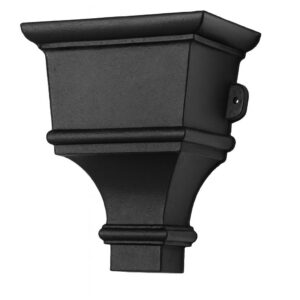
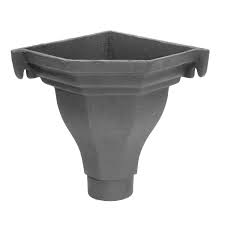
The Pultney Tapered Cast Iron Hopper Head is a traditional flat-backed hopper head with a clean, utilitarian character — well suited to vernacular and Georgian-influenced architecture. Its chamfered, faceted body tapers cleanly from a wide rectangular opening to a circular downpipe outlet, without surface decoration or ornament. The result is a hopper that reads as architecturally resolved rather than plain: the angled facets catch the light and give the casting visual depth, while the flat back sits flush against a wall or fascia.
Available in three pipe connection sizes — 65mm, 75mm, and 100mm — with dimensions scaling accordingly. The 65mm and 75mm versions measure 210mm wide × 163mm deep × 195mm high; the 100mm version measures 253mm wide × 210mm deep × 210mm high. All sizes include integral fixing holes. The hopper is available in Standard Black or Heritage Colour finishes, and connects to matching cast iron downpipes via spigot and socket.
The Pultney suits a broad range of building types: Georgian and Regency townhouses, Victorian terraces, rural farmhouses, barns, and functional estate buildings where an unfussy traditional hopper is the appropriate solution. It is equally at home on new heritage-style construction and on restoration projects where a period-correct replacement is required.
Cast in solid grey iron in the UK, the Pultney Tapered Hopper Head is appropriate for use on listed buildings and within conservation areas. It is available alongside matching downpipes, offset bends, and fittings to complete a fully coordinated rainwater system.
Round pipe connections: 65mm (RH025, XRH025), 75mm (RH03, XRH03), 100mm (RH04, XRH04)
For listed building projects or technical specification queries, call the team on 0333 987 4452.
| Weight | 1 kg |
|---|---|
| Size/Finish | Primer 210w x 163d x 195h to 65mm, Primer 210w x 163d x 195h to 75mm, Primer 253w x 210d x 195h to 100mm, Black Painted 210w x 163d x 195h to 65mm, Black Painted 210w x 163d x 195h to 75mm, Black Painted 253w x 210d x 195h to 100mm |
The H543 measures 504mm wide x 185mm deep x 200mm high, making it well suited to wide, shallow proportions that suit box-gutter outlets on period roofs, terraces and commercial premises.
The H527 measures 430mm wide x 195mm deep x 540mm high, making it well suited to Victorian villas and townhouses where a decorative leader head is wanted.
Satin chrome has a brushed, low-sheen finish suited to contemporary interiors, while polished chrome has a bright mirror finish. Both are available in the telescopic hand winder range at Tuscan Foundry. The choice typically depends on the existing ironmongery specification.
The Ornamental Airbrick is suited to Victorian villas, bay-fronted terraces, Gothic Revival institutional buildings, church halls, and civic buildings where decorative ironwork is part of the architectural language. It is also appropriate for listed buildings and conservation area properties where the airbrick is on a prominent elevation and the ventilation grille is expected to carry decorative character.
Our cast iron hopper heads are available with 65mm, 75mm and 100mm round outlets, 75mm, 100mm and 125mm square outlets, and 100x75mm, 125x100mm and 150x125mm rectangular outlets, to match the downpipe already on site or specified for the project.
The drainage and guttering market has matured considerably over the past 20 years and there are now many more product choices for consumers to consider.
Despite the influx of new materials it appears that the benchmark for rainwater systems is still cast iron. Cast iron rainwater goods were introduced in the late 18th Century as an alternative to lead. As well as being easier to produce, the material enabled eaves gutters to be installed more simply, since lead could only be used in this location as a lining for timber gutters.
Many modern materials focus on replicating the appearance of cast iron but those materials can vary rarely offer any of the benefits. Cast iron gutters and pipes offer great strength and durability, a proven history of long life, low noise operation and fire resistance. Most old buildings have cast iron rainwater systems that should be maintained and preserved however; these inherent benefits make cast iron an ideal choice for both traditional and modern installations.
It is not uncommon to see modern alternative products marketed with terms like low maintenance or easy to install and cost effective. It has even been said that ‘plastic guttering systems provide a way of achieving a traditional look with modern convenience’. These terms tend to refer to possible cost savings rather than any real product benefits. It is also difficult to quantify the benefits of modern convenience over traditional build quality.
It is worth remembering that all rainwater goods will require some element of maintaining to ensure they are unblocked by debris and remain functional. No rainwater system cleans itself. Today most suppliers of cast iron rainwater systems offer products in both primer or pre-painted with a 10 year protective coating. When describing modern materials, the term ‘cost effective’ is used rather than simply saying cheap. There is no doubt that the initial cost of many modern materials is less than cast iron but you might be surprised to know that over its lifespan, cast iron will cost around a third of plastic.
It is easy to forget about your rainwater system but it does need to be maintained and inspected at least twice a year regardless of the product material. It does not matter whether the property is hundreds of years old or brand new, the message is the same; ‘maintaining your rainwater system contributes to the external appearance of the building as well as keeping it free from damp and structural damage.
Please call 0333 987 4452 or use the contact form with the size, quantity and connection details, and we'll provide a quotation.
Polished chrome has a bright mirror finish, while satin chrome has a brushed, low-sheen appearance. Both are available in the telescopic hand winder range. The finish choice typically depends on the ironmongery specification for the project.
Our bespoke rise and fall gutter brackets — including fascia, side rafter, and top rafter variants for Osma Roofline and Osma SuperLine systems — are manufactured to order. The standard lead time is 10–14 working days from receipt of a confirmed order. If you have a programme deadline, please call us on 0333 987 4452 and we will advise on current availability.
Prices are shown on each product page. For project quantities, conservation specifications, or to discuss suitability for a listed building, call 0333 987 4452 or use the contact form.