
Established 1893 | BS 460:2002 Certified | UK & International Supply | Expert Technical Support | 0333 987 4452
A translation guide for New Zealand heritage architects, builders, roofers and owners specifying British cast iron rainwater goods. We set out what each component is called in both countries, how approvals and consents work, and how to write a schedule that prices correctly first time.
New Zealand uses one word that surprises most British readers: spouting, meaning a gutter. The outlet from the spouting to the downpipe is a dropper, a British running outlet. A British hopper head is a New Zealand rainwater head or rainhead. Downpipe, bracket, stop end and box gutter are shared. On contracts, main contractor is used in both countries; under NZS 3910 the owner is the principal, and the contract administrator is the Engineer to the Contract. Heritage protection works mainly through district plans and resource consent, with the Heritage New Zealand List as an information source. Cast iron fixings should be checked for seismic loads. Sizes are metric but not always interchangeable.
In New Zealand gutters are usually called spouting, the outlet to the downpipe is a dropper, and a hopper head is a rainwater head or rainhead. Most other British terms are understood, but a schedule that uses one vocabulary and is priced in the other can lead to the wrong fitting, or a connection that does not match on site.
We have written this guide for heritage architects, builders, roofers and owners in New Zealand who are specifying British cast iron rainwater goods, and for British professionals working on New Zealand buildings. It follows our guides to UK and US terminology and UK and Australian terminology. For freight, duties and how international orders work, see our international supply and shipping page.
Cast iron rainwater goods in New Zealand are found mainly on Victorian and Edwardian commercial, civic and church buildings, many of them built to British patterns; most timber houses had formed galvanised iron spouting instead. Knowing which applies to your building is the first step in specifying the right replacement.
New Zealand’s nineteenth-century building stock grew quickly after the 1860s gold rushes in Otago and the West Coast and the growth of the main centres. Banks, post offices, churches, warehouses and town halls in Dunedin, Oamaru, Christchurch, Wellington and Auckland were often built in stone or brick, with cast iron rainwater heads, downpipes and, on some buildings, cast iron gutters. Much of this ironwork was imported from Britain or cast locally to British patterns.
Timber houses — colonial cottages, villas and later bungalows — are the heart of New Zealand’s domestic heritage. Their spouting was usually formed galvanised iron in OG or half-round profiles, with plain round downpipes. Cast iron appears on some of these houses, typically as rainwater heads or decorative features, but rarely as spouting.
This matters for specification. On a Victorian stone building, cast iron is often the authentic material for heads, downpipes and gutters, and it can be matched or copy cast from surviving components. On a timber villa, the right approach may be cast iron only for heads and features, with the spouting profile chosen from historic evidence.
Spouting is the New Zealand word for a gutter, and many fittings take its name; most profile names are shared with Britain. The table below maps the terms we see on New Zealand schedules to their British equivalents.
| British term | New Zealand term | Notes |
|---|---|---|
| Gutter, guttering | Spouting | The standard New Zealand term. Gutter is also understood. |
| Ogee (OG) gutter | OG spouting | Same shape. A cast ogee has a true moulded face. |
| Half-round gutter | Half-round spouting | Same profile. |
| Box gutter, parapet gutter | Internal gutter, box gutter | Behind a parapet or between roof planes. |
| Running outlet, outlet | Dropper, spouting outlet | Connects spouting to the downpipe. |
| Box gutter outlet box | Sump | Collects water in an internal gutter. |
| Stop end | Stop end, stopend | Same meaning. |
| Internal / external angle | Internal / external corner | Changes of direction. |
| Union, joint | Joiner, spouting joiner | Joins two lengths. |
| Bracket | Spouting bracket | Same component. |
| Fall | Fall | Same term. |
Many heritage houses and commercial buildings now carry later spouting in a different profile or material from the original. The authentic profile is usually shown by historic photographs, surviving brackets, marks on the fascia, or a matching building nearby. Where cast iron was used, ogee and half-round gutters are the usual matches. If the evidence is unclear, send us photographs and we will advise.
Downpipe is the standard term in both Britain and New Zealand, and most fittings share their names. The differences are mainly at the foot of the pipe, where New Zealand practice connects to stormwater drainage.
| British term | New Zealand term | Notes |
|---|---|---|
| Downpipe | Downpipe | Same term. |
| Bend | Bend, elbow | Both terms used. |
| Offset, swan neck | Offset | Takes the pipe around the eaves. |
| Branch | Junction, Y-junction | Joins two pipes. |
| Shoe | Shoe | Discharges above ground. |
| Gully, surface water drain | Stormwater sump, stormwater drain | Stormwater is the New Zealand term for surface water drainage. |
| Pipe ears, eared pipe | Eared downpipe | Integral ears for fixing to the wall. |
| Pipe clip, holderbat | Downpipe clip, bracket | For pipes without ears. |
| Socket and spigot | Socket and spigot | Same term. |
At ground level, downpipes usually connect to a stormwater system through a fitting sized to local pipe. Measure the internal diameter of the existing connection before ordering, or allow for a new adaptor.
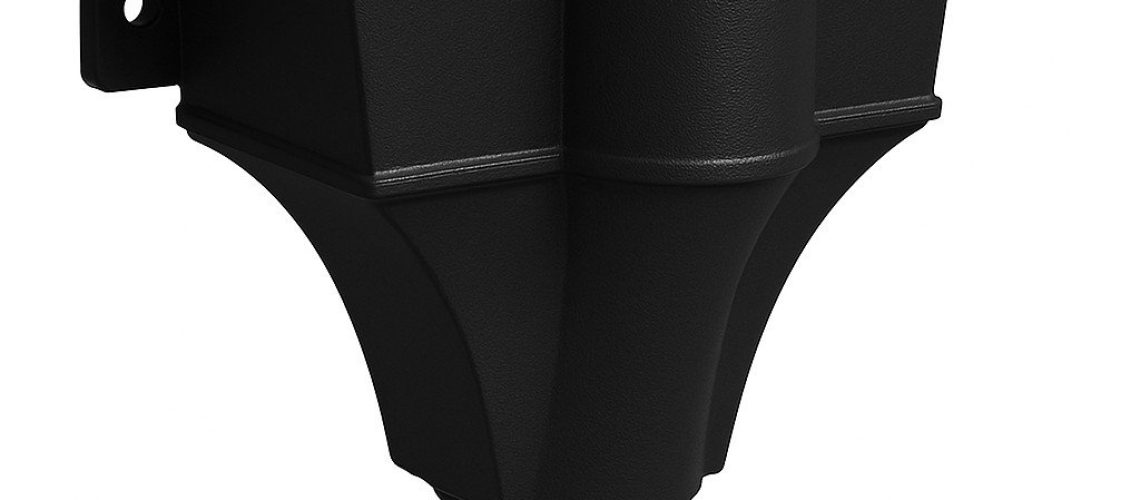
Rainwater head, rainhead and hopper head are names for the same component: the open box at the top of a downpipe that collects water from spouting, an internal gutter or a parapet outlet. In Britain, hopper head is most common; in New Zealand and Australia, rainwater head or rainhead; in the USA, leader head.
On New Zealand heritage buildings, cast iron rainwater heads are often the best-preserved element of the original rainwater system. Many carry dates, initials or ornament, and district plan heritage assessments often mention them. We hold a wide range of cast iron rainwater heads and can copy an original from a surviving example, photographs or measured drawings.
Both countries use metric sizes, but British cast iron and New Zealand formed-steel sizes are not always interchangeable, and cast iron fixings need checking for seismic loads. Use nominal sizes to identify a component, and measured dimensions at every connection.
| Component | Common British cast iron sizes | Common New Zealand sizes |
|---|---|---|
| Half-round gutter | 100mm, 115mm, 125mm, 150mm | Half-round spouting in several sizes |
| Ogee (OG) gutter | Several sizes and patterns | OG spouting in several sizes |
| Round downpipe | 65mm, 75mm, 100mm | 80mm and 100mm round |
| Rectangular downpipe | Available in selected patterns | Several rectangular sizes |
New Zealand contract and trade terms are close to British usage, but some roles, licences and consents have their own names. The table sets out the pairs we meet most often.
| British term | New Zealand term |
|---|---|
| Client | Client, owner; principal (NZS 3910) |
| Main contractor | Main contractor; builder on residential work |
| Contract administrator | Engineer to the Contract (NZS 3910), contract administrator |
| Roofer | Roofer, roofing contractor (often an LBP) |
| — | Licensed Building Practitioner (LBP) |
| Conservation architect | Heritage architect, conservation architect |
| Conservation officer | Council heritage adviser |
| Listed building | Scheduled heritage building (district plan); place on the Heritage New Zealand List |
| Conservation area | Heritage area, special character area (depending on the plan) |
| Planning permission, Listed Building Consent | Resource consent |
| Building Regulations approval | Building consent; Code Compliance Certificate (CCC) |
| Surface water drainage | Stormwater |
| Quantity surveyor | Quantity surveyor |
| Practical completion | Practical completion |
In New Zealand, heritage buildings are protected mainly through council district plans, with resource consent required for many external changes to scheduled buildings; entry on the Heritage New Zealand List is primarily informational. Approval depends on the council, the plan and the building.
Replacing a failed cast iron rainwater head or downpipe with cast iron to the same design is generally the most straightforward case. Changing the profile or material of documented spouting is more likely to need consent and careful justification.
Much of New Zealand’s heritage building stock is close to the sea and exposed to wind-driven rain, so the finish should suit the site. Our coastal specification uses enhanced preparation and a more robust paint build for marine exposure. Linseed oil paint remains the heritage-appropriate topcoat, weathering gradually and simple to maintain with a wash-down and a fresh coat.
The most reliable schedule for a New Zealand order names each component in both New Zealand and British terms, gives measured dimensions at every connection, and states the profile from historic evidence. This checklist is what we ask for.
In the UK we carry out site surveys ourselves; in New Zealand a heritage architect, surveyor or roofer can gather the same information using this checklist, and we can review it remotely.
Most problems come from vocabulary and from assuming modern sizes match historic cast iron. Each of these is avoidable at schedule stage.
The following are representative examples of the situations we are asked about by New Zealand clients. They show how the terminology and specification points above play out in practice.
Victorian commercial building, Otago (representative example)
A two-storey stone commercial building on a main street had cast iron rainwater heads and downpipes behind a parapet, with one head cracked and one downpipe missing. The district plan scheduled the façade, so the council heritage adviser was consulted early. A surviving head was measured and photographed, and a new head was copy cast to match. Fixings into the stone were reviewed by the engineer because the building had been seismically strengthened.
Church, Canterbury (representative example)
A nineteenth-century church had its original cast iron downpipes and heads, with several joints failing and a section lost during earlier earthquake repairs. The main contractor’s schedule referred to spouting, droppers and rainheads; the British equivalents were added before quotation. Replacement sections were matched to the surviving pattern, and a linseed oil paint finish was specified to suit the building’s conservation plan.
Bay villa, Auckland (representative example)
An owner restoring a timber villa in a special character area wanted to replace later, non-original spouting. Historic photographs showed OG-profile spouting with plain round downpipes. The architect confirmed the spouting size against the fascia, and the downpipe connection was measured against the existing stormwater pipe. Only the rainwater heads on the rear lean-to were in cast iron, and those were matched from a surviving example.
Civic building, Wellington (representative example)
A heritage-listed civic building with an internal box gutter behind a parapet discharged through ornamental cast iron rainwater heads. Two heads were copy cast from measured drawings. The project programme allowed for 12–14 weeks from pattern approval and up to three months of sea freight, so the order was placed as soon as the drawings were approved rather than waiting for the scaffold.
Spouting is the usual New Zealand word for a roof gutter. It means the same as gutter or guttering in British usage, and fittings are often named after it: spouting brackets, spouting joiners and spouting stop ends.
A dropper is the New Zealand name for the outlet that connects spouting to the downpipe. In British terms it is a running outlet or gutter outlet.
In New Zealand a hopper head is usually called a rainwater head or rainhead. It is the open box at the top of a downpipe that collects water from spouting, an internal gutter or a parapet outlet.
Yes. We supply cast iron gutters, downpipes, rainwater heads and fittings to projects in New Zealand, and we can copy cast an existing head from photographs, drawings or a sample. Bespoke items take typically 12–14 weeks from pattern approval, plus up to three months for sea freight.
Not by itself. Entry on the New Zealand Heritage List/Rārangi Kōrero is mainly informational. Legal controls usually come from the council’s district plan heritage schedule, a heritage covenant on the title, or building consent requirements. Check with the council before starting work.
It depends on the district plan. Buildings scheduled for heritage protection often need resource consent for external alterations, while like-for-like repair may be permitted. Resource management law is being reformed, so check the current position with your council’s heritage adviser.
Like-for-like replacement of spouting and downpipes is often exempt from building consent, but work must still comply with the Building Code, including clause E1 Surface Water. Check with your building consent authority if the design, size or drainage connection is changing.
Cast iron is heavier than formed-steel spouting, so fixings matter. Brackets, straps and wall fixings should be designed for the load and checked by the project engineer on seismically sensitive or strengthened buildings. The weight is manageable when the fixing detail is right.
Main contractor is used in New Zealand as in Britain, and the builder is often the main contractor on residential work. Under NZS 3910 the owner is called the principal, and the contract administrator is the Engineer to the Contract.
An LBP is a Licensed Building Practitioner. In New Zealand certain restricted building work must be carried out or supervised by an LBP, and roofing is one of the licence classes. There is no single British equivalent.
Most timber villas and bungalows had formed galvanised iron spouting rather than cast iron. Cast iron rainwater goods are more typical of Victorian and Edwardian commercial, civic and church buildings, especially in stone and brick. Rainwater heads and downpipes are the elements most often in cast iron.
For exposed coastal sites we recommend our coastal specification, with enhanced preparation and a robust paint build. Linseed oil paint remains the heritage-appropriate topcoat and is easy to maintain. Ask us for advice on your site’s exposure.
Not always. British cast iron downpipes are commonly 65mm, 75mm and 100mm round, and New Zealand downpipes include 80mm and 100mm round and a range of rectangular sizes. Measure connections to existing stormwater pipes and sumps before ordering.
New Zealand and British rainwater systems share much of their history, and most of the differences are in the names. Spouting is a gutter, a dropper is a running outlet, a rainhead is a hopper head, and a scheduled building needs resource consent rather than Listed Building Consent.
Our recommendations are straightforward. Establish from historic evidence whether the building had cast iron or formed spouting. Measure every connection to existing stormwater and internal gutter outlets. Design fixings for the weight of cast iron. Resolve consents early, and allow typically 12–14 weeks for bespoke work, plus up to three months for sea freight.
We supply cast iron gutters, downpipes, rainwater heads and fittings, made to BS 460, to heritage projects in New Zealand and worldwide, and we copy cast components that are no longer made. Send your schedule, drawings or photographs through our contact page or call +44 333 987 4452. For freight, duties and how international orders work, see international supply and shipping.