
Established 1893 | BS 460:2002 Certified | UK & International Supply | Expert Technical Support | 0333 987 4452
A translation guide for Australian heritage architects, builders, roof plumbers and owners specifying British cast iron rainwater goods. We set out which terms match, which differ, where sizes and standards diverge, and how to write a schedule that prices correctly first time.
British and Australian rainwater terms overlap more than British and American ones, but the differences still matter. A British hopper head is an Australian rainwater head or rainhead. Downpipe is used in both countries. Australian gutters are described by profile — quad, OG (ogee), squareline and half round — and many heritage buildings also have box gutters with sumps. Australian roof plumbing adds terms with no single British equivalent, such as the pop (gutter outlet) and the spreader. On contracts, the head contractor or builder is the British main contractor, and the owner may be called the principal. Sizes are metric in both countries but not always interchangeable. Approvals are set by each state and council, not nationally.
In Australia a hopper head is usually called a rainwater head or rainhead, and gutters are usually named by profile: quad, OG, squareline or half round. Most other British terms, including downpipe, stop end and bracket, are understood, but roof plumbing uses several words of its own. A schedule that mixes the two vocabularies can lead to the wrong fitting or a connection that does not match on site.
We have written this guide for heritage architects, builders, roof plumbers and owners in Australia who are specifying British cast iron rainwater goods, and for British professionals working on Australian buildings. It follows our guide to UK and US rainwater terminology, and it covers gutters, downpipes, heads, sumps and fittings, sizes and standards, contract terms, and heritage approvals. For how freight, duties and international orders work, see our international supply and shipping page.
A great deal of the cast iron on nineteenth-century Australian buildings was imported from Britain or cast locally to British patterns, so the components on a Melbourne or Sydney terrace are often very close to their British counterparts. The vocabulary has drifted mainly because twentieth-century formed-steel products brought their own profile names.
The boom years of the second half of the nineteenth century — driven in Victoria and New South Wales by gold and rapid urban growth — produced large numbers of terraces, villas, banks, town halls and churches. Many carried cast iron rainwater heads, downpipes and gutters alongside the decorative cast iron verandah work, known as iron lace, that is now so closely associated with Australian Victorian architecture.
Federation-era houses from around 1890 to 1915 continued the tradition, often with ogee gutters on terracotta-tiled roofs. From the mid twentieth century, roll-formed steel gutters became standard, and the quad profile became the everyday Australian gutter. As a result, many heritage buildings now carry a quad gutter that is itself a replacement for an earlier ogee or half-round profile.
For owners and architects, this shared history is useful. Where original cast iron survives, it can often be matched from existing British patterns. Where it does not, we can copy cast from photographs, measured drawings or a surviving component.
Gutter means the same thing in both countries, but Australians usually name gutters by profile, and several fitting names differ. The table below maps the terms we see on Australian schedules to their British equivalents.
| British term | Australian term | Notes |
|---|---|---|
| Gutter, guttering | Gutter, guttering, eaves gutter | Same meaning. |
| Ogee (OG) gutter | OG gutter, ogee | Same shape. A cast ogee has a true moulded face. |
| Half-round gutter | Half-round gutter | Same term; common on older and heritage buildings. |
| — | Quad gutter | Formed-steel profile with a quarter-round face; the standard modern Australian gutter. |
| — | Squareline gutter | Modern square-faced formed-steel profile; not a heritage profile. |
| Box gutter, parapet gutter | Box gutter | Same term; usually behind a parapet or between roof planes. |
| Outlet, running outlet | Pop, outlet, nozzle | The outlet that connects the gutter to the downpipe. |
| Box gutter outlet box | Sump | A box in the sole of a box gutter that feeds the outlet. |
| Overflow | Overflow, overflow weir | Australian codes place strong emphasis on overflow provision. |
| Stop end | Stopend, stop end | Same meaning. |
| Internal / external angle | Internal / external corner, mitre | Changes of direction. |
| Bracket | Bracket, gutter bracket, strap | Same meaning. |
| Fall | Fall | Same term. |
This is the most common profile question we are asked. A quad gutter on a Victorian terrace or Federation house is almost always a later replacement. The authentic profile is usually an ogee or a half round, and the evidence is often still on the building: surviving brackets, marks on the fascia, a matching house in the row, or early photographs. If the evidence is unclear, send us photographs and we will advise.
Box gutters behind parapets are common on Australian terraces and commercial buildings. They are usually lined gutters built into the roof, and their sumps and overflows are governed by local plumbing requirements. Cast iron has a role where the box gutter discharges through the parapet: the rainwater head and downpipe below are often cast iron, and those we can supply or copy.
Downpipe is the standard term in both Britain and Australia, and most downpipe fittings share their names. The main differences are at the foot of the pipe and in how water is discharged.
| British term | Australian term | Notes |
|---|---|---|
| Downpipe, rainwater pipe | Downpipe | Same term. |
| Bend | Bend, elbow | Both terms are used. |
| Offset, swan neck | Offset, swan neck | Takes the pipe around the eaves. |
| Branch | Junction, Y-junction | Joins two pipes. |
| Shoe | Shoe, downpipe shoe | Discharges above ground. |
| Gully, surface water drain | Stormwater pit, stormwater drain | Stormwater is the Australian term for surface water drainage. |
| — | Spreader | Discharges a downpipe evenly onto a lower roof. |
| Pipe ears, eared pipe | Eared downpipe | Integral ears for fixing to the wall. |
| Pipe clip, holderbat | Downpipe clip, bracket | For pipes without ears. |
| Socket and spigot | Socket and spigot | Same term. |
Take particular care at ground level. Australian downpipes usually connect to a stormwater drain through a fitting at the base, and the joint must suit the existing pipe. Measure the internal diameter of the stormwater connection before ordering, or allow for a new adaptor.
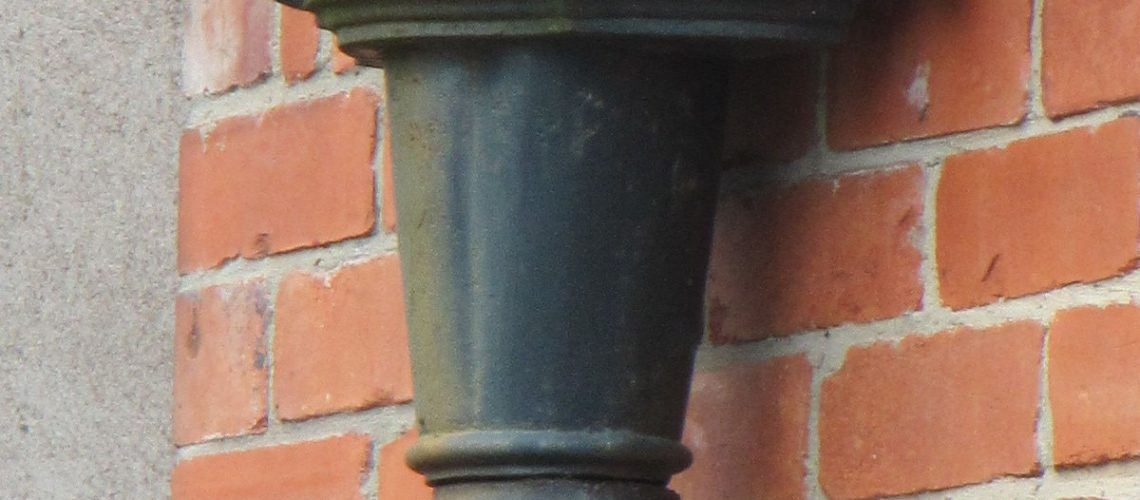
Rainwater head, rainhead and hopper head are three names for the same component: the open box at the top of a downpipe that collects water from a gutter, outlet or box gutter. In Britain, hopper head is most common; in Australia, rainhead or rainwater head; in the USA, leader head or conductor head.
Rainwater heads are where cast iron is at its most decorative, with date panels, initials, crests and foliage. On Australian heritage buildings they are often among the most significant surviving elements of the original rainwater system, and heritage advisers generally expect them to be matched closely. We hold a wide range of cast iron rainwater heads and can copy an original head from a surviving example, photographs or measured drawings.
Australian rainheads on modern buildings are often designed as overflow devices, with an overflow slot in the front face. Historic cast iron heads were not usually designed this way, so where a code overflow is required, discuss the detail with your roof plumber or hydraulic engineer at the design stage.
Both countries use metric sizes, but British cast iron and Australian formed-steel sizes are not always interchangeable. Use nominal sizes to identify a component, and measured dimensions wherever it joins something existing.
| Component | Common British cast iron sizes | Common Australian sizes |
|---|---|---|
| Half-round gutter | 100mm, 115mm, 125mm, 150mm | 125mm and 150mm (formed steel) |
| Ogee (OG) gutter | Several sizes and patterns | OG in formed steel, in several sizes |
| Round downpipe | 65mm, 75mm, 100mm | 90mm and 100mm round |
| Rectangular downpipe | Available in selected patterns | 100×50mm, 100×75mm |
Our cast iron rainwater goods are made to BS 460:2002, the British Standard for cast iron rainwater goods. In Australia, roof drainage is covered by the National Construction Code and AS/NZS 3500.3, which sets requirements for capacity, overflow and the connection to stormwater. Heritage buildings often need a balance between authentic appearance and current performance, so the roof plumber or hydraulic engineer should confirm the design. Our product catalogue gives dimensions for each item.
Australian contract and trade terms are closer to British usage than American ones, but several roles and approvals have different names. The table sets out the pairs we meet most often.
| British term | Australian term |
|---|---|
| Client | Client, owner; principal (under common standard contracts) |
| Main contractor | Head contractor; builder on domestic work |
| Contract administrator | Superintendent |
| Specialist contractor | Subcontractor, trade contractor |
| Roofer, rainwater installer | Roof plumber |
| Tradesperson | Tradie (informal) |
| Conservation architect | Heritage architect |
| Conservation officer | Council heritage adviser, heritage officer |
| Heritage consultant | Heritage consultant, heritage adviser |
| Listed building | Heritage-listed place, heritage item, place in a Heritage Overlay |
| Conservation area | Heritage conservation area (NSW), heritage precinct (Heritage Overlay, Victoria) |
| Planning application | Development application (DA, NSW), planning permit (Victoria) |
| Building control | Building surveyor, certifier |
| Quantity surveyor | Quantity surveyor |
| Surface water drainage | Stormwater |
| Programme | Programme |
| Practical completion | Practical completion |
Heritage protection in Australia is managed by each state and territory and by local councils, so the approval needed to replace gutters, downpipes or rainwater heads depends on where the building is and how it is listed. There is no single national equivalent of British Listed Building Consent.
Replacing a failed cast iron rainwater head or downpipe with cast iron to the same design is generally the most straightforward case. Replacing a documented ogee or half-round gutter with a modern profile, or introducing a different material, is the kind of change that attracts scrutiny.
Australian sites can be more demanding than a typical British one, so the finish and fixing specification should suit the exposure. Three conditions come up most often.
The most reliable schedule for an Australian order names each component in both Australian and British terms, gives measured dimensions at every connection, and states the profile from historic evidence. This checklist is what we ask for.
In the UK we carry out site surveys ourselves; in Australia, a heritage architect, building surveyor or roof plumber can gather the same information using this checklist, and we can review it remotely.
Most problems come from assuming that a modern Australian profile or size has a direct British cast iron equivalent. Each of these is avoidable at schedule stage.
The following are representative examples of the situations we are asked about by Australian clients. They show how the terminology and specification points above play out in practice.
Victorian terrace, inner Melbourne (representative example)
A two-storey boom-era terrace in a Heritage Overlay had lost its original rainwater head and part of the downpipe; a later formed-steel quad gutter ran across the front. The owner’s heritage architect used photographs of matching houses in the row to specify a cast ogee gutter and a replacement head copy cast from a surviving neighbour. The council heritage adviser was consulted before work began, and the downpipe connection was measured against the existing stormwater pipe at ground level.
Sydney terrace, Paddington area (representative example)
A mid-Victorian terrace in a heritage conservation area had cast iron downpipes with integral ears and a cracked rainwater head behind the parapet. The roof plumber’s schedule used local terms: rainhead, sump, pop and stopend. The British equivalents — hopper head, outlet and stop end — were added alongside before quotation. A linseed oil finish in a period colour was chosen to match the neighbouring terraces.
Federation Queen Anne house, New South Wales (representative example)
An early twentieth-century house with terracotta roof tiles had its original ogee gutters replaced in quad profile during the 1970s. Evidence from surviving brackets and early photographs supported reinstating an ogee profile. The builder was the head contractor, and the heritage consultant prepared the documentation. Sizes were confirmed against the fascia, and a coastal specification was used because the house is close to the harbour.
Civic building, Victorian goldfields town (representative example)
A nineteenth-century town hall on a State Heritage Register had ornamental rainwater heads with a date panel, two of them missing. New heads were copy cast from a surviving original, supported by measured drawings from the conservation architect. The state heritage office’s approval process set the timetable, so the 12–14 week pattern and casting period, plus sea freight, was built into the programme from the outset.
In Australia a hopper head is usually called a rainwater head or rainhead. Both describe the open box at the top of a downpipe that collects water from a gutter, box gutter outlet or parapet.
No. A rainhead sits outside the building at the top of a downpipe and collects water from a gutter or outlet. A sump is a box set into the sole of a box gutter that collects water and feeds the outlet or downpipe below. Many heritage buildings have both.
A quad gutter is the most common Australian formed-steel eaves gutter, with a rounded, quarter-round face. It is a twentieth-century sheet-metal profile. On many Victorian and Federation buildings, a cast or formed ogee (OG) or half-round gutter is the more authentic match.
Yes. OG is shorthand for ogee, a gutter with an S-curved moulded face. Australian formed-steel OG gutters follow the same shape as the British cast iron ogee gutter, though dimensions and fixing details differ.
Yes. We supply cast iron rainwater heads, downpipes, gutters and fittings to projects in Australia, and we can copy cast an existing head from photographs, drawings or a sample. Bespoke items take typically 12–14 weeks from pattern approval, plus up to three months for sea freight.
It depends on the state and the listing. In Victoria, works in a Heritage Overlay normally need a planning permit, though like-for-like repair and maintenance may be exempt; items on a State Heritage Register need state approval or an exemption. Check with the council heritage adviser or state heritage office first.
A spreader is a fitting at the foot of a downpipe that discharges water evenly onto a lower roof instead of into a gutter or drain. It is an Australian roof-plumbing term with no single British equivalent.
A roof plumber is the Australian trade that installs gutters, downpipes, flashings and roof drainage. In several states roof plumbing is licensed work. In the UK this work is usually done by a roofer or a specialist rainwater installer.
Roof drainage in Australia is covered by the National Construction Code and AS/NZS 3500.3, the plumbing and drainage standard for stormwater. Our cast iron rainwater goods are made to BS 460:2002, and the project’s roof plumber or hydraulic engineer should confirm the design meets local requirements.
Head contractor is the usual Australian equivalent of a British main contractor, and the builder is often the head contractor on domestic work. Under common Australian standard contracts the owner is called the principal, and the contract administrator is the superintendent.
Iron lace is the decorative cast iron used on Australian verandahs, balconies and fences, particularly on Victorian terraces. It is a separate trade from rainwater goods. We focus on cast iron gutters, downpipes and rainwater heads, which often sit alongside iron lace on the same buildings.
Cast iron is non-combustible, which is helpful in bushfire-prone areas. Requirements depend on the site’s Bushfire Attack Level (BAL) under AS 3959, including details such as gutter guards and sealing, so confirm the full specification with your building surveyor.
For coastal and high-UV sites we recommend our coastal specification, with enhanced preparation and a robust paint build. Linseed oil paint remains the heritage-appropriate topcoat and is easy to maintain. The right system depends on exposure, so ask us for advice on your site.
Not always. British cast iron downpipes are commonly 65mm, 75mm and 100mm round, while Australian formed-steel downpipes include 90mm and 100mm round and rectangular sizes such as 100×50mm and 100×75mm. Measure connections to existing stormwater pipes and sumps before ordering.
British and Australian heritage rainwater systems share much of their history, and most of the differences are in the names. A hopper head is a rainwater head or rainhead. Gutters are named by profile. The pop, the sump and the spreader are Australian roof-plumbing terms. And the head contractor or builder is the British main contractor.
Our recommendations are straightforward. Choose the gutter profile from historic evidence, not from the quad gutter currently on the building. Measure every connection to existing stormwater and box gutter outlets. Resolve overflow and heritage approvals early. Allow typically 12–14 weeks for bespoke work, plus up to three months for sea freight.
We supply cast iron gutters, downpipes, rainwater heads and fittings, made to BS 460, to heritage projects in Australia and worldwide, and we copy cast components that are no longer made. Send your schedule, drawings or photographs through our contact page or call +44 333 987 4452. For freight, duties and how international orders work, see international supply and shipping. Our guide to New Zealand terminology covers spouting, downpipes and rainwater heads across the Tasman.