
Established 1893 | BS 460:2002 Certified | UK & International Supply | Expert Technical Support | 0333 987 4452
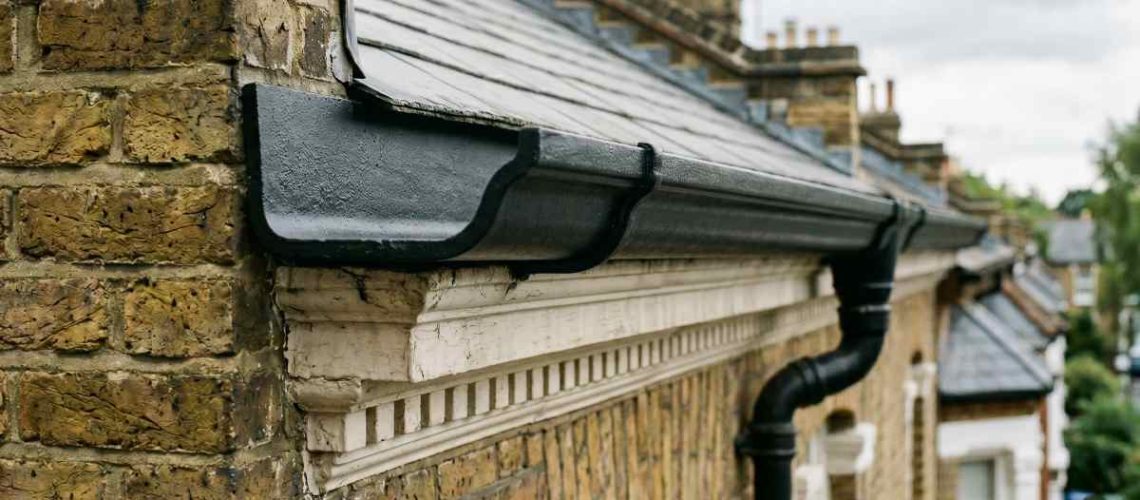
From its origins in medieval architectural mouldings to its defining presence on Victorian terraces and Georgian townhouses, the ogee gutter profile has shaped the character of the British built environment for nearly two centuries. We explore its history, its variants, the buildings it belongs to, and why it remains the only authentic choice for conservation and listed building work today.
The ogee gutter is the most historically significant and architecturally expressive cast iron rainwater profile ever produced, and it remains the definitive choice for the restoration of Victorian, Georgian, and Edwardian buildings across Britain today. Few elements of a period façade are as quietly consequential as the gutter line. Get it right — an original-profile cast iron ogee, properly proportioned and finished — and the building reads as complete. Get it wrong, and the substitution of an alien profile, however neatly fitted, announces itself immediately to any informed eye. The ogee profile is not simply a style preference; it is a direct expression of the architectural logic of the buildings it serves.
We have been supplying cast iron ogee gutters to conservation architects, building surveyors, and heritage contractors for well over a century. In that time, we have seen the ogee profile used on everything from modest back-to-back terraces to Grade I listed country houses — and our respect for its history has only deepened. This article is our attempt to do that history justice.
The word derives from the Old French ogive or augive, traced to Late Latin augiva, meaning a diagonal rib of a vault or pointed arch. The earliest recorded use in English dates to around 1356, and the term entered common architectural parlance to describe a specific double curve — concave above, convex below — that produced the characteristic sinuous, S-shaped profile. The word ogee and its near-twin ogive are doublets: two forms of the same etymological root that diverged in meaning over centuries, with ogive retained for pointed Gothic arches and ogee becoming the standard term for the double-curved moulding itself.
The ogee curve is arguably one of the oldest decorative motifs in world architecture. Its origins are thought to lie in sixth-century Persia and Morocco, where the form appeared in textiles before migrating westward along the Silk Road into Islamic architecture, and eventually into the Gothic cathedrals of medieval Europe. By the fourteenth century, ogee arches were a defining feature of the English Decorated Gothic style — the swelling, double-curved canopies over doorways and niches at Ely Cathedral and Southwell Minster being among the most celebrated examples.
In classical architectural language, the ogee moulding appears as the cyma recta or cyma reversa depending on the orientation of its curves — terms familiar to any architect trained in the classical orders. It is this language of mouldings — carried from ancient Greece through Rome, through the Renaissance, and into the pattern books of the Georgian era — that provided the intellectual and aesthetic framework from which the cast iron ogee gutter would eventually emerge.
The dominance of cast iron in British rainwater management was not simply a matter of material availability; it was, in significant part, driven by legislation. The London Building Acts of 1724 and 1774 were transformative. The 1724 Act required downpipes on front elevations to protect pedestrians from roof water. The more sweeping Building Act of 1774 — which mandated stone or brick parapets and restricted external timber ornamentation to reduce fire risk — effectively moved the drainage line from the eaves to internal parapet gutters and required robust vertical systems to carry the water to the ground.
As lead remained prohibitively expensive for the rapidly expanding middle-class housing market of the late eighteenth century, the Industrial Revolution provided its timely replacement. The green sand casting process allowed cast iron as a building material to be mass-produced in standardised profiles at a fraction of the cost of hand-formed lead. Foundries in Birmingham, Nottingham, Glasgow, and across the industrial North rapidly developed gutter catalogues offering dozens of profile variations — and the ogee, with its direct reference to the classical cornice mouldings already present on Georgian building façades, quickly established itself as the prestige choice.
The term 'ogee gutter' encompasses several related but distinct profiles. Understanding the differences between them is essential to correct specification on a restoration project. The three principal types in the historic cast iron repertoire are the Victorian Ogee, the Moulded Ogee (G46), and the Notts Ogee — each with its own architectural pedigree and appropriate building context.
This is the profile most people mean when they speak of an ogee gutter. Its front face presents a shallow, sinuous S-curve — the convex upper portion flowing into the concave lower — that directly echoes the classical cyma recta moulding seen on Georgian and Victorian cornices. The profile sits against the fascia with its flat back and carries water in a relatively shallow but wide channel. Standard sizes are typically 100mm (4-inch), 115mm (4.5-inch), and 125mm (5-inch) internal widths.
It was the backbone of the Victorian terrace, appearing on the millions of brick-built dwellings constructed between roughly 1840 and 1910, but it was by no means limited to modest housing. The same profile — scaled up — appeared on Georgian townhouses, Regency villas, and early-Victorian institutional buildings throughout the country. Its hydraulic capacity is well-suited to standard domestic roof pitches and catchment areas, and its relatively simple form meant foundries could produce it economically at scale. Our Victorian ogee gutters remain the most frequently specified profile in residential conservation work.
The G46 — also referred to simply as the Moulded Ogee or No. 46 — is a deeper, more substantial interpretation of the same ogee principle. Where the Victorian OG has a relatively open, shallow channel, the G46 features a flat back, a flat bottom, and a more prominent ogee moulding to the front face, creating a deeper, box-like form with a dramatically enhanced flow capacity. The profile's alternative name, the 'railway pattern,' reflects its widespread use by the Great Western Railway and other Victorian industrial and institutional clients who needed robust drainage for large-catchment roofs.
For estate buildings, schools, agricultural ranges, and high-status Victorian villas, the G46 is often the authentic specification. Its hydraulic performance and stronger visual weight make it the appropriate choice where the standard Victorian OG would be undersized or too slight in character. We offer our G46 moulded ogee gutter in two profile sizes with a comprehensive range of fittings.
The Notts Ogee is a regional variant produced by foundries in the Nottinghamshire area, and its distinctive profile represents the way local industrial heritage shaped the specific patterns found on the streetscapes of different parts of the country. It is narrower and more angular in character than the standard Victorian OG, and remains the period-authentic choice for restorations in the East Midlands. It is one of several examples — alongside the beaded half round in Scotland and Northern England — of how the cast iron gutter trade developed genuine regional character, rather than producing a single uniform national standard.
The ogee profile appears across an exceptionally wide range of building types, though its association with certain periods and architectural contexts is clear. Georgian townhouses — particularly those in Bath, Edinburgh's New Town, and the great London squares — often used an ogee-profiled gutter that deliberately echoed the cornice mouldings of the stone or stucco façade below. This was deliberate architectural thinking: the rainwater goods were understood as part of the elevational composition, not merely functional infrastructure.
The Victorian terrace, however, is the building type most indelibly associated with the Victorian Ogee. From the back streets of Birmingham to the seafront terraces of Brighton and the brick-built rows of Leeds and Manchester, the same graceful S-curve appears at the eaves — almost always finished in black, almost always in cast iron. These were production-line buildings in many respects, but their gutter profiles were never arbitrary; they were drawn directly from the same architectural vocabulary as the more ambitious buildings of the same era.
Edwardian villas and the larger Arts and Crafts houses of the 1890s to 1910s often retained ogee gutters — particularly the deeper G46 profile — as part of their emphasis on honest materials and robust detailing. Country houses, rectories, schools, and railway station buildings of the mid- to late Victorian period frequently used the G46 or the Moulded Regent profile for its greater visual weight and hydraulic performance. For all these buildings, like-for-like replacement is both a heritage obligation and an architectural imperative.
On a listed building, the replacement of cast iron gutters — including ogee profiles — will typically require Listed Building Consent unless the works are a direct like-for-like replacement in the same material. Conservation officers are increasingly alert to inappropriate substitutions, and the use of a different gutter profile — even in cast iron — may be challenged where it alters the character of the building or its setting. Historic England's guidance is clear that the original materials and profiles should be reinstated wherever practicable, and that this principle applies to rainwater goods as much as to windows, doors, or masonry.
Where original gutters have been lost or are substantially damaged, we offer a copy casting service that can replicate surviving fragments or work from photographs, drawings, or measured surveys. For complex projects where multiple profiles are present, or where the provenance of the existing system is uncertain, we would always recommend commissioning a professional on-site survey before specification is finalised. This is a chargeable service, but it regularly saves significant cost and time by identifying exactly what is needed before materials are ordered.
The sustainability and long-term benefits of cast iron are well established but are worth restating in the context of ogee profiles specifically. A properly maintained cast iron ogee gutter can remain in continuous service for well over a century — the original Victorian examples visible on countless terraces and listed buildings are testament to this. By contrast, plastic and aluminium systems require replacement roughly every twenty to thirty years. Over a hundred-year period, a cast iron system is estimated to cost substantially less than an equivalent PVC system would over the same period when replacement cycles are factored in.
Cast iron is also manufactured predominantly from recycled scrap iron — typically 90 to 100 per cent recycled content — and is itself fully recyclable at end of life. The finishing of cast iron rainwater goods with linseed oil paints rather than petroleum-based coatings provides a further sustainability advantage, and is the heritage-appropriate choice for listed and conservation area buildings. Linseed oil penetrates the surface of the iron rather than forming a brittle film, providing superior long-term protection and an authentic period appearance.
We have been supplying cast iron ogee gutters and rainwater systems to the conservation and heritage sector since our founding in 1893. In that time, the Victorian Ogee, the G46 Moulded, and the Notts Ogee have passed through our foundry by the mile — each one part of the quiet, essential work of keeping Britain's historic buildings weathertight and architecturally coherent. We understand the significance of the ogee profile not simply as a product, but as an architectural language: one that connects the buildings of today to the moulding vocabularies of medieval Gothic, classical antiquity, and the great industrial foundry tradition of Victorian Britain. Whether your project requires standard Victorian OG sections in prompt-despatch stock or a bespoke copy casting of a regional variant that has not been in production for fifty years, our team has the expertise and the foundry relationships to specify and supply the right solution. Standard stock items are available for prompt despatch; bespoke and copy cast work typically requires eight to ten weeks from confirmation. We would encourage you to contact us to discuss your project, however straightforward or complex it may appear. The ogee gutter has protected the fabric of this country's historic buildings for nearly two hundred years. We intend to ensure it continues to do so.
The Victorian Ogee features a shallow, elegant S-curve appropriate for domestic Victorian terraces and Georgian townhouses. The Moulded Ogee G46 is a deeper, more robust profile with a flat back and flat bottom and a more prominent ogee moulding, offering greater hydraulic capacity. The two profiles are not interchangeable — matching the original profile is essential on listed and conservation area buildings.
Works that constitute genuine like-for-like replacement of cast iron gutters in the same material and profile generally do not require Listed Building Consent, though you should always confirm this with your local authority conservation officer before proceeding. Changing material or profile will typically require consent.
The term derives from the Old French ‘ogive’ — a pointed arch or diagonal vault rib — describing the double S-shaped curve. Foundries drew on classical architectural moulding vocabulary to create profiles that complemented Georgian and Victorian buildings.
A properly maintained cast iron ogee gutter can remain in continuous service for well in excess of a hundred years. Key requirements are regular cleaning, repainting every eight to ten years, and attention to joints. Many Victorian originals are still performing effectively today.
Yes. Linseed oil paint is the heritage-appropriate and conservation-recommended finish for cast iron rainwater goods. It penetrates the surface of the iron rather than forming a brittle film, providing superior long-term protection and a period-authentic appearance.
Yes. Our copy casting service can reproduce non-standard ogee profiles from a surviving length, measured survey, photographs, or drawings. Copy casting typically requires eight to ten weeks from pattern confirmation to delivery.
Cast iron is manufactured from 90–100 per cent recycled scrap iron, is fully recyclable at end of life, and has a service life that dramatically outlasts plastic and aluminium alternatives. When finished with linseed oil paints, the environmental credentials are further strengthened.