
Cast Iron Gutters in Monmouthshire: Heritage Rainwater Systems for the Listed Buildings of the Welsh Border
From the Bath stone Shire Hall in Monmouth to the red sandstone priory church at Abergavenny and the canal wharves of the Blaenavon iron trade, Monmouthshire holds a concentrated and varied stock of historic buildings. We set out how to specify cast iron gutters, downpipes and hoppers that respect that heritage, satisfy the Welsh consent regime and cope with the rainfall of the border hills.
Technical summary: Historic buildings in Monmouthshire should be fitted with cast iron rainwater goods that match the original profile, size and fixing: typically ogee on the Georgian and early Victorian stucco and brick frontages of Monmouth, Usk and Chepstow, half-round on Victorian terraces, chapels, farm and canal buildings, and beaded half-round on some vernacular stock, with larger sections where heavy stone-tiled roofs or the wetter north-west demand more capacity. Listed building consent is decided by Monmouthshire County Council or, within the National Park, the Bannau Brycheiniog National Park Authority, under the Historic Environment (Wales) Act 2023, and every application needs a heritage impact statement. We supply standard stock for prompt despatch, bespoke and copy casting in typically 12 to 14 weeks, radius gutters in 12 to 14 weeks, linseed oil paint finishes, and a chargeable site survey service for complex projects.
Monmouthshire's Heritage Landscape
Monmouthshire sits on the border between Wales and England, from the Black Mountains above Abergavenny to the Severn levels at Caldicot and the wooded gorge of the lower Wye at Tintern and Chepstow. Cast iron gutters in Monmouthshire should match the surviving profile, size and fixing of each building, be sized for the county’s wet western valleys, and be agreed with the correct planning authority, Monmouthshire County Council or the Bannau Brycheiniog National Park Authority, before any change is made to a listed building. That applies equally to a Baroque court house in Monmouth and a canal-side warehouse below the Blorenge.
The county’s historic environment is dense for its size. Monmouthshire County Council’s plan evidence records approximately 2,200 listed buildings, of which around 2 per cent are Grade I, 10 per cent Grade II* and 88 per cent Grade II, together with 31 conservation areas covering some 1,648 hectares, around 169 scheduled monuments and 44 registered historic parks and gardens. The same evidence identifies around 176 listed buildings as being at risk.
Three designations shape the county. The lower Wye, including Tintern, lies within the Wye Valley National Landscape, which Monmouthshire shares with Herefordshire and Gloucestershire. The north-west, including the Sugar Loaf, the Llanthony valley, Govilon and Gilwern, lies within Bannau Brycheiniog National Park. Part of the Blaenavon Industrial Landscape World Heritage Site, inscribed in 2000 and managed mainly from Torfaen, also extends into Monmouthshire’s north-west.
We supply traditional cast iron gutters, downpipes and hopper heads for listed, conservation-area and period buildings throughout Monmouthshire, working with architects, surveyors, conservation officers, contractors and owners to specify rainwater systems that satisfy conservation requirements and protect the fabric beneath them.
Typical Heritage Buildings and Materials in Monmouthshire
Monmouthshire’s historic buildings are built largely of Old Red Sandstone, with Carboniferous limestone around Chepstow and the Wye, Pennant sandstone on the western coalfield edge, and a strong tradition of lime render and colourwash in the towns. Natural Welsh slate is the dominant roof covering, with heavy sandstone tiles on some older houses.
Stone: red sandstone, limestone and Pennant
Old Red Sandstone underlies most of the county, from the Black Mountains in the north round either side of the Silurian Usk Inlier at its centre. It gives Abergavenny and the villages of the Monnow valley their warm red and brown rubble walls, and it roofs older houses with heavy sandstone tiles, as at Llanvihangel Court. Carboniferous limestone appears in the south-east and along the sides of the Wye Valley, and limestone rubble appears in buildings around Chepstow and the lower Wye. On the western edge, towards the valleys, the harder Pennant sandstone of the Coal Measures takes over; in Monmouth it survives in historic paving and setts.
Monmouth, Usk and Chepstow: render, brick and ashlar
Monmouth reads as a late Georgian and early Victorian town laid over a medieval plan. Its conservation area appraisal notes that most buildings are rendered or stuccoed and painted white, cream or subtle pinks, greys and yellows, with red and orange brick on the higher-status houses of Whitecross Street and St James’ Street, and natural slate at varied pitches. Its civic set-pieces, the Bath stone Shire Hall of 1724 and George Vaughan Maddox’s Priory Street of the 1830s, sit a short walk from the Monnow Bridge, the county’s fortified medieval river crossing. Usk and Chepstow share the same pattern of rendered frontages, slate roofs and stone civic and ecclesiastical buildings.
Churches, country houses and industry
The county’s medieval churches, many of them Grade I, are typically red sandstone rubble with limestone dressings and slate or lead roofs. The north-west carries the industrial legacy of the Blaenavon ironworks, with tramroads, limekilns and canal wharves along the Monmouthshire and Brecon Canal at Govilon and Llanfoist.
How cast iron complements these materials
Against red sandstone rubble, a black or dark painted cast iron half-round gutter on rise-and-fall brackets keeps the eaves line quiet and throws water clear of lime pointing. On a painted stucco frontage in Monmouth, a moulded ogee reads as the top member of the cornice, which is how the facade was composed. On limewashed walls, a sound downpipe with properly spaced ears is what keeps a pale elevation free of the green staining that betrays a failed joint.
Cast Iron on Listed and Conservation Properties in Monmouthshire
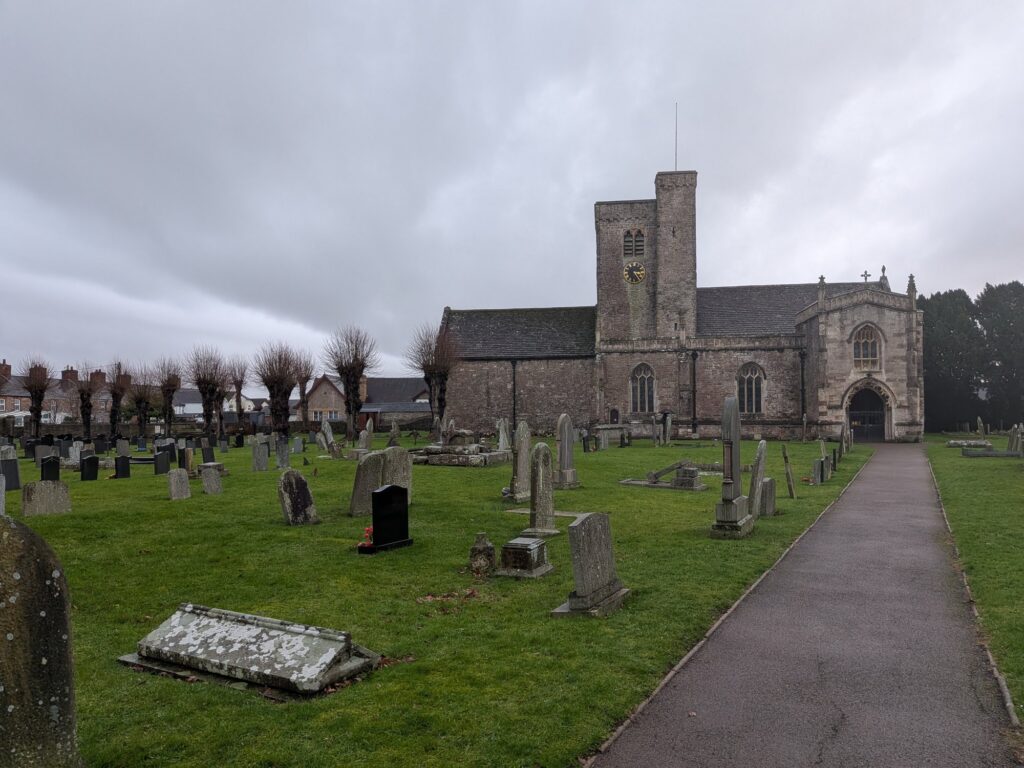
Cast iron is the expected material for rainwater goods on listed and conservation-area buildings in Monmouthshire because it is, in most cases, what the building was given, and like-for-like repair is the starting point of Welsh conservation practice. Where historic castings survive they contribute to significance; where they have been lost, reinstating cast iron of the correct pattern is normally what conservation officers look for.
Why matching the existing profile matters
The gutter profile sets the eaves line. Replacing a moulded ogee with a half-round on a Monmouth frontage, or a beaded half-round with a plain section on a sandstone farmhouse, alters the shadow line and detailing the listing protects, and it tends to be noticed. Our guide to cast iron gutter profiles explains how to identify what is on the building. Where a section is not a stock pattern, it can be reproduced from a surviving length.
Working with conservation officers in Monmouthshire
Monmouthshire County Council’s heritage officers, and the heritage team at the National Park Authority, will expect a proposal to show what exists, what is to be replaced and why. The county council points listed building owners to Cadw’s Managing Change and Maintenance Matters guidance and encourages advice before work starts. Photographs of the existing gutters, downpipes and hoppers, a note of profile and size, and the fixing method are the minimum a sensible pre-application conversation needs. Our page on cast iron rainwater goods for listed buildings sets out the technical information we can provide to support it.
What authenticity means in practice
- The same profile and nominal size as the original, or as the evidence shows it to have been.
- Fixings of the historic type, whether fascia brackets, rafter brackets or drive-in spikes into masonry, as found on the building.
- Hopper heads reinstated where they existed, including dated or decorated patterns.
- A traditional paint finish, typically linseed oil based, in a colour appropriate to the building.
Rainfall, Exposure and Maintenance: Protecting Historic Buildings in Monmouthshire
Water is the principal threat to historic fabric in Monmouthshire, and the rainwater system is the first defence against it. Rainfall rises sharply from the Severn levels to the hills around Abergavenny, and river valleys lined with mature trees load gutters with leaves every autumn.
The Met Office station at Usk, in the centre of the county, records an average of around 1,110 mm of rain a year, with rain on nearly 140 days and around 50 days of air frost. The Black Mountains and the hills of the National Park are wetter still. Gutters and outlets must cope with frequent, heavy flows, and freeze-thaw punishes any saturated masonry below a leaking joint.
Common failures on Monmouthshire buildings
- Blocked outlets and hopper heads under trees in the Wye, Usk and Monnow valleys, causing overflow onto walls and into roof timbers.
- Cracked downpipes on the back face, where the split is hidden, leaving a wet stripe down sandstone, render or limewash.
- Rusted brackets and failed joints on long runs, allowing sagging gutters to discharge onto the wall face.
- Undersized twentieth-century replacements that cannot carry storm flows from large slate or stone-tiled roofs.
- Parapet and valley gutters on churches and larger houses blocked by silt and debris, with water backing up under the roof covering.
What routine maintenance should look like
We suggest clearing gutters, hoppers and gullies at least twice a year on most Monmouthshire buildings, after leaf fall and again in spring, with checks after storms and snow. Paint should be inspected annually and touched in where the film has broken, particularly on the backs of pipes and at joints. Our guide to maintaining cast iron drainage on historic buildings covers access, cleaning and inspection routines in more detail.
Planning, Consent and Conservation Guidance in Monmouthshire
In Monmouthshire, listed building consent is decided by one of two local planning authorities: Monmouthshire County Council for most of the county, and the Bannau Brycheiniog National Park Authority for the north-west within the National Park. Both work under the Historic Environment (Wales) Act 2023, which came into force on 4 November 2024, with Cadw as the Welsh Government’s historic environment service.
The 2023 Act consolidated the Planning (Listed Buildings and Conservation Areas) Act 1990 and the Ancient Monuments and Archaeological Areas Act 1979 into a single bilingual statute. The substance of the listed building regime is largely unchanged.
Do I need listed building consent to replace gutters in Monmouthshire?
Routine and genuinely like-for-like repair does not normally need consent, but Cadw warns that the criteria for like-for-like can be quite exacting and advises taking advice first. Any change of material, profile, size, colour or downpipe position on a listed building is likely to need listed building consent, and Cadw notes that even repainting can require it. Carrying out work without consent can be a criminal offence. Our article on planning requirements for gutter repair on listed buildings explains the distinction.
Which authority do I speak to in Monmouthshire?
For Monmouth, Abergavenny town, Usk, Chepstow, Caldicot, Raglan and Tintern, the authority is Monmouthshire County Council, based at County Hall in Usk. For Llanthony, Cwmyoy, Govilon, Gilwern and other settlements within Bannau Brycheiniog National Park, it is the National Park Authority. If you are unsure whether a building falls inside the Park boundary, check before submitting anything.
| Planning authority | Area covered in Monmouthshire | Heritage contact and guidance |
|---|---|---|
| Monmouthshire County Council | Most of the county, including Monmouth, Abergavenny, Usk, Chepstow, Caldicot, Raglan and the Wye Valley; around 2,200 listed buildings and 31 conservation areas | Planning and heritage, County Hall, The Rhadyr, Usk, 01633 644644; conservation area appraisals adopted as supplementary planning guidance, including Monmouth (2016) |
| Bannau Brycheiniog National Park Authority | The north-west within the National Park, including Llanthony, Cwmyoy, Govilon, Gilwern and the northern part of the Blaenavon World Heritage Site | Heritage officers, 01874 624437; chargeable pre-application advice |
| Cadw | All of Wales | Listing records and national guidance, including Managing Change to Listed Buildings in Wales and Maintenance Matters |
What do conservation officers in Monmouthshire expect to see?
Every listed building consent application in Wales must be accompanied by a heritage impact statement and detailed plans. For rainwater goods, that means describing the significance of the existing system, what is proposed and why, and how the replacement matches the original. Clear photographs, profile and size, fixing method and proposed finish will usually support a proportionate assessment.
Can I change the gutter profile on a listed building in Monmouthshire?
Changing the profile alters the building’s appearance and will normally need consent, which is unlikely without good evidence. The exception is reinstatement: where research shows a correct historic profile was replaced with an inappropriate one, restoring it can be supported. This is practical guidance, not legal advice; confirm the position for your own building with the relevant authority before work starts.
Cast Iron Profiles and Products Commonly Used in Monmouthshire
Half-round and ogee are the profiles found most often on Monmouthshire buildings, with beaded half-round on vernacular stock and larger or deeper sections on big roofs and in the wetter north-west. The evidence on the building decides the profile; the roof area and outlet positions decide the size.
Cast iron half-round gutters are the common pattern on Victorian terraces, chapels, farm buildings and canal-side structures. Cast iron ogee gutters belong on the Georgian and early Victorian frontages of Monmouth, Usk and Chepstow, where the moulding continues the cornice. Sizing should be checked against roof area rather than copied from a later, undersized replacement.
| Building type | Where in Monmouthshire | Typical cast iron specification | Notes |
|---|---|---|---|
| Georgian and Regency town frontages | Monmouth, Usk, Chepstow | Moulded or standard ogee on fascia or rafter brackets; round downpipes; rainwater heads | Match the moulding exactly; on stucco the gutter reads as part of the cornice |
| Civic buildings and court houses | Monmouth, Usk, Abergavenny | Ogee or box gutters behind parapets; hopper heads and large downpipes | Parapet outlets and hopper capacity are critical |
| Churches and chapels | Abergavenny, Usk, Chepstow and rural parishes | Half-round or ogee at eaves; cast iron hoppers and downpipes serving parapet gutters | Safe access for clearing matters as much as capacity |
| Tudor and seventeenth-century houses | Northern valleys and the Monnow | Half-round or beaded half-round; copy cast heads where patterns are unique | Stone-tiled roofs are heavy and shed large volumes to few outlets |
| Industrial and canal buildings | Govilon, Llanfoist, Tintern | Half-round or deep half-round; robust downpipes and shoes | Keep discharge clear of rubble walls and towpaths |
Cast iron hopper heads deserve particular attention in Monmouthshire, because they collect the discharge from parapet and valley gutters and are the first thing to block under leaf fall. Where a building carries a unique pattern, whether a dated rainwater head or an unusual moulding, we can reproduce it by copy casting from a surviving section or fragment.
Standard stock is available for prompt despatch; please confirm current availability on enquiry. Bespoke and copy cast items typically require 12 to 14 weeks from pattern confirmation to delivery. Radius gutters for bows, curved bays and apses require site measurement and templates, and typically take 12 to 14 weeks.
Landmark Buildings in Monmouthshire and What They Teach Us
Five listed buildings show the range of rainwater challenges Monmouthshire presents, from a Baroque court house to a canal warehouse built for the Blaenavon iron trade. None is presented as a Tuscan Foundry project; each is described from its listing and published sources. The great ruins, Tintern Abbey, Raglan Castle and Chepstow Castle, are omitted as they no longer carry roofs.
Shire Hall, Agincourt Square, Monmouth (Grade I)
Built in 1724 to designs by Philip Fisher of Bristol, the Shire Hall is a Baroque building of Bath stone ashlar with giant Ionic pilasters, an open arcaded ground floor, a moulded cornice and plain parapet, a hipped Welsh slate roof and a cupola. In 1839 to 1840 its courtroom saw the treason trial of the Chartists John Frost, Zephaniah Williams and William Jones. A parapeted civic roof depends on concealed gutters, outlets and hopper capacity, and on routine clearing.
Llanvihangel Court, Llanvihangel Crucorney (Grade I)
Traditionally dated to 1471, Llanvihangel Court was substantially rebuilt around 1599 and altered in the 1670s. Its walls are red and brown sandstone rubble with freestone dressings, and its roofs are stone tiled; the stable block of the 1630s is also Grade I. Heavy stone-tiled roofs gather large volumes of water to relatively few outlets, so on a house of this kind outlet position, gutter capacity and discharge well clear of rubble walls and early timbers are the priorities.
Priory Church of St Mary, Abergavenny (Grade I)
The present church dates mainly from the late thirteenth to late fourteenth centuries, and was restored in 1828 to 1829, by Thomas Nicholson in 1881 to 1882 and by E. A. Johnson in 1896. It is built mostly of red sandstone rubble with white limestone dressings and roofed in natural slate, with lead on the tower and west porch, and a castellated tower parapet. On church roofs of this scale, parapet outlets, hoppers and access for clearing govern performance.
Nos 1 to 6 Priory Street, Monmouth (Grade II*)
Built soon after 1837 by George Vaughan Maddox, this stuccoed range was part of the Monmouth street improvements that created Priory Street as a new route relieving Church Street, above the red sandstone Shambles arcade on the Monnow bank. It is listed Grade II* as an important piece of early nineteenth-century town planning. On a unified terrace, a consistent gutter profile, matching downpipe positions and colour across every owner’s frontage protect the composition.
Llanfoist Wharf Boathouse, Llanfoist (Grade II)
Built around 1825 as Hill’s Warehouse, this two-storey canal-side building of local rubble with a hipped slate roof stored iron brought down the tramroad from Garnddyrys Forge for shipment on the canal. It fell out of use in the 1860s when railways took the traffic, and later became a boat-repair yard. The wharf is recognised as part of the Blaenavon World Heritage landscape. Rubble walls beside water need gutters and downpipes that discharge cleanly and are easy to maintain.
Other buildings make the same points in different ways: the Sessions House at Usk, a Grade II* court house of 1875 to 1878 by T. H. Wyatt, and Abergavenny’s Grade II Town Hall and market of 1869 to 1871, with its Old Red Sandstone walls and Bath stone dressings. We regularly supply half-round and ogee gutters, downpipes and hopper heads for the county’s chapels, farmhouses, town terraces and cottages. For ecclesiastical projects, our page on church and chapel rainwater systems sets out the particular demands of parapet gutters and outlets.
What Getting the Specification Wrong Costs in Monmouthshire
On a listed building in Monmouthshire, a wrong rainwater specification costs twice: once in wasted castings, labour and scaffold, and again in damage to historic fabric if an inadequate system stays in place. The specifier carries that exposure, and a site survey is the most reliable way to remove it.
When a profile is misidentified from a photograph or a size is guessed, the castings arrive, the scaffold is up and the new gutter does not match the surviving lengths. The conservation officer questions the work and the architect answers to the client. On copy cast items, a second order adds another 12 to 14 weeks, often into winter, with scaffold hire running.
That is why, on complex projects, we recommend our chargeable site survey and site visit service before specification is finalised. A survey records profiles, sizes, fixings, outlet positions and hopper patterns, identifies what can be retained, and provides an accurate basis for the heritage impact statement. It is professional due diligence that protects the project outcome, particularly where components are damaged or missing, access is difficult, or copy casting is required.
Finishing the job: linseed oil paint
The finish matters as much as the casting. We recommend linseed oil paint for cast iron guttering and pipes as the heritage-appropriate choice: it bonds well to properly prepared iron, stays flexible, weathers by gentle chalking rather than flaking, and can be recoated without full stripping. It has limitations to plan for. It dries more slowly than modern coatings, particularly in cool, damp weather, so application needs a suitable window, and it needs a regular cycle of inspection and recoating to keep performing.
Working With Us on Monmouthshire Projects
We work with architects, surveyors, contractors and owners across Monmouthshire, from Abergavenny and the Black Mountains valleys to Monmouth, Usk, Raglan, Chepstow and Caldicot. A typical project runs from enquiry and photographs, through advice on profile, size and fittings, to quotation, manufacture or supply from stock, and delivery to site.
What to send us
- Clear photographs of the gutter profile, downpipes, hoppers, brackets and joints, with a tape measure in shot where possible.
- Measured drawings or an elevation survey, if available.
- For copy casting, a surviving length, fragment or hopper head, or detailed photographs with dimensions.
- Quantities, run lengths and any access or delivery constraints, such as narrow town-centre streets or canal-side sites.
We deliver throughout the county. Standard stock is available for prompt despatch, subject to availability; bespoke and copy cast work typically requires 12 to 14 weeks and radius gutters 12 to 14 weeks, so engage early where work must finish before winter. For projects across the Wye in the Forest of Dean and beyond, our guide to historic buildings in Gloucestershire covers the English side of the border.
Contact us to discuss cast iron rainwater systems for your Monmouthshire project, or call 0333 987 4452.
Frequently Asked Questions
Do I need listed building consent to replace cast iron gutters on a Grade II listed building in Monmouthshire?
You do not normally need consent for routine or genuinely like-for-like repair using the same material, profile and fixing, but any change to material, profile, size, colour or pipe position is likely to require listed building consent. Applications go to Monmouthshire County Council, or to the Bannau Brycheiniog National Park Authority if the building is within the National Park. Confirm the position with the relevant authority before work begins.
Which council deals with listed building consent in Monmouthshire?
Monmouthshire County Council, based at County Hall in Usk, is the local planning authority for most of the county, including Monmouth, Abergavenny, Usk, Chepstow and Caldicot. The Bannau Brycheiniog National Park Authority decides applications within the National Park, including Llanthony, Govilon and Gilwern. Cadw sets national guidance and holds the listing records.
What law governs listed buildings in Wales now?
Listed buildings in Wales are governed by the Historic Environment (Wales) Act 2023, which came into force on 4 November 2024. It consolidated the earlier legislation into a single bilingual Act without substantially changing the listed building regime. Every listed building consent application must include a heritage impact statement.
What type of cast iron guttering is best for listed buildings in Monmouthshire?
The right guttering is the profile the building originally had. That is usually ogee on the Georgian and early Victorian frontages of Monmouth, Usk and Chepstow, half-round on Victorian terraces, chapels and farm buildings, and beaded half-round on some vernacular buildings. Size should then be checked against the roof area and outlet positions.
Can cast iron gutters be used in conservation areas in Monmouthshire?
Yes, cast iron is the traditional and expected material for rainwater goods in Monmouthshire’s 31 conservation areas. It matches the historic character that designation protects, from Monmouth and Abergavenny to Tintern and Usk. Check with the council whether any permission is needed for your particular building before work starts.
How long do cast iron gutters last on historic buildings?
Well-maintained cast iron gutters and downpipes routinely last well over a century. Their life depends on keeping the paint film intact, clearing debris regularly and replacing failed fixings before they allow sagging. Many original Victorian systems remain in service today.
Can you copy cast a gutter or hopper head from a listed building in Monmouthshire?
Yes, we can copy cast gutters, hopper heads and fittings from a surviving section, fragment or detailed measured photographs. Bespoke and copy cast items typically take 12 to 14 weeks from pattern confirmation to delivery. For damaged or incomplete components we may recommend a site survey first.
Do you supply cast iron rainwater goods to Monmouth, Abergavenny and Chepstow?
Yes, we deliver throughout Monmouthshire, including Monmouth, Abergavenny, Chepstow, Usk, Caldicot and Raglan. Standard stock is available for prompt despatch, subject to availability. Please tell us about any access restrictions, such as narrow streets or canal-side sites, when you enquire.
How long does delivery take for cast iron gutters in Monmouthshire?
Standard stock items are available for prompt despatch; please confirm current availability when you enquire. Bespoke and copy cast items typically take 12 to 14 weeks, and radius gutters 12 to 14 weeks. We recommend planning orders early so work can be completed before winter weather.
Is a site survey worth it for a cast iron gutter project?
On complex or sensitive projects, yes: our chargeable site survey records profiles, sizes, fixings, outlets and hopper patterns before specification is finalised. It avoids ordering the wrong castings and supports the heritage impact statement. It is most valuable where components are damaged or missing, access is difficult or copy casting is needed.
What paint should be used on cast iron gutters on a listed building?
We recommend linseed oil paint as the heritage-appropriate finish for cast iron on listed buildings. It bonds well to prepared iron, stays flexible and can be recoated without full stripping. It dries more slowly than modern coatings and needs a regular maintenance cycle, and repainting a listed building in a different colour may itself need consent in Wales.
Why do gutters on old buildings in Monmouthshire overflow in heavy rain?
Overflow in Monmouthshire is most often caused by blocked outlets and hoppers under trees in the Wye, Usk and Monnow valleys, or by undersized twentieth-century replacement sections. Usk averages around 1,110 mm of rain a year, and the hills of the north-west are wetter. Regular clearing and correctly sized gutters and downpipes prevent repeated wetting of historic walls.
Conclusion
Specifying cast iron gutters in Monmouthshire comes down to a few principles: identify and match the surviving profile, size and fixing; size the system for the rainfall of the county’s western hills and the leaf fall of its valleys; finish it with a maintainable linseed oil paint system; and agree any change with Monmouthshire County Council or the Bannau Brycheiniog National Park Authority, supported by a heritage impact statement, before work starts. Old Red Sandstone, limestone, stucco and stone-tiled roofs all reward that care.
Tuscan Foundry Products has supplied cast iron rainwater goods since 1893, from our base in Mid Wales. We supply projects across Monmouthshire, from Abergavenny and Monmouth to Usk, Chepstow and Caldicot, offering standard stock ranges, bespoke and copy casting, radius guttering, linseed oil paint finishes and a chargeable site survey service for complex work. To discuss your Monmouthshire project, call us on 0333 987 4452 or visit tuscanfoundry.com.