
Cast Iron Gutters in Gwynedd: Heritage Rainwater Systems for the Slate, Stone and Listed Buildings of Eryri and Llŷn
From Caernarfon’s Victorian civic hall beneath the castle walls to the slate quarry workshops of Llanberis, the dolerite streets of Dolgellau and the planned town of Tremadog, Gwynedd’s historic buildings stand in some of the wettest country in Britain. We set out how to specify cast iron gutters, downpipes and hoppers that respect that heritage and cope with Eryri’s rainfall and Atlantic exposure.
Technical summary: Historic buildings in Gwynedd should be fitted with cast iron rainwater goods that match the original profile, size and fixing: typically half-round on quarry terraces, chapels and farm buildings, and ogee on Georgian and Victorian town houses and civic frontages in Caernarfon, Dolgellau and Tremadog, with capacity checked against rainfall that rises from around 920 mm a year on Llŷn to several thousand millimetres in Eryri. Listed building consent is decided by Gwynedd Council or, within the National Park, by the Eryri National Park Authority, under the Historic Environment (Wales) Act 2023, and every application needs a heritage impact statement. We supply standard stock for prompt despatch, bespoke and copy casting in typically 12 to 14 weeks, radius gutters in 12 to 14 weeks, linseed oil paint finishes, and a chargeable site survey service for complex projects.
Gwynedd's Heritage Landscape
Gwynedd runs from the Menai Strait and the slate valleys of Eryri to the tip of the Llŷn peninsula and south along Cardigan Bay to the Dyfi. Cast iron gutters in Gwynedd should match the surviving profile, size and fixing of each building, be sized for some of the heaviest rainfall in Britain, be protected against Atlantic exposure by a maintained paint system, and be agreed with the correct planning authority, Gwynedd Council or the Eryri National Park Authority, before any change is made to a listed building.
Gwynedd Council records around 2,400 listed buildings in its own planning area, with many more inside Eryri National Park, which is a separate planning authority. The county also has two World Heritage Sites: the Castles and Town Walls of King Edward in Gwynedd, inscribed in 1986, whose Gwynedd components are Caernarfon and Harlech, and the Slate Landscape of Northwest Wales, inscribed in 2021. Much of central and southern Gwynedd lies within Eryri National Park, whose Authority is a planning authority in its own right, while the Llŷn National Landscape protects the coast and hills of the peninsula. Cadw, the Welsh Government’s historic environment service, maintains the list.
The building stock is unmistakable: Victorian civic buildings of rock-faced stone in Caernarfon, grey dolerite town houses in Dolgellau, slate quarry workshops and chapels at Llanberis, Bethesda and Blaenau Ffestiniog, the planned town of Tremadog, harbour terraces at Porthmadog and Pwllheli, and country houses from Penrhyn Castle to Plas yn Rhiw. We supply traditional cast iron gutters, downpipes and hopper heads for listed, conservation-area and period buildings across the county, and we work with architects, surveyors, conservation officers, contractors and owners to specify rainwater systems that satisfy conservation requirements.
Typical Heritage Buildings and Materials in Gwynedd
Gwynedd’s historic buildings are built largely of local rubble stone, slatestone, granite and dolerite, almost always under Welsh slate roofs. Most of the surviving stock dates from the late eighteenth and nineteenth centuries, when the slate industry built its towns, ports and chapels.
Slate: the county’s defining material
By the late nineteenth century, according to UNESCO, the quarries of north-west Wales produced about a third of the world’s output of roofing slates and architectural slabs. The great workings at Penrhyn above Bethesda, Dinorwig above Llanberis, the Nantlle valley and the mines of Blaenau Ffestiniog shaped everything around them: slate roofs, slate sills and lintels, slate slab walls and fences, and slatestone masonry of remarkable precision, as the Dinorwig workshops at Gilfach Ddu show. On exposed upland gables, slate-hanging protects rubble walls from driven rain. Gwynedd Council’s supplementary planning guidance on the Slate Landscapes of North West Wales reflects how central this material is to the county’s character.
Dolerite, granite and rubble
Dolgellau is the clearest example of a stone town in Gwynedd: tall buildings of grey dolerite and slate on narrow streets, largely rebuilt in the early nineteenth century around its market square. The Eryri National Park Authority records some 180 listed buildings in the town. Elsewhere, the hard igneous rocks of Eryri and Llŷn were used as roughly squared rubble, as at Tremadog, where William Madocks’s planned town of the first decade of the nineteenth century is built of large blocks of quarried stone under slate roofs on projecting eaves.
Civic, ecclesiastical and country house building
Caernarfon, the county town, gathers a group of Victorian public buildings beneath the castle walls, and Bangor is a cathedral and university city. Country houses range from Hopper’s neo-Norman Penrhyn Castle, faced in Anglesey limestone, to the modest manor house of Plas yn Rhiw on Llŷn, listed Grade II*.
How cast iron complements these materials
Against dark slatestone, dolerite and grey rubble, a black or dark-painted cast iron gutter reads as a firm line under the slate eaves rather than a contrasting band. A half-round suits the plain eaves of quarry terraces and chapels; an ogee gives the moulded edge that Georgian and early Victorian town houses expect. Downpipes are often visible along their full height on tall Dolgellau and Caernarfon frontages, so their diameter, spacing and fixing are part of the elevation.
Cast Iron on Listed and Conservation Properties in Gwynedd
Cast iron is the expected material for rainwater goods on listed and conservation-area buildings in Gwynedd because, for most of the county’s nineteenth-century stock, it is what the building was given. Like-for-like replacement is the starting point of Welsh conservation practice, and original sections that survive form part of the building’s significance.
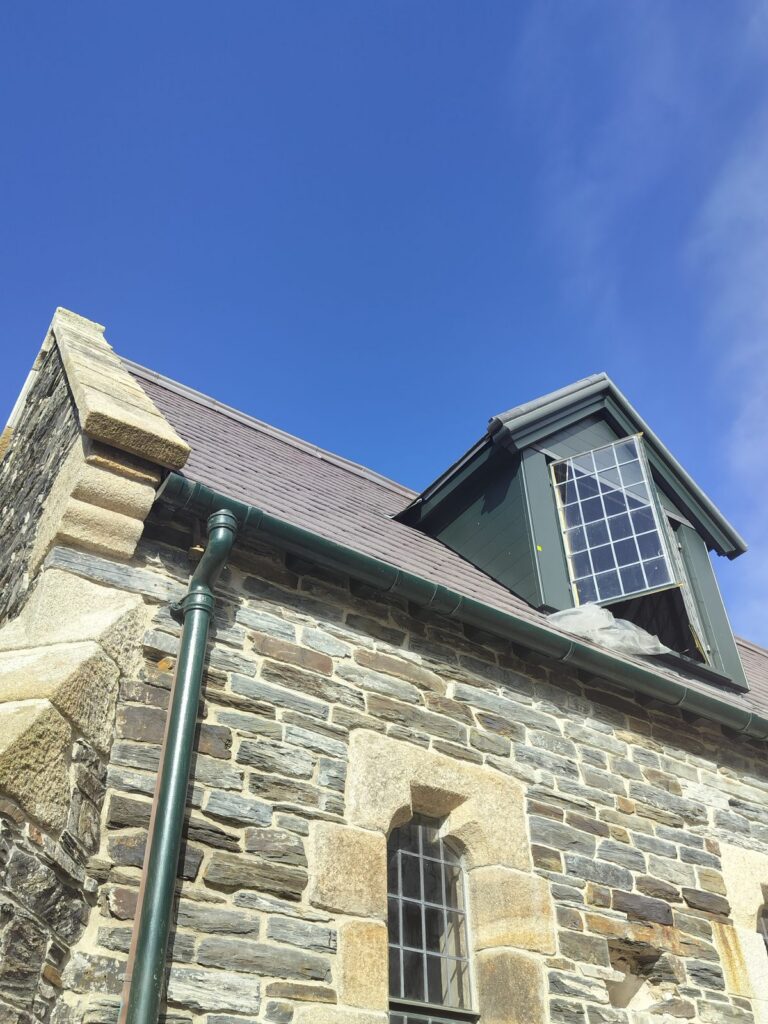
Why the existing profile matters
A gutter profile sets the eaves line. Replacing an ogee with a half-round, or losing a beaded edge along a terrace, changes a detail the listing protects, and on a uniform street such as Market Square in Tremadog one mismatched house breaks the group. Our guide to cast iron gutter profiles explains how to identify what is on the building before anything is ordered.
Working with conservation officers in Gwynedd
Conservation officers at Gwynedd Council and at the Eryri National Park Authority will expect a proposal to show what exists, what is to be replaced and why. Photographs of the gutter, downpipes, hoppers and brackets, the profile and size, the fixing method and the proposed finish are the minimum a useful pre-application conversation needs. Both authorities offer pre-application advice, and early contact avoids abortive orders where castings must be made to pattern.
What authenticity means in practice
- The same profile and nominal size as the original, or as the evidence shows it to have been.
- Brackets and fixings of the historic type: fascia or rafter brackets, or drive-in spikes into rubble and slatestone, as found.
- Rainwater heads reinstated where they existed, and historic lead heads retained rather than replaced.
- A paint finish appropriate to the building, traditionally linseed oil based, in a colour agreed for the facade.
Rainfall, Exposure and Maintenance on Gwynedd Buildings
Rainfall is the defining pressure on rainwater goods in Gwynedd. Totals rise steeply from the coast to the mountains, so a gutter sized adequately for a building on Llŷn may be undersized for the same roof in Blaenau Ffestiniog.
The Met Office station at Aberdaron, at the tip of Llŷn, records an annual average of around 920 mm (1991 to 2020). Inland the figures change completely: annual rainfall in Eryri ranges from around 3,000 mm at Blaenau Ffestiniog to around 5,000 mm on the summit of Yr Wyddfa, and Crib Goch is widely cited as the wettest spot in the United Kingdom, averaging close to 4,500 mm a year. Dolgellau, in a valley town setting, receives around 70 inches, roughly 1,800 mm. On the coast from Aberdyfi to Pwllheli and along the Menai Strait, salt-laden westerly winds add a second pressure. Our article on linseed oil paint for cast iron in salt-air environments explains how preparation and a shorter inspection cycle keep coastal ironwork sound, and our paper on climate change and historic structures looks at rising storm intensity.
Common failures on Gwynedd buildings
- Gutters and downpipes undersized for upland rainfall, overflowing at every heavy storm and saturating rubble and slatestone walls.
- Blocked outlets and hopper heads under trees in the valleys around Dolgellau, Bala and Beddgelert, and in sheltered chapel yards.
- Corrosion at unpainted pipe backs and joints on seafront elevations at Barmouth, Criccieth, Pwllheli and Aberdyfi.
- Parapet and valley gutters on civic buildings and churches silting up out of sight until water appears inside.
What routine maintenance should look like
On most Gwynedd buildings we suggest clearing gutters and hoppers at least twice a year, after leaf fall and again in spring, with an additional check after winter storms. In the uplands, review whether outlet numbers and downpipe sizes are adequate for the roof area before replacing like for like. On coastal elevations, inspect the paint annually and touch in any break straight away.
Planning, Consent and Conservation Guidance in Gwynedd
In Gwynedd, listed building consent is decided either by Gwynedd Council or, inside Eryri National Park, by the Eryri National Park Authority, under the Historic Environment (Wales) Act 2023, which came into force on 4 November 2024. Cadw maintains the list and publishes national guidance.
Every listed building consent application in Wales must include a heritage impact statement.
Which authority covers my building in Gwynedd?
Bangor, Caernarfon, Pwllheli, Porthmadog, Blaenau Ffestiniog and the Llŷn peninsula fall to Gwynedd Council; Blaenau Ffestiniog, although surrounded by the Park, was left outside its boundary. Dolgellau, Bala, Harlech, Aberdyfi and Beddgelert lie within Eryri, whose Authority manages 14 conservation areas across the Park, 13 of them in Gwynedd. Beddgelert is additionally covered by an Article 4 Direction controlling external changes.
Do I need listed building consent to replace gutters in Gwynedd?
Genuinely like-for-like repair, using the same material, profile, size and fixing, is not normally treated as needing consent, but the authority will apply that test carefully. Any change of material, profile, size, colour or downpipe position on a listed building is likely to need consent, and Cadw notes that unauthorised work can be a criminal offence. Our article on planning requirements for gutter repair on listed buildings explains the distinction.
Can I increase the gutter size on a listed building in Gwynedd?
A modest increase in capacity can sometimes be supported where evidence shows the existing system cannot cope with rainfall, particularly in the uplands, but it is a change that needs to be justified in the heritage impact statement. Additional downpipes or a deeper section of the same profile often achieve the capacity without altering the eaves line. This is practical guidance, not legal advice; confirm the position for your own building with the planning authority before work starts.
| Body or guidance | Role in Gwynedd | Useful for rainwater work |
|---|---|---|
| Gwynedd Council (planning and conservation) | Local planning authority outside the National Park, including Bangor, Caernarfon, Porthmadog, Pwllheli, Blaenau Ffestiniog and Llŷn | Pre-application advice; Anglesey and Gwynedd Joint Local Development Plan; Slate Landscapes SPG |
| Eryri National Park Authority | Local planning authority within the Park, including Dolgellau, Bala, Harlech, Aberdyfi and Beddgelert | Pre-application advice service; 14 conservation areas; Article 4 Direction at Beddgelert |
| Cadw | Welsh Government historic environment service; maintains the list | Listed building consent and heritage impact statement guidance; Managing Change to Listed Buildings in Wales |
| World Heritage Site management | Slate Landscape of Northwest Wales (2021); Castles and Town Walls of King Edward in Gwynedd (1986) | Setting and character considerations for buildings in and near the six slate components, Caernarfon and Harlech |
Cast Iron Profiles and Products Commonly Used in Gwynedd
Half-round and ogee are the profiles found most often on Gwynedd buildings: half-round on quarry terraces, chapels and farm buildings, ogee on Georgian and early Victorian town houses and civic frontages. The evidence on the building comes first, then the hydraulic demand of the roof, which in Gwynedd is often considerable.
Cast iron half-round gutters are the usual pattern on the terraces of Bethesda, Llanberis and Blaenau Ffestiniog and on the county’s chapels. Cast iron ogee gutters belong on the formal fronts of Caernarfon, Dolgellau, Tremadog and Pwllheli, where the gutter completes the eaves. Where a large slate roof in a high-rainfall area discharges to few outlets, a deeper section or additional downpipes can add capacity without changing the character of the eaves.
| Building type | Where in Gwynedd | Typical profile and components | Notes |
|---|---|---|---|
| Quarry terraces and cottages | Bethesda, Llanberis, Blaenau Ffestiniog, Nantlle valley | Half-round or beaded half-round on drive-in spikes or fascia brackets; round downpipes | Check capacity against upland rainfall; keep one profile along a terrace |
| Georgian and Victorian town houses | Dolgellau, Caernarfon, Tremadog, Pwllheli | Ogee on projecting or bracketed eaves; downpipes of matching finish | Tall frontages make downpipe spacing and fixing highly visible |
| Chapels and churches | Every town and quarry village; Bangor | Half-round or ogee at eaves; hoppers serving parapets and valleys | Outlet capacity and safe access for clearing are critical |
| Civic buildings | Caernarfon, Dolgellau, Bangor | Parapet and box gutters, rainwater heads, larger downpipes | Hidden gutters need a measured survey and routine inspection |
| Country houses | Penrhyn, Llŷn estates, Mawddach valley | Lead or cast iron rainwater heads, often dated; copy cast fittings | Retain historic lead heads; match cast iron to its phase |
| Industrial and slate buildings | Gilfach Ddu, Porthmadog harbour, quarry sites | Heavy half-round and large-diameter pipes | Large roof areas; see our industrial buildings guidance |
Cast iron hopper heads matter on Gwynedd’s parapeted civic and church roofs because they receive storm flows and are the first components to block. Where a building carries a pattern no longer made, such as a crested rainwater head or an unusual moulding, we can reproduce it by copy casting from a surviving section, fragment or detailed survey.
Standard stock is available for prompt despatch; please confirm current availability on enquiry. Bespoke and copy cast items typically require 12 to 14 weeks from pattern confirmation to delivery. Radius gutters, for curved bays, apses and towers, require site measurement and template creation, and typically take 12 to 14 weeks.
Landmark Buildings in Gwynedd and What They Teach Us
Five listed buildings show the range of rainwater considerations Gwynedd presents, from a slate quarry workshop to a cathedral with dated rainwater heads. None is presented as a Tuscan Foundry project; each is described from its listing and published sources.
County Court (former County Hall), Caernarfon (Grade I)
Built in 1863 to designs by John Thomas, County Surveyor, the former County Hall faces Caernarfon Castle across Castle Ditch. Its listing records snecked rock-faced sandstone with Penmon stone dressings, and a slate roof behind coped parapets with a central skylight. It is listed as an exceptional work of nineteenth-century civic architecture, forming a group with the police station and former jail. Parapet roofs of this kind drain through concealed gutters and outlets, where silting goes unseen until water reaches the interior.
Penrhyn Castle, Llandygai (Grade I)
Built between 1820 and 1837 for the Penrhyn slate fortune, Penrhyn Castle is regarded as Thomas Hopper’s masterpiece and a leading example of the short-lived Norman Revival. Its listing describes local rubblestone faced in finely jointed Anglesey limestone ashlar, with flat lead roofs concealed by castellated parapets; its 70 roofs cover more than an acre. On a roof system of that scale, every parapet outlet, rainwater head and downpipe is part of one drainage network, and a single blockage can go unnoticed.
Cathedral Church of St Deiniol, Bangor (Grade I)
Bangor Cathedral stands on a sixth-century foundation. The present fabric spans the thirteenth to sixteenth centuries, with Bishop Skevington’s nave and western tower of the early 1500s and a restoration by George Gilbert Scott from 1868 to 1880. The listing records rubble masonry with dressed stone, mainly lead roofs and crenellated parapets, and rainwater heads dated 1791. Those dated heads are significant fabric in their own right, and parapet drainage depends on keeping them sound and clear.
Dinorwic Slate Quarry Workshops, Gilfach Ddu, Llanberis (Grade I)
Erected in 1870 beside Llyn Padarn, the workshops of Dinorwig quarry now house the National Slate Museum. The listing describes a vast quadrangle of tightly jointed snecked slatestone, slate roofs throughout, and a De Winton water wheel 15.4 metres in diameter. It calls the complex a pinnacle of industrial architecture. Long ranges of slate roof around a courtyard deliver large volumes of water to eaves gutters and downpipes in one of the wettest parts of Wales.
Market Square, Tremadog (Market Hall Grade II*, houses Grade II)
Tremadog was created by William Madocks on reclaimed land in the first decade of the nineteenth century. The Market Hall of 1807 has a hipped slate roof on projecting bracketed eaves over roughly dressed quarried stone, and Nos. 6 to 12 Market Square, of around 1805, are two-storey houses of large squared blocks with slate roofs on projecting eaves. Across a planned square, consistent gutter profile, bracket spacing and colour hold the group together.
Beyond these landmarks, the everyday heritage of Gwynedd is its chapels, quarry terraces, harbour frontages and upland farmhouses. We supply half-round and ogee gutters, downpipes and hopper heads for Grade II listed and conservation-area properties of all these types. For chapels and churches, our page on church and chapel rainwater systems sets out the particular demands of valley and parapet gutters, and our industrial buildings page covers larger sections for quarry and harbour buildings.
What Getting the Specification Wrong Costs in Gwynedd
On a listed building in Gwynedd, a wrong rainwater specification costs twice: in wasted castings, scaffold and labour, and in damage to historic fabric if an inadequate system is left in place. The specifier carries that exposure, and a site survey is the most reliable way to remove it.
When a profile is misread from a photograph or a size is guessed, the castings arrive, the scaffold is up on a narrow Dolgellau street or a Caernarfon frontage, and the new gutter does not match the surviving lengths. The conservation officer questions the work and the architect is answerable to the client. On copy cast items, a second order means another 12 to 14 weeks, often into the wettest months, with scaffold hire running.
Undersizing carries a slower cost. In a climate where upland totals are several times those of lowland Britain, a gutter that overflows at every storm saturates rubble walls that dry slowly, and by the time damp shows inside, the repair is to the building rather than the gutter.
That is why, on complex projects, we recommend our chargeable site survey and site visit service before specification is finalised. A survey records profiles, sizes, fixings, outlet positions and hopper patterns, assesses capacity against roof area and exposure, identifies what can be retained, and gives an accurate basis for the heritage impact statement. It is professional due diligence that protects the project outcome, particularly where components are damaged or missing, access is difficult, or copy casting is required.
Finishing the job: linseed oil paint
We recommend linseed oil paint for cast iron guttering and pipes as the heritage-appropriate finish for Gwynedd buildings. It bonds well to properly prepared iron, remains flexible, weathers by gentle chalking rather than flaking, and can be recoated without full stripping. Its limitations should be planned for: it dries more slowly than modern coatings, especially in cool, damp weather, so application needs a suitable dry window, and it needs a disciplined cycle of inspection and recoating to keep performing, more frequently on exposed coastal elevations.
Working With Us on Gwynedd Projects
We work with architects, surveyors, contractors and owners across Gwynedd, from Bangor and Caernarfon on the Menai Strait through Llanberis, Porthmadog and Blaenau Ffestiniog to Pwllheli on Llŷn and Dolgellau, Barmouth and Tywyn in Meirionnydd.
A typical project runs from enquiry and photographs, through advice on profile, size and fittings, to quotation, manufacture or supply from stock, and delivery.
What to send us
- Clear photographs of the gutter profile, downpipes, hoppers, brackets and joints, with a tape measure in shot where possible.
- Measured drawings or a measured survey of the elevations, if available, and the approximate roof area draining to each outlet.
- For copy casting, a surviving length, fragment or rainwater head, or detailed photographs and dimensions.
- Quantities, run lengths and access constraints, such as steep streets, quarry sites or harbour frontages.
We deliver throughout the county, including upland and rural sites; please mention access restrictions when you enquire. Standard stock is available for prompt despatch, subject to availability; bespoke and copy cast work typically requires 12 to 14 weeks and radius gutters 12 to 14 weeks, so engage early where work must be completed before winter.
Contact us to discuss cast iron rainwater systems for your Gwynedd project, or call 0333 987 4452.
Frequently Asked Questions
Do I need listed building consent to replace cast iron gutters on a Grade II listed building in Gwynedd?
You may not need consent for genuinely like-for-like repair using the same material, profile, size and fixing, but any change to material, profile, size, colour or downpipe position is likely to need listed building consent. Applications go to Gwynedd Council or, inside Eryri National Park, to the Eryri National Park Authority. Always confirm the position with the right authority before work begins.
Who decides listed building consent in Gwynedd, the council or the national park?
It depends on where the building is. Gwynedd Council decides applications outside Eryri National Park, including Bangor, Caernarfon, Porthmadog, Pwllheli and Blaenau Ffestiniog, while the Eryri National Park Authority decides them within the Park, including Dolgellau, Bala, Harlech and Aberdyfi. Cadw maintains the list and publishes national guidance for both.
What law governs listed buildings in Wales now?
Listed buildings in Wales are governed by the Historic Environment (Wales) Act 2023, which came into force on 4 November 2024. It consolidated the earlier legislation into a single bilingual Act without substantially changing the listed building regime. Every listed building consent application must include a heritage impact statement.
What type of cast iron guttering is best for listed buildings in Gwynedd?
The right gutter is the one that matches the evidence on the building. In Gwynedd that usually means half-round on quarry terraces, chapels and farm buildings, and ogee on Georgian and Victorian town houses and civic frontages in Caernarfon, Dolgellau and Tremadog. Size should be checked against roof area and local rainfall rather than copied from a later replacement.
How does heavy rainfall in Eryri affect gutter sizing on historic buildings?
High rainfall means a gutter that is adequate on the coast can be undersized for the same roof in the mountains. Annual totals in Eryri range from around 3,000 mm at Blaenau Ffestiniog to around 5,000 mm on Yr Wyddfa, against around 920 mm at Aberdaron. Where capacity is inadequate, a deeper section of the same profile or additional downpipes can often be agreed without changing the eaves line.
Can you copy cast a gutter or rainwater head from a listed building in Gwynedd?
Yes, we can reproduce gutter profiles, rainwater heads and fittings by copy casting from a surviving length, fragment or detailed survey. Bespoke and copy cast items typically require 12 to 14 weeks from pattern confirmation to delivery. On complex buildings, our chargeable site survey ensures the pattern is recorded accurately.
Do you supply cast iron rainwater systems to Caernarfon, Bangor and the rest of Gwynedd?
Yes, we supply cast iron gutters, downpipes and hopper heads throughout Gwynedd, including Caernarfon, Bangor, Porthmadog, Pwllheli, Dolgellau, Blaenau Ffestiniog and Barmouth. Standard stock is available for prompt despatch, subject to availability. Please tell us about any access restrictions when you enquire.
How long do cast iron gutters last on historic buildings?
Well-maintained cast iron gutters and downpipes commonly last a century or more, and many original nineteenth-century systems are still in service. Their life depends on the paint film being kept intact and outlets being kept clear. Neglect, rather than the material, is what usually ends a cast iron system’s life.
Why is linseed oil paint recommended for cast iron gutters on period buildings?
Linseed oil paint bonds well to properly prepared cast iron, stays flexible and weathers by gentle chalking rather than flaking, so it can be recoated without full stripping. It dries more slowly than modern coatings and needs a regular cycle of inspection and recoating. For historic buildings, it is the finish most consistent with traditional practice.
When should I book a site survey for cast iron guttering on a Gwynedd building?
Book a site survey before specification is finalised on any complex Gwynedd project, especially where components are damaged or missing, access is difficult, capacity is in doubt or copy casting is needed. Our site survey is a chargeable service that records profiles, sizes, fixings and outlets accurately. It protects the project from costly mismatches once scaffold is up.
How long does delivery of bespoke cast iron guttering take?
Standard stock is available for prompt despatch, subject to confirmation of availability. Bespoke and copy cast items typically require 12 to 14 weeks from pattern confirmation, and radius gutters for curved bays or apses typically take 12 to 14 weeks. We recommend engaging early where work must be finished before winter.
Does the Slate Landscape World Heritage Site affect gutter replacement in Gwynedd?
World Heritage status does not add a separate consent for gutters, but the character of the slate landscape is a material consideration for buildings in and around its six components, from Bethesda and Llanberis to Blaenau Ffestiniog and Abergynolwyn. Gwynedd Council has adopted supplementary planning guidance on the Slate Landscapes of North West Wales. Where the building is listed, the usual listed building consent rules apply.
Conclusion
Specifying cast iron gutters in Gwynedd comes down to a few principles: identify and match the surviving profile, size and fixing; check capacity against some of the heaviest rainfall in Britain, particularly in Eryri; prepare and paint every face, and maintain that finish, especially on the coast; and agree any change with the right authority, Gwynedd Council or the Eryri National Park Authority, supported by a heritage impact statement, before work starts. Slate terraces, dolerite town houses, Victorian civic halls and parapeted country houses all reward that care.
Tuscan Foundry Products has supplied cast iron rainwater goods since 1893, and we are based in Mid Wales. We supply projects across Gwynedd, from Bangor and Caernarfon to Porthmadog, Pwllheli and Dolgellau, offering standard stock ranges, bespoke and copy casting, radius guttering, linseed oil paint finishes and a chargeable site survey service for complex work. To discuss your Gwynedd project, call us on 0333 987 4452 or visit tuscanfoundry.com.