Established 1893 | BS 460:2002 Certified | UK & International Supply | Expert Technical Support | 0333 987 4452
A conservation-led guide to stripping cast iron gutters, downpipes and hopper heads. We set out the real dangers of grit blasting historic ironwork, the hidden adhesion paradox of soda blasting, the low-impact methods that clean without destroying, and when replacement becomes the sounder decision.
Technical Summary
Do not use conventional grit blasting on historic cast iron rainwater goods. Grey cast iron has a dense, silica-rich casting skin formed as molten metal chills against the sand mould, and this skin gives the material its natural corrosion resistance. Once removed, it cannot be regenerated. Aggressive media at high pressure strips that skin, exposes the porous graphitic matrix beneath, erases maker marks and decorative crispness, and can micro-fracture brittle ears and spigots. When total coating removal is genuinely justified, appropriate methods include alkaline chemical paste, cryogenic dry ice, controlled micro-abrasive vortex systems, or fine spherical media at low pressure off-site. Soda blasting is mechanically safe but demands rigorous salt removal before priming.
More historic cast iron rainwater goods are lost to badly specified cleaning than to weather. The single most damaging thing you can do to a historic cast iron gutter, downpipe or hopper head is to blast it clean with aggressive grit at high pressure. The process looks decisive and produces an immaculate bare-metal finish, but it destroys the one feature that gave the casting its longevity in the first place.
We have supplied cast iron gutters and rainwater systems to conservation projects since 1893, and the pattern is consistent. A contractor accustomed to structural steel arrives on a listed building, applies the preparation standard they know, and achieves a Sa 2.5 finish in an afternoon. Twelve years later, the same ironwork is pitting, blistering and shedding paint faster than it ever did in its first century. Nothing failed in the paint. Something was removed from the iron.
This guide is written for architects, conservation officers, surveyors and heritage contractors who need to write or approve a surface preparation specification. It explains what is actually at stake metallurgically, which blasting media are defensible on historic fabric, what soda blasting does that most specifiers do not anticipate, how lead paint changes the legal picture entirely, and when the honest answer is that a component is beyond saving and should be replaced or copy cast.
The casting skin is a dense, silica-infused surface layer formed when molten iron chills rapidly against the sand mould, and it is the primary reason historic cast iron survives outdoors for a century or more. It is not a coating; it cannot be reapplied, and once abraded away it is gone permanently.
Historic rainwater goods are almost always grey cast iron, typically carrying two to four per cent carbon alongside silicon, manganese and trace sulphur and phosphorus. Slow cooling in the mould allows excess carbon to precipitate as microscopic graphite flakes within a ferrite or pearlite matrix. That structure gives the material exceptional compressive strength and dimensional stability, which is why cast iron as a building material performs so well in eaves gutters and long downpipe runs. It also makes the metal brittle. Cast iron has almost no ductility: under sufficient impact or thermal shock, it fractures rather than deforms.
The chilled outer layer behaves quite differently from the core. It is harder, denser and far less permeable, and it forms an effective natural barrier against oxygen and moisture. Beneath it, the graphitic matrix is comparatively porous. If you breach the skin and expose that porous interior to the atmosphere, it behaves like a hygroscopic sponge, holding moisture against the metal and driving corrosion rates well above the component’s original condition. This is the central conservation principle in all cast iron surface preparation: the skin is the asset, the paint is only its maintenance layer.
Total removal of all coatings should never be the default specification on a historic building. Sound, tightly adhered historic paint is both an effective moisture barrier and a record of the building’s decorative history, and Historic England, Historic Environment Scotland, Cadw and the SPAB all favour retaining it.
Where the existing paint film is tightly adhered, free of blistering, crazing and flaking, and shows no rust pustules breaking through, the correct specification is a wash down with neutral detergent to remove atmospheric soiling, biological growth and grease, followed by targeted hand preparation only at areas of localised failure. Sound surrounding paintwork is then feathered back with fine abrasive paper, typically around 220 grit, to shear off chalked material and create a light mechanical key. Hand tools cannot generate enough force to breach the fire skin, so the risk of inducing micro-fractures during routine maintenance is effectively nil.
Complete removal is technically justified only where one of the following applies:
If none of these applies, stripping is not conservation. It is avoidable harm, and on a listed building it may also be a consent issue. Our questions on listed buildings resource covers where the consent line generally falls.
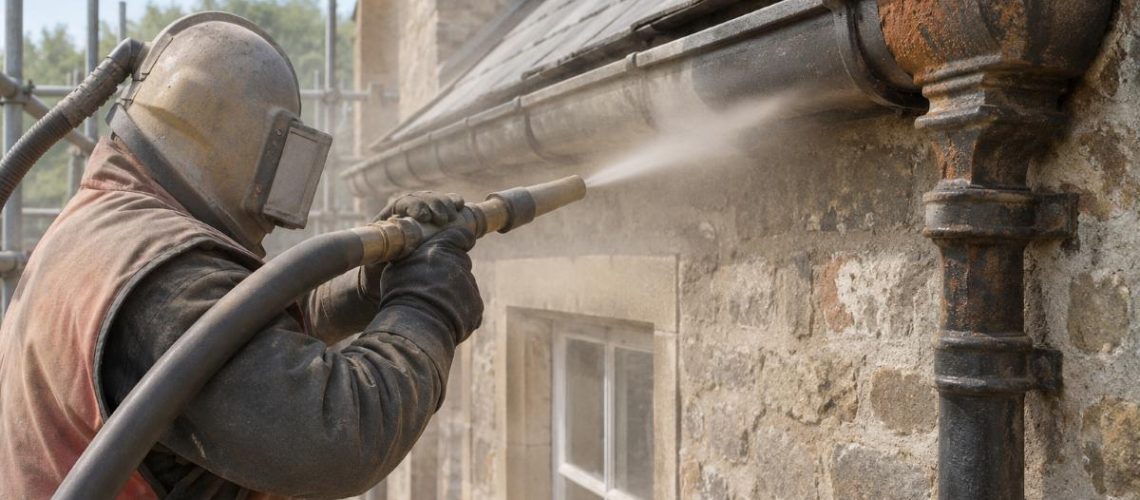
Conventional grit blasting propels sharp, angular media at high velocity and is profoundly destructive to historic cast iron. It is fast, cheap and effective at reaching industrial cleanliness standards, and that combination is precisely why it keeps appearing in specifications where it does not belong.
The method uses aggressive media such as crushed copper slag, garnet or aluminium oxide, driven by compressed air at pressures commonly above 5.0 bar, to achieve ISO 8501-1 grades of Sa 2.5 (very thorough blast cleaning, near-white metal) or Sa 3 (visually clean white metal). Those standards were written for fabricated steel receiving a modern industrial coating system. Applied to a Victorian downpipe, the same process does four things, none of them recoverable:
For these reasons, UK heritage authorities effectively prohibit in-situ abrasive grit blasting on historic ironwork. The risks of containment failure, masonry abrasion and irreversible damage cannot be managed adequately at height on a scaffold. Where abrasive blasting is specified, it should be off-site, in a controlled workshop, at 1.5 to 3.0 bar, and use fine spherical media such as glass beads, which scour rather than cut because they have no sharp edges.
Soda blasting is mechanically safe for historic cast iron but chemically hazardous to the coating that follows it. Sodium bicarbonate will not touch the casting skin. What it leaves behind will destroy your paint system if you don’t remove it properly.
The medium is food-grade sodium bicarbonate, which registers roughly 2.4 on the Mohs scale and is extremely friable. On impact, each crystal shatters, converting kinetic energy into a localised cleaning action that lifts paint, grease, and carbon crusts without profiling, etching, or scratching the substrate beneath. The fire skin survives intact. For ornate hopper heads, decorative brackets, and moulded gutter profiles, this is a genuine advantage, and because sodium bicarbonate is alkaline, it temporarily neutralises acidic surface contamination and buffers the bare metal against immediate flash rusting.
The complication is what stays behind. Soda blasting deposits a microscopic, tenacious film of pulverised alkaline salt across the surface and drives it deep into the iron’s natural porosity. Prime directly over that residue and two things happen. The residual high pH interferes with the cross-linking of the paint binder, and the trapped water-soluble salts draw moisture osmotically through the semi-permeable film. Hydrostatic pressure builds beneath the coating, resulting in widespread osmotic blistering and wholesale delamination, typically within the first two or three years.
Coatings applied over inadequately decontaminated soda-blasted surfaces routinely fail cross-hatch adhesion testing to ASTM D3359 outright, and perform poorly under pull-off testing to ISO 4624. People almost always blame the paint. It is seldom the paint.
Soda blasting can be used safely, but only with a mandatory post-blast decontamination protocol: exhaustive fresh-water flushing with an acidic salt-removing agent to dissolve residual chlorides and bring surface pH back to neutral, followed by verification before applying any primer. If a specification calls for soda blasting without also specifying neutralisation and pH verification, it is incomplete.
Dry ice blasting is the least invasive kinetic method available for historic cast iron because it leaves no residue. Solid carbon dioxide pellets are propelled at high velocity and clean through three simultaneous mechanisms.
Dry ice has a hardness comparable to chalk. It cannot pit the iron or strip the casting skin. Because the medium sublimates entirely, the process produces no secondary waste stream, leaving only the dislodged paint chips for disposal. It deposits no moisture, chlorides, or alkaline residue, so no neutralisation stage is needed and the surface is ready for immediate priming.
Its limitation is efficacy, not safety. Dry ice excels at shattering brittle historic alkyd and oil paints, soot and carbon deposits, which describes most historic rainwater goods well. It struggles against soft, highly elastic modern synthetic coatings, which absorb the impact rather than fracturing. Where a twentieth-century acrylic or elastomeric overcoat sits on top of the historic layers, dry ice alone will often stall.
Vortex systems provide the best compromise where chemistry stalls, dry ice is ineffective, and adjacent masonry must be protected. Conservation officers most commonly accept them for in-situ work on ornate ironwork.
The TORC system, developed from the earlier JOS system, uses a specialised nozzle to generate a gentle swirling vortex from low-pressure compressed air, a small volume of water, and an inert ultra-fine granulate such as calcium carbonate, dolomite or calcite. Operating pressures are low, and the action is tangential rather than perpendicular.
That distinction matters. Conventional blasting delivers point-blank kinetic impact; the vortex teases coatings and residues out of surface irregularities without scouring the metal. The water content serves two further purposes: it suppresses lead dust at source, and it prevents frictional heat build-up that can distort thin castings. In competent hands, it removes tenacious coatings from ornate rainwater hopper heads and delicate brackets without the impact trauma that destroys the casting skin. Operator skill is the variable—the same equipment, badly used, can still cause damage.
Where total coating removal is justified on ornate or in-situ components, alkaline paste stripping is often the safest route, because it removes paint by chemical dissolution rather than impact and therefore carries zero risk of mechanical fracture.
Alkaline paste systems are formulated around concentrated sodium or calcium hydroxide. The paste is trowelled over the contours of the casting and covered with a laminated blanket that retards evaporation and extends dwell time. The alkali works by saponification, breaking down the fatty acid chains in historic linseed oil and lead carbonate paint binders and converting a rigid film into a soluble slurry. Peeling the blanket away can lift twenty or thirty layers of historic paint in one application, leaving the fire skin entirely unblemished.
The same caution applies as with soda blasting, for the same underlying reason. Caustic residue becomes trapped in surface porosity, and if you rinse only with water, the substrate remains chemically active. Residual alkalinity induces rapid flash rusting and will saponify the binder of a new oil-based or alkyd primer from beneath the film. Exhaustive neutralisation with a mild acidic agent to a stable pH of 6.5 to 7.5 is a technical requirement, not a refinement. Historic England also advises against chemical cleaning below 6 degrees or above 25 degrees Celsius, as reaction rates and dwell times become unpredictable at both extremes.
The table below summarises how the principal methods perform against the criteria that matter on historic rainwater goods.
| Method | Casting skin | Lead dust control | Residue/neutralisation | Best application |
|---|---|---|---|---|
| Hand and power tool preparation (St 2 / St 3) | Preserved | Poor if dry; requires H-class extraction | None | Routine maintenance and localised failure |
| Conventional grit blasting | Destroyed | Very poor | Abrasive waste plus lead | Not appropriate for historic cast iron |
| Fine glass bead, low pressure, off-site | Largely preserved | Contained in workshop | Media recovery only | Workshop restoration of sound sections |
| Soda blasting | Preserved | Moderate; media binds some dust | Mandatory acidic wash and pH check | Ornate work where residue can be fully removed |
| Dry ice blasting | Preserved | Good; no secondary media | None — sublimates fully | Brittle historic alkyd and oil paints |
| TORC / JOS vortex | Preserved | Good; water suppresses dust | Light rinse | In-situ ornate work near sensitive masonry |
| Alkaline paste stripping | Preserved | Good; lead bound in slurry | Mandatory neutralisation to pH 6.5–7.5 | Heavy multi-layer paint on ornate castings |
Assume every historic cast iron rainwater system is coated in lead paint until testing proves otherwise. Red lead primers and lead carbonate topcoats were standard practice on ironwork for well over a century, and disturbing them brings the work within the Control of Lead at Work Regulations 2002 and the COSHH Regulations 2002.
The methods that generate the greatest risk are dry mechanical sanding, high-speed grinding and uncontrolled flame burning, all of which produce respirable lead dust or lead fume. Where heat is used, it must be limited to temperature-controlled infrared or hot-air equipment held below 500 degrees Celsius, above which lead begins to vaporise. Chemical stripping and wet abrasive methods are preferred precisely because they bind lead particulates in a wet slurry and prevent airborne contamination.
Practical compliance requirements on a heritage rainwater project include:
Specifiers should also note that this framework is under active review. The Health and Safety Executive ran a public consultation on the Control of Lead at Work Regulations 2002 exposure values and associated guidance, closing on 24 May 2026 — the first substantial review of blood lead thresholds in more than twenty years. Proposed changes to action and suspension levels would directly affect contractors undertaking paint removal on pre-1992 buildings. Anyone writing preparation specifications with a long procurement lead-in should confirm the current position with the HSE before tendering.
Not every historic casting is worth saving, and pretending otherwise is not good conservation practice. Where a component has suffered terminal wall loss, replacement is the more honest and economical answer — and where the original is significant, we can copy-cast a replacement from an existing sound section.
The decisive factor is usually graphitic corrosion, and it is deceptive. Selective leaching dissolves the iron matrix while leaving the graphite skeleton intact, so the component retains its original shape and profile but loses almost all its mechanical strength. Affected iron becomes soft, porous and markedly lighter, loses its magnetic response, and can often be broken by hand. Visual inspection alone will not find it. Ultrasonic thickness testing is a practical diagnostic tool, allowing residual wall thickness to be mapped in situ and sound sections to be distinguished from those that are structurally spent.
There is also a straightforward economic argument. Stripping, neutralising, repairing and recoating a badly degraded gutter run can exceed the cost of new castings, and it buys a shorter service life. Where the surviving fabric is compromised, but the profile is historically important, copy casting gives the best of both positions: the original detail is preserved exactly. At the same time, the building receives a component with a full century of service ahead of it. We work from a physical sample or surviving fragment, from measured drawings, or from good photographs with dimensions, and a single sound section removed from the run is usually the ideal pattern source.
Two practical points to build into the programme. Bespoke and copy cast work runs to a typical lead time of 8 to 10 weeks, and radius or curved gutters to 12 to 14 weeks, so you need to make pattern decisions early rather than when the scaffold goes up. On complex, damaged, or access-constrained sites, an on-site survey before the specification is finalised is the most reliable way to avoid a mismatch discovered at installation. This is a chargeable service, and on difficult projects it consistently pays for itself.
A defensible specification names the method, the pressure, the media and the post-treatment. Specifications that require ironwork to be “cleaned back to sound substrate” shift the decision to whoever holds the lance, where most damage originates.
1. Survey and test. Record condition, sample the paint for lead, and use ultrasonic thickness testing where graphitic corrosion is suspected.
2. Establish the threshold. Decide, component by component, whether the case for total removal is actually met. Default to retention.
3. Select the method. Match the method to the condition, access, ornament, and adjacent fabric, using the comparison table above.
4. Specify the parameters. State maximum pressure, media type and grade, standoff distance, and the required finish standard (St 2 or St 3 for hand preparation; Sa 2.5 only for off-site workshop preparation of sections being fully recoated).
5. Specify decontamination. Where soda or alkaline chemistry is used, require an acidic neutralising wash and documented pH verification before priming.
6. Require trial panels. A one-square-metre trial area, inspected and approved before general work proceeds, is the single most effective safeguard available.
7. Close the coating window. Bare cast iron will flash rust within hours in UK conditions. Specify priming on the same day as preparation, and require the substrate to be dry and above dew point.
For finishing, the choice of system should match the building’s sensitivity. For off-site bare-metal restoration, a zinc-rich primer, a micaceous iron oxide intermediate coat and a UV-stable topcoat provide excellent protection. For listed buildings where breathability and authenticity are the drivers, linseed oil paint remains our recommendation: it penetrates the micro-porosity of the iron, stays flexible through thermal cycling, and allows interstitial moisture to escape rather than trapping it. Our linseed oil paint specification guide covers coats, cure times and maintenance intervals in detail.
Most preparation failures on heritage rainwater systems come from a small and repetitive set of errors.
The following examples illustrate how method selection changes with building type, ornament and exposure.
Former Textile Mill, West Yorkshire — Grade II* Listed.
A mid-nineteenth-century mill conversion required removal of up to fourteen paint layers from cast iron eaves gutters and internal downpipes. Paint sampling confirmed red lead throughout. Dry ice blasting was selected for the internal runs, where the brittle historic alkyd fractured readily and the absence of secondary waste simplified containment within an occupied envelope. The team removed external sections for workshop preparation. Foundry stamps recording the original Halifax maker survived intact and were recorded before recoating.
Country House, Perthshire — Category A Listed
A general contractor soda-blasted the ornate hopper heads and rectangular downpipes and primed them the following morning without neutralisation. Blistering appeared within eighteen months, and cross-hatch testing returned complete delamination. The system was stripped a second time, flushed with an acidic salt-removing wash, pH verified, and recoated. The ironwork itself was undamaged throughout — the casting skin had survived — but the client paid for the same preparation twice.
Georgian Terrace, Bath — Grade II* Listed
A terrace within the World Heritage Site carried moulded ogee gutters and decorative hoppers obscured by accumulated paint. The conservation officer ruled out in-situ blasting on grounds of ashlar abrasion. Alkaline paste stripping under laminated blankets chemically removed the build-up, restoring the crispness of the mouldings without kinetic impact. We documented neutralisation to pH 7 before priming, then finished the system in linseed oil paint to a researched historic colour.
Parish Church, Powys — Grade I Listed
A rural church with limited scaffold access required cleaning of decorative brackets and hopper heads adjacent to friable lime render. TORC vortex cleaning was specified for its low pressure, tangential action and water-based dust suppression, protecting both the ironwork and the render. Ultrasonic testing identified two downpipe sections with terminal wall loss from graphitic corrosion. One sound section was removed and used as the pattern for copy cast replacements.
Commercial Warehouse, Belfast — Grade B1 Listed
A late Victorian warehouse in a marine exposure zone showed advanced corrosion at every bracket junction, traced to stainless steel fixings introduced during a 1990s refurbishment. Sections were removed for off-site preparation using fine glass bead media at 2.0 bar, preserving the casting skin. Reassembly used hot-dip galvanised mild steel throughout, with dielectric isolation where marine-grade fixings were unavoidable. A zinc-rich primer and MIO build coat were specified for the exposure.
No. Do not use conventional sandblasting or grit blasting on historic cast iron rainwater goods, and in-situ blasting on a listed building will almost always be refused. Aggressive angular media removes the silica-rich casting skin that gives the iron its natural corrosion resistance, erases foundry marks and decorative detail, and can micro-fracture brittle ears and spigots. It also disperses lead paint dust across the site. Where abrasive blasting is used, it should be off-site, at 1.5 to 3.0 bar, with fine spherical media.
Soda blasting is mechanically safe for cast iron because sodium bicarbonate is soft and friable, shattering on impact rather than cutting the surface. The casting skin survives. The risk is chemical rather than physical: the process leaves alkaline salt residues in the iron’s porosity, and priming over them causes osmotic blistering and total paint failure, usually within two to three years. Soda blasting is only safe when followed by an acidic salt-removing wash and documented pH verification before priming.
Like-for-like maintenance and repainting of existing rainwater goods generally does not require Listed Building Consent, but any change in method, profile, material, or colour may. Aggressive cleaning that would remove historic fabric, including sound paint layers of archaeological interest, can itself be a consent matter. Replacement sections, altered downpipe positions and changes to gutter profile normally require consent. We would always recommend an early conversation with the local conservation officer before finalising a preparation specification.
The casting skin, sometimes called the fire skin, is the dense, hard, silica-infused outer layer formed as molten iron chills against the sand mould. It is far less permeable than the metal beneath it and provides most of the material’s natural resistance to oxygen and moisture. It cannot be regenerated. Once blasting removes it, the porous graphitic core is exposed and retains moisture, so the corrosion rate rises above the component’s original condition, permanently shortening its remaining life.
Work on lead paint falls under the Control of Lead at Work Regulations 2002 and COSHH. Dry sanding, high-speed grinding and flame burning are not acceptable because they generate respirable dust and fumes. Wet methods and chemical stripping are preferred as they bind lead in slurry. Requirements include face-fit tested FFP3 respirators, disposable coveralls, H-class HEPA extraction on powered tools, full containment of slurry and chippings, and disposal as hazardous waste. HSE consulted on revised exposure values in 2026, so confirm the current position.
For most historic rainwater goods, yes. Dry ice is non-abrasive, cannot strip the casting skin, and sublimates completely, leaving no moisture, chlorides or alkaline residue and therefore no neutralisation stage before priming. Soda blasting is equally gentle mechanically but always requires decontamination. The exception is coating type: dry ice embrittles and fractures brittle historic alkyd and oil paints, but struggles against soft, elastic modern synthetic overcoats, where soda or chemical stripping may be more effective.
Prime on the same day, ideally within a few hours. Freshly exposed cast iron flash rusts rapidly in typical UK humidity, and even a light bloom of oxidation compromises primer adhesion. The substrate must be clean, dry, above dew point, and chemically neutral where soda or alkaline stripping has been used. If priming cannot follow immediately, plan the works so that only the area achievable in a single shift is stripped, rather than exposing a whole elevation at once.
Surface preparation is the point at which a historic cast iron rainwater system is either given another century or quietly deprived of one. The governing principle is minimal intervention: retain sound historic paint, strip only where adhesion failure, sub-surface pathology, loss of architectural fidelity or off-site repair genuinely requires it, and protect the casting skin above all else. Where total removal is justified, alkaline paste stripping, cryogenic dry ice, controlled micro-abrasive vortex systems, or fine spherical media at low pressure off-site are defensible options. Conventional grit blasting is not. Soda blasting is viable only with rigorous neutralisation, and lead paint changes the legal and practical picture entirely.
We have been casting and supplying rainwater goods since 1893, and we spend much of our time helping conservation professionals decide what can be saved and what cannot. When a component is sound, our advice is nearly always to keep it, prepare it sympathetically and finish it in linseed oil paint. When ultrasonic testing shows it is structurally spent, we would rather say so, and either supply a matching section from our catalogue of heritage rainwater goods or copy-cast a replacement from a surviving original. Bespoke and copy-cast work typically takes 8 to 10 weeks, so early decisions matter. If you are writing a preparation specification and would value a second opinion, or would like us to review a system before the scaffold goes up, please get in touch on 0333 987 4452.
Tuscan Foundry Products