The H534 measures 430mm wide x 240mm deep x 366mm high, making it well suited to Victorian villas and townhouses.
Established 1893 | BS 460:2002 Certified | UK & International Supply | Expert Technical Support | 0333 987 4452
£95.00 – £125.00Price range: £95.00 through £125.00 ex VAT (£114.00 – £150.00 inc VAT)
UK delivery from £30. Fittings are despatched boxed. See delivery rates.
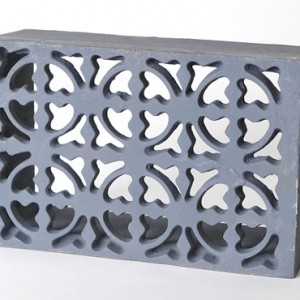
The Ornamental Airbrick is a decorative cast iron ventilation grille produced in a Gothic foliate pattern — a design closely associated with the high Victorian aesthetic that dominated ecclesiastical, collegiate, and civic architecture from the 1850s through to the 1890s. Where the louvre and school board patterns prioritise utility, the Ornamental Airbrick is a statement piece: a grille that is meant to be read as part of the decorative programme of the building rather than as a purely functional element.
The face presents an interlaced foliate pattern derived from Gothic tracery — pointed arches, leaf forms, and interlocking curves filling the grille area within a moulded outer frame. The casting has good surface definition, with the foliate relief clearly legible at typical viewing distances. Available in three sizes — 225mm × 75mm, 225mm × 150mm, and 225mm × 225mm — it fits standard airbrick positions in brick coursing, with drilled fixing lugs to each face for solid bedding into masonry.
The Ornamental Airbrick is most naturally specified on Victorian Gothic buildings: churches, chapels, vicarages, school buildings, almshouses, and estate architecture where decorative ironwork was part of the original specification. It is also appropriate on listed buildings and conservation area properties where an existing ornamental grille is being replaced in kind, and on high-specification heritage new build where the client expects period accuracy in the detailing rather than a plain functional alternative.
UK-cast in solid grey iron and supplied in your choice of finish. For conservation officer-approved specifications, listed building projects, or to discuss suitability, call 0333 987 4452.
The H534 measures 430mm wide x 240mm deep x 366mm high, making it well suited to Victorian villas and townhouses.
Rooflight opener handles can be ordered directly through tuscanfoundry.com. For volume orders or project-specific queries, please call 0333 987 4452 or use the contact form on our website.
The physical properties of cast iron are sustained throughout its working life, so with proper maintenance we'd expect our gutters and pipes to last over 100 years under normal conditions.
The Brass Rooflight Opener Handle 1520mm is a pole-operated handle designed for manual rooflight opening mechanisms. It is suitable for use with Lumen Rooflights and compatible timber-framed skylights, and is particularly appropriate for period and heritage properties where a brass finish is specified.
The H544 measures 380mm wide x 220mm deep x 418mm high, making it well suited to Georgian and Victorian townhouses and period commercial buildings.
Tuscan Foundry's cast iron hopper heads are available in Standard Black and Heritage Colour finishes. A linseed oil paint finish is also offered — a sustainable, vapour-permeable option particularly appropriate for listed buildings and conservation projects. Heritage colour swatches are available from the team on request.
The handle is compatible with Lumen Rooflights and most pole-operated rooflight and skylight systems. If you are unsure whether it suits your specific rooflight, call us on 0333 987 4452 and we can advise.
The Ornamental Airbrick is most appropriate on Victorian Gothic buildings — churches, chapels, vicarages, almshouses, collegiate buildings, and high-specification estate architecture — where decorative ironwork was part of the original design. It suits listed building replacements in kind and heritage new build where period accuracy in detailing is expected.
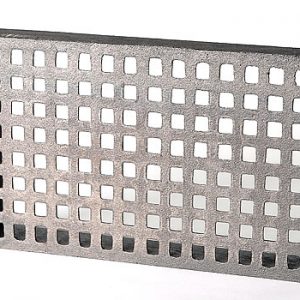
The louvre face provides directional airflow and offers some resistance to driven rain entering the subfloor void, making it a practical choice for exposed elevations or properties in areas with significant prevailing wind and rainfall. The square-grid (school board) pattern offers a larger open ventilation area but less weather protection.
Most old buildings have cast iron rainwater systems that should be maintained and preserved however; these inherent benefits make cast iron an ideal choice for both traditional and modern installations. It is not uncommon to see modern alternative products marketed with terms like low maintenance or easy to install and cost effective. It has even been said that ‘plastic guttering systems provide a way of achieving a traditional look with modern convenience
As well as being easier to produce, the material enabled eaves gutters to be installed more simply, since lead could only be used in this location as a lining for timber gutters. Many modern materials focus on replicating the appearance of cast iron but those materials can vary rarely offer any of the benefits. Cast iron gutters and pipes offer great strength and durability, a proven history of long life, low noise operation and fire resistance.
Most old buildings have cast iron rainwater systems that should be maintained and preserved however; these inherent benefits make cast iron an ideal choice for both traditional and modern installations. It is not uncommon to see modern alternative products marketed with terms like low maintenance or easy to install and cost effective. It has even been said that ‘plastic guttering systems provide a way of achieving a traditional look with modern convenience’.
These terms tend to refer to possible cost savings rather than any real product benefits. It is also difficult to quantify the benefits of modern convenience over traditional build quality. It is worth remembering that all rainwater goods will require some element of maintaining to ensure they are unblocked by debris and remain functional. No rainwater system cleans itself.
Today most suppliers of cast iron rainwater systems offer products in both primer or pre-painted with a 10 year protective coating. When describing modern materials, the term ‘cost effective’ is used rather than simply saying cheap. There is no doubt that the initial cost of many modern materials is less than cast iron but you might be surprised to know that over its lifespan, cast iron will cost around a third of plastic.