Skip to content
Tuscan Foundry Products Logo Black
Find out more about our products by giving us a call
0333 987 4452
Linkedin Envelope
  • About Us
  • Buildings
    • Churches
    • Industrial
    • Residential
  • Finishes
  • Products
  • Support
  • Restoration Index
  • Contact
  • News & Articles
  • About Us
  • Buildings
    • Churches
    • Industrial
    • Residential
  • Finishes
  • Products
  • Support
  • Restoration Index
  • Contact
  • News & Articles
£0.00 0 Basket
Tuscan Foundry Products Logo Black
  • About Us
  • Buildings
    • Churches
    • Industrial
    • Residential
  • Finishes
  • Products
  • Support
  • Restoration Index
  • Contact
  • News & Articles
  • About Us
  • Buildings
    • Churches
    • Industrial
    • Residential
  • Finishes
  • Products
  • Support
  • Restoration Index
  • Contact
  • News & Articles
£0.00 0 Basket

Established 1893   |   BS 460:2002 Certified   |   UK & International Supply   |   Expert Technical Support   |   0333 987 4452
Cast Iron Downpipe Bases in Denmark: Terminology and Guidance for Historic Buildings

  • September 18, 2026
Back
Cast iron downpipe bases copy cast for listed and protected buildings in Denmark: Danish terms, consent, sizes, lead times and delivery.
Cast-Iron-Rectangular-Anti-Splash-Shoe_church-repair-and-restoration

For British architects, contractors and owners working on historic buildings in Denmark, and for local specifiers who read English. What the cast iron base section is, how local rainwater terms translate, and how to order an exact copy from the UK.

Dansk: Støbejernsrør til nedløbsrør: guide til fredede og bevaringsværdige bygninger

Technical summary

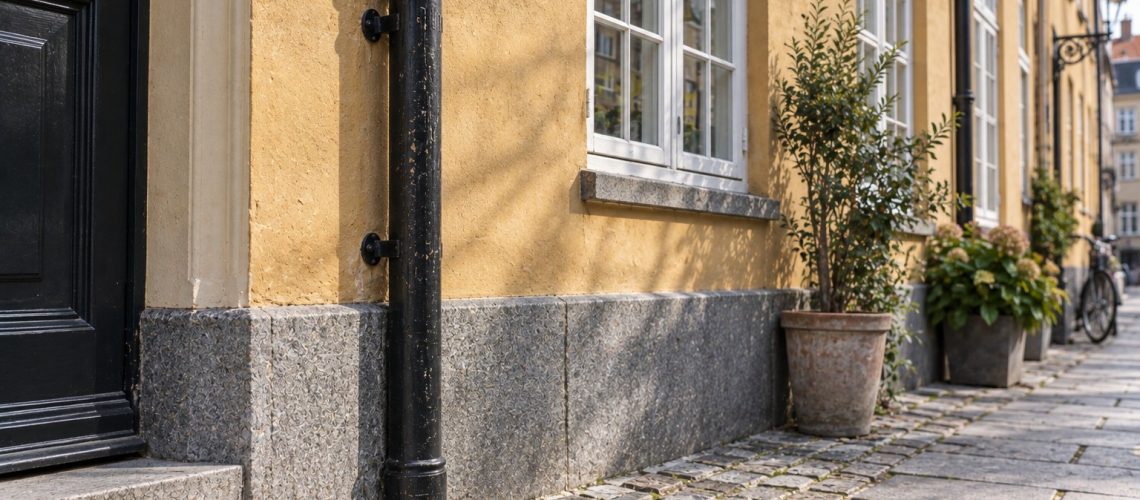
On historic Danish buildings, gutters (tagrender) and downpipes (nedløbsrør) are traditionally zinc, sometimes copper. Cast iron is used at the foot of the downpipe, where impact damage is most likely. A 1948 Dansk Byggeskik guidance sheet recommended that the lower part of external downpipes, up to 2 metres above ground, be made of cast iron or galvanised steel. Many of these cast iron sections are now cracked or missing. We copy cast them to order with a socket sized to the existing zinc pipe. On fredede bygninger (listed buildings), work beyond ordinary maintenance needs permission from Slots- og Kulturstyrelsen.

The cast iron base section in Denmark

In Denmark, the bottom length of an external downpipe, up to about 2 metres above ground, was traditionally cast iron, to protect the zinc pipe above from knocks.

The May 1948 Dansk Byggeskik sheet on gutters and downpipes (BB 349.11) recommended that the lower part of external downpipes, up to 2 metres above ground, be made of cast iron or galvanised steel pipe. Suppliers still sell cast iron pipe for the foot of downpipes where mechanical damage is a risk. The pipe connects at its foot to a gully (nedløbsbrønd).

Britain has no exact equivalent: a British cast iron downpipe usually runs full height and ends in a shoe or drain connector.

Danish and British rainwater terms

Most Danish rainwater terms have a direct British equivalent; the cast iron base section is the one without an exact match. Use both sets of terms on a schedule for a project in Denmark.

Danish term British term Notes
Tagrende Eaves gutter
Kasserende Box gutter
Nedløbsrør Downpipe Upper part usually zinc.
Støbejernsrør (at the foot) No exact equivalent (cast iron downpipe base) Bottom section, up to 2 m.
Tud Running outlet
Rendejern Gutter bracket
Nedløbsbrønd / tagbrønd Gully
Fredet bygning Listed building Permission from Slots- og Kulturstyrelsen.
Bevaringsværdig bygning Locally protected building Rules set by the municipality.

Copy casting a downpipe base

We reproduce cast iron base sections by casting from a surviving example, measured photographs or drawings. The more complete the reference, the closer the copy.

  1. Send a surviving section, or photographs from front and side with a tape measure in shot, plus measurements.
  2. We prepare the pattern and ask you to approve it before casting.
  3. Castings are poured, fettled and checked.
  4. Finish in primer, factory black, linseed oil paint or our coastal specification.
  5. We keep the pattern, so repeat orders are simpler and cheaper.

Lead time is typically 12–14 weeks from pattern approval; linseed oil paint adds 6–7 weeks. Our guide to copy casting explains the process.

Consent for protected buildings in Denmark

Listed buildings in Denmark (fredede bygninger) are regulated by Slots- og Kulturstyrelsen; locally protected buildings (bevaringsværdige bygninger) by the municipality.

  • Fredede bygninger — work beyond ordinary maintenance needs permission from Slots- og Kulturstyrelsen under the Listed Buildings Act (bygningsfredningsloven).
  • 2024 rules — replacing zinc or copper gutters and downpipes on a fredet building now needs, in many cases, only written notice to Slots- og Kulturstyrelsen. Check the current rules for the specific building before work starts.
  • Bevaringsværdige bygninger — the municipality sets the rules, often through a local plan (lokalplan) based on a SAVE assessment. Some municipalities require permission for all external changes.

What we need from you

  • Number of sections and their positions on the façade
  • Shape: straight or bent, round or square, plain, fluted or decorated
  • Overall length
  • Outside diameter of the upper pipe that sits in the cast iron section
  • Size and type of the connection to the drain
  • Wall fixing and wall material
  • Front and side photographs with a tape measure in shot
  • Finish and colour
  • Protection status and any conditions set by the heritage authority
  • Delivery address, site access and target date

Delivery to Denmark

Orders to Denmark are quoted individually and travel by pallet road freight, with courier for small items. Goods enter the EU through customs. Goods meeting the UK–EU rules of origin enter free of customs duty, but import VAT and clearance charges usually apply. UK VAT is zero-rated on exports with proof of export. See international supply and shipping for full details.

Danish downpipe bases — frequently asked questions

What is the cast iron base of a downpipe called in Denmark?

In Denmark it is usually called “støbejernsrør” (cast iron pipe) at the foot of the nedløbsrør. It is the cast iron bottom section of a downpipe whose upper part is zinc, sometimes copper, fitted to resist impact and connect the downpipe to the drain.

Were gutters in Denmark made of cast iron?

Rarely. Historic gutters and upper downpipes in Denmark are usually zinc, sometimes copper. Cast iron appears mainly at the foot of the downpipe.

Can you copy an existing cast iron downpipe base from a building in Denmark?

Yes. We copy cast base sections from a surviving example, measured photographs or drawings, matching length, profile, socket and any decoration. Allow typically 12–14 weeks from pattern approval, plus road freight.

Will a new cast iron base fit the existing downpipe?

Yes, if we have the outside diameter of the existing pipe and the size of the connection to the drain. The upper pipe sits in the socket of the cast iron section, which we make to the measured size.

Do I need permission to replace downpipe sections on a protected building in Denmark?

On a fredet (listed) building, work beyond ordinary maintenance needs permission from Slots- og Kulturstyrelsen, although under the 2024 rules replacing zinc or copper gutters and downpipes often needs only written notice. For bevaringsværdige buildings, the municipality sets the rules. Check before starting work.

How are orders delivered to Denmark?

By pallet road freight, with courier for small items. Goods enter the EU through customs; goods meeting the UK–EU rules of origin enter free of customs duty, but import VAT and clearance charges usually apply.

Conclusion

In Denmark, cast iron belongs mainly at the foot of the downpipe, where it protects the zinc pipe and gives the façade its finished detail. A base section copied exactly, sized to the existing pipe and finished correctly, restores that detail. We copy cast downpipe bases to order and supply complete BS 460 cast iron systems for British-style buildings. Send photographs and measurements through our contact page or call +44 333 987 4452.

Facebook
Twitter
LinkedIn
Pinterest
PrevPrevious
NextNext
Tuscan Foundry Products Logo White

Working together to make the world a brighter place

NuDawn Logo

CONTACT US

Sales & Customer Services:
0333 987 4452

Tyn-Y-Clyn
Llanafarn Fawr
Builth Wells
Powys LD2 3LU
United Kingdom

FOLLOW US

Twitter

MESSAGE US

ABOUT US
  • About Us
  • News
  • Testimonials
  • Gallery
  • About Us
  • News
  • Testimonials
  • Gallery
PRODUCTS
  • Bespoke Commissions
  • Cast Iron Soil Pipes
  • Cast Iron Gutters & Pipes
  • Heating & Cast Iron Radiators
  • Hardware & Spares
  • Cast Iron Radius Guttering
  • Bespoke Commissions
  • Cast Iron Soil Pipes
  • Cast Iron Gutters & Pipes
  • Heating & Cast Iron Radiators
  • Hardware & Spares
  • Cast Iron Radius Guttering
SUPPORT
  • Brochures
  • Delivery
  • International Shipping
  • Downloads
  • Surveys & Visits
  • Brochures
  • Delivery
  • International Shipping
  • Downloads
  • Surveys & Visits
CONTACT
  • Contact
  • Referral Scheme
  • FAQ
  • Privacy Policy
  • Terms And Conditions
  • Contact
  • Referral Scheme
  • FAQ
  • Privacy Policy
  • Terms And Conditions
Tuscan Foundry Products Logo Black
Find out more about our products by giving us a call
0333 987 4452

Tuscan Foundry Products, Tyn-Y-Clyn, Llanafan Fawr, Builth Wells, Powys LD2 3LU, United Kingdom

© Tuscan Foundry Products 2026

This website uses cookies to improve your experience. We'll assume you're ok with this, but you can opt-out if you wish.AcceptReject Read More
Privacy & Cookies Policy

Privacy Overview

This website uses cookies to improve your experience while you navigate through the website. Out of these, the cookies that are categorized as necessary are stored on your browser as they are essential for the working of basic functionalities of the website. We also use third-party cookies that help us analyze and understand how you use this website. These cookies will be stored in your browser only with your consent. You also have the option to opt-out of these cookies. But opting out of some of these cookies may affect your browsing experience.
Necessary
Always Enabled
Necessary cookies are absolutely essential for the website to function properly. This category only includes cookies that ensures basic functionalities and security features of the website. These cookies do not store any personal information.
Non-necessary
Any cookies that may not be particularly necessary for the website to function and is used specifically to collect user personal data via analytics, ads, other embedded contents are termed as non-necessary cookies. It is mandatory to procure user consent prior to running these cookies on your website.
SAVE & ACCEPT